
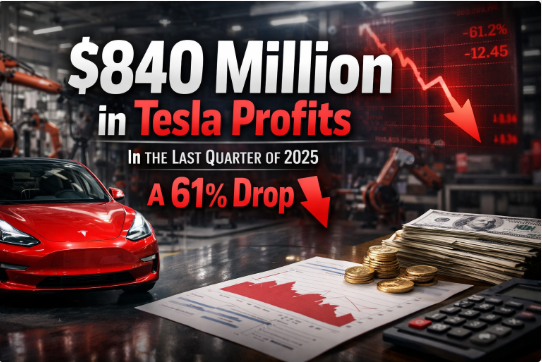
$840 million in Tesla profits in the last quarter of 2025… a 61% drop
Tesla’s fourth-quarter 2025 earnings landed with a thud: $840 million in net income, down 61% year-over-year, on $24.9 billion in revenue (off roughly 3%). That combination—shrinking profit despite still-massive sales—tells a story bigger than a single quarter. It marks the end of Tesla’s hyper-profitable, pricing-power era and the beginning of a more complicated chapter where competition, costs, and a strategic pivot toward AI and robotics all jostle for center stage. (The Verge)
What the headline numbers really say
On the surface, $24.9 billion in quarterly revenue is enormous. Yet the $840 million net income line is the one to underline. A year ago, Tesla’s Q4 net income was about $2.1 billion; this year, the bottom line collapsed even as revenue slipped only modestly. That implies margin compression—i.e., it’s getting more expensive (or less lucrative) to move vehicles and scale the rest of the business. Analysts and reporters across outlets converged on the same framing: profit fell 61% year over year, to $840 million. (Anadolu Ajansı)
For the full year 2025, Tesla posted $3.8 billion in net income on $94.8 billion in revenue—both down ~3% from 2024. This is Tesla’s first annual revenue decline and the weakest annual profit since the pandemic period, underscoring that the Q4 squeeze wasn’t a fluke. (The Verge)
Why profits fell: the three-part squeeze
1) Pricing and competition:
Tesla faced intensifying global competition, particularly from Chinese EV makers like BYD, which undercut pricing and expanded rapidly in Europe and emerging markets. With consumers far more price-sensitive than in 2021–2022, Tesla’s price cuts did their job on deliveries but ate into margins. Several wrap-ups note double-digit declines in automotive revenue and deliveries from a year ago, consistent with the margin pressure story. (Quartz)
2) Cost drift and operating leverage in reverse:
Expenses didn’t fall as fast as pricing. Reports flagged rising operating expenses (R&D, AI compute, manufacturing transitions) against a backdrop of softer demand—resulting in margins that compressed further than the revenue line would suggest. When costs rise faster than sales, operating leverage works against you; that’s visibly what happened in Q4. (Quartz)
3) Strategic pivot spending (AI, robots, and autonomy):
Tesla is explicitly spending into its future: the $2 billion investment into xAI (Elon Musk’s AI startup) and reallocation of resources toward robotaxis (“Cybercab”) and the Optimus humanoid robot. The thesis is that higher-margin software and services can eventually outrun the car business. The cost is here now; the scaled revenue arrives later—if it arrives. (Reuters)
The context: a changing EV market and a shifting Tesla
EV adoption is still growing globally, but supply is catching up with demand, incentives are more mixed, and the field is crowded. In 2025, Tesla also ceded the global EV crown to BYD in several tallies, a symbolic shift that coincided with a tougher profit picture. Meanwhile, Tesla’s vehicle lineup is aging compared to the flood of new Chinese and European models, many of which attack the low-to-mid price bands Tesla used to dominate. (The Verge)
Against that competitive tide, Tesla is betting on software-led margins: Full Self-Driving subscriptions, energy storage, AI training, and robotics. The company reiterated that Cybercab production is slated to begin in 2026. Whether robotaxis scale in the near term is an open question; approvals and real-world performance will decide the pace. But the direction of travel—less “only a car company,” more “AI + energy + robotics platform”—is clear. (Reuters)
Energy, software, and “everything else” as margin lifelines
The fourth-quarter numbers hint at Tesla’s long-running push to diversify profit beyond vehicle sales. Energy generation and storage posted strong growth in several roundups, and subscriptions tied to autonomy continue to expand, even as the company sunsets up-front FSD purchases in favor of recurring revenue. Tesla’s own Q4 2025 Update Deck points to services and Supercharging profit contributions as part of the margin patchwork that cushions automotive cyclicality. The mix is improving, but it’s not yet large enough to offset a 61% net-income decline at company scale. (Tesla Assets)
The investor lens: shock now, optionality later
Short term, a 61% plunge in quarterly profit is a reality check. Longer term, bulls argue that Tesla is quietly transforming into an AI-infrastructure-heavy platform with multiple high-margin option bets:
Autonomy: If robotaxis go live at scale, software margins eclipse hardware margins.
Humanoid robotics: If Optimus matures into a generalized labor platform, gross profit stands to be far higher than automobiles.
Energy: If grid storage and virtual power plants keep accelerating, Tesla’s energy business becomes a higher-multiple, utility-tech hybrid.
Skeptics counter that these are if-heavy scenarios and that the car business must carry the company until optionality turns into recurring cash flows. The current math—$840 million in Q4 profits versus $2.1 billion a year earlier—suggests the bridge is long and the toll is rising. (Anadolu Ajansı)
What to watch in 2026
1) Execution and timing on Cybercab:
Tesla reaffirmed plans to start Cybercab production in 2026. Product timelines are notoriously slippery in autonomy, so watch for hardware readiness, regulatory pilots, and city-by-city deployment milestones. Even limited, geo-fenced service could open new high-margin revenue. (Reuters)
2) FSD (Supervised) metrics and attach rate:
The more drivers on subscriptions, the stronger the recurring revenue base. Moving from up-front purchases to subscriptions creates a revenue annuity, but it takes time for the installed base to compound. Tesla signaled continued expansion of FSD-linked insurance discounts in select states, which—if it delivers real-world savings—can nudge adoption higher. (Tesla Assets)
3) Energy storage deployments:
Megapacks have two advantages: expanding total addressable market (utilities and developers worldwide) and potentially steadier demand than consumer cars. Scale here helps smooth seasonality and pricing wars in automotive.
4) Cost discipline while investing in AI:
The $2 billion xAI investment is both a capability sprint and a margin headwind. Investors will track capex and opex closely to see whether cost per unit of progress (in model performance or autonomy milestones) is trending down—or at least delivering measurable improvements in product features that customers will pay for. (Reuters)
5) Product freshness and mid-cycle updates:
A fresher lineup matters. If Tesla lands timely refreshes (design, interior tech, efficiency gains) that don't crush margins, it can stabilize pricing without constant discounting. Conversely, delayed refreshes leave room for competitors to box the company into discounts.
The narrative risk: perception and brand gravity
Multiple reports noted that public sentiment, political crosswinds, and brand controversies may have dampened demand among certain consumer segments in 2025. Whether you buy that explanation or not, the broader point is simple: brand gravity matters in consumer durables. Rivals are closing the perception gap on quality and tech; Tesla must either widen its software and charging moat or deepen its customer-love advantage with relentless product polish. (The Verge)
The bottom line for this quarter
Net income: $840 million (down 61% YoY)
Revenue: $24.9 billion (down ~3% YoY)
Full-year 2025: $3.8 billion net income on $94.8 billion revenue (both down ~3%)
Strategic moves: $2B into xAI; heavier emphasis on AI, autonomy, and robotics; Cybercab targeted for 2026 production
Implication: Tesla is trading short-term earnings for long-term optionality. Whether that optionality cashes in depends on execution in autonomy, energy, and robotics. (Anadolu Ajansı)
A human take: progress isn’t linear, but cash flows are
Markets love a clean S-curve. Reality is messier. Tesla’s Q4 shows why: the company is trying to leap from “best EV margin machine” to “AI-and-energy platform” while fending off cutthroat competition. That’s like rebuilding an airplane mid-flight: possible, but the ride gets bumpy. If you believe autonomy and robotics are near, this is disciplined investment. If you don’t, this is margin erosion wrapped in techno-optimism. The truth may live in the timing. In 2026, proof will look less like splashy demos and more like measured KPIs: paid FSD miles, city-level robotaxi pilots with transparent safety stats, Megapack gigawatt-hours delivered, and unit-cost curves bending down.
Meanwhile, the company still has enviable assets: charging infrastructure, software update culture, vertical integration, and a brand that—love it or roll your eyes—has set the tempo of the EV decade. If Tesla translates those assets into sticky, subscription-heavy revenue, the 61% profit drop will age into a footnote on the way to a new business model. If not, Q4 2025 will be remembered as the quarter the future got too expensive.
Sources and corroboration
Multiple reputable outlets and Tesla’s own investor materials confirm the key figures and context referenced here: $840 million in Q4 2025 net income (down 61% YoY), $24.9 billion in Q4 revenue (about 3% lower), and $3.8 billion net income on $94.8 billion revenue for 2025, alongside the company’s $2 billion investment in xAI and emphasis on Cybercab in 2026. (The Verge)
SEO keywords (one paragraph): Tesla Q4 2025 earnings, Tesla profit drops 61%, Tesla net income $840 million, Tesla revenue $24.9 billion, Tesla annual profit 2025, Tesla revenue decline 2025, Tesla earnings report January 29 2026, TSLA stock analysis, Tesla robotaxi Cybercab 2026, Tesla xAI investment $2 billion, Tesla AI strategy, Tesla Optimus humanoid robot, Tesla Full Self-Driving subscription, Tesla margins decline, Tesla competition BYD, global EV market 2025, Tesla energy business Megapack, Tesla Supercharging network, Tesla automotive revenue down, EV price wars 2025, Tesla deliveries 2025, Tesla brand perception, Tesla autonomy roadmap, Tesla earnings recap, Tesla investor takeaways.