
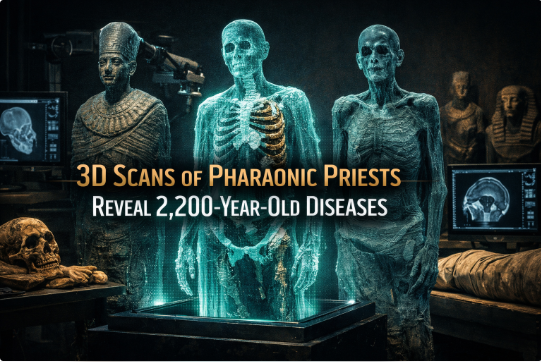
A 3D scan of priests from the Pharaonic era reveals diseases of the age from 2,200 years ago.
When a modern scanner whispers through linen and resin, time answers back. Recently, high-resolution 3D imaging of mummified priests—men who once served the gods, managed temple estates, and advised rulers—has revealed an intimate medical record from roughly 2,200 years ago. These scans aren’t just pretty pictures; they’re patient charts from antiquity, exposing heart disease, dental troubles, infectious parasites, occupational injuries, and the unexpected realities of elite daily life in late Pharaonic and early Hellenistic Egypt. The story that unfolds is humbling: even those close to power and ritual were, like us, susceptible to the slow arithmetic of age, diet, and environment in the land of the Nile.
The promise of non-invasive archaeology
For decades, X-rays hinted at what lay beneath wrappings and gilded masks. Now, advanced CT and micro-CT scanning provide extraordinary anatomical detail without disturbing a single fiber of linen. Instead of unwrapping mummies, researchers “virtually unroll” them: layer by layer, tooth by tooth, vessel by vessel. The results are precise reconstructions that reveal skeletal pathologies, calcified arteries, inflammatory changes, and even the faint signatures of surgical intervention.
This approach respects the integrity of the human remains—vital for ethical archaeology—and it protects the historical information encoded in resins, amulets, and wrappings. The scans also let teams run measurements repeatedly, compare findings across collections, and build robust datasets. That’s the scientific sweet spot: reproducibility. With standardized imaging protocols and careful metadata, future scholars can re-examine the same priests without exposing them to further handling.
Priests as a medical cohort
Priests were not just ritual specialists. They were administrators, scribes, and custodians of knowledge. Many lived in temple precincts, oversaw agricultural holdings, and supervised craft workers. As a result, they formed a semi-distinct population: mostly male, with privileged access to food, health care, and rest—but also bound by duty cycles, dietary prescriptions, and the stresses of bureaucratic life. Studying their bodies offers a rare chance to see how status intersected with health in ancient Egypt.
Geography matters too. Temple networks stretched from the Delta to Upper Egypt, from the urban bustle of Cairo (near ancient Memphis) to the monumental landscapes around Luxor. Climate, water sources, and local parasites varied regionally; so did access to certain foods and medicinal plants. When scans show differences in disease patterns between priests buried in the north versus the south, that’s a clue about environment and economy as much as personal habit.
What 3D scans reveal about cardiovascular disease
One of the most striking patterns in mummy research is the presence of vascular calcifications—mineralized plaques in arteries that suggest atherosclerosis (hardening of the arteries). In priests scanned from this period, radiologists can trace linear, branching densities along the expected course of major vessels. While we can’t measure cholesterol from 2,200 years ago, these arterial signatures are consistent with cardiovascular disease, especially in older individuals.
What drove it? Diet is a prime suspect. Elite tables often featured rich breads, dates, honey, beer, fish, fowl, and occasionally beef or other red meat. Combine calorie-dense foods with low bursts of strenuous activity—scribal work is not exactly a cardio class—and you have a plausible recipe for plaque. Inflammatory burden from chronic infections could have contributed too; infections raise systemic inflammation, which accelerates atherosclerosis. The priestly lifestyle, in short, mixed abundance with stressors that modern cardiologists would recognize instantly.
The dentistry of eternity: teeth tell complicated truths
If arteries tell us about diet and inflammation, teeth shout about daily life. CT scans spotlight widespread dental wear, pulp exposure, abscess cavities (dark voids at tooth roots), and alveolar bone loss indicative of periodontal disease. The culprits were not just sweet treats; they were microscopic. Grit from stone-ground flour and windblown sand embedded in food worked like sandpaper, abrading enamel. Over decades, that abrasion exposed dentin, invited bacteria, and triggered infection.
Priests were not immune. Some scans reveal deep caries (cavities), periapical cysts, and missing teeth that likely fell out years before death. Dental pain leaves indirect skeletal signs too: remodeled bone around tooth sockets, sinus thickening from chronic infection, and even changes in the temporomandibular joint (the jaw hinge). Imagine chanting liturgies with a persistent toothache; the human element here is vivid.
Bones, joints, and the ergonomics of ritual life
Posture and repetitive tasks etch themselves into bone. In priests, researchers commonly report osteoarthritis in weight-bearing joints—knees and hips—as well as degenerative changes in the spine. Osteophytes (bone spurs), narrowed joint spaces, and Schmorl’s nodes (depressions in the vertebral endplates) are typical. What would cause this for scribes and ritual specialists? Consider the mixed routine: periods of standing during ceremonies, long hours of writing or accounting, and occasional lifting of heavy ritual equipment or storage jars.
Some skeletons display healed fractures—ribs, clavicles, or forearm bones—evidence of accidental falls or occupational mishaps. CT makes these old injuries unmistakable, with callus formation and minor deformities. None of this diminishes the priests’ status. It simply restores them as working people whose bodies tracked the demands of sacred and administrative labor.
Parasites in paradise: the Nile’s invisible companions
Ancient Egypt was glorious, but the river that nourished it was also a highway for pathogens. CT scans sometimes catch calcified eggs or organ changes suggesting chronic parasitic infection. Schistosomiasis (bilharzia) is the textbook example: caused by flukes that thrive in freshwater. Chronic schistosomiasis can scar the bladder and liver; it also drives long-term inflammation. While direct identification is rare in scans alone, compatible patterns—organ calcifications, enlarged spleen or liver contours preserved by mummification—support the diagnosis when married to historical ecology.
Tapeworms and roundworms also left hints, often through incidental calcified nodules or the secondary damage they cause over time. The priests’ relative wealth could reduce some exposures, but ritual washings and life near irrigation channels might have kept parasite risk stubbornly high.
Respiratory clues: sand, smoke, and incense
Mummification preserves the architecture of sinuses and airways surprisingly well. In several priests, CT imagery shows thickened sinus walls and patterns suggestive of chronic sinusitis—likely from dust, smoke, and frequent exposure to incense in closed temple spaces. The desert isn’t gentle on airways, and neither are cook fires or ritual burners. Over decades, that irritation adds up.
Tracheal and bronchial calcifications are less common but documented. Some priests may have had long-standing respiratory conditions that flared during flood season when humidity and mold rose. The scans help reconstruct these environmental rhythms, reminding us that sacred ritual unfolded in real air, with real particulate matter.
Clues from amulets, resins, and surgical traces
Artifacts embedded in mummification are sources of biomedical context too. Protective amulets—wedjat eyes, djed pillars, scarabs—appear clearly in scans, each placed with ritual intent over hearts, throats, or viscera. Linen packs, resin plugs, and carefully positioned arms can hint at the individual’s status and the embalmer’s school. Variations in resin density help identify plant sources and recipes; some resins were antimicrobial, which may have been discovered empirically.
Occasionally, scans reveal signs that embalmers or physicians attempted interventions in life: healed trepanations (skull openings), reductions of fractures, or dental splints. Trepanation is rare in Egyptian material, but when present it attracts attention. More frequently, we find meticulous excerebration (brain removal) channels and evisceration cuts—post-mortem procedures that speak to technical expertise and theological doctrine rather than medical treatment. Still, the combined picture is clear: a culture obsessed with order and skilled in bodily craft.
How 3D data changes the questions we can ask
Before 3D scanning, pathology in mummified remains was a scatter of anecdotes—dramatic but often unquantified. Now, radiologists and bioarchaeologists can do cohort studies. They can compare disease prevalence across age brackets, time periods, and social roles. They can ask: Did atherosclerosis increase during economic booms, when elites feasted more? Were dental abscesses more common in regions with sandier flour? Did priests who lived closer to marshland have more signs of schistosomiasis? With interoperable datasets, we can finally test these hypotheses.
Just as crucially, 3D models are shareable. Museums and archives can grant controlled access to de-identified volumes and segmentations, letting researchers worldwide examine the same evidence. That democratizes discovery and avoids the bottleneck of physical travel and direct handling. Institutions like the British Museum and the Grand Egyptian Museum increasingly publish detailed imaging notes alongside exhibitions, making public scholarship part of the artifact’s life.
Rethinking “ancient diseases” vs. “modern diseases”
There’s a tempting myth that heart disease and dental crises are strictly modern problems—the wages of fast food and desk jobs. The priests’ scans puncture that myth. Atherosclerosis, arthritis, abscesses: these walked beside humanity long before the industrial age. What changed isn’t the existence of disease but its distribution, tempo, and triggers. Modern lifestyles amplify some risks (sedentary time, ultra-processed foods) and reduce others (certain infections). The ancient record forces nuance: biology is old; epidemiology is historical.
This nuance matters for public health. When we see calcified arteries in a 2,200-year-old priest, we’re seeing the baseline vulnerability of the human cardiovascular system under conditions of relative privilege and mixed physical labor. It suggests that prevention must work with deep human tendencies—our love of rich foods, our bodies’ inflammatory wiring—rather than pretending those tendencies are recent inventions.
The ethics: persons, not specimens
Medical imaging can feel clinical, but these are individuals with names once spoken at festivals and funerals. Ethical research centers dignity: consent is impossible in the modern sense, so transparency, cultural consultation, and restraint are essential. Many teams work with Egyptian authorities and communities to ensure respectful handling and public communication. That also means avoiding sensationalism. If a scan reveals a tumor or a congenital condition, the point is not to gawk but to understand, with empathy, how that person lived and how their society cared for them.
Museums increasingly frame exhibitions as conversations about mortality, medicine, and meaning. Visitors learn about embalming chemistry and priestly liturgy, but also about grief, remembrance, and medical humility. That’s a good evolution. It aligns technology with humanity.
A day in the life, reconstructed
Imagine a priest in the late Ptolemaic era, serving a temple near the Nile. Dawn begins with ablutions in cool water. Rituals follow: incense, chant, procession. Administrative hours arrive with clay sealings, tallies of grain, attention to contracts. Food is generous—flatbreads, figs, beer, a portion of fowl—as temple economies distribute offerings. By afternoon, there is inspection of storerooms, consultation with artisans, perhaps a legal dispute settled by reference to tradition. As evening comes, more rites: lamps, offerings, hymns.
Now overlay the medical map recovered by scans: a knee that grinds painfully during long standing, a tooth that throbs at night, sinuses inflamed by incense, arteries slowly hardening beneath the ribs. Nothing mythical here. Just the measured wear of a well-fed life lived in a demanding institution. The 3D data makes this reconstruction specific: the bone spur on the patella is not an idea; it’s visible. The molar abscess is a dark halo in the jaw, the arterial plaque a chalk-white thread. The priest is not a symbol but a person with ailments and resilience.
What the findings mean for historians—and for us
For historians, the scans are a rare control panel: they let us tweak variables and compare outcomes. Combine osteological age estimation with amulet sets, coffin inscriptions, and known temple calendars, and new patterns appear. Perhaps veterans of certain rites developed shoulder osteoarthritis more often. Perhaps priests attached to grain administration carried more spinal compression from lifting bags. Perhaps urban priests showed more sinusitis than rural ones. Each “perhaps” is now testable.
For the rest of us, the lesson is humbling. Our bodies are ancient technology. They cope bravely with abundance and scarcity, repetitive work and ritual stress. We are not so distant from those priests. A checkup, a change in diet, a dental appointment—these are modern answers to old questions. The scans, paradoxically, encourage compassion for ourselves. If elite priests 2,200 years ago struggled with plaque and pain, then personal health isn’t a moral test; it’s an ongoing negotiation with biology.
Looking ahead: where imaging and AI meet antiquity
The next frontier is segmentation and pattern recognition. With enough high-quality scans, machine-learning models can flag subtle pathologies—early joint changes, microfractures, vascular calcifications below the threshold of casual inspection. Automated amulet detection can correlate ritual kits with regions or periods. Texture analysis of resins can map trade networks by chemical proxy. All of this deepens context without lifting a scalpel.
Virtual reality reconstructions will follow. Visitors could “walk through” a priest’s body—arteries visible, bones labeled, amulets glowing softly—and then compare multiple individuals to see how health varied by age or region. Carefully designed, these experiences could avoid spectacle and emphasize rigorous science. They would also expand access for students worldwide, especially those who cannot travel to major collections.
A note on context and chronology
“Pharaonic era” is a broad umbrella. Priests from about 2,200 years ago lived during a transitional age after the last native dynasties, overlapping with the Ptolemaic period, when Greek and Egyptian traditions braided together. Temples remained powerful, bilingual record-keeping flourished, and elites navigated a hybrid cultural landscape. The medical patterns we see are therefore snapshots of change: new foods and trade goods, familiar parasites, old rituals in fresh political weather.
On the ground, that meant pragmatic adaptation. Healers blended herbal knowledge, ritual incantation, and empirical practice. Embalmers refined their recipes. Administrators balanced temple incomes with royal demands. The priests at the center were neither relics nor revolutionaries; they were professionals keeping an old machine running under new management. Their bodies, now scanned, are the ledger entries of that work.
Visiting the evidence, responsibly
If you’re planning a trip to see such mummies and their imaging results, large collections in London, Berlin, and across Egypt present CT reconstructions in galleries and catalogs. Many museums provide digital kiosks with interactive views: rotate a skull, peel back wrappings, hover over an amulet to read its meaning. When you engage with these displays, remember that you’re looking at someone’s remains. Read the labels. Notice the ethical notes. Appreciate the fusion of physics, anatomy, and history that made the image possible.
And then—this is vital—carry that curiosity forward. Ask how we know what we know. Scan-based paleopathology relies on comparative collections, clinical knowledge, and careful statistics. It’s not magical sight; it’s disciplined inference. The more we practice that kind of thinking, the better both our history and our present health decisions become.
Conclusion: time, illness, and shared humanity
The 3D scans of priests do not diminish the aura of ancient Egypt. They deepen it. To realize that a man who lit sacred lamps also worried his aching tooth with his tongue, that a keeper of temple accounts felt his knee lock during a long festival day, that a respected ritualist carried plaques in his arteries—this is to understand the past as continuous with our present. The deities differ; the bodies do not.
Science, here, is a form of empathy. It listens carefully to what remains can say, uses technology to amplify faint signals, and resists the urge to sensationalize. The priests stand again, not as puzzles solved, but as people recognized. Thanks to non-invasive imaging, their ailments become our teachers. The lesson isn’t morbid. It’s practical and humane: care for bodies, honor the dead, test your claims, and keep your curiosity tuned like a temple harp.
SEO Keywords (one-paragraph list): ancient egypt mummies, 3d scan of mummies, ct scan of pharaonic priests, paleopathology in ancient egypt, atherosclerosis in mummies, dental disease in antiquity, schistosomiasis nile river, noninvasive archaeology, micro-ct mummy imaging, egyptian priests health, late pharaonic period health, ptolemaic egypt medicine, ancient cardiovascular disease, mummy sinusitis incense, osteoarthritis in ancient egypt, virtual unwrapping mummies, museum ct reconstructions, bioarchaeology egypt, embalming resins analysis, amulets and health, ancient diet and disease, nile environment parasites, temple economy priests, egyptian archaeology technology, humanized history blog.