
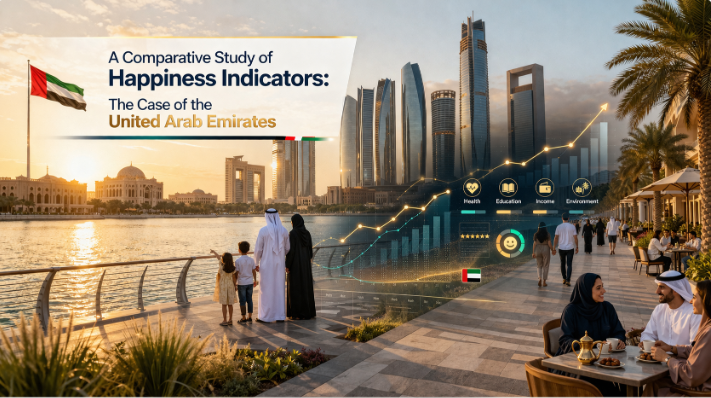
A Comparative Study of Happiness Indicators: The Case of the United Arab Emirates
On March 24, 2026, the United Arab Emirates offers one of the most interesting case studies in the global conversation about happiness indicators, quality of life, and national wellbeing. According to WAM’s report on the newly released World Happiness Report 2026, the UAE ranked 1st in the Arab world and 21st globally, a position that keeps it ahead of many advanced economies while confirming its status as the region’s leading happiness performer. That ranking alone is newsworthy, but the more important question is deeper: what exactly is the UAE doing well, where does it still lag behind the top-tier happiness leaders, and what can a comparative reading of the data actually tell us? (WAM)
A serious comparative study of happiness indicators has to begin by clearing up a common misunderstanding. The World Happiness Report does not rank countries by a homemade policy index. It ranks them by people’s own self-assessed life evaluations, averaged over 2023–2025 in the 2026 edition, using the Cantril Ladder question from the Gallup World Poll. The report then uses six explanatory variables to help interpret why countries score the way they do: GDP per capita, social support, healthy life expectancy, freedom to make life choices, generosity, and perceptions of corruption. It also tracks positive affect and negative affect, meaning how often people report emotions such as enjoyment, laughter, worry, sadness, and anger. That distinction matters because a country can be economically successful without necessarily excelling in the more social and emotional foundations of happiness. (worldhappiness.report)
This is exactly why the UAE is such a compelling case. In the 2026 data, the UAE sits in a strong upper tier rather than the absolute global top tier. The official World Happiness Report data file places Finland first at 7.764, followed by Iceland at 7.540, while the United Arab Emirates stands at 6.821 and rank 21. The same dataset shows how tightly packed the middle-upper ranks are: Saudi Arabia is 22nd at 6.817, and the United States is 23rd at 6.816. Other advanced economies the UAE outranks include the United Kingdom at 6.694, France at 6.586, and Singapore at 6.585. In practical terms, this means the UAE is no longer just performing well “for the region”; it is competing inside the same conversation as major Western economies and high-capacity Asian states. (files.worldhappiness.report)
That upward trend is also not accidental or entirely new. The UAE government’s official happiness page notes that the country ranked 22nd globally in the World Happiness Report 2024, up from 26th in 2023. WAM then reported that the UAE rose to 21st in the 2025 report, and it has retained that 21st-place global standing in 2026 while remaining the happiest country in the Arab world. Seen over several years, the pattern is not dramatic volatility but steady high performance with incremental gains. That is often the sign of a country whose wellbeing model is supported by institutions rather than short-term sentiment alone. (u.ae)
Still, a national happiness ranking only tells part of the story. What makes the UAE especially interesting is that local and emirate-level data help explain the broader picture. Abu Dhabi’s 2024 Quality of Life Survey, published in 2025, reported that the emirate’s happiness indicator rose to 7.74 out of 10, with 93.6% of residents saying they feel safe walking alone at night. The same survey found that 75.6% of residents reported a strong social support network, and 34.3% reported participation in volunteering. More than 100,000 people from 190 nationalities took part, and the survey covered 14 wellbeing dimensions, including housing, work-life balance, health, education, safety, civic participation, environmental quality, digital happiness, and overall wellbeing. For anyone studying UAE happiness indicators, this is crucial: it shows that the country’s performance is not being presented only through an international headline ranking, but also through broader, more granular quality of life metrics. (addcd.gov.ae)
That local evidence helps explain why the UAE performs strongly in global comparisons. Safety, efficient public services, economic opportunity, and visible investment in quality-of-life policy all shape how people evaluate their lives. The UAE’s own policy architecture makes this explicit. The National Strategy for Wellbeing 2031 aims to make the UAE a world leader in quality of life, while the Dubai Quality of Life Strategy 2033 includes more than 200 projects, initiatives, and supporting plans. The federal government’s 2026 budget framework also describes a human-centric strategy designed to achieve high standards of quality of life and decent living. In other words, wellbeing in the UAE is not being treated as a soft cultural theme; it is being built into governance, planning, and public-service design. (u.ae)
There is also a wider institutional ecosystem behind the rankings. The UAE’s official happiness platform highlights the National Programme for Happiness and Well-Being, including workplace guidance aimed at embedding wellbeing in organizational culture. The country has also broadened its understanding of happiness to include the digital sphere. The National Policy for Quality of Digital Life is designed to maintain a safe digital community and promote a positive online identity, while the UAE Council for Digital Wellbeing aims to ensure a balance between digital and real life. That may sound secondary compared with income or health, but in a highly connected, urban, and digitally intensive society, digital wellbeing has become part of the modern happiness equation. (u.ae)
Health is another critical layer. The UAE’s SDG report, published in March 2026, says the country’s mental health policy launched in 2017 is being implemented through a 2019–2026 plan focused on awareness, service development, prevention, collaboration, and stronger research systems. The same report states that more than 30,000 people benefited from remotely delivered mental health services in 2023, that users of mental healthcare services reported 98% satisfaction between 2020 and 2023, and that the country has also invested in healthier lifestyles and preventive care. These details matter because the World Happiness Report consistently shows that healthy life expectancy and the social conditions around wellbeing are strong predictors of life evaluation. A modern happiness model cannot rely on GDP alone; it has to include a functioning public-health and mental-wellbeing infrastructure.
But a comparative study becomes genuinely useful only when it looks for tension, not just success. And here the UAE story becomes more nuanced. The Abu Dhabi Quality of Life Survey reported that while happiness, safety, and digital wellbeing were strong, working hours remain higher than the OECD average, suggesting that work-life balance remains a pressure point. That is important because high-performing economies often reach a stage where the next gains in happiness do not come mainly from income, but from time, flexibility, family life, mental ease, and trust-rich community environments. The UAE appears to be strong at building infrastructure, services, and opportunity; its next challenge is likely to be how to deepen the softer social foundations of everyday wellbeing without weakening its economic dynamism. (addcd.gov.ae)
This is where comparison with the top-ranked Nordic countries becomes especially revealing. The World Happiness Report’s framework does not say that rich countries win simply because they are rich. Instead, it shows that happiness is most durable where material prosperity is paired with strong social support, freedom, health, and low corruption, and where positive emotions are reinforced by trust and belonging. That is why countries like Finland, Iceland, and Denmark remain so resilient at the top. For the UAE, the lesson is not that its model is failing; clearly it is not. The lesson is that if the country wants to move from “top regional performer” to “top global top 10 contender,” the biggest future gains are likely to come less from raw growth and more from community depth, work-life balance, health resilience, and long-run social trust. That is an inference, but it is a reasonable one when you read the report’s methodology next to the UAE’s own local quality-of-life data. (worldhappiness.report)
There is another comparative point that often gets overlooked: demographics matter. The World Happiness Report’s regional analysis has noted that the Middle East and North Africa generally show a happiness profile that favors the young, but the pattern is reversed in the UAE and Saudi Arabia, which the report links to their large foreign-born worker populations in younger age groups. That is a reminder that happiness indicators are never purely abstract national averages. In the UAE, they sit on top of a uniquely multinational social structure with very different life experiences across age, nationality, income level, and occupational class. So when people ask whether the UAE is a “happy country,” the best answer is yes, but it is a happiness model produced by a highly distinctive social composition that deserves careful interpretation. (worldhappiness.report)
What makes the UAE case compelling in 2026, then, is not just its ranking but its policy intentionality. This is a country that has spent years turning happiness from a slogan into a measurable governance theme. It has linked wellbeing to public services, digital life, mental health, community participation, urban strategy, and long-term national planning. That helps explain why the UAE now consistently outperforms much larger or older economies on happiness rankings. At the same time, the country’s own surveys show that success is not evenly finished work; pressures around time, social balance, and deeper forms of support still matter. This is precisely what makes the UAE valuable as a comparative case study: it shows how a state can climb high in global wellbeing rankings through intentional design, while still facing the more subtle challenge of translating prosperity into deeper everyday ease and belonging. (u.ae)
In human terms, that may be the most useful takeaway of all. Happiness at the national level is never just about smiles, branding, or optimistic messaging. It is about whether people feel safe, supported, respected, healthy, free, and able to imagine a good future. On those measures, the UAE has built a strong and increasingly competitive model. Its 21st-place global ranking in the World Happiness Report 2026 confirms that the country is already one of the world’s most successful examples of state-led wellbeing strategy. The next phase of the story will likely be about whether the UAE can convert that strong platform into even deeper social cohesion, better time balance, and a more fully lived sense of happiness across all segments of its remarkably diverse population. (WAM)
SEO keyword paragraph: A Comparative Study of Happiness Indicators: The Case of the United Arab Emirates, UAE happiness indicators, United Arab Emirates happiness ranking 2026, World Happiness Report 2026 UAE, UAE quality of life, happiness index UAE, wellbeing in the UAE, UAE happiness report, Arab world happiest country, Abu Dhabi quality of life survey, Dubai Quality of Life Strategy 2033, National Strategy for Wellbeing 2031, UAE mental health policy, digital wellbeing UAE, happiness and quality of life in Dubai, happiness indicators comparison, global happiness rankings 2026, happiest countries in the world, UAE social support indicators, UAE safety and wellbeing, work-life balance in the UAE, happiness economy UAE, public policy and happiness, wellbeing strategy UAE, quality of life indicators UAE, comparative happiness study, happiness research Middle East, national wellbeing indicators, SEO blog on happiness, UAE wellbeing blog.