
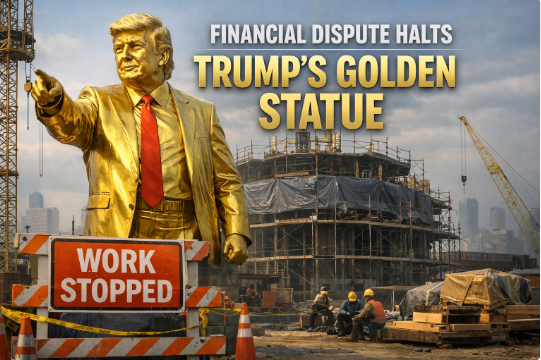
A financial dispute halts work on Trump’s golden statue
In a year already overflowing with political theater and crypto drama, the strangest crossover episode yet features a 15-foot, gold-leaf-coated likeness of Donald Trump lying on its back in an Ohio studio, its public debut stalled by a bitter money and rights dispute. The sculptor insists he’s still owed a significant balance; the statue’s backers—mostly crypto entrepreneurs—say they’ve already paid what’s due. And so the figure waits, gleaming and horizontal, a monument to contracts and cash flow rather than to power. Several outlets describe a remaining tab in the neighborhood of $90–92k on a roughly $360k commission, and confirm that the statue—nicknamed “Don Colossus”—is in limbo until the bill and intellectual-property issues are settled. (France 24)
The basics: what’s built, what’s owed, and what’s blocked
At the center of the dispute is a monumental bronze coated in 23.75-carat gold leaf—an emphatic aesthetic designed to echo a gilded, larger-than-life public persona. The artist, Ohio sculptor Alan Cottrill, says the patrons who commissioned the work leveraged the statue’s image for marketing before paying him fully and properly licensing the rights; they allegedly used it to hype a meme-coin project branded “Patriot Token,” then fell behind on obligations. Cottrill has responded the way artisans have for centuries: he’s keeping the work until he’s paid, including compensation tied to intellectual-property usage. Multiple reports corroborate the stoppage and the debt range. (The Times)
The backers push back with their own narrative: they claim they met the payment schedule, including the gold-leaf finish, and that the sculptor agreed to how the imagery would be used. But regardless of who’s right on the fine print, one fact is not in dispute—the project is frozen. The statue remains in the studio; no unveiling, no installation, no photo-ops. The gilded giant is waiting—patient as bronze, stubborn as a blockchain. (The Times)
Where it was headed (and how it got here)
“Don Colossus” wasn’t intended to live forever on a foam pad in Zanesville. Early plans linked the monument to an inauguration-adjacent moment, then later to a splashy reveal at Trump National Doral Miami once the dust settled, possibly tying the debut to marquee events on the presidential calendar. That destination has been echoed across several reports that also tie the commission to a group of cryptocurrency promoters hoping to vault their project into the mainstream. The problem: when the marketing cart gets hooked to the art horse, and the cart is funded in volatile crypto rather than predictable cash, small contractual ambiguities can balloon into very expensive standstills. (The Times)
The timeline is dizzying. Work ramped up through 2024–2025; promotional assets appeared online; a meme coin spiked, then cratered; and the statue never left the studio. As news cycles cycled, the gold continued to shine—quietly—for visitors walking past the enormous bust and torso in Cottrill’s workspace. Recent wire-service photos show the upper portion of the 15-foot figure resting on its back, the studio lights bouncing from gold leaf that, unlike the coin that hyped it, never lost its luster. (France 24)
How a creative brief became a balance sheet problem
Behind every spectacular public artwork is an unglamorous stack of paperwork: milestones, delivery terms, change orders, copyright licenses, and what lawyers blandly call “usage.” This project bundled all of it with a speculative crypto marketing plan. According to multiple reports, the commissioning group used imagery of the statue in web promotions and pitch decks for Patriot-branded tokens before finalizing IP payments. The sculptor says that was never part of the deal, or at least not at the price the patrons paid. Whether you call it a licensing oversight or a deliberate stretch, this is exactly how expensive art stalls happen: the art is technically finished; the paperwork is not. (The Times)
The alleged arrears—roughly $90k—becomes less abstract when you translate it into foundry time, mold work, patination, and gold-leaf application by specialist artisans. Statues of this scale require cranes, rigging teams, and insurers who don’t faint at the word “oversized.” Even small delays cascade into storage and security costs. A missed milestone isn’t just a date on a spreadsheet; it’s a truck sitting idle, a rigger waiting on call, a climate-controlled room occupied by something that weighs as much as a small SUV. Reports mention that Cottrill is also seeking compensation for storage and IP-related issues, not only the cash balance for fabrication. (The Times)
The crypto subplot that keeps complicating everything
Crypto loves a symbol, and few symbols generate attention like a golden statue of a sitting president. But attention is a double-edged sword: it can attract buyers to a token launch—and regulators, journalists, skeptics, and litigators. The Patriot Token effort, by several accounts, used images and videos of the work-in-progress sculpture as promotional fodder, then saw the token’s value deflate sharply afterward. Whether the coin’s trajectory caused the payment snag or merely coincided with it, the PR optics grew uglier by the day: headlines now pair the words “golden Trump statue” with “crypto pay dispute”—two sticky phrases no marketer wants married in the same sentence. (Yahoo Finance)
For observers outside the token world, here’s the short version: a meme coin is a speculative digital asset whose value leans heavily on community hype. If the hype engine stutters—say, because your signature marketing prop is legally blocked from leaving a Midwestern studio—your token’s thesis takes a hit. The snowball rolls downhill from there. That narrative arc has been chronicled by tech and finance outlets over the past week, and it frames the statue not as a celebration but as a cautionary tale. (Yahoo Finance)
Art, politics, and the long history of statues getting stuck
There’s something timeless about this mess. Across centuries, public monuments have been delayed by wars, regime changes, budget shortfalls, and even quarrels over where a pedestal should stand. In this case the catalyst isn’t geopolitics; it’s invoices and IP clauses. Yet the cultural stakes feel familiar. Supporters of monumental art say it creates lasting civic narrative. Detractors call it propaganda in bronze. Those arguments don’t vanish simply because the medium mixes gilding with the internet; they just travel faster.
And the subject here is a uniquely polarizing one. Monuments to living political figures tend to attract controversy—even more so when they’re designed as grandiose, gold-gleaming tributes. That puts sponsors on the back foot, contractors in the crosshairs, and insurers in a cold sweat. The crypto angle turns up the thermostat: projects with volatile funding streams often emphasize speed (“deploy the hype now”) while large-scale sculpture demands patience (“let the patina cure”). The philosophical mismatch is the whole story in miniature.
The legal angles: who owns what—and when?
Two legal concepts loom large:
Title and delivery. In many commission contracts, the creator retains title until final payment clears. No pay, no delivery. If the artisan also controls the only practical exit route (and a forklift), leverage tilts their way. Reports indicate that’s precisely where we are: the sculptor has the piece, and he’s not releasing it until the ledger goes to zero. (The Times)
Copyright and licensing. A commissioned sculpture still implicates a separate bundle of rights for reproductions and marketing uses. Using studio photos or 3D renders in token ads might require an explicit license even if the physical piece is paid in full. That’s where disputes get squishy: was there an agreed-upon promotional license? Was it time-limited? Did it cover tokens and digital promotions? The fewer nouns in the contract, the more nouns in the lawsuit.
None of this is exotic law. It’s just unglamorous detail that either gets handled up front or explodes later. From what’s public, the explosion has already happened; the shrapnel is reputational as much as financial. (The Times)
Why the destination matters
If the plan holds, the statue’s ultimate home would be a high-visibility property strongly associated with Trump—Miami-area Doral. That matters for three reasons. First, visibility: a resort visited by dignitaries, donors, and the traveling press corps is a 24/7 stage. Second, permanence: monuments at private properties can be curated with fewer municipal headaches, meaning the statue’s fate is less dependent on local councils and more on ownership and brand strategy. Third, logistics: siting, anchoring, wind-load calculations, and permits differ for hospitality grounds compared with a public plaza. Those are solvable problems—once the studio gate opens. Reports tie the prospective unveiling to Doral after the dispute is resolved, but “prospective” is doing heavy lifting here. (The Times)
The image that launched a thousand headlines
Journalists, being visual creatures, latched onto one indelible frame: a colossal, gold-leafed bust portion lying flat, shop lights flickering over metallic planes, a forklift lingering like a supporting actor. That picture summarizes the paradox: something designed to tower instead teaches humility from the floor. The AFP/France-24 and regional reprints carry this image, and it’s the strongest single asset in the story’s SEO constellation because it compresses the narrative into one arresting idea: status paused. (France 24)
Money, meaning, and the risk math of spectacle
From a risk perspective, spectacle is a multiplier. Big art attracts big attention; big attention invites legal scrutiny; legal scrutiny demands bulletproof paperwork. The crypto backers might have considered a different playbook: fund the commission in full, complete IP licensing, arrange site permits, then unveil with a synchronized media plan and token roadmap. Instead, the hype cadence seems to have outrun the legal cadence. When those rhythms conflict, cash flow gets strangled, then headlines do the rest. Finance outlets have already framed the episode as a mini case study in “liquidity meets licensing.” (AInvest)
What happens next?
There are only a handful of outcomes.
The backers pay the balance and settle IP claims. This is the shortest route: clear the invoice, sign a retroactive promotional license, and schedule pickup. The statue ships; installation crews dust off the site plan; a ribbon is cut at Doral or another sympathetic venue. Several reports suggest this is the intended arc once the dispute is resolved. (The Times)
A negotiated middle ground. The parties could split the difference, with a partial payment now and a revenue-share or attribution requirement on future marketing usage. That would let the project exit the studio while preserving claims if the statue becomes a profitable brand asset.
Litigation or liens. If negotiations fail, expect filings. In many states, artisans can assert possessory liens on works until paid. That means the statue might legally remain right where it is until a court orders otherwise.
A public-relations pivot. The backers could reframe the project as a tale of perseverance—“We stood by local craftsmen and paid premium for gold-leaf excellence”—but the internet never forgets the initial headline. Brands can pivot; a URL slug can’t.
Strategically, the first option is the only one that doesn’t set money on fire. Storage and security are not free, and every week adds carrying costs that erode whatever speculative upside the backers hoped to capture with their token tie-ins.
The cultural read: why this story sticks
This saga resonates because it braids three things modern audiences can’t stop clicking:
Celebrity power. A gilded statue of a president is the Platonic ideal of a clickable sentence.
Crypto volatility. Add a meme-coin subplot and you’ve built a media magnet.
Art-world drama. Artists holding pieces “hostage” until they’re paid is as old as patronage itself, but it never stops being vivid.
It also tells a quieter truth about how public memory is built. Monuments aren’t only about the person depicted; they’re about the process and values of the people doing the depicting. If that process is slapdash or opportunistic, the sculpture becomes a mirror you might not enjoy looking into.
Takeaways for anyone commissioning big public art
If you’re plotting your own landmark—political, corporate, or cultural—steal these lessons before you commission the first maquette:
Front-load IP. Don’t assume physical ownership grants promotional rights. Write the license like your marketing depends on it—because it does.
Pay milestones on time. Foundries and gilders operate on tight schedules. Delays eat budgets.
Plan the destination early. Engineering for a hotel terrace is not the same as a public plaza. Lock the site so the sculpture’s base, weight, and wind shear are designed to spec.
Separate hype from hardware. Do not rely on speculative token proceeds to pay real-world invoices. Bronze, unlike a meme coin, will not pump on command.
None of this is rocket science; it’s just craftsmanship applied to contracts. The craftsmanship is the part the public sees. The contracts are the part that decides whether the public sees it at all.
Where the story stands—today
As of February 7, 2026, the gilded statue remains unfinished in the most important sense: not the foundry work, but the business work. Newsrooms from wire services to finance blogs concur that the project sits dormant while the parties spar over roughly $90,000 and the scope of promotional rights. Until that ledger hits zero and the license is buttoned up, the giant won’t rise from the studio floor. And if it eventually makes it to a pedestal at Doral, it will arrive carrying not just the weight of bronze and gold, but the gravity of a modern parable: in 2026, even monuments to power can be paused by a missing line item. (France 24)
Frequently asked questions (because the internet will ask anyway)
Is the statue actually “solid gold”? No. It’s a bronze structure coated in gold leaf—a thin layer of gold applied by hand. That’s standard practice for gilded monuments: radiant look, sane budget. Multiple reports specify gold leaf rather than solid gold. (France 24)
How tall is it? Reports consistently describe a roughly 15-foot (about 4.6-meter) sculpture, though early hype pieces threw around larger numbers. Wire photos and captions from this week note the 15-foot scale. (thestandard.com.hk)
Where is it physically? In the artist’s studio in Zanesville, Ohio. The bust portion can be seen lying on its back, waiting—politely but immovably—for accountants and lawyers to finish their part. (France 24)
Where was it supposed to go? The most frequently cited destination is Trump’s Doral resort in Florida, pending resolution of the dispute and any site logistics. (The Times)
Who paid for it? A group of cryptocurrency entrepreneurs and Trump backers who reportedly hoped to align the piece with a crypto project and later, an event-ready unveiling. Their marketing embrace of the statue ahead of final payments is part of what triggered the dispute. (France 24)
SEO keyword paragraph (to help your site rank without turning it into a keyword soup)
donald trump statue, golden trump statue, don colossus statue, alan cottrill sculptor, trump doral statue, gold leaf bronze statue, crypto pay dispute, patriot token memecoin, trump statue controversy, trump monument halted, trump art controversy 2026, trump statue ohio studio, trump national doral miami sculpture, donald trump golden statue news, trump statue funding dispute, intellectual property dispute sculpture, cryptocurrency marketing controversy, meme coin scandal, gilded statue politics, united states politics news 2026, trump supporters crypto, large scale bronze statue, statue installation delayed, art commission dispute, trump statue unveiling postponed, trump statue latest updates, ohio sculptor trump, 15 foot statue gold leaf, political monument controversy, art law licensing, public art contract dispute, trump statue payment owed, crypto funded art project, doral florida trump statue, trending political news, breaking us news 2026, SEO news keywords politics, high ranking political keywords, golden statue halted by financial dispute.