
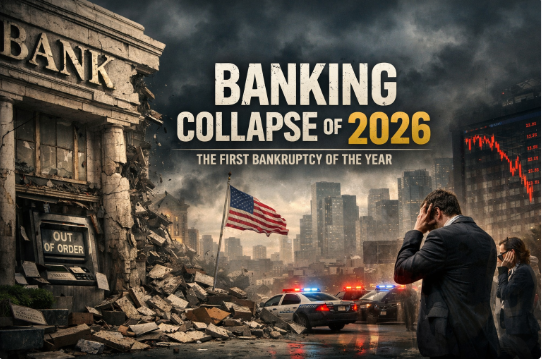
An American bank collapses in the first banking bankruptcy of 2026
On January 30, 2026, a small Chicago lender, Metropolitan Capital Bank & Trust, was closed by regulators and handed to the Federal Deposit Insurance Corporation (FDIC) as receiver—the first U.S. banking bankruptcy of the year. By the next business day, deposit accounts and most operations had been transferred to First Independence Bank, ensuring customers could access their money and continue routine banking with minimal disruption. (FDIC)
This story is more than a one-bank problem. It’s a compact primer on how the U.S. bank-resolution machine works in 2026, what “bank failure” means in practice, and why even modest community-bank collapses ripple through markets already nervous about interest-rate whiplash, commercial real estate jitters, and deposit flight. Reports from trade and local press—American Banker and the Chicago Sun-Times—quickly framed the event as the first failure of 2026, confirming the closure date and acquisition details. (American Banker)
What actually happened when the bank “failed”?
When a U.S. insured bank is deemed non-viable, state or federal regulators close the institution at the end of a business day (usually a Friday). The FDIC steps in as receiver and either sells the whole bank or parts of it to another institution, or—if no bidder emerges—pays out insured deposits directly. In this case, the FDIC arranged a purchase-and-assumption (P&A) transaction with First Independence Bank. That’s why customers’ debit cards kept working, checks cleared, and branches reopened under new signage with surprisingly little drama. (FDIC)
Key facts the FDIC disclosed:
Assuming bank: First Independence Bank, which reopened the failed bank’s location(s) as its own branches.
Deposit treatment: All deposits were transferred. Insured balances are protected; amounts above FDIC limits are handled through the receivership process.
Continuity: Checks drawn before the closure continued to be honored—again, the practical upside of the P&A route over liquidation. (FDIC)
The FDIC’s Failed Bank List page confirms Metropolitan Capital Bank & Trust closed on January 30, 2026—a useful canonical record for journalists and depositors alike. (FDIC)
Why did this failure matter?
Let’s be honest: outside Chicago, this wasn’t a “Lehman moment.” The bank’s balance sheet was small compared with regional or money-center peers. But firsts matter. Being the first bank failure of 2026 inevitably reverberates through investor psychology because it resets the scoreboard for a new year. After a lull in late 2025, a fresh failure invites familiar questions: Are more banks nursing unrecognized losses? How fragile are deposit bases in a higher-for-longer rate regime? Are commercial real estate portfolios wobbling?
Financial media that track market sentiment—crypto outlets included—were quick to connect the failure with broader risk-off trading in gold, silver, Bitcoin, and equities. While correlation isn’t causation, the timing helped stoke “contagion” conversation, especially around unrealized losses on bank securities portfolios. Treat those causal leaps with skepticism, but don’t ignore that narratives can move markets. (CryptoSlate)
How the FDIC protects depositors—what’s insured, what isn’t
The FDIC insures most deposit accounts up to standardized limits. The headline number people know—$250,000 per depositor, per insured bank, per ownership category—still applies. In a P&A deal like this one, insured deposits slide over to the assuming bank seamlessly. If you had $100,000 in a savings account, your money remained available; you just wound up a customer of First Independence Bank. Any uninsured amounts (balances above coverage limits) are processed by the receiver, with recoveries depending on asset sales and the receivership’s final accounting. (FDIC)
That distinction matters for small businesses and nonprofits that can run balances above FDIC insurance caps for payroll or operations. Many institutions use “sweep” services, collateralized deposits, or network deposit products to spread funds across multiple banks to stay under per-bank caps—practices that deserve renewed attention any time a failure occurs.
The anatomy of a small-bank collapse in 2026
Every bank’s story is idiosyncratic, but the broad forces squeezing U.S. community and niche banks are familiar:
Interest-rate risk: When rates rise fast, banks holding lots of longer-duration, fixed-rate securities (like low-coupon Treasuries or MBS bought in 2020–2021) see the market value of those securities drop. Unrealized losses don’t matter—until they suddenly do, because deposit flight forces asset sales or because capital ratios start looking thin.
Deposit mix: Banks dependent on a narrow deposit base (for instance, a specialized clientele or high proportion of uninsured deposits) are more vulnerable to swift outflows. Money market funds yield competitively, and treasury bills have become the world’s most boring-yet-tempting alternative.
Credit exposures: Local commercial real estate—especially offices—is still digesting post-pandemic shifts. Even if losses are contained, reserve builds and watchlists can pull oxygen from earnings.
Funding costs and margin compression: Paying more to retain deposits while earning slowly on older, low-yield assets squeezes net interest margins. That’s not fatal by itself, but it can be the straw that breaks a weak camel’s back.
Regulators are well aware. In fact, policy memos and speeches in late 2025 and early 2026 flagged tweaks in resolution planning and receivership playbooks, drawing lessons from the 2023 failures. Expect more guidance on liquidity monitoring, uninsured deposit concentrations, and sale processes as the year progresses. (Sullivan & Cromwell)
What customers in Chicago experienced
For depositors, the most important thing was continuity. ATMs worked, online banking portals redirected, and branch doors reopened under the assuming bank’s brand. Checks that hadn’t yet cleared were processed as usual—assuming sufficient funds—because the receiver and assuming bank coordinated to honor them. That’s the point of arranging a P&A deal over a straight payoff: it reduces friction, confusion, and the social-media-amplified panic that can follow a closure announcement. (FDIC)
Local coverage underscored the “first failure of 2026” framing, which—while technically accurate—can create exaggerated fear if stripped of scale and context. A single small-bank receivership is not evidence of a system-wide cascade. It is a reminder to mind basic hygiene: confirm FDIC coverage for your accounts, diversify large operating balances, and keep cash-management policies up to date. (Chicago Sun-Times)
What investors and founders read between the lines
For bank equity investors: A first failure raises screens across the sector. Analysts dig into banks with similar funding mixes or geographic exposures and reassess capital adequacy under stress. Watch for 8-Ks disclosing unrealized losses, changes in deposit betas, or revised guidance on net interest margins.
For startup founders and CFOs: 2023 taught an unforgettable lesson about concentration risk in operating accounts. Treasury management policies that once felt fussy now feel existential. Cash segmentation—some in operating accounts, some in T-bills or government money market funds—has become standard.
For real-estate owners and borrowers: Community banks remain crucial lenders. A failure can delay loan approvals, alter underwriting appetite, or change servicing teams. It’s not usually catastrophic, but it can stretch timelines and move terms.
For crypto traders: Macro headlines are tinder. A bank failure, even a small one, can spark risk-off moves or flight-to-quality trades that whipsaw crypto, precious metals, and rates markets. The underlying plumbing might be unrelated, but narrative momentum matters. (CryptoSlate)
How this compares with 2025—and what to watch next
Two small banks failed in 2025 (Pulaski Savings Bank in January and The Santa Anna National Bank in June), both resolved without systemic fallout. That’s an important precedent: modest, isolated failures can be absorbed by the system when the resolution toolkit is well-practiced and buyer interest exists. The 2026 failure so far looks similar in mechanics, right down to the overnight branch conversion. (Bankrate)
Here’s what to monitor through the next few quarters:
FDIC’s evolving guidance. Policy updates on resolution planning and sale processes could speed up weekend deals, clarify how uninsured deposits are handled, or refine bidder incentives. Faster, cleaner resolutions reduce contagion risk. (Sullivan & Cromwell)
Bank earnings calls. Listen for commentary on deposit costs, retention strategies, and securities-portfolio repositioning. If more banks accelerate loss recognition by selling underwater bonds, short-term pain could lead to sturdier balance sheets.
CRE data—especially offices. Watch delinquency trends and appraisal updates in metros with high remote-work footprints. Community banks with concentrated portfolios may bulk up reserves or de-risk exposures.
Market narratives. Whether deserved or not, narrative gravity can turn one-off closures into “trend stories.” If failures remain limited and idiosyncratic, markets will eventually refocus on rates, growth, and earnings.
What to do if you had an account at the failed bank
If you were a Metropolitan Capital Bank & Trust customer, the next steps are mercifully simple:
Keep using your accounts. They’ve been transferred to First Independence Bank; your routing and account numbers typically continue to work through the transition.
Verify FDIC coverage. If you keep balances above standard limits, consider diversifying via multiple insured institutions or using deposit network products. The FDIC page for the receivership explains claims processes for any uninsured amounts and provides the Proof of Claim instructions and address. (FDIC)
Beware of scams. The FDIC will never ask for your private information via unsolicited calls or emails. Treat “we’re the FDIC” messages the same way you treat “we’re the IRS” calls: hang up, find the real contact info, and initiate the call yourself. (FDIC)
The bigger picture: resilience through practice
A paradox of modern bank regulation is that visible failures can signal functioning safeguards. When resolution frameworks work—insured depositors are protected, branches reopen swiftly under a capable buyer, and communication is clear—confidence in the broader system can strengthen even as one institution disappears. The first banking bankruptcy of 2026 fits that mold so far.
Still, resilience is a moving target. Higher-for-longer rates continue to expose weak interest-rate risk management; digital banking enables faster deposit runs than regulators designed for a generation ago; and social media can turn a rumor into a run. The playbook must keep evolving. Regulators know this, as the memos and policy trackers suggest. (Sullivan & Cromwell)
Final thought
This failure is a useful reminder that good banking is boring banking: conservative risk, stable funding, and clear communication. The more unglamorous the operations, the more likely a bank can weather whatever 2026 throws at it. For customers, the action item is simple: confirm your FDIC coverage and diversify anything above the cap. For executives, it’s about sweating the fundamentals—asset-liability management, liquidity buffers, and transparent reporting. For the rest of us, it’s about keeping perspective: one small-bank receivership does not a crisis make.
Sources and further reading
FDIC Failed Bank List entry confirming closure (Jan. 30, 2026) and assuming institution details. (FDIC)
FDIC receivership page with deposit transfer, check honoring, and claims information. (FDIC)
Local and trade press framing it as the first bank failure of 2026. (Chicago Sun-Times)
Market-narrative angle on risk sentiment and unrealized losses context. (CryptoSlate)
Policy context on resolution planning updates heading into 2026. (Sullivan & Cromwell)
SEO keywords (one-paragraph boost): US bank failure 2026, first American bank bankruptcy 2026, Metropolitan Capital Bank collapse, FDIC receivership 2026, Chicago bank closed January 30 2026, First Independence Bank acquisition, insured deposit limits $250,000, what happens when a bank fails, how FDIC protects depositors, failed bank list 2026, community bank risks 2026, interest rate risk in banks, unrealized losses securities portfolio, commercial real estate exposure banks, deposit flight higher-for-longer, purchase and assumption deal explained, bank contagion risk 2026, safe cash management strategies, diversify uninsured deposits, small business banking failure steps, bank closure weekend playbook, US banking news today, financial stability 2026, FDIC insurance coverage rules, Chicago banking news 2026.