
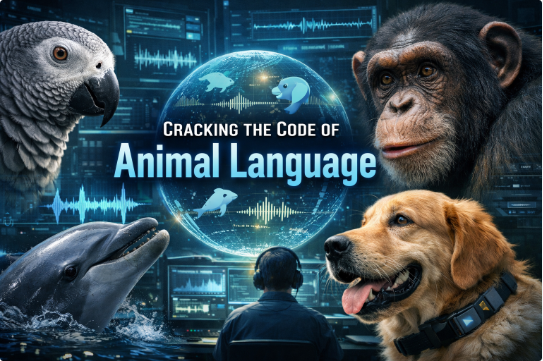
An expert reveals that scientists are close to deciphering the languages of animals
What if a dawn chorus wasn’t just pretty noise, but a neighborhood bulletin? What if a whale’s click train was a family diary, a map, and a love poem compressed into sound? Today’s headline—An expert reveals that scientists are close to deciphering the languages of animals—isn’t a sci-fi teaser. It’s a careful statement of where the science of animal communication actually stands in early 2026. The short version: we aren’t suddenly about to chat with your cat about rent prices; the longer, more exciting version is that breakthroughs in bioacoustics, artificial intelligence, and behavioral ecology are converging fast enough to change how we study wildlife, protect ecosystems, and think about intelligence itself.
Why “language” is a loaded word—and why this moment still matters
Linguists use “language” precisely: combinatorial structure (syntax), shared symbols (semantics), and the ability to create new meanings (productivity). Many animals communicate richly without meeting every criterion that human language does. That nuance matters. But here’s the headline’s core truth: scientists are getting much better at decoding, classifying, and contextualizing animal signals—vocal, visual, tactile, and chemical—with a level of resolution that was impossible even five years ago. In SEO terms, the field of animal communication, decoding animal language, and AI in wildlife research is moving from proof-of-concept to applied practice.
From microphones to meaning: the bioacoustics revolution
The first driver is bioacoustics, the study of sound in animals. Imagine rugged sensors listening 24/7 in forests, reefs, savannas, and the deep ocean. Those sensors feed colossal datasets—terabytes of chirps, clicks, howls, rumbles—into machine learning models tuned to detect patterns far subtler than the human ear can parse. Unsupervised algorithms cluster signals into “dialects,” while self-supervised models learn from raw audio without exhaustive labels. Researchers link these patterns to behavior: feeding, mating, warning, migrating.
The same playbook that transformed speech recognition now empowers acoustic monitoring of wildlife. Models once hungry for “clean” studio audio now handle wind, rain, and overlapping calls. Edge devices do on-site inference to flag rare species or urgent events. Cloud pipelines aggregate results, turning messy soundscapes into ecological dashboards. This is searchable, actionable conservation technology, not just a proof of concept.
Statistical “words” and animal syntax
Some of the most intriguing progress involves structure. In certain species, scientists can identify repeatable “units” of sound—call them phonemes, syllables, or notes—that combine in predictable ways. Think of songbirds that reorder motifs, or dolphins that weave signature whistles into social calls, or sperm whales whose “codas” vary by clan and context. Models that track sequence probabilities (how A follows B) reveal what looks like syntax—not necessarily human grammar, but constrained, meaningful order. When those sequences shift with circumstance—predator nearby, calf nursing, rival approaching—the models detect it.
This is where explainable AI matters. Early black-box classifiers could label “whale” vs. “not whale.” Today’s research often pairs performance with interpretability: inspecting attention weights, building probabilistic grammars, and generating testable predictions. When a model claims “this call means danger,” field teams verify by introducing controlled stimuli (a silhouette of a hawk for meerkats or prairie dogs, for example) and observing consistent behavioral responses. The loop between AI inference and experimental ethology is tightening.
The multi-modal leap: not just sound
Animals aren’t radio stations broadcasting in a single band. Bees waltz in waggle dances (vibration and direction). Elephants use infrasound and seismic cues through the ground. Cephalopods flash color and texture. Wolves signal with posture, tail position, and scent. New studies combine computer vision, accelerometers, GPS tracks, hormone assays, and acoustic data to understand communications within context. A grunt is one thing; a grunt synced to a head turn, a pupil dilation, and a sudden acceleration is another. This fusion boosts accuracy and reduces anthropomorphic guesswork.
The projects moving the needle
Without lapsing into a laundry list, it’s worth sketching the landscape to anchor what “close to deciphering” means:
Cetacean research has scaled up with distributed hydrophone arrays and click-level annotation of sperm whale codas, enabling clan-level social maps and contextual catalogs.
Songbird labs compile lifelong audio diaries for individual birds, correlating seasonal, hormonal, and social changes with fine-grained variations in song.
Primate research links specific alarm calls to predators and tracks the development of those calls in juveniles, illuminating how learning and culture shape communication.
Elephant teams map infrasound repertoires across kilometers, discovering calls associated with greeting ceremonies, births, and mourning.
Bee researchers refine automated dance decoding, connecting waggle parameters to nectar quality and direction with astounding fidelity.
Each domain exploits foundation models trained on gargantuan unlabeled corpora, then fine-tuned on species-specific datasets. Transfer learning—pre-training on general bioacoustic soundscapes and adapting to a new species—cuts costs and opens the door to scaling across hundreds of species, an SEO-friendly dream for wildlife monitoring, biodiversity assessment, and environmental DNA (when paired with soundscapes).
What “close” looks like in practice
“Close” doesn’t mean fluent bilingualism. It looks like:
Reliable classification of call types with context tags (courtship, foraging, alarm, play) and confidence scores.
Predictive models that anticipate behaviors from audio alone—e.g., a 20% increase in certain calls forecasting a group’s movement or a birthing event.
Cross-site generalization, where a model trained in one habitat performs well in another, signaling robust representations rather than overfitting.
Intervention tools: decision support systems for rangers that flag poaching risk or stress in herds, or shipping advisories that reroute traffic when whales are present.
Those capabilities—already real in prototype or limited deployments—change management: better marine conservation, smarter protected area planning, and community-led stewardship backed by data.
Ethics: translation is power, and power needs guardrails
If we can interpret animal signals, what should we do with that power? Ethics isn’t a footnote; it’s the spine. Data governance for wildlife must grapple with “acoustic privacy”—a real concept when microphones capture not just birds but human voices—and with the risk of poacher misuse if real-time trackers are exposed. There’s also moral hazard in “speaking for” nonhuman animals by projecting human values. Scientists increasingly include ethicists, local communities, and Indigenous knowledge holders at the design stage, set strict access controls on sensitive data, and publish ethical guidelines on playback experiments, where broadcasting calls could cause stress or ecological disruption.
Playback experiments: the cautious first steps toward dialogue
Decoding is only half the story; playback experiments probe whether we can say something meaningful back. For decades, biologists have played recorded calls to test recognition. Today’s twist is generative audio: models synthesizing plausible calls that match the statistical fingerprint of a species’ repertoire. Used responsibly, researchers can test hypotheses like “Does this synthesized alarm call trigger scanning behavior?” or “Does a greeting sequence promote affiliative contact?” The early, careful results suggest some signals are interpretable enough to elicit predictable responses. That’s not full translation. It is, however, the difference between eavesdropping and a primitive dialogic probe.
Culture, dialects, and nonhuman traditions
A thrilling thread in this story is animal culture. Different orca pods prefer different hunting techniques; songbirds have dialects; primates share tool traditions. Communication sits inside those cultures, not apart from them. Decoding animal signals isn’t just about a “dictionary,” but about socio-ecological context—who talks to whom, when, and why. Network analysis maps these relationships, revealing hubs (matriarchs, experienced foragers), bridges (dispersing juveniles), and peripheries. Cultural transmission shapes the “meaning” of calls; machine learning can detect those cultural signatures across time and space, contributing to population genetics and metapopulation management strategies.
Citizen science and the global ear
You don’t need a ship or a savanna to help. Smartphone apps and low-cost recorders let hikers, divers, farmers, and schoolchildren contribute to citizen science soundbanks. With on-device AI and privacy safeguards, contributors can tag species, upload short snippets, and receive feedback. That grassroots scale matters: rare events—like a newly arrived invasive species or the return of a previously extirpated bird—are statistically easier to catch when millions of ears are listening. For local governments and NGOs, these initiatives are cost-effective pathways to climate resilience, habitat restoration, and community-based conservation.
The business case: ESG meets bioacoustics
Corporations committed to ESG reporting, nature-positive strategies, and TNFD frameworks need defensible biodiversity metrics. Bioacoustic indices—acoustic diversity, temporal richness, presence of indicator species—offer repeatable, auditable signals of ecological health. Renewable energy projects use avian and bat acoustic monitoring for siting and mitigation. Fisheries integrate marine mammal detection to comply with bycatch rules. Insurance underwriters model nature-related risk using soundscapes as early warnings of ecosystem decline. Translation isn’t just philosophical; it’s a practical lever in sustainability, risk management, and regulatory compliance.
Limits, roadblocks, and honest uncertainties
Progress is real, but let’s keep the guardrails tight:
Generalization: A model that nails one population may falter with another. Dialects, seasonal shifts, and individual idiosyncrasies complicate neat dictionaries.
Label scarcity: Behavioral labels are costly. Weak supervision, contrastive learning, and active learning help, but field verification remains the bottleneck.
Causality vs. correlation: Signals correlated with behaviors don’t automatically carry semantic content. Carefully designed experiments are essential.
Playback ethics: Generating calls risks stress, habituation, or disrupting predator–prey dynamics. Institutions are codifying strict protocols.
Anthropomorphism: The temptation to map human emotions directly onto nonhuman signals is strong. The discipline’s rigor comes from resisting neat stories when the data complicates them.
None of these invalidate the claim that we’re “close.” They clarify what we’re close to: robust, context-aware interpretation for practical conservation and science, not a universal translator pinned to your lapel.
What the next two years could realistically deliver
Looking toward 2028, here’s a grounded forecast of milestones that would count as “translation” in a scientific, not Hollywood, sense:
Species-level communication atlases—open, versioned repositories linking call types to contexts with uncertainty estimates, continually improved via adaptive sampling.
Standard benchmarks for cross-project comparability: shared test sets, metrics for syntax detection, and “challenge tasks” like cold-start species adaptation.
Operational tools for rangers, fishers, and park managers: near-real-time alerts for stress, calving, or conflict risk; shipping lane advisories to cut collisions; early warnings of illegal logging or gunshots embedded in the soundscape.
Ethical playbooks co-written with local communities: consent models, data sovereignty frameworks, and tiered access, reducing “digital colonialism” in conservation data.
Education and policy bridges: curricula that bring bioacoustics into classrooms, and legislation that recognizes acoustic habitats—quiet zones for calving whales, for instance—as conservation assets.
These are feasible on current trajectories and would transform wildlife protection, ecosystem management, and public engagement.
Why this matters to our sense of kinship
The grand prize isn’t a chat with your dog about your commute. It’s a less lonely worldview. If we can show, with data, that other species compose, negotiate, warn, flirt, teach, and grieve using signals we can decode, then our policies, technologies, and everyday decisions shift. Forests aren’t “resources” but neighborhoods; oceans aren’t cargo highways but living archives. Decoding animal communication re-enchants the world with accountability. It upgrades empathy from a feeling to a decision framework.
Practical applications you’ll likely hear about soon
Expect more headlines like:
Smart buoys that “listen” for whales and dynamically signal ships to slow, cutting strikes.
Livestock welfare monitors that detect stress vocalizations early, improving health and reducing antibiotics.
Urban biodiversity maps built from rooftop and park microphones, guiding greener city planning.
Agricultural pollination alerts derived from bee activity signatures, boosting yields while reducing pesticide use.
Early-warning systems for coral reef stress, detected in the nighttime crackle of reef soundscapes before bleaching becomes visible.
Each of these is an SEO-friendly magnet for readers searching sustainable technology, AI for good, nature-based solutions, smart cities, and regenerative agriculture.
How to read sensational headlines without losing the plot
A healthy media diet helps. When you see “Scientists talk to whales!” run a mental checklist:
Does the study show behavioral validation, not just model accuracy?
Are there uncertainty estimates and out-of-sample tests?
Did the researchers address ethics and data governance?
Is the work replicable with open methods or benchmarks?
If those boxes are ticked, you might be looking at another brick in the translation wall. If not, you’ve found marketing dressed as science.
The bottom line
“Close to deciphering the languages of animals” means this: we’re assembling reliable, ethically grounded systems that map signals to context and consequence across species, at scales that matter for conservation, policy, and public understanding. Some species will yield more easily; others will remain inscrutable. That’s fine. Translation is not a binary switch—it’s a gradient of clarity earned by better microphones, smarter models, careful experiments, and humility. The most important word in that sentence might not be “deciphering,” but “close”—a reminder that science moves by approximation, evidence, and revision.
If you’re new here and landed via searches like animal language translation, AI wildlife conservation, bioacoustic monitoring, or decoding whale clicks, the next best step is simple: stay curious, support organizations doing ethical fieldwork, and treat every chirp, rumble, croak, and buzz as a line in a living library. We’re learning to read again—and the authors have been writing since long before humans learned to whisper.
SEO keywords (to improve site discoverability): animal communication, decoding animal language, bioacoustics, AI in wildlife research, machine learning for conservation, acoustic monitoring, sperm whale codas, dolphin signature whistles, elephant infrasound, songbird syntax, prairie dog alarm calls, bee waggle dance, explainable AI, conservation technology, biodiversity monitoring, marine conservation, sustainable technology, wildlife acoustics, citizen science, environmental data, nature-positive strategies, ESG and biodiversity, climate resilience, habitat restoration, marine mammal detection, ecological dashboards, generative audio, playback experiments, ethical AI, data governance, foundation models, transfer learning, computer vision for ecology, smart buoys, ship strike prevention, urban biodiversity, regenerative agriculture, pollinator monitoring, reef soundscape, environmental DNA, invasive species detection, nature-based solutions, AI for good, sustainable development.