
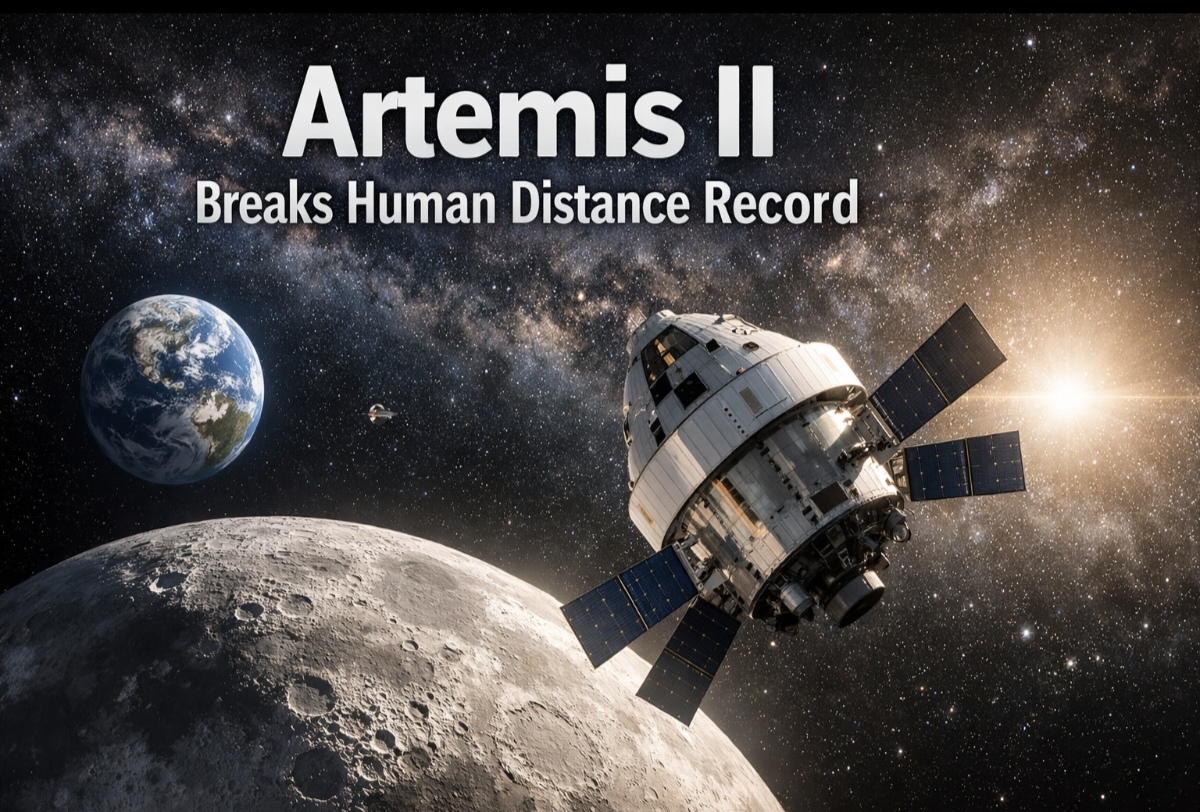
Artemis II breaks human distance record
Today, April 7, 2026, feels like one of those rare days when space exploration stops being an abstract promise and becomes something immediate, emotional, and undeniably historic. NASA’s Artemis II mission has now carried human beings farther from Earth than ever before, officially surpassing the old Apollo 13 mark and setting a new record at 252,756 miles from Earth during its lunar flyby. For anyone following the Artemis program, the Orion spacecraft, or the broader future of human deep space exploration, this is more than a headline. It is proof that the return to the Moon is not a concept anymore. It is happening, in real time, with four astronauts aboard the first crewed Artemis mission.
What makes this moment so compelling is that the record itself is only part of the story. Artemis II is NASA’s first crewed mission with the Space Launch System rocket and Orion spacecraft, and it launched on April 1, 2026 on an approximately 10-day mission around the Moon. That means this flight is not simply chasing a symbolic milestone; it is validating the hardware, systems, and operational discipline needed for a sustained return to cislunar space and, eventually, missions farther out. In practical terms, Artemis II is the bridge between the successful uncrewed Artemis I test in 2022 and the future lunar surface missions NASA has been building toward for years.
The exact sequence of events makes the achievement even more dramatic. NASA says the crew first surpassed Apollo 13’s long-standing record of 248,655 miles from Earth at 12:56 p.m. CDT on April 6, and later reached the mission’s maximum distance of 252,756 miles during the lunar flyby. At the same time, Orion made its closest pass over the Moon at roughly 4,067 miles above the lunar surface, combining precision navigation, deep-space communications, and human spaceflight into a single unforgettable arc around our nearest celestial neighbor. In a mission full of powerful visuals and technical milestones, that combination of distance, proximity, and timing gave Artemis II the feeling of history unfolding by the minute.
The crew at the center of this story gives the mission even greater resonance. Artemis II is flown by Reid Wiseman, Victor Glover, Christina Koch, and Jeremy Hansen, a team that reflects both continuity and change in human spaceflight. NASA has emphasized that this crew includes the first woman, first person of color, and first Canadian on a lunar mission, a reminder that the modern Moon program is being shaped by a broader, more representative generation of explorers. That matters for the symbolism of Artemis, but it also matters for public engagement, international partnership, and the long-term legitimacy of lunar exploration in the twenty-first century.
There is also a deeper emotional power in the fact that Artemis II is the first human return to the Moon’s vicinity since Apollo 17 in 1972. For decades, the Moon has lived in popular imagination as both an achievement and an unfinished chapter. Entire generations grew up with the Apollo landings as history rather than lived experience. Artemis II changes that. The mission does not land, but it brings people back into the lunar environment, back into the line of sight of the far side, back into the realm where Earth can disappear below a lunar horizon and rise again moments later. In that sense, Artemis II is not a repeat of Apollo. It is the reopening of a frontier that had been quiet for more than half a century.
One reason this mission is so easy to connect with on a human level is that the record was broken not in a sterile laboratory setting, but during one of the most dramatic phases of the journey: the planned communications blackout behind the Moon. As Orion passed out of radio contact, the crew experienced Earthset, then later Earthrise, while mission control waited for signal reacquisition. NASA said the blackout lasted about 40 minutes, and just after that period Orion emerged with a restored signal and a new place in the record books. It is hard to imagine a better metaphor for exploration: people disappearing into the unknown, carrying the hopes of Earth with them, and returning with something no one has ever done before.
That kind of imagery is why “Artemis II breaks human distance record” is such a strong title, but the title still understates what the astronauts were actually doing. This was not a passive sightseeing loop. During the flyby, the crew photographed and described impact craters, ancient lava flows, surface cracks, ridges, color differences, and brightness variations across the Moon, especially on the far side. NASA’s mission updates note that those observations can help scientists better understand lunar composition, age, and geologic evolution. In other words, the astronauts were not just witnessing history; they were contributing to it with real-time human observation, an asset that remains uniquely valuable even in the age of robotic missions and autonomous sensors.
The science side of the mission gives Artemis II much of its long-term importance. NASA has been clear that Artemis II is intended to demonstrate Orion’s capabilities in deep space, verify that its systems operate as designed with crew aboard, and help lay the foundation for safe and efficient human exploration of the Moon and Mars. That means every communications handoff, every life-support check, every navigation correction, and every crew activity feeds directly into later missions. For spaceflight planners, Artemis II is a test flight. For the public, it feels like an adventure. The truth is that it is both, and that balance is exactly what makes it so powerful.
Another reason this mission stands out is the sheer scale of the journey. NASA’s updated Artemis II Q&A says the crew is expected to travel a total of 695,081 miles from launch to splashdown. That number is useful because it reminds us that the record-setting distance from Earth is only one measure of what this mission represents. Deep space travel is about endurance, system reliability, and operational tempo across days, not just a single peak metric. The farther the crew travels, the more meaningful each success becomes: power generation, thermal control, environmental systems, crew performance, and the spacecraft’s ability to sustain people far beyond low Earth orbit.
Artemis II also delivered something that great exploration always seems to produce: moments of awe that no technical briefing can fully capture. NASA reported that the crew witnessed a nearly hour-long solar eclipse as Orion, the Moon, and the Sun aligned, giving them a view of the solar corona around the Moon’s edge. During that same phase, the astronauts reported six flashes of light from meteoroids striking the lunar surface. Those details matter scientifically, but they also matter culturally. They are the kind of vivid experiences that give a mission lasting emotional afterlife, the moments people remember years later when they think about why we go to space in the first place.
For SEO, for storytelling, and for sheer public fascination, Artemis II is arriving at exactly the right moment. Interest in the NASA Moon mission, the Artemis program, the Orion spacecraft, and the future of human spaceflight has been building for years, but many people were still waiting for a mission that felt undeniably real. Artemis I proved the architecture could fly. Artemis II proves people can go with it. That distinction matters. A crewed lunar flyby transforms public perception because it reintroduces risk, skill, emotion, and direct human presence into deep-space exploration. Suddenly, terms like “lunar flyby,” “deep space mission,” “Moon orbit trajectory,” and “return to the Moon” are no longer future-facing marketing phrases. They describe a mission that is happening now.
There is also a strategic layer to this mission that should not be overlooked. Artemis II is not only about inspiration; it is about operational confidence. NASA has framed the mission as a key step toward long-term lunar exploration and eventual Mars ambitions. The agency’s mission pages repeatedly stress that Artemis II is meant to validate systems, support future lunar surface missions, and extend humanity’s reach deeper into space. That makes today’s record feel especially important because it shows measurable progress. It is one thing to talk about building a sustained human presence beyond Earth. It is another to demonstrate, with astronauts aboard, that the transportation backbone of that vision can perform in deep space.
As of April 7, 2026, Artemis II is no longer just on its way to the Moon; it has already completed the defining portion of the mission and begun the return leg home. NASA’s live updates said that after the lunar observation period ended, Orion was starting its trip back toward Earth, and later on April 7 it was expected to exit the Moon’s sphere of influence. That current status matters because it places the record in living context. This is not a retrospective celebration of a mission long completed. It is a milestone reached during an active flight, with the spacecraft still in transit and the world still following along.
The most meaningful part of Artemis II may be that it turns distance into something personal. “Farthest humans from Earth” sounds technical until you picture four astronauts watching Earth drop below the lunar horizon, trusting a spacecraft that humanity designed, launched, and guided across a quarter-million miles of space. That image carries the emotional essence of the Artemis program. It is not simply about flags, hardware, or prestige. It is about extending the human presence outward while still keeping our sense of home in view. Every great era of exploration has needed moments that make people feel the scale of the journey. Artemis II just delivered one of those moments for our time.
So yes, Artemis II broke the human distance record, and that alone would have made it a major space news story. But the deeper truth is even more exciting. This mission signals that deep-space human exploration has re-entered the present tense. The Artemis II crew has shown that NASA’s lunar architecture is not confined to simulations, announcements, or decade-long planning cycles. It is flying now, around the Moon now, and redefining what the next era of exploration can look like. For anyone searching for the meaning behind the milestone, that is the real answer: Artemis II is not only farther than Apollo 13. It is closer than ever to the future humanity has been trying to reach.
SEO closing paragraph: Artemis II, NASA Moon mission, human distance record, farthest humans from Earth, Artemis II mission, Orion spacecraft, Space Launch System, crewed lunar flyby, return to the Moon, deep space exploration, lunar mission 2026, NASA Artemis program, Moon mission news, Apollo 13 record broken, human spaceflight record, Artemis II crew, lunar science, Earthrise from the Moon, Orion lunar flyby, future Moon missions, Mars mission preparation, NASA space exploration, Moon to Mars, historic Moon mission, latest Artemis II update.