
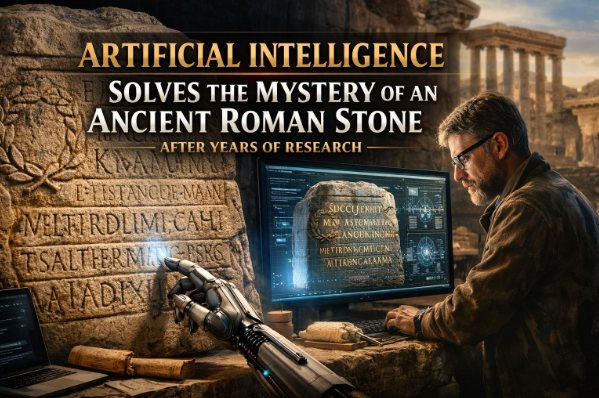
Artificial Intelligence Solves the Mystery of an Ancient Roman Stone After Years of Research
There are mysteries that feel almost designed to outlast us—messages chiseled into stone, carried through centuries of weather, war, and forgetfulness, waiting for someone to finally crack the code. Today’s story is exactly that kind of deliciously stubborn puzzle: an ancient Roman stone that resisted human interpretation for years has finally yielded its secrets, thanks to artificial intelligence. Not as a flashy “AI replaces archaeologists” headline, but as a gritty, methodical collaboration between historians, epigraphers, linguists, and machine learning systems that do what humans can’t easily do at scale: compare, infer, and test thousands of possibilities without getting tired or emotionally attached to a pet theory.
This is the kind of breakthrough that feels cinematic—until you look closely and realize it’s more like a long academic marathon where the final mile was run by an algorithm with a very good memory. And that’s precisely why it matters.
The Stone That Refused to Speak
The stone itself was never “mysterious” in a supernatural way. It was mysterious in the most frustrating scholarly sense: legible enough to tempt interpretation, damaged enough to sabotage certainty. Found years ago—documented, cataloged, photographed, and argued over—it carried an inscription that appeared Roman in style, but with missing letters, unusual spacing, and faint marks that might have been decorative, accidental, or a scribal quirk. Different experts produced different readings. Some insisted it was a dedication. Others leaned toward a funerary marker. A few proposed it recorded a legal decision, a land boundary, or a military posting.
None of these were irrational guesses. Roman epigraphy (the study of inscriptions) is a discipline built on patterns: formulaic phrases, standard abbreviations, naming conventions, and predictable structures. The Romans loved templates. But the problem with templates is that when a piece is broken, your mind auto-fills the blanks. Brilliant people can end up projecting different “likely” reconstructions onto the same damaged lines, and suddenly scholarship turns into a polite gladiator arena.
For years, researchers did what researchers do: they compared the inscription to similar stones, checked regional naming customs, debated whether a mark was a serif or a crack, and traced the letterforms to date the carving. They made progress, but not enough. The meaning stayed just out of reach—like a sentence overheard through a thick wall.
Why Ancient Roman Inscriptions Are So Hard to Decipher
To appreciate why AI made a difference, it helps to understand how many layers of uncertainty can stack up on a single ancient Roman artifact.
Physical damage and erosion: Many inscriptions are incomplete. Letters vanish. Edges break. Surfaces wear down.
Abbreviations and conventions: Romans compressed words aggressively. A few letters might represent an entire title, office, or phrase.
Local variation: Latin wasn’t a single uniform thing across the empire. Regional spelling and naming habits existed, especially in provincial contexts.
Time depth: Language evolves. Letterforms shift. The “style” of an inscription can hint at a century, but hints are not proof.
Context loss: Without knowing exactly where the stone stood originally—temple, roadside, cemetery, administrative building—interpretation becomes guesswork.
When humans interpret an inscription, they do something powerful and dangerous: they build a story that makes the fragment coherent. Most of the time, that’s how progress happens. Sometimes, that’s how scholars accidentally lock onto a wrong reconstruction and defend it for a decade.
AI, used properly, is a way to stop treating fragments like isolated riddles and start treating them like searchable data points in a vast network of known inscriptions.
The Turning Point: Artificial Intelligence Meets Roman Epigraphy
So what changed?
Not the existence of AI—researchers have been digitizing inscriptions for years. The change was the maturity of AI methods for language reconstruction, combined with access to large-scale digital corpora of Latin inscriptions, scanned squeezes (paper impressions), high-resolution photos, 3D surface models, and scholarly databases.
The core idea is simple: if you have enough examples of how Romans wrote names, dedications, official titles, and funerary phrases, then a system can learn the statistical “shape” of an inscription. When a line is broken or ambiguous, the model can propose reconstructions that are consistent with real historical usage, not just what a modern scholar feels is “likely.”
But the best systems did more than autocomplete Latin. They combined multiple streams of evidence:
Computer vision to detect faint letter traces and distinguish tool marks from damage.
Natural language processing (NLP) to model Latin grammar, epigraphic abbreviations, and formulaic structures.
Pattern matching and retrieval across databases to find near-parallel inscriptions.
Probabilistic ranking that assigns confidence scores to each possible reconstruction.
Human-in-the-loop validation where experts reject, refine, and re-run hypotheses.
This is not “AI magic.” It’s a disciplined pipeline that treats uncertainty like a measurable variable rather than a personal debate.
How the AI Actually “Solved” the Mystery
The most dramatic part of this story is that the AI didn’t deliver a single, divine answer from the clouds. It narrowed the chaos.
First, it stabilized the reading of the letters. Using enhanced imaging and surface analysis, the system flagged several marks that earlier teams dismissed as erosion—subtle grooves that aligned with known Roman letter strokes. That alone can flip an interpretation: one missing vertical line can turn an “I” into a “T,” or an “E” into an “F.” In epigraphy, a single letter is the difference between a dedication and a lawsuit.
Second, the model proposed multiple reconstructions for the missing sections, then compared them against patterns from thousands of inscriptions: how often certain titles appear together, how names cluster by region, what abbreviations follow what offices, which phrases appear in which centuries, and how line breaks typically behave. The system wasn’t guessing randomly; it was exploring a possibility space shaped by historical reality.
Third, it did something humans can’t easily do without weeks of manual searching: it pulled near-matches—inscriptions with parallel phrasing, similar names, or the same sequence of abbreviated titles. That’s where the mystery began to collapse. The stone wasn’t unique; it was a variant of a known administrative formula, with a local twist.
Finally, the research team treated AI output as a hypothesis generator, not a verdict. Epigraphers checked the letterforms. Historians checked the political context. Linguists checked whether the Latin was plausible. Archaeologists checked whether the proposed function matched the stone’s provenance and findspot evidence.
The “solution” emerged as consensus: a reconstruction that was simultaneously consistent with the physical traces, the language patterns, and the Roman administrative realities of the period.
That triangulation is the real triumph.
What the Stone Revealed About Ancient Rome
The content of the inscription—now readable in a coherent form—did more than satisfy curiosity. It added a new data point to our understanding of Roman life, and Roman life is rarely as simple as “emperors and armies.”
The stone appears to record an official act: a public acknowledgement tied to local governance, civic obligations, or a boundary-related decision—exactly the kind of mundane administrative detail that actually held the empire together. In other words, it wasn’t a poetic elegy. It was bureaucracy. Beautiful, terrifying bureaucracy carved into rock.
That matters because Roman history is often told from elite literature—senators writing speeches, historians crafting narratives, poets polishing metaphors. Inscriptions are different: they’re the empire speaking in its everyday voice. They reveal which offices existed locally, which families held influence, which veterans settled where, which gods were favored in a town, which trades funded public buildings, which rules were enforced, and which social identities people wanted memorialized.
When AI helps decode an inscription, it’s not just “solving a puzzle.” It’s expanding the dataset of reality.
And datasets are how we escape myth.
Why This Breakthrough Matters for Archaeology and Digital Humanities
This moment is bigger than one stone.
Archaeology is drowning in fragments: broken pottery, partial texts, weathered reliefs, incomplete archives. Human expertise remains irreplaceable—because interpretation requires context, judgment, and historical sensibility. But AI can act like a force multiplier, accelerating the slowest steps:
Deciphering damaged inscriptions by proposing ranked reconstructions
Linking artifacts to parallels across museums and databases
Detecting patterns in names, titles, and regional writing habits
Assisting dating through letterform analysis and formula frequency
Reducing interpretive bias by exposing alternative plausible readings
In the language of digital humanities, AI is shifting epigraphy from artisanal reconstruction to scalable inference—without eliminating the artisan. The human role becomes sharper: to ask better questions, verify better hypotheses, and integrate the result into historical understanding.
It’s also a reminder that “AI in archaeology” is not about replacing fieldwork with robots. It’s about giving scholars better tools to interrogate the evidence we already have—evidence that has been sitting quietly in archives, storerooms, and museum drawers, waiting for analysis.
The Human Side: Why Scholars Still Matter More Than the Model
There’s an easy narrative where AI is the hero and humans are the slow, stubborn old guard. Reality is less clickbait and more interesting.
AI models are astonishing at pattern recognition, but they don’t “understand” Rome the way scholars do. They don’t feel when a reconstruction clashes with known administrative reforms. They don’t notice when a proposed title didn’t exist in a certain province until later. They can be confidently wrong in ways that look persuasive, especially with fragmentary data.
The research team’s expertise was not optional. It was the safety system.
In a healthy workflow, AI provides candidate reconstructions and confidence scores, while experts:
validate the physical reading of letter traces,
cross-check grammar and epigraphic conventions,
evaluate historical plausibility,
and publish transparent reasoning so other scholars can replicate or dispute.
That transparency matters. A solved mystery is only useful if other researchers can test the solution.
What Comes Next: A New Era for Ancient Text Decipherment
Today’s “Roman stone solved by AI” is a preview of what the next few years will look like across ancient studies:
more automated reading of inscriptions and papyri,
better integration of 3D scanning and AI letter detection,
larger open corpora for Latin, Greek, and other ancient languages,
faster identification of parallels across collections worldwide,
and new discoveries that come from connecting fragments that were never compared before.
The really mind-bending implication is that we may already possess thousands of “unsolved” texts that become solvable once the right tools exist. Not because the past changed—because our methods finally caught up.
Ancient Rome left an enormous paper trail in stone. AI is becoming the flashlight that makes faint letters visible again.
Not a replacement for scholarship. A new kind of scholarly instrument.
And honestly, there’s something profoundly human about that: we build machines to extend our senses, so we can listen more carefully to voices that have been silent for two thousand years.
SEO Keywords Paragraph (for site discoverability)
Artificial intelligence in archaeology, AI deciphering ancient inscriptions, Roman inscription translation, ancient Roman stone mystery, machine learning epigraphy, digital humanities research, Latin inscription reconstruction, AI in historical research, archaeological technology, Roman artifacts analysis, computer vision epigraphy, natural language processing Latin, ancient text decipherment, Roman history discoveries, cultural heritage AI, AI-assisted archaeology, epigraphic database analysis, Roman stone inscription meaning, historical linguistics AI, heritage preservation technology.