
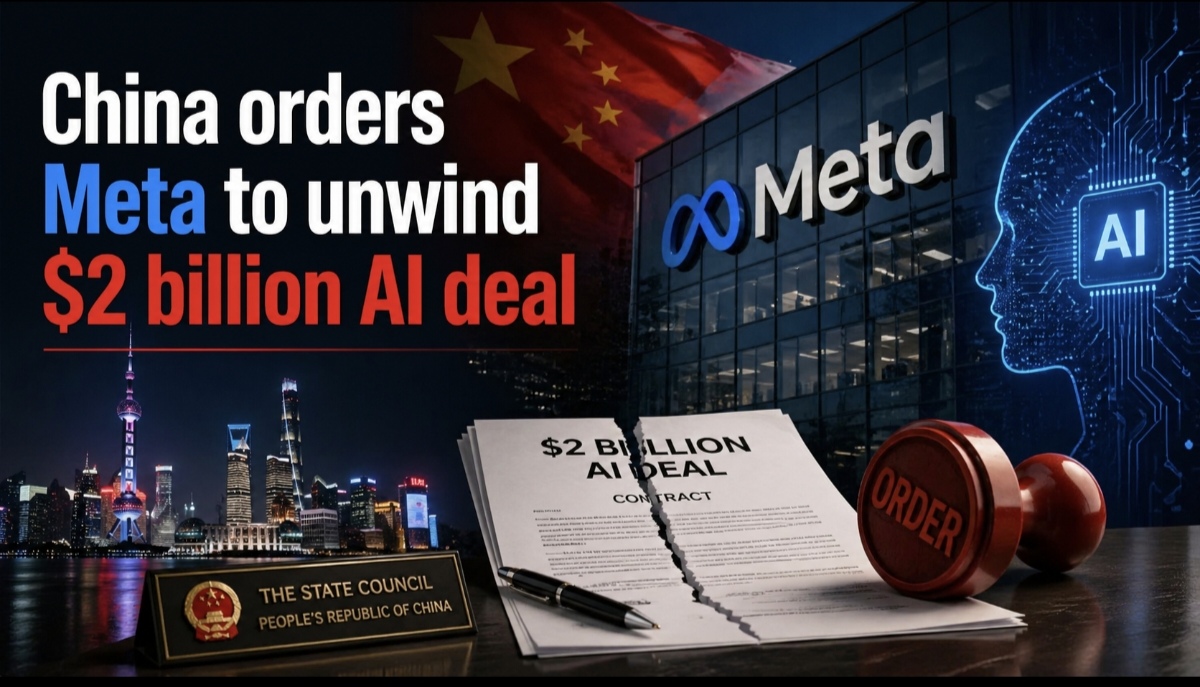
China Orders Meta to Unwind $2 Billion AI Deal: Why the Manus Reversal Matters Far Beyond One Acquisition
As of April 29, 2026, one of the most important stories in global technology is no longer just about who is building the best artificial intelligence tools. It is about who controls them, who gets to own them, and which government gets the final say when AI talent, intellectual property, data, and strategic know-how cross borders. China’s order forcing Meta to unwind its more than $2 billion acquisition of AI startup Manus has become a defining moment in the global AI race because it shows that frontier technology deals are now being judged not only by investors and founders, but by national security logic. Reuters reported that China’s National Development and Reform Commission, or NDRC, ordered the acquisition to be withdrawn under the country’s foreign investment security review system, even though Manus had already shifted operations to Singapore.
For Meta, the story is bigger than a failed merger. The company bought Manus to strengthen its position in AI agents, the fast-growing category of tools designed to complete complex tasks with minimal human intervention. In simple terms, Meta was not just buying another startup. It was trying to buy speed, talent, product capability, and a stronger position in the increasingly crowded race for agentic AI. Reuters reported that Manus had been promoted as a major AI innovator and that Meta saw the company as a way to deepen its own work on advanced AI agents. That makes this reversal especially painful, because in the AI economy, lost time can matter almost as much as lost capital.
What makes this episode so dramatic is that the transaction had already advanced well beyond the normal stage where regulators simply say yes or no. Reuters reported that China’s commerce ministry had opened a probe in January, shortly after Meta completed the acquisition, and that Beijing is now seeking to undo a transaction that was, in practical terms, already done. A separate Reuters report said Meta was preparing to reverse the deal and that Chinese authorities had reportedly given the companies several weeks to restore Manus’s Chinese assets and remove previously transferred data or technology. That is not standard regulatory friction. That is a message of state power.
The Manus case also matters because it challenges a strategy that many startups have treated as a workable path in politically sensitive sectors: move operations offshore, restructure ownership, raise international capital, and operate from a neutral hub such as Singapore. Reuters reported that after a funding round led by Benchmark in 2025, Manus shut its China offices, laid off employees, and moved operations to Singapore, with its parent re-incorporating there. But China’s response suggests that formal incorporation is no longer enough to settle the deeper question of who really owns the strategic value of a company. If the technology, the engineers, the founders, the research roots, or the data links remain closely tied to China, Beijing may still treat that company as a matter of Chinese national interest.
That is why this is not just a Meta story or a Manus story. It is a story about AI regulation in China, cross-border tech deals, foreign investment review, and the sharp escalation of U.S.-China tech rivalry. Reuters described the decision as a sign that Beijing is expanding the reach of its national security review regime over transactions involving Chinese-origin assets, shareholders, talent, or technology. Analysts quoted by Reuters said the move effectively draws a red line around Chinese AI talent and technology, particularly where American buyers are involved. AP similarly reported that China framed the step as a way to prevent foreign transfer of advanced technology. The signal to the market is unmistakable: the era of treating AI startup acquisitions as purely commercial events is over.
There is also a human layer to this story that makes it more than a boardroom dispute. Reuters reported that Manus co-founders Xiao Hong and Ji Yichao were summoned by regulators in March and later barred from leaving China, while some Manus staff had already moved into Meta’s Singapore offices and continued projects there. That detail changes the tone of the whole episode. It tells founders, engineers, and investors that AI regulation is no longer only about compliance checklists or legal memos. It can become personal, immediate, and operational. The modern AI startup does not just move code and capital across jurisdictions; it moves people, expertise, and institutional memory. Governments know that now, and they are acting accordingly.
From an SEO and digital publishing perspective, this is exactly why searches around China Meta AI deal, Meta Manus acquisition, AI startup acquisition, China AI regulation, cross-border technology deals, and U.S.-China tech war are likely to stay hot. The story connects several high-intent topics at once: Big Tech strategy, geopolitics, antitrust-style intervention, AI sovereignty, data security, and foreign investment risk. It has the ingredients that drive sustained organic traffic because readers are not just looking for a one-day headline. They are searching for context. They want to know what this means for Meta stock, for the future of AI agents, for startup exits, for Singapore’s role as a tech hub, and for the broader decoupling of American and Chinese innovation ecosystems. Reuters and other coverage indicate this case is already being treated as a major precedent rather than an isolated dispute.
The deeper commercial problem is that unwinding an AI acquisition is much harder than unwinding a conventional asset purchase. Lawyers quoted by Reuters said reversing a knowledge-intensive transaction could require undoing equity transfers, returning funds, deleting transferred code, data, or other intellectual property, and even pulling personnel back. But unlike a factory sale or a real estate deal, AI knowledge does not sit neatly in one place. Once engineers have collaborated, once models have been tested, once internal systems have been integrated, and once technical understanding has been absorbed by teams, the process becomes messy. One lawyer quoted by Reuters described these situations as a kind of “unscrambling the eggs” problem. That phrase captures the heart of the challenge: even if the paperwork can be reversed, the learning often cannot be cleanly erased.
For Meta, the strategic damage may lie in momentum loss. The company has been trying to prove that it can compete aggressively in the next phase of artificial intelligence, particularly in AI agents that can research, code, plan, and execute digital workflows. Reuters reported that Meta had been moving quickly in its search for AI targets and that due diligence on Manus lasted only a few weeks, suggesting urgency in Meta’s acquisition strategy. That urgency now looks risky. In a sector where competition moves at extraordinary speed, regulatory miscalculation can become a product problem. While Meta said the transaction complied with applicable law and that it expects an appropriate resolution, the episode raises hard questions about how global tech companies evaluate geopolitical exposure when buying AI firms with deep China roots.
For founders and venture capital firms, the warning may be even louder. Reuters reported that previous investors in Manus included Benchmark, Tencent, HSG, and ZhenFund, and that the structure of the deal plus the relocation to Singapore had been expected to create a path forward. Instead, the case may reset how investors think about AI startup exits involving Chinese talent or technology. If approvals from Beijing become a de facto closing condition for sensitive cross-border transactions, then valuations, timelines, and deal certainty all change. Investors may demand stronger operational separation, cleaner IP ownership, more transparent data governance, and clearer evidence that a company’s offshore structure is real rather than cosmetic. In practical terms, this could make fundraising harder, exits slower, and acquisitions more expensive across the AI sector.
Singapore also sits awkwardly at the center of this moment. For years, it has been seen as a sophisticated, rules-based base for Asian technology firms seeking access to global markets and international capital. But the Manus case suggests that geopolitical neutrality has limits when the core issue is not the mailing address of a holding company but the origin of the technology and the strategic significance of the expertise behind it. Reuters quoted legal and academic observers saying the case raises the compliance threshold for Chinese firms moving to Singapore and signals that companies may need to show a genuine operational shift, including where management sits, where IP is owned, where research and development occurs, and where data is stored. That could have ripple effects across regional startup formation and offshore structuring.
It is also impossible to separate this episode from the wider U.S.-China struggle over advanced technology. Washington has spent years tightening restrictions on China’s access to advanced chips and other strategic technologies, while Beijing has become increasingly determined to keep sensitive domestic capabilities from slipping into foreign hands. Reuters explicitly tied the Meta-Manus dispute to this broader contest, noting China’s commitment to stopping U.S. firms from acquiring Chinese AI talent and intellectual property while the United States seeks to limit Chinese access to top-end semiconductors. In that sense, this is not simply about one startup sale. It is a highly visible front in the battle over who will shape the next generation of AI infrastructure, products, talent pipelines, and global standards.
For readers, businesses, and publishers trying to understand where the AI market goes next, the most important takeaway is this: the future of artificial intelligence will not be decided by product innovation alone. It will be shaped by sovereignty, regulation, trust, jurisdiction, and the political boundaries around strategic technology. China’s order to unwind Meta’s $2 billion AI deal shows that in 2026, AI is being treated less like a normal software category and more like a national capability. That changes how companies buy, sell, build, partner, hire, and expand. It changes how investors price risk. And it changes how global audiences should read every major AI headline going forward. Today’s story is about Meta and Manus. Tomorrow’s story may involve a different company, a different jurisdiction, and a different regulatory tool. But the underlying lesson will likely be the same: in the age of AI, ownership is geopolitical.
SEO keyword paragraph: China orders Meta to unwind $2 billion AI deal, Meta Manus acquisition, Manus AI, China AI regulation, Meta AI agents, AI startup acquisition, cross-border tech deals, foreign investment security review, national security concerns, U.S.-China tech war, artificial intelligence regulation, AI talent transfer, strategic technology, data security, Singapore AI startup, Chinese AI startup, Meta acquisition news, frontier technology investment, agentic AI, AI industry analysis, global AI race, tech regulation China, foreign investment in China, Meta AI strategy, AI intellectual property, AI compliance risk, Chinese technology policy, international tech deals, AI market trends, AI governance.