
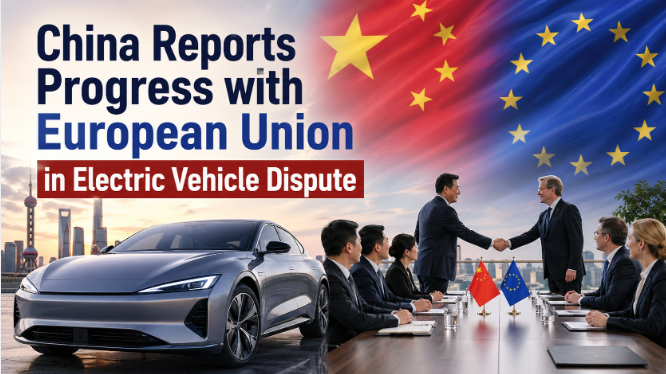
China Reports Progress with European Union in Electric Vehicle Dispute
The long-running China-EU electric vehicle dispute may finally be entering a more constructive phase, and that matters far beyond tariffs and trade lawyers. On April 28, 2026, China said it had made meaningful progress with the European Union over the conflict surrounding EU tariffs on Chinese-made electric vehicles, with Chinese Commerce Minister Wang Wentao describing the latest state of affairs as a “soft landing.” That phrase alone has attracted attention across the global EV market, because it suggests something more practical than a headline-grabbing confrontation: not a total victory for either side, but a workable path that could reduce friction, calm investors, and give automakers room to plan. Reuters reported that Wang made the remarks while meeting the head of Germany’s automotive industry association and again urged the EU to respect World Trade Organization rules, fair competition, and open trade principles. (Reuters)
To understand why this moment feels important, it helps to remember how intense the dispute became. The European Commission finalized its anti-subsidy investigation into battery electric vehicles from China on October 29, 2024, imposing definitive countervailing duties ranging from 7.8% to 35.3%, on top of the EU’s standard 10% car import duty. In practical terms, that pushed some total tariff burdens as high as 45.3%. The EU’s official position has been that Chinese EV supply chains benefited from unfair state support and posed a threat of economic injury to European producers. Official EU trade materials list company-specific rates including 17.0% for BYD, 18.8% for Geely, 35.3% for SAIC, 7.8% for Tesla’s Shanghai-made vehicles after individual examination, and 20.7% for other cooperating companies, with the measures set to last for five years. (Trade and Economic Security)
That original tariff decision did not happen in a vacuum. Europe’s concern was never just about one shipment of low-cost EVs arriving at a port. It was about industrial strategy, manufacturing resilience, green transition politics, and whether Europe could build a competitive electric vehicle industry without being overwhelmed by cheaper imports. Reuters reported at the time that Brussels argued China’s spare EV production capacity was roughly twice the size of the EU market, making Europe a natural destination for oversupply. From the EU’s perspective, this was a test case in trade defense, industrial policy, and the future of European car manufacturing. From China’s perspective, however, the measures looked protectionist, politically motivated, and contrary to the spirit of rules-based global trade. That gap in perception is what made the dispute so difficult to solve. (Reuters)
What makes the story on April 28, 2026 more interesting is that progress did not appear overnight. A real shift became visible in January 2026, when both sides moved toward a more structured framework for compromise. China’s Ministry of Commerce said the two sides had conducted multiple rounds of consultations in a spirit of mutual respect and that this progress reflected their ability and willingness to resolve differences through dialogue under WTO rules. On the same day, the European Commission issued a formal Guidance Document for Chinese exporters seeking to submit price undertaking offers. That guidance explained that the Commission would assess such offers objectively, fairly, on a non-discriminatory basis, and in line with WTO principles. It also clarified the kinds of commitments involved, including minimum import price, sales channels, cross-compensation, and even future investments in the EU. This was not the language of a frozen trade war. It was the language of a legal, technical, but very real negotiation track. (english.mofcom.gov.cn)
Then came the development that gave the market something concrete to evaluate. On February 10, 2026, the European Commission accepted its first price undertaking from a Chinese exporter of battery electric vehicles: Volkswagen (Anhui) for the CUPRA Tavascan. Under the deal, the China-made model could be exported into the EU at or above a minimum import price and would be exempt from the countervailing duties that would otherwise apply. The Commission said Volkswagen (Anhui) also agreed to limit import volumes and invest in significant BEV-related projects in the EU with clearly defined milestones. Reuters described the arrangement as a breakthrough because it showed that an alternative to blanket tariff payment was not just theoretical. It was operational. In trade policy terms, that was a major signal. In business terms, it told carmakers that the path to market access in Europe might now depend less on confrontation and more on structured compliance. (Trade and Economic Security)
That February deal also changed Beijing’s posture. Just two days later, Reuters reported that China had softened its stance and was willing to accept that Chinese EV makers could negotiate independently with the EU. Earlier, Beijing had preferred a more centralized approach and had urged Brussels not to hold separate talks with individual manufacturers. But after Volkswagen secured the Tavascan reprieve, China’s commerce ministry signaled that it hoped more Chinese companies would reach similar price commitment agreements with the European side. In other words, the dispute started to move from a broad geopolitical confrontation toward a more granular, model-by-model and company-by-company resolution process. That does not make the issue simple. It does, however, make it more manageable. (Reuters)
Seen through that lens, Wang Wentao’s “soft landing” language on April 28, 2026 makes sense. It follows months of technical consultation, a published EU guidance mechanism, one approved exemption, and a visible Chinese willingness to keep the negotiation channel open. It also follows another Reuters-reported meeting on April 24, 2026, when Wang met Ola Källenius, Mercedes-Benz chair and the head of the European Automobile Manufacturers’ Association, and said the trade tensions over EVs could be resolved. The messaging has been consistent: China wants European industry voices, especially major automakers and industry associations, to push Brussels toward a more commercially flexible outcome. The implication is clear. China sees the European auto industry not only as a stakeholder in the dispute, but as a possible bridge to its solution. (Reuters)
For Europe, the situation is more delicate than it may first appear. European policymakers cannot simply step back and say the problem is solved, because their original concern was structural. The Commission’s case rests on its finding that Chinese EV value chains benefited from subsidies that distorted competition. If Brussels loosens its approach too quickly, it risks criticism from domestic manufacturers, labor groups, and industrial strategists who believe Europe must defend its own EV supply chain, battery ecosystem, and automotive jobs. But if it remains too rigid, it risks raising prices for consumers, straining ties with European brands that manufacture in China, and complicating its own green transition by limiting access to competitively priced electric vehicles. The current path—allowing WTO-compatible, monitored undertakings—looks like an attempt to split the difference. (Trade and Economic Security)
For Chinese automakers, the latest progress is encouraging, but it is not a blank check. The Cupra Tavascan arrangement shows that Europe is open to alternatives, yet it also shows the conditions will be demanding. Minimum prices, volume caps, investment commitments, legal scrutiny, and ongoing compliance all add complexity. Reuters noted in February that analysts expected approvals for other automakers to take time and to be handled case by case. That means Chinese brands still face a difficult European market, even if the political tone has improved. They must now decide whether to absorb tariffs, apply for undertakings, localize more production in Europe, pivot harder into hybrids where relevant rules differ, or combine several strategies at once. In short, the China EV export strategy to Europe is evolving from pure scale and price competition into a more regulated game shaped by diplomacy and industrial policy. (Reuters)
Consumers, meanwhile, should pay close attention because this dispute influences more than trade headlines. It shapes the affordability and availability of electric cars in Europe, the pace of EV adoption, and the level of competitive pressure on legacy manufacturers. If negotiations continue to improve, European buyers could see a market where imported Chinese-made EVs remain present, but under more tightly controlled pricing and volume conditions. That may preserve competition without fully flooding the market. It may also create incentives for more investment inside Europe, which is exactly what Brussels wants. The Commission’s accepted undertaking with Volkswagen (Anhui) explicitly linked tariff relief not only to minimum pricing and import limits, but also to significant BEV-related investment projects in the EU. That kind of arrangement hints at a future where trade access and local industrial commitment become increasingly tied together. (Trade and Economic Security)
There is also an important legal and diplomatic layer to all of this. China has consistently framed the issue around WTO compliance and fair competition, and the WTO’s dispute docket shows that on November 4, 2024, China requested consultations with the EU over the definitive countervailing duties on electric vehicles from China. At the same time, both Beijing and Brussels have kept negotiating possible alternatives rather than relying only on litigation. That dual-track approach—legal challenge on one side, practical consultation on the other—is common in modern trade conflicts. It allows both parties to defend their principles publicly while still searching for business-friendly outcomes privately. In this case, the fact that official Chinese and EU statements both emphasize dialogue, objective criteria, and WTO rules suggests neither side wants the EV dispute to spiral into a full-blown economic rupture. (World Trade Organization)
Still, it would be premature to declare the dispute over. The phrase “soft landing” is encouraging, but it is not the same as a final settlement. The EU duties remain in place. Only one high-profile undertaking has been accepted so far. Other Chinese exporters may not be able—or willing—to meet the same conditions. Political pressure inside Europe remains strong, especially as Chinese brands continue pushing into the region with aggressive pricing and sharper product positioning. Reuters reported in April that Chinese EV makers have, in many cases, been able to absorb EU tariffs and still price vehicles below comparable European rivals. That reality is exactly why the issue will remain politically sensitive. Even if procedures become more flexible, the underlying competition challenge has not disappeared. (Reuters)
Even so, the progress reported on April 28, 2026 matters because it shows the dispute is no longer trapped in its most confrontational phase. Both China and the European Union appear to understand that the future of the electric vehicle market, clean transportation, and automotive supply chains is too important to be dictated by slogans alone. Europe wants to protect industrial capacity. China wants fairer market access. Automakers want certainty. Consumers want affordable EVs. Investors want predictability. The “soft landing” language captures the fact that all four interests are now pulling negotiators away from maximalism and toward managed coexistence. That may not satisfy the loudest voices on either side, but in trade policy, durable solutions are often built exactly that way.
For businesses, analysts, and readers following China-EU trade relations, the real takeaway is this: the next chapter of the electric vehicle dispute will likely be defined not by dramatic tariff announcements, but by the fine print of compliance. Watch for more price undertaking offers, more discussion about minimum import prices, more scrutiny of local investment commitments, and possibly more production localization inside Europe. If additional undertakings are approved, confidence will grow that the dispute is moving toward a stable framework. If talks stall, the old tensions will return quickly. For now, though, the latest signal from Beijing is more constructive than combative, and that alone makes April 28, 2026 an important date in the evolving story of the China-EU EV tariff dispute. (Reuters)
To strengthen SEO naturally, use and repeat relevant search phrases in moderation across your site, such as China Reports Progress with European Union in Electric Vehicle Dispute, China EU electric vehicle dispute, EU tariffs on Chinese EVs, China EV tariffs, Chinese electric vehicles in Europe, European Union EV trade dispute, battery electric vehicles from China, EU anti-subsidy investigation, China EU trade relations, electric vehicle tariffs, WTO rules and EV dispute, Chinese EV market in Europe, global EV market, European auto industry, EV supply chain, green mobility, affordable electric cars, price undertaking, minimum import price, and automotive trade policy.