
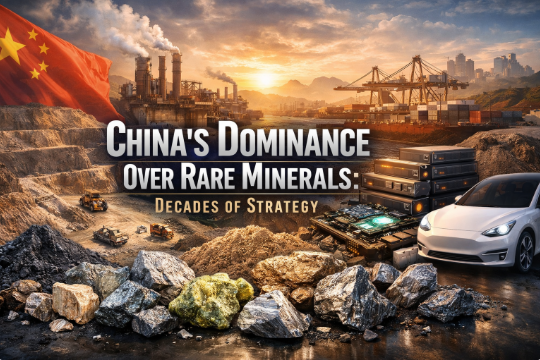
China’s dominance over rare minerals is the result of decades of strategy
When people talk about the technologies that define our era—electric vehicles, smartphones, wind turbines, precision-guided satellites—they usually celebrate the brilliant software, the elegant designs, or the visionary founders. The quiet truth is simpler and more elemental: the future is made of rocks. Not just any rocks, but a cluster of rare minerals and strategic metals—lithium, cobalt, nickel, graphite, manganese, gallium, germanium, tungsten, rare earth elements (REEs) like neodymium, praseodymium, dysprosium, and terbium—that power batteries, motors, chips, and advanced sensors. China’s dominance over these minerals didn’t appear overnight; it’s the outcome of a deliberate, multi-decade strategy that fused geology with geopolitics, industrial policy with patient capital, and gritty processing expertise with global deal-making. For companies, investors, and governments, understanding how we arrived here is step one. Step two is deciding what to do next.
A long game that began before it was fashionable
In the 1980s and 1990s, while many countries were happily outsourcing heavy industry and embracing “just-in-time” global supply chains, Chinese policymakers were laying down “just-in-case” foundations. They identified resource security as a national priority, particularly for inputs that would underpin next-generation manufacturing. Instead of chasing quick wins, they invested in geological surveys, mining education, metallurgical research institutes, and—crucially—the messy, expensive middle of the value chain known as beneficiation and refining.
That middle step is the least glamorous part of the minerals story. Mining gets the photos; refining gets the blisters. It requires chemical plants, complex separation processes, energy, water, and tight environmental controls to avoid toxic byproducts. Many advanced economies were happy to let someone else take on that burden. China made the opposite bet, seeing refining and processing capacity as a strategic chokepoint that would yield pricing power, know-how, and supply security for decades. The result: an ecosystem that could profitably process low-grade ore, scale quickly when demand spiked, and dictate global quality standards.
The “cluster effect” that compounds advantages
Dominance in minerals isn’t just about who holds the ore in the ground; it’s about who can turn it into puzzle-piece-perfect inputs for downstream manufacturers. China built dense industrial clusters—city-regions where miners, refiners, cathode and anode makers, magnet manufacturers, component suppliers, and end-product OEMs operate within truck-driving distance of each other. Cluster effects lower costs, accelerate learning, and shorten feedback loops. When a battery maker needs a tweak in the purity of lithium carbonate or a magnet producer wants a different grain size in NdFeB alloys, the change request can be implemented in weeks rather than months. That speed compounds into a durable competitive advantage.
This is also why China’s market share is strongest in the steps that sit between raw ore and finished technology: processing and intermediate components. For example, even when ore is mined elsewhere—lithium in South America or Australia, cobalt in the Democratic Republic of the Congo, nickel in Indonesia—the concentrate often ends up in Chinese facilities for conversion into battery-grade chemicals. Control of conversion equals control of cadence: who scales, how fast they scale, and at what price point.
Policy consistency and the “patient capital” mindset
Another feature of China’s rise in rare minerals is policy consistency across decades. While governments elsewhere cycled through energy priorities and industrial fads, Chinese plans repeatedly singled out advanced materials, critical minerals, and energy storage as strategic sectors. That messaging unlocked “patient capital”—financing that accepted thin margins today for dominant positions tomorrow. State-owned enterprises and policy banks took risks on long-lead projects, underwriting export credit, enabling discounted power tariffs for energy-hungry plants, and co-investing in overseas mines.
This approach delivered three benefits that compound over time:
Learning curves: The more material you process, the cheaper and cleaner you get at processing it. Learning by doing lowered costs and improved quality.
Standards setting: When you’re the main buyer and processor, you nudge global specifications toward what your plants can produce most efficiently.
Network effects: Suppliers, researchers, and technical talent concentrate around successful hubs, making it even harder to dislodge incumbents.
Vertical integration as a risk-shield
China’s companies pursued vertical integration that stretches from overseas mine stakes to domestic refining to component manufacturing and final products. This doesn’t mean every company does everything; it means the ecosystem can cover the full chain. In batteries, for instance, firms can source nickel matte from Indonesia, convert it into nickel sulfate at home, produce cathodes and anodes, assemble cells and packs, and sell them to domestic and foreign automakers. In permanent magnets, they can buy or import rare earth oxides, refine them into metals, manufacture magnet alloys and finished magnets, and integrate them into motors for wind turbines or EV drive units.
Vertical integration hedges against shocks. If the price of a particular input spikes, downstream affiliates can absorb temporary margin pressure without halting production. If a foreign government restricts exports of critical ore, domestic refiners still have material to run. Integrated chains also make it easier to innovate: metallurgists can collaborate directly with motor designers or battery chemists to tailor materials to next-generation specs.
Overseas partnerships and the “strings” in supply security
China’s dominance isn’t only built at home. It’s cemented by decades of relationship-building abroad. Chinese firms and policy banks financed mines and infrastructure across Africa, Latin America, and Southeast Asia, often bundling investments with roads, ports, and power plants. These deals sometimes faced criticism for debt terms or environmental impacts, but they reliably delivered one outcome: offtake agreements. Offtake deals lock in access to ores and concentrates at predictable prices, with volumes reserved for Chinese buyers. In a tight market, those contracts act like lifelines.
Consider cobalt: the Democratic Republic of the Congo holds the richest reserves, and Chinese companies have taken large stakes in some of its major mines. In nickel, partnerships in Indonesia rapidly scaled production of nickel intermediates suitable for battery materials. In lithium, long-term purchase agreements with Australian miners created reliable pipelines. Each partnership adds another thread to a web of supply security that is difficult for competitors to replicate quickly.
Technical mastery in refining—the hidden fortress
Mining headlines capture attention, but the real fortress is technical mastery in refining. Rare earth separation, for example, demands solvent extraction facilities with dozens, sometimes hundreds, of mixer-settlers operating with precise control over pH, temperature, and flow rates. Battery-grade lithium requires removal of trace impurities to parts-per-million levels that can cripple cell performance if not managed. High-purity manganese sulfate and nickel sulfate production must hit consistent crystal size distributions and contamination thresholds to avoid downstream yield loss.
This is tacit knowledge—hard to learn from a manual, built through years of iterations, and embedded in teams and equipment. China invested relentlessly in this tacit layer: vocational training, engineering programs, industry-university labs, and cross-pollination between processors and product designers. The result is not just capacity, but repeatable quality at scale, which translates into bankable supply contracts and dependable timelines for manufacturers.
Environmental and social considerations: the double-edged sword
No discussion of minerals is complete without acknowledging environmental and social impacts. Processing rare earths can produce radioactive tailings if not managed carefully. Nickel and cobalt mining can disrupt ecosystems and communities. Early waves of China’s industrialization sometimes prioritized speed over environmental restoration; in recent years, regulators have tightened enforcement, shuttered non-compliant plants, and pushed for cleaner processes. This introduced short-term constraints but spurred investment in waste treatment, recycling, and closed-loop systems.
On the global stage, China’s incumbency creates an opportunity to set best practices—if market incentives and policy goals align. Cleaner refining and more transparent supply chains can reduce risk for international buyers. Conversely, if environmental compliance tightens unevenly across countries, production could migrate to jurisdictions with weaker standards. Any durable strategy—by China or its competitors—must reconcile cost, sustainability, and community benefits.
The geopolitics of minerals: leverage, signaling, and mutual dependence
When a single country dominates processing of inputs that underpin clean energy, defense, and digital infrastructure, geopolitics follows. Export controls—on materials like graphite, gallium, or germanium—have become tools for signaling and leverage. They can recalibrate negotiations, remind counterparties of interdependence, or deter hostile policies. But blunt instruments cut both ways. Restricting exports can spur accelerated diversification elsewhere, ignite stockpiling frenzies, or depress long-term demand if buyers redesign around alternative chemistries.
The practical reality is mutual dependence. China benefits from steady access to overseas ore and healthy export markets for its processed materials. Importing nations benefit from competitively priced inputs and the ability to scale their energy and technology transitions quickly. The challenge is designing buffers—stockpiles, diversified supply chains, substitution research—so that political shocks don’t derail industrial plans.
The diversification push: real progress, slow clocks
In response to concentration risk, many countries are now mobilizing to diversify supply. New mines in Australia, Canada, and the United States; processing investments in Europe; and partnerships with resource-rich nations in Africa and Latin America are all ramping up. OEMs are experimenting with alternative battery chemistries—such as LFP (lithium iron phosphate), LMFP (manganese-doped LFP), high-manganese cathodes, and sodium-ion—to reduce reliance on constrained inputs like nickel and cobalt. Magnet makers are testing rare-earth-lean formulations or motor designs that minimize dysprosium use.
These efforts matter. They create redundancy, pressure-test logistics, and force continuous innovation. But geology and industrial base building obey slow clocks. Permitting timelines stretch for years. Building a new separation plant requires skilled teams, qualified suppliers, and customers willing to qualify new inputs. Even with policy incentives, it takes time to erode a lead built over decades. A realistic view recognizes both truths: diversification can and should proceed, and China’s central role will remain significant for the foreseeable future.
Recycling and circularity: the third supply pillar
Primary mining will stay essential, yet a major share of future supply can be met through recycling. End-of-life batteries contain lithium, nickel, cobalt, manganese, and copper at concentrations far higher than most ores. Wind turbine generators and EV motors contain valuable rare earth magnets. China has moved quickly here too, nurturing a domestic battery recycling industry that collects production scrap (“black mass”) and end-of-life cells, processing them into high-purity precursors. Closing the loop reduces import dependencies, cuts environmental burdens, and stabilizes prices.
For countries aiming to catch up, investing in recycling has two advantages: shorter lead times than new mines and alignment with climate and circular economy goals. The bottleneck is logistics—collecting, transporting, and safely processing diverse battery formats—and qualification, since recycled materials must meet the same stringent specs as virgin inputs.
Price cycles and the stability premium
Critical minerals markets are famously cyclical. When demand spikes, prices surge; investment floods in; supply overshoots; prices crash. Companies with deep balance sheets, flexible plants, and diversified customer bases can ride these waves. China’s integrated ecosystem has repeatedly demonstrated the ability to maintain production through downturns, secure long-term offtakes during booms, and steadily ratchet quality while lowering cost. That stability is valuable to downstream industries that plan multiyear product roadmaps and can’t afford raw-material roulette.
For buyers outside China, price volatility underscores the value of supply agreements that balance security and flexibility: multi-year contracts with volume bands, price floors and ceilings, and indexation to input costs. It also reinforces the importance of transparent benchmarks. As new hubs emerge, credible price discovery for lithium, nickel sulfate, and rare earth oxides will help smooth planning and financing.
What businesses can do now
If you’re an automaker, wind-turbine manufacturer, electronics company, or grid-scale storage developer, minerals strategy is now core strategy. A few pragmatic moves help:
Map your chain in painful detail. Know the mine, the refiner, the converter, and the specific plant that makes your intermediate materials. Track their energy sources, water availability, and regulatory exposure.
Qualify a second source—then actually buy from them. Paper optionality isn’t real optionality. Split volumes, even if it costs a little more initially, to keep alternative suppliers healthy.
Design for substitution and recycling. Select chemistries that can pivot if a particular input becomes constrained. Engineer products to simplify disassembly and material recovery at end of life.
Engage on standards and sustainability. Work with suppliers on traceability, emissions accounting, and waste management. High standards can be a competitive moat and a hedge against policy shocks.
Build buffers intelligently. Instead of hoarding everything, maintain rolling stockpiles of the specific intermediates that are hardest to replace, and use financial hedges for the rest.
What policymakers can learn from China’s playbook
The question for governments isn’t “How do we copy-paste China?” It’s “What elements of long-horizon policy make sense in our context?” A few stand out:
Invest in the middle of the chain. Mines are vital, but processing and component manufacturing determine who captures value and sets standards.
Enable patient capital. Blended finance, loan guarantees, and predictable permitting can de-risk projects that would otherwise stall in the “valley of death.”
Back talent pipelines. Metallurgy, chemical engineering, geology, and operations are the backbone skills. Scholarships, apprenticeships, and research centers pay dividends for decades.
Coordinate, don’t micromanage. Set clear goals, remove blockers, and let firms compete. Aim for clusters that concentrate capabilities while maintaining strong environmental enforcement.
Champion transparency. Public data on reserves, processing capacity, emissions, and waste flows helps markets function and reduces rumor-driven volatility.
The road ahead: strategy meets chemistry
China’s leadership in rare minerals is the product of deliberate strategy, accumulated competence, and relentless iteration. It reflects a belief—borne out by results—that controlling chokepoints in materials and processing confers durable power in high-tech manufacturing. Competitors face a long climb, but not an impossible one. The energy transition and digital economy are expanding the pie. There is room for multiple hubs—regional centers of excellence that specialize in different parts of the chain, collaborate on standards, and compete on cost, quality, and sustainability.
For businesses and governments, the most useful stance is simultaneously pragmatic and ambitious: shore up today’s supply while building tomorrow’s resilience. That means contracts and stockpiles, yes; but also recycling plants, substitution R&D, talent development, and patient infrastructure investment. The clock is measured in years, not weeks, which is exactly why action today matters.
In the end, the future still runs on rocks. The winners will be those who treat minerals not as commodities to be taken for granted, but as strategic assets to be cultivated—patiently, scientifically, and with a clear view of how chemistry shapes geopolitics. China played that game early and well. The rest of the world is finally joining the board.
Key takeaways for readers and decision-makers
China’s dominance is rooted in decades of consistent policy, large-scale investment in refining and processing, and vertically integrated supply chains.
The cluster effect—dense local ecosystems connecting miners, refiners, component makers, and OEMs—creates speed and cost advantages that are hard to copy quickly.
Overseas investments and offtake agreements lock in access to ore, while technical mastery in purification and separation builds a durable moat.
Diversification is accelerating worldwide, but timelines are long. Recycling and substitution can narrow gaps faster than new mines alone.
Smart strategies blend short-term resilience (stockpiles, hedges, dual sourcing) with long-term capacity (processing plants, talent pipelines, standards, sustainability).
What to watch in 2026
Permitting reform and project timelines in the United States, Europe, Australia, and Canada that could unlock new refining capacity.
Battery chemistry shifts—LFP, LMFP, sodium-ion—that change demand for specific minerals and rebalance market power.
Recycling scale-up as end-of-life EV batteries begin arriving in larger volumes and black-mass processing improves.
Export control dynamics around inputs like graphite, gallium, and germanium that influence pricing, inventories, and substitution.
Corporate offtake strategies as OEMs move from announcements to binding multi-year contracts with clear sustainability clauses.
SEO Keywords (single paragraph)
China rare minerals strategy, China dominance in critical minerals, rare earth elements supply chain, battery materials refining, lithium nickel cobalt manganese supply, graphite anode market, neodymium praseodymium dysprosium magnets, EV battery materials China, gallium germanium export controls, tungsten and manganese processing, cobalt supply chain DRC partnerships, nickel matte Indonesia batteries, lithium carbonate hydroxide battery grade, REE separation refining China, critical minerals geopolitics, clean energy supply chain security, battery recycling black mass, vertical integration mining to magnets, industrial policy patient capital, minerals processing cluster effect, supply diversification strategies, LFP LMFP sodium-ion batteries, ESG in mining and refining, offtake agreements long-term contracts, strategic metals pricing trends, global refining capacity 2026, sustainable battery materials, circular economy critical minerals, export restrictions graphite, semiconductor materials gallium germanium, magnet metals NdFeB, energy transition metals demand.