
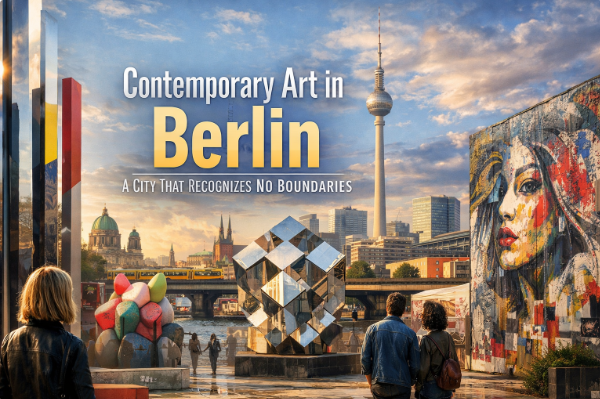
Contemporary Art in Berlin: A City That Recognizes No Boundaries
Berlin doesn’t just “have” contemporary art—it breathes it, argues with it, remixes it, and then pins it to the wall next to a flyer for a basement techno night. This city is famously allergic to neat categories, and nowhere is that more obvious than in its contemporary art scene. Here, art refuses to behave: it spills out of galleries, colonizes abandoned factories, rides the U-Bahn as posters and performances, and pops up in courtyards where you’d swear nothing “cultural” should logically happen. Berlin is a city that recognizes no boundaries—between high and low culture, between studio and street, between local and global, between art and activism. And that boundarylessness is precisely why artists, collectors, curators, and curious travelers keep returning.
To understand contemporary art in Berlin, you have to understand Berlin itself: a city built from layers of reinvention. The capital’s history is not a quiet museum label—it’s an active ingredient. The Cold War, the Wall, reunification, decades of migration, and an ongoing tension between radical creativity and rapid urban development shape what artists make and how audiences read it. In Berlin, the past is never fully “over,” and the future is always under construction. That creates the perfect habitat for experimental art, conceptual work, politically engaged practice, and new media art that feels plugged into the nervous system of the city.
A City of Studios, Squats, and Sharp Ideas
Berlin earned its reputation as an artist haven through a potent combination: space (for a while), affordability (for a while), and a culture that tolerates—sometimes even celebrates—risk. Even as rents have risen and gentrification pushes creatives outward, Berlin’s artistic ecosystem stays weirdly resilient. The reason isn’t just economics. It’s also psychological and social: Berlin offers permission. Permission to make something unfinished. Permission to fail publicly. Permission to invent a new language of form without needing to smooth it into market-friendly polish. That’s why emerging artists in Berlin often experiment with hybrid formats—video installations that behave like diaries, sound art that functions like architecture, performance art that looks like protest, sculpture that feels like a tool for survival.
Berlin’s contemporary art culture is also deeply communal. Openings here are less like exclusive events and more like social laboratories. You’ll find curators talking to students, collectors wandering into off-spaces, and artists exchanging contacts with musicians, coders, and designers. This cross-pollination matters because Berlin is not a city where art sits politely in a corner; it interacts with nightlife, publishing, architecture, fashion, and tech. That’s how you get exhibitions that feel like temporary worlds rather than mere displays. It’s also why Berlin keeps producing new art spaces: artist-run initiatives, pop-up galleries, project rooms, studio collectives, and temporary exhibitions in places that don’t look like they should host art at all.
Galleries and Institutions: The Backbone of the Scene
Berlin’s major museums and contemporary art institutions provide gravity to a scene that might otherwise float into pure chaos. They anchor artistic discourse, support research-based practices, and offer the kind of long-term visibility that artists need. But what makes Berlin special is that institutions don’t “own” the story. They’re important, yes—but they share the stage with a dense network of galleries and independent spaces that constantly challenge the center.
This is one of the city’s greatest strengths: the range. If you’re interested in painting, Berlin has serious contemporary painters pushing color, abstraction, figuration, and material experimentation. If you’re drawn to conceptual art, Berlin practically speaks that language as a native tongue. If you care about photography, post-photography, and image politics, Berlin is a rich terrain. If you want installation art, Berlin gives you scale—rooms you can walk into and feel your sense of reality tilt. And if you’re hunting new media art, VR exhibitions, AI-influenced aesthetics, interactive design, and digital art, Berlin’s creative technology culture makes those practices feel at home.
Berlin galleries are often internationally connected, which makes the city a major node in the global art market while still keeping an underground pulse. The result: you can spend one afternoon moving between polished exhibitions in established gallery districts and raw, experimental shows in small project spaces. And both can feel equally essential—because Berlin doesn’t believe in a single “correct” version of contemporary art.
Neighborhoods as Art Maps: Where Creativity Clusters
Berlin’s art geography is almost a living organism. Different neighborhoods act like different organs in the same body: each has its own rhythm, mood, and artistic identity.
Mitte often reads as the “classic” gallery zone—central, historically dense, and full of contemporary art galleries with international programs. It’s a place where collectors, curators, and cultural tourists often begin. But don’t mistake central for conservative: Mitte can be sharp, conceptual, and deeply current.
Kreuzberg has long carried Berlin’s rebellious heart. It’s where you feel the city’s political edge and multicultural reality in the same breath. Street art in Berlin isn’t just decoration here; it’s a visual language of dissent, identity, humor, and critique. Kreuzberg also hosts spaces that embrace socially engaged art, performance, and cross-disciplinary experimentation.
Neukölln is a place where emerging artists and new galleries have shaped an energetic art ecosystem. It’s known for its open studio culture, artist-run initiatives, and exhibitions that feel intimate but ambitious. It’s also a neighborhood where the conversation about gentrification, migration, and cultural identity is not abstract—it’s lived.
Prenzlauer Berg and Friedrichshain contribute their own mixes—studios, alternative spaces, and a shifting cultural fabric that reflects Berlin’s ongoing transformation. Meanwhile, Wedding has increasingly become a magnet for studios and independent art spaces, partly because artists follow the same logic as water: they flow toward available space.
The key thing: in Berlin, the city itself is part of the exhibition. You don’t just “visit” contemporary art; you move through an urban artwork made of history, ideology, architecture, music, languages, and contradictions.
Off-Spaces and the Spirit of Experimentation
If Berlin has a superpower, it’s the off-space culture. Off-spaces—independent, often artist-run project spaces—are where Berlin’s most experimental contemporary art tends to flourish. These spaces operate with fewer rules, smaller budgets, and bigger nerves. They can be ephemeral by design, popping up for a season and disappearing before the city can label them.
This matters for the health of the art scene. Off-spaces create room for artists who aren’t yet absorbed into the commercial gallery system. They give emerging curators a place to test ideas. They offer a platform for political art, identity-based practice, conceptual performance, and installations that don’t translate neatly into “sellable objects.” They also keep Berlin from becoming a sterile art brand. Even as the art market grows, the off-space ecosystem continues to act as a counterbalance—an immune system that fights against blandness.
And it’s not only about rebellion. Off-spaces also help build community. They’re where collaborations begin, where artists meet audiences directly, and where art can feel less like a commodity and more like a conversation. In a city that recognizes no boundaries, off-spaces are the borderless frontier.
Street Art, Public Space, and the City as Canvas
Berlin street art is not an accessory. It’s a central thread in the city’s visual culture. Murals, stencils, posters, tags, and paste-ups turn everyday streets into a constantly updated gallery. Berlin’s public art culture invites debate: who owns the city’s surfaces, who gets to speak, and what counts as “legitimate” art?
This tension is part of Berlin’s identity. Contemporary art in Berlin frequently engages with public space, urban policy, memory, surveillance, and resistance. The city’s walls have always been political—literally during the era of division, and metaphorically today as neighborhoods change under economic pressure. That’s why political art here often feels less like a theoretical pose and more like a social necessity.
Berlin also hosts public installations and performances that blur the line between spectator and participant. You might encounter a sound piece in an unexpected location or a performance that looks like everyday life until it suddenly doesn’t. This is where Berlin’s boundaryless ethos becomes physical: art is not confined to a white cube; it collides with daily reality.
Performance, Conceptual Art, and the Berlin Mindset
Berlin has a special affection for conceptual art—work that prioritizes ideas, systems, and meanings over purely aesthetic pleasure. That doesn’t mean Berlin art is cold or academic. It means it’s often ambitious, investigative, and unafraid of discomfort. Conceptual practices here tackle power, identity, labor, ecology, sexuality, technology, and historical trauma. They ask what images do, what language hides, what institutions control, and what futures we’re building.
Performance art thrives in this environment because Berlin already has a strong culture of experimentation in music, theater, and nightlife. Many contemporary artists work across disciplines: performance merges with video installation, choreography merges with sound art, and sculpture merges with social practice. The result is a scene where exhibitions can feel like living events rather than static displays.
Berlin’s contemporary art also has a talent for irony—sharp, playful, and often dark. The city’s humor tends to be skeptical of grand claims. That skepticism acts like a filter: only the most honest, strange, or compelling work tends to survive the local conversation. Pretension is a fragile creature here.
Digital Art, New Media, and Berlin’s Tech-Creative Fusion
Berlin is also a stronghold for new media art and digital culture. As technology shapes how we live—through algorithms, platforms, AI systems, and constant connectivity—Berlin artists are digging into these structures like archaeologists of the present. Digital art in Berlin often examines surveillance, data extraction, online identity, synthetic imagery, and the psychological effects of screens. You’ll see works using interactive installations, generative visuals, VR experiences, and hybrid exhibitions that combine physical and digital space.
This is one of the most exciting directions in contemporary Berlin art: the city’s creative communities overlap. Tech workers attend gallery openings. Artists collaborate with coders. Designers move between product work and installation projects. Sound artists build instruments, then build exhibitions around them. Berlin’s “no boundaries” reputation becomes a practical advantage here—because new media art is inherently interdisciplinary.
Art Fairs, Biennials, and the Global Spotlight
Berlin’s art scene isn’t isolated; it’s plugged into international networks. Art fairs, biennials, and major exhibitions draw global attention and shape the city’s cultural calendar. These events can be polarizing—some see them as commercialization, others as opportunities for visibility and funding. In Berlin, you’ll hear both arguments in the same conversation, sometimes from the same person.
What’s consistent is that these large-scale events tend to amplify Berlin’s strengths: experimentation, political engagement, and a willingness to question the art world itself. Even when the market enters the room, Berlin tends to keep a foot in the doorway to the outside—where artists are still building work with little concern for what sells.
The Collector, the Traveler, and the Local: Who Is Berlin Art For?
One of Berlin’s strangest gifts is that contemporary art can be deeply serious while still accessible. You don’t need a PhD in art theory to enjoy the scene—curiosity is enough. Many galleries are free to enter, and openings are often open to all. That democratic openness attracts travelers who want an authentic cultural experience beyond the typical tourist checklist. It also draws collectors looking for emerging contemporary artists and galleries with strong curatorial vision.
At the same time, Berlin’s art scene belongs to locals in a way that feels genuine. It’s woven into daily life, not segregated into a cultural district behind velvet ropes. Artists live here, argue here, make here, and exhibit here—often in the same neighborhoods where people buy groceries and walk dogs. That coexistence is part of Berlin’s magic.
Boundaries Berlin Refuses: Identity, Migration, and Global Dialogue
Berlin’s contemporary art is also shaped by migration and multicultural reality. Many artists living and working in Berlin come from across Europe, the Middle East, Africa, the Americas, and Asia. This isn’t just diversity as a buzzword; it’s a genuine mixing of perspectives, languages, and histories. Berlin’s art often grapples with belonging, displacement, citizenship, and memory. It’s a city where diaspora narratives and postcolonial critique sit beside experiments in abstraction and material form.
Because of this, Berlin becomes a global conversation space. It’s not only about “German contemporary art”—it’s about contemporary art in Berlin, a city that functions like a cultural crossroads. That distinction matters. Berlin hosts collisions: between aesthetics and politics, between tradition and radical reinvention, between personal narrative and collective history. And out of those collisions comes work that feels alive.
Why Berlin Still Matters for Contemporary Art
Plenty of cities have great galleries. Plenty have museums, fairs, and collectors. Berlin’s difference is its relationship to freedom—messy, contested, and real. The city recognizes no boundaries, but it also forces you to notice where boundaries still exist: in housing, in funding, in cultural gatekeeping, in institutional power. Berlin’s contemporary art scene doesn’t pretend those contradictions aren’t there. It makes them visible, plays with them, and sometimes fights them.
That’s why visiting Berlin for contemporary art can feel like more than cultural consumption. It can feel like stepping into an ongoing debate about what art is for—beauty, critique, healing, disruption, pleasure, truth-telling, community building, future design. Berlin allows all of these purposes to exist side by side, sometimes harmoniously, sometimes in tension. And that tension is productive. It’s the electricity in the air at an opening. It’s the reason you walk out of an exhibition and keep thinking about it hours later.
Berlin is not a city that offers a single narrative. It offers a framework: experiment relentlessly, question authority, collaborate wildly, and don’t apologize for complexity. Contemporary art in Berlin is a mirror of that framework. It refuses boundaries because Berlin itself refuses to settle.
SEO keyword paragraph (high-ranking keyword cluster):
Contemporary art in Berlin thrives through cutting-edge galleries, experimental exhibitions, and a vibrant creative scene spanning Berlin museums, independent art spaces, and iconic street art. Explore Berlin contemporary art galleries in Mitte, Kreuzberg, and Neukölln, discover emerging artists in Berlin, and experience conceptual art, installation art, performance art, and digital art across the city’s top cultural hotspots. From Berlin art events and curator-led shows to urban art culture and new media art, Berlin remains a leading destination for modern art lovers, art collectors, and cultural travelers seeking the best contemporary art exhibitions in Berlin.