
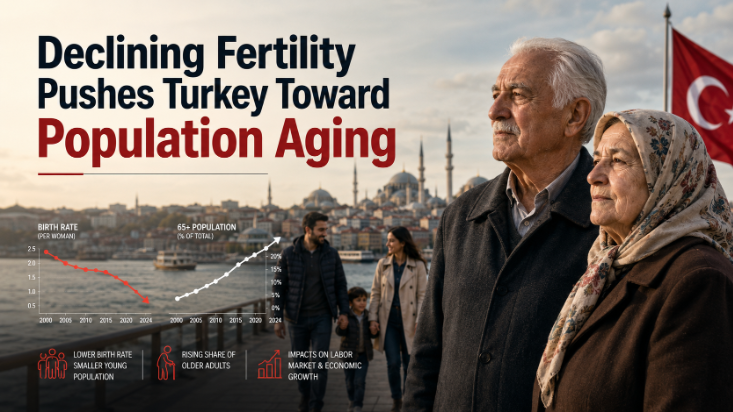
Declining Fertility Pushes Turkey Toward Population Aging
Turkey is entering a new demographic chapter. For decades, the country was often described as young, dynamic, and demographically energetic — a bridge between Europe’s aging societies and the younger populations of the Middle East. But that image is changing quickly. Declining fertility, delayed marriage, rising living costs, urban pressure, and changing family expectations are pushing Türkiye toward a future in which older citizens make up a much larger share of the population.
The numbers tell a clear story. Türkiye’s total fertility rate fell to 1.48 children per woman in 2024, far below the replacement level of around 2.1 children per woman. Official figures also show that fertility is lower in dense urban areas, with 1.39 children per woman in densely populated areas, compared with 1.83 in rural areas. (Turkish Statistical Institute) This means the fertility decline is not only national; it is also deeply linked to the way modern Turkish families live, work, rent homes, build careers, and plan their futures.
At the same time, the elderly population is growing. In 2025, people aged 65 and older reached 9,583,059, rising from 7,953,555 in 2020. Their share of the population increased from 9.5% to 11.1% in just five years, while the old-age dependency ratio rose to 16.2%. (Turkish Minute) In simple terms, Turkey now has fewer babies being born and more people living into older age. That combination is the foundation of population aging.
For many Turkish families, this trend is not an abstract statistic. It is visible in daily life. Young couples delay marriage because housing is expensive. Parents think twice before having a second or third child because education, healthcare, childcare, and basic living costs have become heavier burdens. Women are more educated and more active in the workforce, but many still face a difficult choice between career progression and motherhood. Families that once expected three or four children now often plan for one child — or none at all.
This does not mean Turkish society has stopped valuing family. On the contrary, family remains central to social identity, care, support, and belonging. But the economics of family life have changed. A child today requires not only emotional commitment, but also financial stability, housing security, time, childcare, and confidence in the future. When that confidence weakens, birth rates fall.
The fertility decline is especially important because Turkey’s economic model has long benefited from a large working-age population. A young population supports growth by expanding the labor force, increasing consumption, strengthening the tax base, and reducing pressure on pensions. But when fertility remains low for many years, the population structure gradually shifts. The number of children falls first. Then schools, universities, and labor markets begin to feel the change. Later, the pension system, healthcare sector, and elderly care services come under pressure.
That is why population aging is not only a social issue. It is also an economic issue. Fewer young workers can mean slower labor-force growth, tighter public finances, higher pension costs, and greater demand for healthcare. Older societies can still be prosperous, innovative, and productive, but they must plan earlier and invest more intelligently in productivity, technology, healthcare, and social support.
Turkey’s transition is happening faster than many people expected. According to projections cited from TurkStat data, the share of people aged 65 and older could reach 13.5% in 2030, 17.9% in 2040, and 27% by 2060 under the main scenario. (Turkish Minute) That means today’s demographic shift is not temporary. It is a long-term structural transformation.
One of the most sensitive parts of this transformation is the dependency ratio. The old-age dependency ratio measures how many elderly people there are for every 100 working-age people. When this ratio rises, each worker indirectly supports more retirees through taxes, social security contributions, family care, and public spending. Turkey’s old-age dependency ratio increased from 14.1% in 2020 to 16.2% in 2025, and projections suggest it could reach 26.5% in 2040 and 45.5% by 2060. (Turkish Minute)
For policymakers, this creates a difficult balancing act. The country must support young families today while preparing for a much older society tomorrow. Cash payments for childbirth can help, but they are rarely enough on their own. International experience shows that fertility policy works best when it combines affordable housing, accessible childcare, flexible work, parental leave, job security, women’s employment support, and confidence in economic stability.
The Turkish government has already recognized the seriousness of the issue. In 2025, Ankara declared the “Year of the Family” and announced incentives to address declining birth rates. Reuters reported that increased maternity and child allowances were part of a package expected to add significant public spending, while officials framed the measures as a response to falling fertility. (Reuters) In May 2026, President Recep Tayyip Erdoğan also introduced a 2026–2035 Family and Population 10-Year Vision, identifying fertility decline, rising marriage age, divorce, youth development, elderly welfare, and rural population balance as major priorities. (Hürriyet Daily News)
However, the challenge is deeper than incentives. If young people cannot afford rent, if childcare is limited, if working mothers fear losing career opportunities, or if families feel insecure about the economy, small payments alone will not reverse the trend. Fertility decisions are personal, emotional, and economic at the same time. They are shaped by trust — trust in income, trust in housing, trust in schools, trust in healthcare, trust in work-life balance, and trust in the future.
Urbanization is another major factor. In Istanbul, Ankara, Izmir, and other large cities, daily life is expensive and competitive. Long commutes, apartment living, high rents, and demanding jobs make larger families harder to manage. TurkStat data show that fertility is lowest in densely populated areas, which confirms the link between urban living and smaller family size. (Turkish Statistical Institute) This matters because Turkey is now overwhelmingly urban, and urban family behavior increasingly defines national fertility trends.
There is also a cultural shift. Younger generations often want to finish education, establish careers, travel, save money, buy property, and achieve personal stability before having children. This does not necessarily mean they reject family. It means the timeline of family formation has moved later. Demographers call this “postponement.” When people delay marriage and childbirth, the annual fertility rate falls, even if some people still have children later. But if postponement continues too long, delayed births can become missed births.
The decline also varies by region. Turkey’s southeastern provinces have historically had higher fertility rates, while western and urbanized provinces tend to have lower rates. Over time, however, the national trend is moving downward. This creates a demographic map with different realities: some provinces still have young populations, while others are already experiencing aging, outmigration, and shrinking household sizes. Regional policy will therefore matter. Rural development, local employment, and balanced investment could help reduce population concentration in expensive metropolitan areas.
Population aging will also reshape Turkey’s consumer economy. A country with more elderly citizens needs more healthcare services, assisted living options, home-care solutions, age-friendly housing, medical technology, pension planning, insurance products, and accessible transportation. This creates pressure, but also opportunity. The “silver economy” can become a major sector if Turkey prepares properly. Businesses that understand aging consumers early may find new markets in wellness, pharmaceuticals, mobility, nutrition, financial services, and elderly care.
Healthcare will be at the center of the transition. Older populations tend to require more treatment for chronic diseases such as diabetes, heart disease, cancer, dementia, and mobility-related conditions. Turkey has invested heavily in healthcare infrastructure over the past two decades, but population aging will require a stronger focus on prevention, long-term care, geriatric medicine, home-based care, and digital health monitoring. Hospitals alone cannot carry the full burden of an aging society.
Families will also feel the pressure. Traditionally, elderly care in Turkey has often been handled within the family. But smaller families mean fewer adult children to care for aging parents. More women working outside the home also means fewer unpaid caregivers available full-time. As household sizes shrink, the state and private sector will likely need to expand formal elderly care services. This is not only a policy challenge; it is a cultural adjustment.
The labor market will need adaptation too. If the working-age population grows more slowly, Turkey will need higher productivity from each worker. That means better education, more advanced skills, technology adoption, automation, and stronger female labor-force participation. Encouraging more births may be one part of the solution, but it will not produce workers overnight. A baby born in 2026 will not enter the labor market until the 2040s. Therefore, Turkey must act on two fronts: support families now and improve productivity immediately.
Migration may also become part of the demographic conversation. Many aging countries use immigration to support labor supply, but migration policy is politically sensitive and socially complex. Turkey already hosts large migrant and refugee populations, and public debate around migration is intense. A successful demographic strategy would need to balance labor-market needs, social cohesion, integration, and national priorities.
The key point is that declining fertility is not a single-issue problem. It is connected to housing, inflation, education, childcare, gender equality, employment, healthcare, pensions, urban planning, migration, and national development. Treating fertility as only a matter of family values misses the broader picture. Families do not make decisions in a vacuum. They respond to the environment around them.
Turkey still has advantages. It remains younger than many European countries. Its median age is lower than much of the European Union. It has a large domestic market, strong family networks, developed cities, expanding infrastructure, and a population that is still large enough to support growth if productivity rises. But the window for easy demographic advantage is narrowing. The country must prepare before aging becomes more expensive and harder to manage.
The lesson from other aging societies is clear: waiting is costly. Japan, South Korea, Italy, Germany, and many Eastern European countries show how difficult it is to reverse fertility decline once low birth rates become socially and economically entrenched. Turkey is not yet in the same position, but it is moving in that direction. The decisions made in the next decade will shape the country’s demographic future for the rest of the century.
A successful response must respect personal choice while making family life easier. Young people should not feel forced to have children. They should feel able to have children if they want them. That means affordable homes, stable jobs, safe childcare, flexible working conditions, better parental leave, stronger support for mothers and fathers, and a social environment where raising children does not feel like an impossible financial risk.
Declining fertility is often described as a crisis, but it can also be seen as a warning signal. It tells policymakers that young adults are under pressure. It tells businesses that the future consumer base is changing. It tells healthcare systems to prepare for older patients. It tells cities to become more livable for families and more accessible for seniors. It tells society that the balance between generations is shifting.
By 12 May 2026, the message is clear: Turkey’s population is still large, still active, and still younger than many developed countries, but its demographic direction has changed. Fewer births and longer lives are pushing the country toward population aging. Whether this becomes a burden or a manageable transition depends on how quickly Turkey responds — not only with slogans and short-term incentives, but with long-term reforms that make family life, work, housing, and aging more secure.
Turkey’s demographic future will not be decided by fertility statistics alone. It will be decided in homes, workplaces, schools, hospitals, city halls, and government ministries. The fertility decline is the signal. Population aging is the consequence. The real question is whether Turkey can build a society where young people feel confident enough to start families and older citizens can age with dignity, security, and care.
SEO Keywords: Turkey fertility rate, Türkiye fertility decline, declining birth rate in Turkey, Turkey population aging, Türkiye aging population, Turkish demographic crisis, low fertility in Turkey, Turkey birth rate 2026, population aging in Türkiye, elderly population Turkey, Turkey demographic transition, replacement fertility rate Turkey, Turkey family policy, Turkey population forecast, aging society Turkey, Turkish economy and demographics, Turkey old-age dependency ratio, fertility decline causes, urbanization and fertility Turkey, Turkey 2026 demographic trends.