
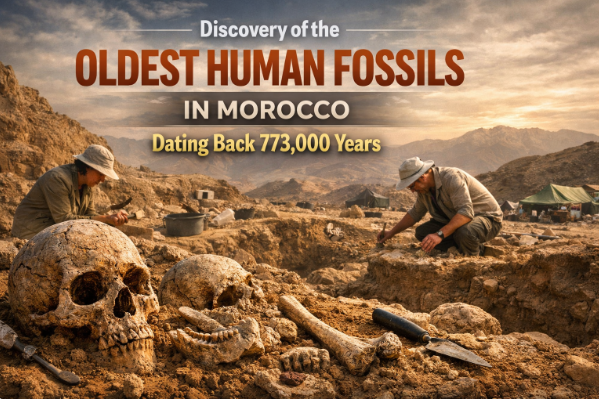
Discovery of the Oldest Human Fossils in Morocco Dating Back 773,000 Years
Sometimes the past doesn’t whisper—it barges in, covered in dust, carrying a jawbone, and demanding you redraw the family tree.
Early in 2026, researchers working in Casablanca, Morocco, reported hominin (human-lineage) fossils dated to roughly 773,000 years ago—a number so big it makes your brain reach for a chair. These remains, found at Thomas Quarry I in a cave deposit often described as the “Grotte à Hominidés” (Cave of Hominids), are being discussed as a potential window into a population near the shared ancestry of Homo sapiens, Neanderthals, and Denisovans. In other words: not necessarily “us,” not exactly “them,” but maybe something close to the branching point where several human lineages diverged. That’s why this discovery is triggering genuine excitement across paleoanthropology, human origins research, and African archaeology. (Nature)
This matters because the human fossil record has an infamous “gap zone” in Africa—especially between about 1 million and 600,000 years ago—where evidence is patchy, scattered, and often frustratingly hard to interpret. These Moroccan fossils appear to land right in that gap, potentially anchoring a key chapter in Middle Pleistocene human evolution. (Reuters)
Where the fossils were found: Casablanca’s deep-time archives
When people think “human evolution,” they often picture East Africa’s Rift Valley. That focus isn’t random—East Africa has delivered a spectacular record of early hominins and stone tools. But Morocco has been quietly building a reputation as one of the most consequential regions for understanding the long arc of human history. (Remember Jebel Irhoud, where fossils dated to about 315,000 years pushed early Homo sapiens much farther back than many expected? (Wikipedia))
The Casablanca fossil site adds a different kind of power: it reaches much deeper into time. Thomas Quarry I sits in a region shaped by coastal geology, dune systems, caves, and sediment layers that can preserve bones, tools, and the ecological fingerprints of ancient lives. What makes this setting especially compelling is that it doesn’t just preserve fossils—it preserves context: sediments, associated fauna, and technological traces that help reconstruct behavior and environment.
Reports describe remains from at least two adults and a toddler, including jaw fragments, teeth, and other bones, alongside stone tools and animal remains. There’s also evidence suggesting predators like hyenas interacted with the bodies—an unsettling but important detail, because it tells us these were living landscapes with real ecological pressure, not museum dioramas. (Reuters)
The date: why “773,000 years” is unusually convincing
Dating deep-time fossils is hard. Dating them precisely is harder. And dating them in a way that convinces skeptical experts across multiple subfields? That’s the boss level.
In this case, researchers used magnetostratigraphy, a method that reads the “magnetic signature” locked into sediment layers. Earth’s magnetic field has flipped many times in the past (magnetic reversals), and those reversals can be globally correlated. The Moroccan cave sediments reportedly align near the Matuyama–Brunhes reversal, a well-known magnetic boundary around 773,000 years ago, providing a strong chronological anchor. This is one reason the date is being treated as a serious and high-confidence estimate rather than a casual headline number. (Max Planck Society)
If you’re not used to geology-brain: imagine each sediment layer as a page in a book, except some pages are stamped with Earth’s ancient magnetic direction. When you find the page where the stamp flips, you can often match it to a known global event. That’s the basic logic—simple in concept, extremely technical in execution.
What exactly was discovered: not “oldest Homo sapiens,” but potentially something more intriguing
Let’s be precise, because human-evolution headlines love to sprint ahead of the evidence.
These fossils are being discussed as possibly belonging to an archaic human population that shows a blend of primitive and more derived traits—features that don’t slot neatly into a single familiar label like “Homo erectus” or “Homo sapiens.” Some coverage frames them as an evolved form of Homo erectus or a closely related African lineage that sits near the root of later groups. (Reuters)
That distinction matters for SEO, yes—but more importantly it matters for truth. The famous Moroccan “oldest Homo sapiens” story is Jebel Irhoud (~315,000 years). This new Casablanca story is different: it’s far older, and it’s more about ancestry and divergence than about “our species” in the strict sense. (Wikipedia)
A useful way to picture it: if Homo sapiens, Neanderthals, and Denisovans are three major branches, the Thomas Quarry I fossils might be close to the thick part of the trunk before the branches fully separate—or perhaps a branch very near that trunk. Researchers themselves appear cautious: fossils can resemble “ancestral” forms without being direct ancestors, and evolution is rarely a neat single-file line. (Reuters)
Why Morocco keeps showing up in the human origins conversation
Morocco sits at a geographic crossroads: Africa, the Mediterranean, and—via the Strait of Gibraltar—a tantalizing closeness to Iberia. This matters because there are fossil and archaeological sites in Spain (for example, Atapuerca) that represent important early European populations. Some reporting notes morphological or conceptual comparisons with European fossils such as Homo antecessor (though comparisons don’t automatically mean direct relationships). (Reuters)
The larger story is that North Africa is increasingly hard to ignore in models of human evolution. Not as a side-stage, but as a region that may have hosted key populations during pivotal windows—especially in the Middle Pleistocene, when climatic shifts repeatedly transformed habitats, migration routes, and survival strategies.
This is also where the modern view of human origins gets more interesting (and more realistic): instead of a single “Garden of Eden” location, many researchers talk about pan-African evolution—the idea that multiple interconnected populations across Africa contributed to what became Homo sapiens. Older discoveries like Jebel Irhoud already pushed strongly in this direction; the Casablanca fossils add weight by showing that North Africa may have been hosting crucial lineages much earlier than many textbooks used to imply. (Nature)
The tools and the world they lived in: survival, technology, predators
Fossils are bodies. Archaeology is behavior.
One of the most compelling aspects of the Thomas Quarry I narrative is that the remains are associated with stone tools and animal fossils, suggesting a richer reconstruction of daily life. Toolkits from this era can reveal whether hominins were using simple core-and-flake technologies, how they processed animals, and what ecological niches they occupied. Even without turning this into a speculative movie trailer, the presence of tools in the same stratigraphic context anchors these individuals as active agents in their environment.
Then there’s the predator angle: evidence that hyenas (and likely other carnivores) scavenged or interacted with bodies is not just “grim trivia.” It helps reconstruct risk, mortality, and cave usage. Caves can be homes, shelters, temporary refuges—or predator dens. A cave deposit that includes both hominin remains and carnivore signatures can encode a complex story about competition for space and the thin boundary between survival and becoming part of the food web. (ScienceDaily)
The evolutionary stakes: the “last common ancestor” question
The phrase “last common ancestor” is scientifically loaded. It sounds like a single individual. In reality, it usually means a population—a genetically diverse group spread over time and space. Fossils don’t announce “Hello, I am the LCA (Last Common Ancestor).” Researchers infer relationships from anatomy, geology, and increasingly from molecular proxies like ancient proteins when DNA is too degraded.
Still, the reason this discovery is turning heads is that it may represent one of the best candidates yet for a population close to the split leading to Homo sapiens and to later Eurasian archaic humans (Neanderthals and Denisovans). That’s a major claim, and responsible scientists tend to phrase it carefully: “close to,” “near the root,” “plausibly related,” rather than “proven direct ancestor.” (Live Science)
This is where the discovery becomes more than a cool fact. If these Moroccan fossils really do sit near that branching point, they could reshape timelines of when key lineages diverged, and they could shift attention toward Africa—especially North Africa—as the setting for evolutionary transitions that were previously modeled with a heavier Eurasian emphasis.
How this changes the big story of human evolution (without turning it into nonsense)
Human evolution is not a ladder. It’s a braided river: channels diverge, reconnect, dry up, and reappear. Fossil discoveries like this don’t “solve” the puzzle so much as force us to replace an overly simple puzzle with a more accurate (and more complicated) one.
Here’s what the Thomas Quarry I fossils most plausibly do, based on current reporting:
They fill a critical African fossil gap between ~1,000,000 and ~600,000 years ago, especially for North Africa. (Reuters)
They strengthen the case that Africa hosted deep ancestral lineages relevant to later Homo sapiens, Neanderthals, and Denisovans—rather than those relationships being primarily inferred from Eurasian fossils. (Nature)
They emphasize Morocco as a repeat hotspot for rewriting the human origins narrative (from Jebel Irhoud to Casablanca). (Wikipedia)
They highlight the power of modern dating techniques like magnetostratigraphy to pin fossils to globally meaningful time markers. (ScienceDaily)
What they do not do (yet): give us a clean species label everyone agrees on, or a definitive “this is the ancestor” stamp. Paleoanthropology is allergic to certainty for good reason: a single jaw fragment can be anatomically ambiguous, populations vary, and convergent evolution can produce similar traits in different lineages. The scientific method here is slow, cautious, and—when it’s working—deliberately resistant to hype.
Why this discovery is a magnet for public interest (and why that’s not a bad thing)
People love origin stories. It’s a human thing. We ask: Where did we come from? and How far back does “we” go?
A 773,000-year-old Moroccan fossil pushes those questions into a timescale where imagination starts to wobble. Casablanca today is a modern, bustling city; Casablanca then was a very different ecological world—coastal landscapes, shifting dunes, dangerous animals, and small groups of hominins making tools and trying not to die. That collision between the familiar and the unimaginably ancient is exactly why these stories spread.
From a science communication perspective, this discovery is also a good moment to remind readers: “human” is not a single species across time. It’s a family of related populations, with experiments in anatomy and behavior playing out over hundreds of thousands of years.
If you run a website about archaeology, anthropology, history, or science news, this is the kind of topic that attracts a wide audience because it hits multiple high-interest areas at once: oldest fossils, human ancestry, Africa, new Nature paper, breakthrough dating, and the evergreen fascination with our deep past. (Nature)
Looking ahead: what researchers will try next
The next phase will likely involve deeper morphological analysis, broader comparison with African and Eurasian fossil samples, and continued work on the site’s stratigraphy and associated tool industries. Some coverage mentions the possibility of using palaeoproteomics (ancient proteins) to clarify evolutionary relationships when DNA is unavailable—an increasingly important approach for fossils this old. (Live Science)
Expect the story to sharpen over time: today it’s “near the root,” tomorrow it might be “this lineage is closer to X than Y,” and later it may become part of a more detailed map of Middle Pleistocene population structure in Africa. Science rarely gives you a single thunderclap; it gives you a sequence of better approximations.
Final keyword paragraph (SEO-focused)
Oldest human fossils in Morocco, 773,000-year-old human fossils, Casablanca Morocco fossils, Thomas Quarry I Cave of Hominids, Grotte à Hominidés discovery, ancient hominin remains Morocco, human evolution timeline, Homo sapiens ancestor, last common ancestor of humans and Neanderthals, Denisovan ancestry, Middle Pleistocene archaeology, North Africa human origins, magnetostratigraphy dating method, Matuyama–Brunhes reversal fossils, paleoanthropology discovery 2026, Moroccan archaeology breakthroughs, early human stone tools Morocco, African fossil record gap, prehistoric Morocco cave site, Nature human evolution study.