
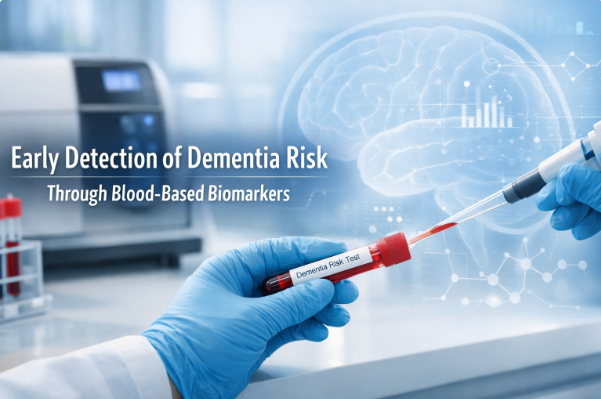
Early Detection of Dementia Risk Through Blood-Based Biomarkers
On March 25, 2026, one of the most important conversations in brain health is no longer just about treating dementia after symptoms become severe. It is about finding risk earlier, understanding what is happening in the brain sooner, and giving patients and families more time to act. That is why blood-based biomarkers for dementia risk have become such a major breakthrough. For years, diagnosing Alzheimer’s disease and related cognitive disorders often meant long waits, specialist referrals, spinal fluid testing, or expensive PET brain scans. Now, a simple blood draw is beginning to change that path. In 2025, the FDA cleared the first blood test to aid in diagnosing Alzheimer’s disease, and the Alzheimer’s Association released its first clinical practice guideline for using blood-based biomarker tests in specialty memory care. That combination of science, regulation, and clinical guidance marks a real turning point in early dementia detection. (U.S. Food and Drug Administration)
What makes this shift so powerful is not only the technology, but the human impact. Memory loss, confusion, word-finding trouble, and changes in judgment can be frightening for patients and families. Too often, people live in uncertainty for months or years, unsure whether they are seeing normal aging, mild cognitive impairment, Alzheimer’s disease, or another cause of cognitive decline. Blood biomarkers for Alzheimer’s disease are helping shorten that period of uncertainty. They do not replace a clinician’s evaluation, and they are not magic screening tools for everyone, but they can make the diagnostic journey faster, less invasive, and more accessible when used appropriately. (U.S. Food and Drug Administration)
To understand why this matters, it helps to understand what a biomarker actually is. A biomarker is a measurable biological signal that reflects a process happening in the body. In dementia care, researchers are especially interested in biomarkers linked to Alzheimer’s disease pathology, including amyloid beta, tau, neurodegeneration, and neuroinflammation. When abnormal proteins begin to build up in the brain, traces of those changes can sometimes be detected in the blood. That means doctors may be able to gather meaningful information about brain disease without immediately relying on a spinal tap or amyloid PET scan. The science is strongest today for Alzheimer’s pathology, which is why many blood tests marketed around dementia risk are really most useful for identifying whether Alzheimer’s-related biological changes are likely to be present. (U.S. Food and Drug Administration)
Among the most talked-about blood biomarkers, p-tau217 has emerged as a standout. The National Institute on Aging reported in 2025 that p-tau217-based blood testing accurately detected Alzheimer’s pathology across disease stages, including before symptoms began, and performed comparably to spinal fluid biomarkers while outperforming brain imaging in that study context. That matters because p-tau217 is closely linked to the tau changes that are central to Alzheimer’s disease. In practical terms, this biomarker is helping move the field from symptom-based guesswork toward more precise biological detection. (National Institute on Aging)
Another important biomarker is p-tau181, which has also shown strong value in clinical assessment. In October 2025, the FDA cleared Roche’s Elecsys Phospho-Tau (181P) Plasma assay as an aid in the initial assessment of adults aged 55 and older with signs, symptoms, or complaints of cognitive decline. The FDA summary states that a negative result is consistent with a negative amyloid PET scan and a reduced likelihood that the person’s cognitive impairment is due to amyloid pathology. At the same time, the same document is explicit that the test is not established for predicting the future development of dementia and should be interpreted together with other clinical information. That is an important distinction for SEO phrases like dementia risk blood test and early Alzheimer’s blood test: these tools are promising, but they are still part of a broader workup, not a crystal ball.
Researchers are also watching amyloid beta 42/40 ratio, GFAP (glial fibrillary acidic protein), and NfL (neurofilament light chain). Amyloid beta biomarkers aim to reflect plaque buildup, GFAP is associated with astrocyte activation and brain response to injury, and NfL is a broader marker of neuronal damage. In a 2025 Nature Medicine study that followed dementia-free older adults in the community for up to 16 years, elevated baseline levels of p-tau181, p-tau217, NfL, and GFAP were associated with higher risk of future all-cause and Alzheimer’s dementia. The same study found negative predictive values above 90% and showed that combining biomarkers, such as p-tau217 with NfL or GFAP, improved prediction. But the researchers also cautioned that these blood biomarkers were not yet suitable as screening tools for cognitively unimpaired older adults in community settings. (Nature)
That caution is exactly why the latest guidelines matter so much. In July 2025, the Alzheimer’s Association released its first clinical practice guideline for blood-based biomarkers in specialty care. The guideline focuses on people with objective cognitive impairment being seen in specialized memory settings, not the general public. It recommends that blood-based biomarker tests with at least 90% sensitivity and 75% specificity can be used as a triage tool, where a negative result helps rule out Alzheimer’s pathology with high probability. It also states that tests with at least 90% sensitivity and 90% specificity may serve as substitutes for amyloid PET or cerebrospinal fluid biomarker testing. Just as importantly, the guideline warns that many commercially available tests do not meet those thresholds and that no blood biomarker test should be ordered before a comprehensive clinical evaluation. (AAIC 2026)
This is where a more human conversation is needed. People hear “blood test for dementia” and may imagine a simple yes-or-no answer. The real picture is more nuanced. A good clinician still asks about memory, language, planning, mood, daily functioning, medications, sleep, depression, vascular risk, and family history. They may still order cognitive testing, MRI, or additional biomarker studies. Blood-based biomarkers are best understood as a powerful new lens, not the whole diagnosis. That nuance matters for patients because a false positive can create anxiety and unnecessary treatment decisions, while a false negative can delay the right answer. The FDA specifically notes those risks for the first cleared Alzheimer’s blood test and states that it is not intended as a screening or stand-alone diagnostic test. (U.S. Food and Drug Administration)
Still, the upside is enormous. First, blood testing is less invasive. A blood draw is far easier for many patients than a lumbar puncture, and it is generally simpler to scale than PET imaging. Second, it may improve access. Many people first mention memory concerns in primary care, not in an academic memory clinic. The older diagnostic pathway often created bottlenecks that slowed referrals, delayed treatment discussions, and kept patients from qualifying for clinical trials. NIA highlighted in 2024 that an Alzheimer’s blood test using p-tau217 and amyloid measures predicted diagnosis with 88% to 92% accuracy, while standard clinical evaluations without biomarker testing were much less accurate in both specialty and primary care settings. (National Institute on Aging)
Third, earlier biological insight creates more room for planning. That does not just mean medication decisions. It can mean addressing sleep apnea, blood pressure, diabetes, hearing loss, depression, and social isolation. It can mean legal and financial planning while a person still has strong decision-making capacity. It can mean honest family conversations before a crisis. And when Alzheimer’s pathology is identified earlier, clinicians may be better positioned to discuss treatment eligibility, monitoring, and the likely trajectory of disease. The emotional value of clarity should not be underestimated. For many families, not knowing is its own form of suffering. (National Institute on Aging)
There is also a larger public health story behind all this. Dementia is rising as populations age, and health systems need ways to identify risk more efficiently and equitably. Blood-based biomarkers offer the possibility of lower-cost, broader-access tools that could reduce disparities created by geography, specialist shortages, and the high cost of advanced imaging. But equity is not automatic. The Alzheimer’s Association guideline explicitly notes that tests are not interchangeable and that many have not been validated broadly across different patient populations and clinical settings. If implementation moves faster than validation, some communities could still be left with less accurate answers. In other words, precision medicine for dementia has to be both scientifically rigorous and socially fair. (AAIC 2026)
Another important point is that dementia risk is bigger than Alzheimer’s disease alone. Alzheimer’s is the most common cause of dementia, but not the only one. Lewy body dementia, frontotemporal dementia, vascular cognitive impairment, mixed dementia, and LATE all add complexity to the diagnostic picture. Today’s blood biomarker advances are most mature for identifying Alzheimer’s-related amyloid and tau pathology. That is a huge achievement, but it does not mean a single blood test can cleanly sort every cause of memory loss. In fact, the NIA has emphasized the continuing need for more sensitive biomarkers for related dementias and for tools that work across diverse populations. (National Institute on Aging)
So what does this mean for readers searching terms like early signs of dementia, Alzheimer’s blood test, mild cognitive impairment diagnosis, or memory loss blood biomarker? It means the field is real, clinically relevant, and moving fast. As of March 25, 2026, blood-based biomarkers are no longer just research headlines. They are entering real-world care pathways. The FDA cleared the first blood test to aid in diagnosing Alzheimer’s disease in May 2025, and by October 2025 another FDA-cleared p-tau181 assay had entered the diagnostic pathway for initial assessment in symptomatic adults. At the same time, professional guidance now gives clinicians a framework for when and how these tests should be used responsibly. (U.S. Food and Drug Administration)
The future is likely to be even more sophisticated. Researchers are refining multi-marker panels, dual-threshold approaches, and combinations of blood tests with digital cognitive tools, genetics, and imaging. Community-based studies suggest these biomarkers may eventually help identify who is at lower near-term risk, who needs closer monitoring, and who may benefit from targeted therapy or trial enrollment. But the strongest current message is balance: excitement without hype, innovation without oversimplification. These tests are opening doors, not ending the conversation. (Nature)
For patients and families, that balance can be reassuring. We are moving into an era where early detection of dementia risk through blood-based biomarkers may help people get answers sooner, start the right conversations earlier, and access better-informed care. That is not the same as promising certainty, and it is not the same as population-wide screening for everyone with no symptoms. But it is a meaningful step toward earlier, kinder, and more precise dementia care. In the world of brain health, that is a breakthrough worth paying attention to. (U.S. Food and Drug Administration)
SEO keyword paragraph: Early detection of dementia risk, blood-based biomarkers, Alzheimer’s disease blood test, dementia blood test, p-tau217, p-tau181, amyloid beta blood test, GFAP biomarker, neurofilament light chain, mild cognitive impairment, cognitive decline, memory loss, early signs of dementia, early Alzheimer’s diagnosis, brain health, neurodegenerative disease, dementia screening, Alzheimer’s biomarkers, blood biomarkers for Alzheimer’s disease, dementia diagnosis, precision medicine, preventive neurology, cognitive health, dementia prevention, memory clinic evaluation, amyloid pathology, tau pathology, dementia risk assessment, older adult brain health, and accessible Alzheimer’s testing are the key search phrases this topic naturally targets when optimized for SEO.