
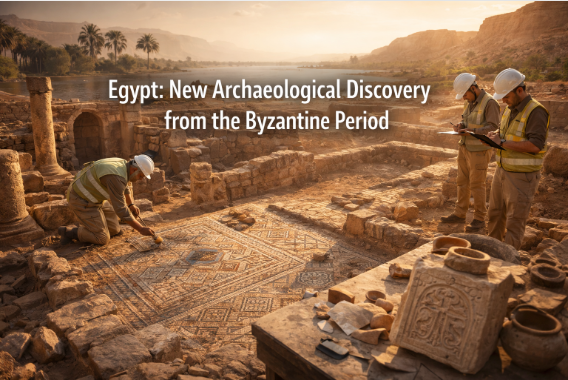
Egypt: New Archaeological Discovery from the Byzantine Period
On April 5, 2026, interest in Egypt archaeological discovery news is once again surging, and for good reason. One of the newest and most fascinating finds linked to Byzantine Egypt is a fifth-century Coptic monastic guesthouse uncovered in Beheira Governorate at the Al-Qalaye site in Hosh Issa. Far from being just another ruin in the desert, this discovery opens a rare window into the daily rhythm of early Christian monasticism in Egypt, revealing how prayer, hospitality, teaching, and community life were woven together in the Byzantine period. For readers who follow ancient Egypt news, Egypt archaeology 2026, and the evolution of Coptic heritage, this discovery is compelling because it does not only add another pin to the archaeological map. It tells a human story about movement, faith, service, and the building of organized religious life in one of the world’s most historically layered civilizations. (Ahram Online)
What makes this new archaeological discovery in Egypt especially powerful is its blend of intimacy and scale. Archaeologists say the newly uncovered structure likely served as a monastic guesthouse, a place where visitors could be received during the formative years of Coptic monastic life. That alone is striking. When many people imagine ancient religious communities, they picture silence, isolation, and retreat. But the Beheira discovery shows something more dynamic: a monastic world that was open enough to welcome travelers, organized enough to teach, and sophisticated enough to build a purpose-designed hospitality space. In other words, this was not only a spiritual refuge. It was part of a functioning network of people, ideas, devotion, and daily survival. That gives the find enormous value for anyone interested in Byzantine archaeology, Christian archaeology in Egypt, and the roots of communal religious life. (Ahram Online)
According to the reported excavation details, the building contains 13 multi-purpose rooms, including spaces used for individual and shared living, along with larger halls for hospitality and teaching. Archaeologists also identified service areas such as kitchens and storage facilities, showing that the site was designed to support real day-to-day activity rather than ceremonial use alone. In the northern section of the structure, the team uncovered a large reception hall with stone benches decorated with plant motifs, while the center of the complex includes a designated prayer space marked by an east-facing niche and a limestone cross. These details matter because they transform the discovery from an abstract headline into something vivid and concrete. You can suddenly picture monks receiving visitors, offering instruction, sharing meals, and moving from work to worship under the same roof. That is the kind of detail that makes Egyptian archaeology feel alive to modern readers. (Ahram Online)
The artistry discovered at the site is just as exciting as the architecture. Excavators reported wall paintings showing monastic figures identified by their garments, along with decorative motifs in red, white, and black. One painted scene includes two gazelles surrounded by vegetal decoration and a double circular motif, while other elements feature braided patterns and floral designs. These are not small details for art historians or cultural researchers. They help connect the find to the wider world of early Coptic art, where symbolic imagery, simplified forms, and plant-based ornament helped create a distinct visual language. The building also yielded a marble column, capitals and bases, pottery vessels, ceramic fragments with plant and geometric decoration, and items bearing Coptic inscriptions. Even remains of bird and animal bones and seashells were found, offering clues about diet and daily life. Together, these discoveries make the Beheira site one of the most textured and human archaeological stories in Egypt this year. (Ahram Online)
One of the most moving aspects of the discovery is a limestone funerary slab inscribed in Coptic, believed to mention a person identified in preliminary readings as “Apa Kyr, son of Shenouda.” Names like this change the emotional temperature of archaeology. Instead of speaking only about periods and structures, the site begins to whisper about individuals. Someone lived here, prayed here, died here, and was remembered here. That is why discoveries from the Byzantine period in Egypt continue to resonate so deeply. They are not just about chronology or architectural typology. They are about recovering fragments of forgotten lives. For readers searching terms such as Coptic inscription Egypt, Byzantine monastery discovery, or early Christian tombstone Egypt, this is exactly the kind of detail that turns a historical report into a memorable narrative. (Ahram Online)
The Beheira discovery is even more significant when placed in the broader history of Egypt’s role in the Christian world. Egypt was central to the development of monasticism long before the medieval period, and scholars have long pointed to Egyptian religious figures as foundational to the communal monastic model. St. Pachomius, an Egyptian monk born around 290, is widely recognized as the founder of cenobitic, or communal, monasticism, establishing a rule and way of life that moved monks from scattered solitary practice into organized communities. Meanwhile, the larger Byzantine transformation of Egypt followed the end of Christian persecution in the early fourth century, a turning point that reshaped the country’s religious and social landscape. This means the Beheira guesthouse is not an isolated curiosity. It belongs to a much larger historical arc in which Egypt helped define how monastic communities would live, pray, work, and grow. (Encyclopedia Britannica)
That larger arc also helps explain why hospitality mattered so much. Early monastic settlements were not always sealed-off enclaves. In many cases, they interacted with pilgrims, students, local communities, workers, and travelers. UNESCO’s description of Abu Mena, one of Egypt’s most important early Christian archaeological sites, highlights a sprawling pilgrimage and monastic center that included churches, baths, workshops, cisterns, and pilgrims’ rest houses. That historical precedent makes the Beheira guesthouse easier to understand. It suggests that receiving people was not an accidental side activity but part of how some monastic landscapes functioned. The new structure therefore offers a vivid example of how Byzantine-era Christian communities in Egypt balanced spiritual seclusion with social contact. For SEO purposes, that makes the story attractive not only to archaeology readers but also to audiences interested in religious tourism, pilgrimage history, Coptic monasteries, and World Heritage in Egypt. (UNESCO World Heritage Centre)
There is another reason this discovery feels important in 2026: it is part of a broader pattern. Earlier this year, archaeologists in Sohag Governorate announced the discovery of a Byzantine monastic residential complex at Al-Qarya bi-Al-Duweir. That site included mudbrick buildings oriented west to east, vaulted cells likely used by monks, plastered floors, courtyards, circular features interpreted as communal dining tables, red-plastered basins, a large church with nave, choir, and sanctuary, and artifacts such as amphorae, ostraca inscribed in Coptic, and limestone architectural fragments. When considered alongside the Beheira guesthouse, the Sohag discovery suggests that archaeologists are beginning to reconstruct not just isolated monuments but the broader infrastructure of monastic life across Egypt. The picture becoming visible is richer, more regional, and more human than many older, more narrowly monumental narratives of archaeology. (Ahram Online)
A third discovery from Qena Governorate adds even more depth to this emerging story. In February 2026, a joint Egyptian-French mission uncovered part of a Byzantine-era Coptic necropolis beneath the remains of a later settlement. Archaeologists found two kinds of burials, linen wrappings, Coptic-style tunics decorated with geometric, floral, and animal motifs, crosses, inscriptions, and evidence that bio-archaeological analysis may reveal diet, health, age, and sex for the individuals buried there. This matters because it shows that the Byzantine period in Egypt was not just about religious buildings. It was also about communities, funerary customs, textiles, craft, household objects, and social continuity across time. When modern readers search for Egypt Coptic necropolis, Byzantine burials Egypt, or Upper Egypt archaeology, they are looking for precisely this kind of layered history. (Ahram Online)
What is especially appealing about the Beheira guesthouse is how strongly it speaks to lived experience. A reception hall implies guests. Teaching spaces imply instruction and transmission of belief. Kitchens and storage imply logistics, planning, and regular use. Wall paintings imply beauty mattered. Bones and shells imply meals were eaten and life unfolded in ordinary ways. A prayer niche and limestone cross imply that worship structured the day. And a funerary inscription implies memory. All of this is why archaeological discovery in Egypt continues to capture the imagination of readers worldwide. The best finds are never just about age. They are about recognition. Across fifteen hundred years, the people at Al-Qalaye begin to feel unexpectedly familiar: they built, hosted, decorated, studied, prayed, and remembered their dead. (Ahram Online)
From a tourism and heritage perspective, the discovery also fits neatly into Egypt’s current effort to spotlight places beyond the country’s most famous ancient pharaonic sites. Officials linked recent finds in Sohag and Qena to broader plans to support cultural tourism and draw attention to lesser-known archaeological destinations. That matters for readers and site owners targeting search phrases like Egypt travel 2026, archaeological tourism Egypt, hidden historical sites in Egypt, and Christian heritage tours Egypt. The modern travel audience is increasingly interested in layered destinations that go beyond pyramids and tombs. Byzantine and Coptic sites offer that depth. They speak to travelers interested in religion, architecture, history, identity, and local continuity. The Beheira discovery therefore has relevance far beyond academic archaeology. It helps expand the idea of what Egypt means to the global imagination. (Ahram Online)
For SEO, this topic is particularly strong because it connects multiple high-interest search themes at once: Egypt archaeology, new archaeological discovery, Byzantine period, Coptic monasticism, Christian history, ancient art, religious tourism, and archaeological news 2026. It also benefits from a powerful contrast that readers naturally find irresistible: Egypt is globally famous for pharaonic antiquity, yet discoveries like this remind audiences that the country’s story did not end with the pyramids. Egypt was also a major center of late antique Christianity, monastic innovation, and artistic transformation. That contrast makes the headline instantly clickable while the substance of the story keeps readers engaged. In search terms, it broadens relevance. In storytelling terms, it deepens curiosity. And in publishing terms, it gives your site the opportunity to rank for both mainstream ancient Egypt searches and more specialized Byzantine archaeology and Coptic heritage queries. (Encyclopedia Britannica)
There is also something timely and deeply human about this discovery in April 2026. In a fast-moving digital age dominated by breaking news, a fifth-century monastic guesthouse might seem, at first glance, like a niche subject. But the opposite is true. The reason people continue searching for Egypt archaeological discoveries is that archaeology restores scale and patience to history. It reminds us that civilizations are built not only by kings and empires, but by communities who cooked meals, painted walls, welcomed strangers, preserved ritual, and left behind traces of care. The Beheira site carries that emotional charge. It makes the Byzantine period feel less distant and more tangible. It also reinforces Egypt’s place not only as a cradle of ancient civilization, but as a lasting crossroads of faith, art, and human continuity. (Ahram Online)
In the end, Egypt: New Archaeological Discovery from the Byzantine Period is far more than a dramatic headline. It is a story about how one newly uncovered building can illuminate a whole world. The guesthouse at Al-Qalaye shows that monastic life in Byzantine Egypt was structured yet adaptive, spiritual yet practical, inward-looking yet connected to travelers and visitors. Combined with the 2026 discoveries in Sohag and Qena, it points toward a larger re-mapping of Coptic and Byzantine archaeology in Egypt, one that may reshape how historians, tourists, and general readers understand the country’s late antique heritage. For anyone following Egypt history, new discoveries in archaeology, or Byzantine monastic life, this is one of the most meaningful stories of the year so far. (Ahram Online)
SEO keyword paragraph: Egypt archaeological discovery, new archaeological discovery in Egypt, Byzantine period Egypt, Byzantine archaeology, Coptic monasticism, early Christian monasticism in Egypt, Beheira archaeological site, Al-Qalaye discovery, Coptic guesthouse Egypt, Byzantine monastery Egypt, Christian archaeology Egypt, ancient Egypt news, Egypt archaeology 2026, Coptic heritage, monastic complex Egypt, archaeological tourism Egypt, Upper Egypt archaeology, Coptic inscriptions, Byzantine-era discovery, Egyptian archaeology news, religious tourism Egypt, early Christian art Egypt, monastic life in Byzantine Egypt, historical sites in Egypt, Christian heritage Egypt, archaeology blog Egypt, latest Egypt discovery, Byzantine Christian history, desert monasticism Egypt, archaeological finds in Egypt.