
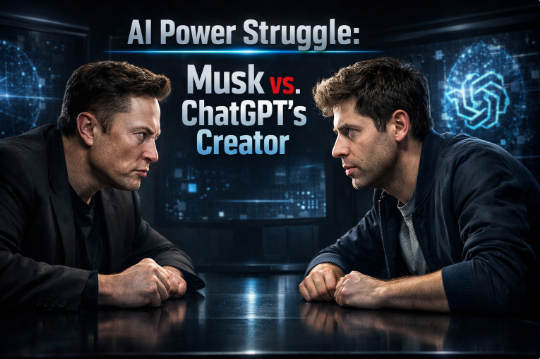
Elon Musk in a Dispute with the Creator of ChatGPT
If you’ve felt the internet vibrating like a tuning fork lately, it’s because one of tech’s most combustible feuds just flared again: Elon Musk versus the leaders of OpenAI—the organization behind ChatGPT, co-founded by Musk in 2015 and now helmed by Sam Altman. What began as a philosophical split over how to build safe artificial intelligence has morphed into a courtroom battle, an industry rivalry, and a live demonstration of how power, profit, and public trust collide when machines start writing our future.
How We Got Here: From Co-Founder to Courtroom
Elon Musk helped seed OpenAI’s nonprofit vision in 2015, aiming to ensure that advanced AI benefits “all of humanity.” He departed OpenAI’s board in 2018, later launching xAI and its counter-ChatGPT system, Grok. In February 2024, Musk sued OpenAI and its leaders, alleging the company abandoned its nonprofit mission in favor of a for-profit structure heavily aligned with Microsoft. OpenAI countered, publishing emails and a detailed rebuttal arguing that Musk supported a for-profit model in earlier years and even proposed using Tesla as a “cash cow” to power AI ambitions. (Reuters)
This isn’t academic grumbling. A federal judge in California recently allowed portions of Musk’s case to go to a jury, putting both OpenAI and Microsoft on a path toward a public trial expected to start in April 2026. Multiple reports put potential damages sought in the stratosphere—headlines have cited figures up to $134 billion in alleged wrongful gains—though the legal arguments will ultimately define what’s actually at stake. The ruling moves the fight from tweets and blog posts into sworn testimony and discovered documents, with the outcome poised to reshape AI governance for years. (The Japan Times)
OpenAI, for its part, has continued to publish its side of the story, most recently in January 2026, emphasizing that it has stayed true to its mission and that Musk’s portrayal omits crucial context from the organization’s early evolution. That includes internal debates about structure, funding, and the practical realities of training frontier-scale models. The specifics are dense, but the gist is clear: both sides insist they’re the real guardians of the original promise—safe, broadly beneficial AI—while accusing the other of mission drift. (OpenAI)
The Stakes: Safety, Alignment, and Who Gets to Steer
Beneath the legal fireworks is a deeper policy and engineering quarrel: how to make powerful models safe, who gets to decide what “safe” means, and how fast to move. Musk has hammered OpenAI over safety and transparency, at times amplifying claims about ChatGPT’s societal harms. Sam Altman and OpenAI argue that they are methodically shipping capabilities with guardrails, audits, and staged deployment. This discourse now plays out in an era when national regulators are suddenly awake—and awake with clipboards.
Consider Europe. The EU has opened a formal investigation into Musk’s xAI over Grok’s image-generation features after watchdogs reported a wave of non-consensual, sexualized deepfakes, including content that appeared to involve minors. The probe, launched under the Digital Services Act, brings real penalties (fines up to 6% of global revenue) and years of precedent-setting case law. Officials have already fined X (formerly Twitter) for transparency issues, and they’re signaling that AI image tools will face a different level of scrutiny—especially when they run at social-network scale. (Financial Times)
In the U.S., a coalition of state attorneys general is also probing Grok’s misuse, citing research that millions of sexualized images were generated in a matter of days. xAI says it has tightened safety systems and limited access, but regulators argue that reactive patches are not enough. Whether you view this as overreach or overdue, the direction of travel is unmistakable: AI companies will be measured not just by how clever their models are, but by what they allow to be created and how fast they mitigate harm. (WIRED)
Rival Products, Rival Philosophies
Strip away the lawsuits and you still have a heavyweight product war: ChatGPT (OpenAI) versus Grok (xAI). Grok leans into real-time data from X, a snappier tone, and a brand forged in Musk’s irreverent style. ChatGPT pushes breadth—long-form reasoning, tool use, enterprise controls—and an expanding ecosystem of integrations. Tech media has been buzzing all month with “Grok 3 vs. ChatGPT 4.5” comparisons across code generation, creative writing, math, and image tasks. Early narratives suggest competitive strength on both sides depending on the benchmark, the prompt, and the safety settings in play. Expect more head-to-head trials as both camps accelerate releases into the spring. (Oreate AI)
This rivalry folds back into the safety debate. Faster iteration cycles can boost capability—and risk. The EU’s inquiry into Grok’s deepfake outputs is a case in point, foregrounding the idea that content harms aren’t theoretical edge cases; they can go viral overnight. Meanwhile, OpenAI’s critics argue that “closed weights” and corporate partnerships undercut the original “for humanity” promise. OpenAI replies that closed weights and staged releases are precisely how you keep extremely capable systems from being misused at scale. In other words, both sides claim the safety high ground—they just define the hill differently. (OpenAI)
Why This Fight Matters Beyond the Headlines
For developers, CIOs, and policy teams, the Musk-OpenAI dispute is not just celebrity drama. It’s a decision tree for the coming decade:
Governance models: Nonprofit guardianship with for-profit subsidiaries versus pure private ventures. Which structure actually produces safer outcomes and more public accountability?
Access and openness: Should state-of-the-art models ship with open weights for research and innovation, or should they remain closed to prevent misuse? The answer affects startups, universities, and national labs.
Liability and platform accountability: If a model generates defamation, deepfakes, or harmful instructions, who is responsible—the publisher, the platform, the model provider, or the prompt author? The DSA and a patchwork of state actions are testing answers in real time. (Financial Times)
Infrastructure and geopolitics: Massive AI “compute farms” and data center projects—like the much-discussed “Stargate” concept—turn safety into nation-scale industrial policy. As models scale, electricity, chips, and supply chains become strategic assets. The rivalry doubles as a race to secure the biggest, smartest, most reliable compute. (Al Jazeera)
The Legal Arc: What a Jury Might Clarify
When a case like this reaches a jury, facts crawl out from behind PR statements. Expect discovery and testimony to focus on:
What the founders actually intended between 2015 and 2018: documents, emails, board minutes, and contemporaneous diaries or notes. OpenAI has already published selective excerpts to frame its case; Musk’s team will aim to pull the lens wide. (OpenAI)
Whether OpenAI’s nonprofit/limited-profit structure violates a founding pact or fulfills it under new constraints. Founders frequently revise governance to match changing technical realities; courts will ask whether the revisions were faithful or opportunistic. (The Japan Times)
The role of Microsoft and commercial partnerships. Were they a necessary financial engine to train cutting-edge systems responsibly, or a pivot that undermined the stated mission? The answer may hinge on internal safety policies, oversight mechanisms, and how much control the nonprofit “parent” truly retains. (The Japan Times)
Damages and remedies. Even if Musk prevails on certain claims, what should a remedy look like? Monetary damages? Governance changes? Transparency requirements? No one should assume that eye-popping dollar figures in headlines are a foregone conclusion—those numbers often shrink when legal theories meet juror skepticism. (Reuters)
Where Public Opinion Lands
Public sentiment is fractal. Some see Musk as the necessary antagonist who forces hard questions about concentration of power, safety transparency, and platform accountability. Others see a self-interested competitor wielding the language of ethics to hobble a rival while racing ahead with Grok. Conversely, OpenAI’s supporters argue the company is the cautious adult in the room, trying to keep state-of-the-art models from spilling into misuse. Its critics warn that centralizing control over general-purpose AI inside a corporate-aligned stack is antithetical to the promise of a nonprofit charter. None of these positions is purely right or wrong; they’re different bets about how to manage high-energy technology in a low-trust world.
The legal timeline forces a reset. In April, jurors will hear sworn accounts of who promised what—about structure, funding, openness, and mission. That matters for more than bragging rights. It will inform how boards draft mission commitments for future labs, how investors structure deals, and how regulators measure “safety” beyond marketing claims. (The Japan Times)
The Business Layer: Customers Choosing Between ChatGPT and Grok
Decision-makers picking AI platforms now weigh more than raw model quality. They must consider:
Regulatory exposure: If your company uses a model tied up in a safety probe, are you accepting reputational risk or compliance headaches? Europe’s DSA enforcement posture suggests fines and forced changes are not theoretical. (Financial Times)
Road-map stability: Will litigation or regulatory constraints throttle a vendor’s release cadence or reshape features like image generation? Watching xAI restrict and tweak Grok in response to backlash is an instructive case study. (WIRED)
Security and data handling: Enterprise buyers scrutinize data retention, fine-tuning policies, and on-prem options. As models gain tools—code execution, browsing, file access—the blast radius of a misstep grows.
Total cost of ownership: Compute-intensive features like multimodal reasoning and image/video generation have real unit costs. Platform pricing, rate limits, and reliability under load matter as much as clever demos.
For many, the pragmatic move is a multi-model strategy—route tasks to the best model for that task, keep an eye on the compliance picture, and demand contractual clarity on safety mitigations, support, and uptime.
What to Watch Next
1) Pre-trial skirmishes (January–March 2026): Expect motions on the scope of discovery, expert witnesses, and what precisely the jury will be allowed to hear. Media outlets will dissect filings line-by-line, and both sides will court public opinion with carefully timed posts. (The Japan Times)
2) EU enforcement milestones: The Commission’s Grok probe will establish a template for how Europe treats generative AI inside social platforms. A ruling with fines or mandated safeguards will ripple into product road maps on both sides of the Atlantic. (Financial Times)
3) Capability escalations: As “Grok 3” and “ChatGPT 4.5” comparisons proliferate, users will pressure both teams for visible leaps—coding accuracy, math reliability, hallucination reduction, and richer tool use. Benchmarks are only half the story; real-world stability will decide loyalty. (Oreate AI)
4) Government posture in the U.S.: The state AG wave against Grok previews a broader appetite to police AI outputs, especially where minors are involved. Expect hearings, model-specific advisories, and, eventually, statutory frameworks that reach beyond image generation. (WIRED)
Bottom Line: Dispute as Destiny
Elon Musk’s dispute with the people behind ChatGPT—shorthand for Sam Altman’s OpenAI, even if “creator” is a team effort—has become the defining drama of the generative-AI era. It combines the questions that actually matter: how to fund safety, who polices platforms, and which governance models keep the public interest in the loop. By spring, a jury will start sorting legal claims from legend. Regulators will keep tightening the screws, especially on image tools. And the models themselves will keep getting better, forcing all of us—developers, CEOs, teachers, parents—to decide what “better” is supposed to mean.
If the great promise of AI is to widen human possibility, then the great responsibility is to contain the blast radius of our own creativity. That’s the paradox at the heart of this fight: both camps insist they’re the careful ones. The rest of us will judge by results—safer products, sturdier policies, and clearer accountability when things go wrong. The future isn’t waiting for a verdict. It’s being coded, trained, and deployed right now.
SEO keyword paragraph (include in your CMS as the final block): Elon Musk dispute with OpenAI, Elon Musk vs Sam Altman, creator of ChatGPT, ChatGPT lawsuit 2026, OpenAI Microsoft partnership, xAI Grok investigation, EU Digital Services Act AI, AI safety and alignment, Grok vs ChatGPT comparison, generative AI deepfakes, AI regulation Europe, OpenAI governance controversy, Musk OpenAI jury trial April 2026, enterprise AI strategy 2026, AI ethics and accountability, multimodal AI models, large language models 2026, AI policy and compliance, real-time AI on X, non-consensual deepfakes, image generation safety, AI market competition, responsible AI deployment, AI trust and transparency. (The Japan Times)