
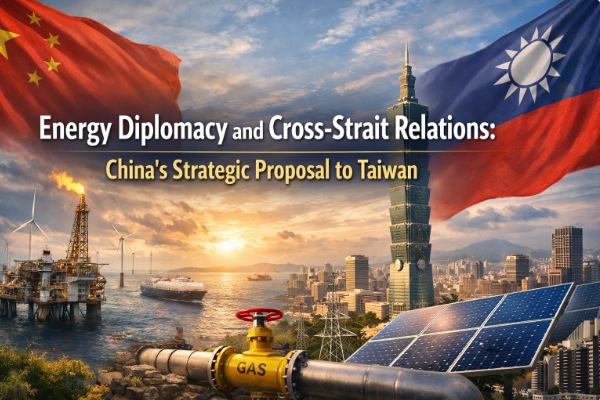
Energy Diplomacy and Cross-Strait Relations: China’s Strategic Proposal to Taiwan
Energy is the quiet engine of geopolitics: it powers factories, heats homes, keeps data centers humming, and—when leveraged strategically—reshapes alliances without firing a shot. On 19 March 2026, cross-strait relations feel like they’re being negotiated not only in diplomatic communiqués and military posture, but also in something far more mundane and universal: electricity, natural gas, shipping routes, and grid stability. In that context, China’s evolving “strategic proposal” to Taiwan can be read as a form of energy diplomacy—an attempt to reframe the relationship through economic interdependence, infrastructure incentives, and the promise (or pressure) of energy security.
This isn’t just about pipelines and power plants. It’s about the language of reassurance and risk: stable energy supply versus strategic dependence, regional connectivity versus political conditionality, lower costs versus sovereignty trade-offs. In the Indo-Pacific, where energy transition policies, semiconductor supply chains, and maritime security collide, energy can act like both lubricant and leverage. And Taiwan—an energy-import dependent democracy sitting at the heart of major sea lanes—feels every tremor.
What follows is a grounded, human-readable look at how energy diplomacy operates in cross-strait dynamics, what a “proposal” built around energy might really be trying to accomplish, and what Taiwan’s options look like when the negotiation table is shaped by electrons, molecules, and megawatts.
Why Energy Diplomacy Matters in Cross-Strait Relations
At its core, energy diplomacy is the use of energy resources, infrastructure, pricing, and cooperation frameworks to influence foreign policy outcomes. It can be soft (joint research, green finance, grid modernization) or hard (export restrictions, price manipulation, sanctions, maritime choke points). In cross-strait relations, energy diplomacy is unusually potent because Taiwan’s geography and import profile create structural vulnerabilities:
Taiwan imports the vast majority of its energy—especially LNG (liquefied natural gas) and other fuels.
Its economy relies on high-availability electricity for advanced manufacturing, particularly semiconductors.
Its critical energy infrastructure (ports, terminals, power stations, undersea cables) is geographically concentrated and exposed to disruption.
That combination creates a strategic truth: energy security is national security. So any proposal—whether framed as cooperation, integration, or “shared development”—automatically carries diplomatic weight. It’s not just “let’s collaborate.” It’s “let’s shape the terms of stability.”
Reading China’s Strategic Proposal: What “Energy Cooperation” Can Signal
When Beijing emphasizes cooperation—especially in a domain as foundational as energy—it often operates on multiple levels at once:
Economic Incentive Layer
Energy projects can be packaged as cost-saving, efficiency-boosting, and investment-friendly. Lower prices, guaranteed supply contracts, and infrastructure funding can be positioned as pragmatic “win-win” outcomes.Interdependence Layer
The deeper the infrastructure integration (contracts, grid links, terminal access, shared standards), the more cross-strait relations become harder to “decouple” without economic pain. Interdependence can be a stabilizer—but it can also become a pressure point.Narrative Layer
Energy cooperation can be framed as humanitarian and non-political: keeping lights on, ensuring winter heating, stabilizing prices for families and businesses. That story is emotionally compelling and politically useful because it reframes geopolitical tension as a solvable technical problem.Strategic Leverage Layer
Long-term supply agreements and infrastructure dependencies can become tools of influence. The same contract that offers stability can also create future vulnerability if it includes implicit conditions, concentrated suppliers, or chokepoints.
So when China advances energy-linked initiatives, it’s worth asking: Is this primarily about stability, about influence, or about both? In real geopolitics, the answer is usually “both,” with the ratio shifting depending on timing, domestic politics, and regional pressure.
Taiwan’s Energy Reality: Transition Goals Under Hard Constraints
Taiwan’s energy policy has to satisfy three simultaneously demanding goals:
Energy security (reliability, resilience, diversified supply)
Energy affordability (competitive electricity prices for industry and households)
Decarbonization (emissions reductions, renewable scale-up, climate commitments)
The friction is obvious: decarbonization often requires major grid upgrades, storage capacity, and new generation; diversification can increase short-term costs; resilience can mean redundancy, which is rarely cheap. Taiwan also faces the “island grid” problem: without broad interconnections to neighboring grids, it must balance supply and demand internally, which increases the value of stable baseload or flexible generation.
This is the opening where energy diplomacy gets traction. Any actor who can credibly promise reliability, lower prices, and smoother transition financing can shape the conversation—even if the political subtext is complicated.
The Energy Diplomacy Toolkit: How Influence Is Built Without Headlines
Energy diplomacy doesn’t always arrive as a single dramatic offer. More often it’s a portfolio of smaller moves that add up:
1) Long-Term LNG and Gas Contracting
Contract structure matters as much as price. Duration, indexing (oil-linked vs spot-linked), take-or-pay provisions, and termination clauses can either enhance or reduce strategic dependence. A “friendly” deal can still lock in leverage if alternatives are limited.
2) Infrastructure Financing and Technical Standards
Who funds terminals, grid upgrades, smart meters, storage facilities, and cybersecurity protocols? Whoever sets standards—hardware, software, compliance—shapes future options. Technical architecture can become geopolitical architecture.
3) Green Energy Cooperation as Soft Power
Joint renewable initiatives, hydrogen research, carbon markets, or ESG-linked finance can rebrand geopolitical engagement as climate pragmatism. The phrase “energy transition” can become diplomatic camouflage: it sounds universally good while embedding strategic ties.
4) Maritime Energy Logistics
For Taiwan, shipping lanes are critical. Energy cargo vulnerability—especially LNG deliveries—creates sensitivity to maritime risk. Energy diplomacy can therefore intersect with naval posture, insurance pricing, and freight cost stability.
5) Crisis Management Channels
Energy-focused hotlines, emergency supply protocols, and price stabilization mechanisms can function as confidence-building measures. They can also normalize ongoing engagement even when broader politics are tense.
Strategic Signaling: Why the Timing Matters
Energy proposals gain momentum when three conditions converge:
Domestic economic pressure (inflation, industrial competitiveness, electricity price sensitivity)
Transition turbulence (renewable intermittency, grid constraints, storage gaps, fuel price volatility)
Geopolitical uncertainty (trade restrictions, maritime risk, sanctions environment, alliance signaling)
In that mix, energy diplomacy becomes attractive because it offers the appearance of control in a chaotic system. It promises smoother prices, more stable supply, and fewer shocks. For decision-makers and voters alike, energy stability feels like a tangible benefit compared with abstract security dilemmas—until the trade-offs become visible.
Taiwan’s Strategic Dilemma: Resilience vs. Dependence
Taiwan’s policy challenge is not simply “accept” or “reject.” It’s managing a spectrum of risk:
Energy resilience requires diversification: multiple LNG sources, robust storage, demand response, grid hardening, and domestic renewables.
Energy diplomacy can provide marginal gains—cost relief, technology access, crisis coordination—but can also create single-point vulnerabilities if dependencies concentrate.
This is where careful policy design becomes everything. The key questions Taiwan would ask of any energy-centered proposal include:
Does it diversify supply—or concentrate it?
Does it expand optionality—or lock in long-term constraints?
Does it increase system resilience—or create a chokepoint?
Are terms reversible without catastrophic disruption?
Are governance and dispute mechanisms transparent and enforceable?
Energy deals are often judged by near-term price and supply. Strategically, they should be judged by exit costs and control points.
The Semiconductor Factor: Electricity as Industrial Strategy
Cross-strait relations cannot be separated from technology competition, and technology competition cannot be separated from electricity. Semiconductor fabrication is energy-intensive and intolerant of instability. Even small disruptions can cause outsized costs.
That makes Taiwan’s energy policy an industrial policy. Grid reliability, reserve margins, and power quality become national competitiveness variables. Any energy proposal that claims to improve reliability can resonate strongly with business stakeholders. But the same dynamic also increases strategic sensitivity: if industrial continuity becomes linked to externally mediated energy stability, the diplomatic stakes rise.
In other words, the more electricity becomes “the lifeblood of the economy,” the more energy diplomacy becomes a geopolitical instrument.
The “Green Transition” Angle: Cooperation or Co-Optation?
A modern strategic proposal rarely arrives wearing the old fossil-fuel uniform. It shows up in a clean-energy suit:
offshore wind supply chains
grid-scale battery storage partnerships
green hydrogen pilot projects
carbon accounting frameworks
sustainable finance and climate-linked investment
These are not inherently suspicious. They’re also not politically neutral. Clean energy infrastructure is still infrastructure—physical assets, data flows, supply contracts, maintenance dependence, software updates, and personnel pipelines.
The strategic trick is that decarbonization can create new dependencies even as it reduces old ones. Solar panels, battery materials, power electronics, and grid software all have supply chain geopolitics. Taiwan’s challenge is building a transition that is not only low-carbon, but also low-coercion—meaning resilient to external pressure.
Scenarios: How Energy Diplomacy Could Shape Cross-Strait Relations
Rather than pretending we can predict the future, it’s more useful to map plausible scenarios—working theories, not prophecies.
Scenario A: “Technical Cooperation, Political Freeze”
Energy cooperation grows through pragmatic channels—research, standards, emergency coordination—while political positions remain unchanged. This can lower volatility and reduce crisis risk, but also normalizes ongoing engagement and could shift public perception over time.
Scenario B: “Economic Sweeteners, Strategic Strings”
Attractive pricing and investment are offered during periods of economic stress, potentially tied (explicitly or implicitly) to political concessions or limits on external partnerships. The risk here is classic: short-term relief trading for long-term constraint.
Scenario C: “Resilience Pushback”
Taiwan accelerates diversification—more storage, more demand response, improved grid resilience, expanded LNG supplier diversity, and faster renewables and inter-island redundancy—reducing the appeal of external energy dependency. Energy diplomacy becomes less effective because the leverage points shrink.
Scenario D: “Crisis-Driven Reframing”
A major regional energy shock—price spikes, shipping disruptions, or infrastructure incidents—creates urgency. Under crisis conditions, proposals that previously seemed sensitive can become politically palatable, because the public prioritizes stability and affordability.
The strategic lesson across scenarios is consistent: energy diplomacy is most powerful when alternatives are expensive and time is short. Building resilience buys time, and time buys sovereignty of choice.
What “Smart” Policy Looks Like: Guardrails, Not Gestures
For Taiwan (and frankly, for any energy-import dependent economy), the best defense against coercive energy diplomacy is not bravado—it’s engineering, contracting discipline, and institutional guardrails:
Supplier diversification (avoid single-source dependence)
Contract transparency and review (especially termination and arbitration clauses)
Strategic storage and redundancy (fuel reserves, grid redundancy, spare parts)
Grid modernization and cybersecurity (hardening and rapid recovery capability)
Demand-side flexibility (industrial demand response, efficiency, peak shaving)
Domestic renewables scale-up paired with storage and transmission upgrades
Regional energy partnerships that broaden options without creating new chokepoints
Energy independence is rarely absolute, especially for islands. But energy resilience is achievable, and resilience is the practical antidote to leverage.
The Bottom Line: Energy as a Diplomatic Language of Power
China’s strategic proposal to Taiwan—when seen through the lens of energy diplomacy—reads like a bid to redefine the relationship in the language of stability, cost, and infrastructure. That language is persuasive because it targets everyday life: electricity bills, industrial competitiveness, and fear of disruption. But energy is never just a commodity in geopolitics. It is a system of dependencies, control points, and risk transfers.
For Taiwan, the policy challenge is to harvest the legitimate benefits of technical cooperation (where possible) while refusing structural dependence that could erode strategic autonomy. For observers of cross-strait relations, the key insight is that modern diplomacy increasingly happens inside power grids, LNG contracts, battery supply chains, and maritime logistics—not only in speeches and summits.
The weird truth of the 21st century is that geopolitics can hinge on something as unglamorous as a transformer substation. History is written by many hands; some of them are holding pens, and some of them are holding circuit breakers.
SEO keyword paragraph (use as-is at the end of your blog): Energy diplomacy, cross-strait relations, China Taiwan proposal, China Taiwan strategy, Taiwan energy security, Indo-Pacific geopolitics, LNG supply Taiwan, Taiwan electricity grid, energy transition Taiwan, renewable energy Taiwan, geopolitical risk Asia, maritime energy logistics, strategic interdependence, Taiwan resilience strategy, clean energy cooperation, green hydrogen Asia, battery storage Taiwan, power grid modernization, energy policy Taiwan, regional security Indo-Pacific, semiconductor energy demand, infrastructure diplomacy, economic coercion risk, China influence strategy, Taiwan national security, energy security strategy, cross-strait economic ties, climate and geopolitics, supply chain security, energy geopolitics 2026.