
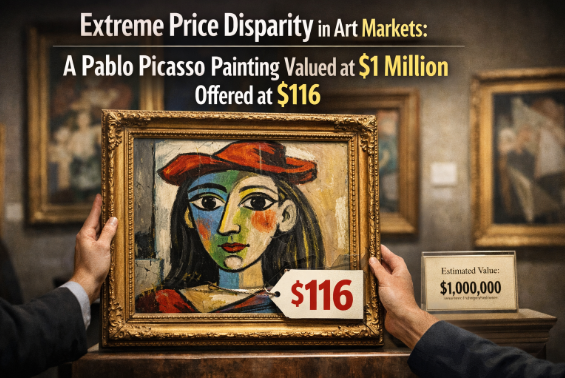
Extreme Price Disparity in Art Markets: A Pablo Picasso Painting Valued at $1 Million Offered at $116
There are few things more attention-grabbing in the global art market than a dramatic mismatch between perceived value and selling price. A headline such as “A Pablo Picasso painting valued at $1 million offered at $116” immediately sparks curiosity, disbelief, excitement, and suspicion all at once. For collectors, investors, gallery owners, art historians, and everyday readers, this kind of story cuts to the heart of a larger conversation about art valuation, market psychology, luxury pricing, authenticity, and the power of brand in fine art. How can an artwork associated with one of the most famous names in modern art appear at a price point lower than a household appliance? Is it an overlooked gem, a reproduction, a misattributed piece, a distressed sale, or a symptom of a market that often prices narrative as much as it prices canvas and paint?
The fascination is understandable. Pablo Picasso is not merely a painter; he is a cultural institution. His name carries enormous weight in the world of blue-chip art, where even sketches, ceramics, prints, and secondary works can command impressive prices. In the public imagination, anything connected to Picasso belongs in a museum, a major auction house, or the climate-controlled vault of a billionaire collector. So when a work said to be valued at $1 million is somehow offered at $116, the gap is so extreme that it forces us to confront a central truth of the art business: value in art is rarely simple, rarely fixed, and almost never determined by aesthetics alone.
At first glance, such a price disparity feels absurd. But the fine art market has always thrived on contradiction. A work may be priceless in cultural meaning and still sell below expectations. Another may appear visually modest yet fetch a record-breaking figure because of provenance, rarity, timing, condition, and buyer competition. This is why stories like this spread quickly across art news, social media, investment blogs, and collector forums. They represent more than a sale; they symbolize the tension between intrinsic artistic value and market-assigned price. In a world where branding shapes perception, Picasso’s name alone can transform a piece into a magnet for speculation.
One of the biggest reasons this type of story resonates is that it feeds a universal dream: the idea of discovering hidden value where no one else is looking. People love tales of flea market finds, estate sale miracles, forgotten attic treasures, and underpriced masterpieces. The possibility that a Picasso artwork might be offered for a fraction of its estimated value taps into a deep emotional current. It suggests that the art world, despite its exclusivity, still contains moments of surprise. It hints that expertise can fail, systems can be imperfect, and fortune can still favor the observant. That emotional hook is powerful, and it is one reason why art collecting remains both a passion and a high-stakes financial arena.
Yet beneath the drama lies a more complex question: what does it actually mean for a painting to be “valued at $1 million”? In the art market, valuation is not always the same as sale price. An appraisal may reflect historical significance, prior comparable sales, scholarly opinions, market optimism, or insurance requirements. But a listing price or offer price can emerge from entirely different circumstances. A seller may need immediate liquidity. A work may be offered in the wrong venue. Documentation may be incomplete. The piece may not be a unique oil painting at all, but rather a print, edition, study, or work from a category that trades differently. In that sense, a dramatic price gap does not always mean the market is irrational; sometimes it means the market is working through uncertainty.
That uncertainty is especially relevant when dealing with a name as celebrated and scrutinized as Picasso. The Picasso market is enormous, but it is also layered. There is a world of difference between a major museum-quality painting and a lower-tier collectible item bearing the same signature. Condition, period, medium, provenance, and documentation shape value at every step. A late ceramic, a signed print, a drawing, and a major Cubist canvas do not occupy the same pricing universe, even though all may be associated with the same artist. This is where casual observers often become confused. They hear “Picasso” and imagine one consistent level of value, when in reality the artist’s market is diverse and segmented.
Still, a price as low as $116 invites scrutiny because it appears to fall far below even ordinary expectations. That is why authenticity becomes the central issue in any such case. In the luxury art market, authenticity is everything. A verified Picasso with solid provenance, expert backing, and catalog inclusion operates in one universe; a work with uncertain origin operates in another entirely. The difference between an authentic masterpiece and an unattributed imitation can amount to millions of dollars. This fragile dependence on documentation explains why art authentication remains one of the most sensitive and consequential aspects of the market. Without trust, price collapses. With trust, value can soar.
The emotional side of this story should not be ignored either. Art is not a stock certificate or a bar of gold. It carries history, identity, memory, symbolism, and prestige. A Picasso is not simply pigment on a surface; it is a fragment of twentieth-century artistic revolution. Picasso changed how people saw form, perspective, and representation. He remains central to discussions of modern art, Cubism, avant-garde movements, art history, and museum culture. Because of that, any sharp gap between name and price feels almost personal to art lovers. It raises questions about whether the market truly honors artistic legacy or merely monetizes it.
There is also a broader economic lesson hidden in the headline. The art market is often portrayed as glamorous, but it can be opaque, inconsistent, and heavily influenced by access. Prices are shaped by auction visibility, dealer relationships, collector confidence, branding, and media coverage. Two seemingly similar works may perform very differently depending on where and how they are sold. A prestigious auction house can produce bidding wars. A quiet online listing can go unnoticed. A work marketed with scholarly context and elite networking may attract wealth, while a poorly presented listing may struggle despite underlying value. This is why art auctions, gallery representation, provenance research, and collector trust matter so much.
The headline also reveals how the digital era is transforming art discovery. In the past, underpriced art might remain hidden in local markets or private circles. Today, online platforms, resale marketplaces, digital catalogs, and social media accelerate visibility. They also accelerate confusion. A dramatic listing can go viral before experts verify it. Public excitement can outrun due diligence. In this environment, stories about alleged bargains spread because they combine the thrill of a treasure hunt with the accessibility of online shopping. The internet has democratized attention, but not necessarily expertise. That creates opportunities for genuine discoveries and for misunderstandings at the same time.
For buyers, this kind of situation underscores the importance of caution. A low price attached to a famous name should trigger both excitement and disciplined skepticism. Serious collectors know that the smartest purchase is not always the cheapest one; it is the one supported by reliable evidence. That means checking provenance, consulting specialists, reviewing certificates, examining condition reports, and understanding the category of the work. The phrase “buy art online” may sound convenient, but the closer one gets to high-value names, the more essential expert guidance becomes. In elite collecting, knowledge protects capital.
For sellers, the story is equally revealing. Underpricing can happen for many reasons: lack of awareness, urgent financial need, estate dispersal, poor representation, or simple miscommunication. Sometimes a seller does not understand what they have. Sometimes they do understand, but they choose speed over maximum return. In distressed contexts, valuable assets often surface at startling prices. This is not unique to art, but in the world of fine art investment, the gap can be far more dramatic because valuation is so dependent on context and confidence. A hurried sale can erase enormous value, especially when the audience is not properly targeted.
From an investment perspective, the title highlights why people increasingly view art as both a passion asset and a speculative vehicle. High-net-worth individuals, wealth managers, and alternative asset investors have spent years promoting art as a store of value, a hedge against volatility, and a prestige holding. But stories like this remind us that art is not a perfectly liquid market. Value on paper is not always value in hand. A painting may be appraised at a remarkable level and still fail to achieve that number in a rushed or uncertain transaction. That gap between theoretical value and realized sale price is one of the defining features of art as an investment.
At the same time, the public obsession with a possible million-dollar Picasso offered for $116 reflects something deeper than finance. It reflects our uneasy relationship with worth itself. Why do we accept that one object can command seven figures while another, visually similar to an untrained eye, sells for almost nothing? The answer lies partly in authorship, partly in scarcity, and partly in storytelling. Art markets do not only sell objects; they sell meaning. A signature is a narrative device. Provenance is a narrative chain. Exhibition history is narrative reinforcement. Collector desire is often driven by the chance to possess not just beauty, but significance.
Picasso’s enduring prominence makes this especially potent. He occupies a rare category of artist whose name transcends art circles and enters mainstream culture. Even people who never visit galleries recognize the name. That kind of universal recognition creates immense symbolic value. It also means that any anomaly involving Picasso becomes instantly shareable. The contrast between $1 million and $116 is dramatic enough to function almost like a social experiment. It exposes how much of the art economy depends on perception and how easily the public can be pulled into the story of a price gap.
This is why the headline works so well from a content marketing and SEO standpoint too. It contains all the ingredients that drive search interest: a legendary artist, a shocking price contradiction, luxury intrigue, collectible appeal, and investment curiosity. Readers searching for Picasso painting price, art market trends, cheap Picasso artwork, famous paintings value, how art is priced, or why art prices vary so much are likely to stop at a title like this. It sits at the intersection of celebrity, finance, culture, and controversy, making it highly clickable and highly discussable.
But beyond click value, the subject deserves thoughtful treatment because it speaks to the fragility of price certainty in every market, not just art. In real estate, fashion, watches, cars, and antiques, value depends on timing, condition, authenticity, and buyer demand. Art simply magnifies those variables because emotional and cultural significance are so central to the transaction. A Picasso offered at $116 becomes a symbol of how markets can detach from assumptions. It reminds collectors that prestige does not eliminate volatility. It reminds casual readers that fame alone does not guarantee transparent pricing. And it reminds everyone that hidden complexity often sits behind sensational headlines.
In many ways, the phrase “extreme price disparity in art markets” captures the essence of the issue perfectly. The art world has always contained extraordinary highs and surprising lows. It is a place where museum pieces coexist with misattributions, where masterpieces are fought over by billionaires, and where potentially important works can remain overlooked until the right expert sees them. This duality is part of what makes the art market endlessly fascinating. It is not merely a marketplace; it is a theater of reputation, scholarship, wealth, emotion, and timing.
For blog readers and site visitors, this topic offers an ideal entry point into a broader discussion of art valuation, collecting strategy, modern art history, Picasso’s legacy, and the economics of luxury assets. It encourages curiosity without requiring specialist knowledge. It invites readers to think critically about what makes art valuable and why prices can diverge so dramatically from expectations. It also humanizes the market by reminding us that behind every listed price there is a story: a seller’s motive, a buyer’s hope, an expert’s opinion, a family inheritance, a legal concern, a missing document, or a misunderstood object.
Ultimately, whether the painting in question proves to be an authentic hidden treasure, a misunderstood collectible, or simply an example of how misleading headlines can be, the larger point remains powerful. The art market is one of the clearest examples of how value is constructed, challenged, defended, and reimagined. A Picasso connected to a $1 million valuation but appearing at $116 is not just a price anomaly; it is a window into the machinery of culture and commerce. It forces us to ask what we are really paying for when we buy art: the object itself, the artist’s legacy, the rarity, the social prestige, the investment potential, or the story we tell ourselves about ownership.
In that sense, the title does exactly what great art-market stories should do. It stops us. It unsettles our assumptions. It makes us look more closely. And in a time when headlines flash by in seconds, anything that causes readers to slow down and question how value is formed has already accomplished something meaningful. Picasso spent his career challenging conventional ways of seeing. It is strangely fitting that a story bearing his name still has the power to do the same.
SEO paragraph: Explore the extreme price disparity in art markets through this compelling analysis of a Pablo Picasso painting valued at $1 million and offered at $116, with insights into Picasso painting price, art market trends, fine art investment, modern art valuation, art authentication, art auction results, blue-chip art, luxury collectibles, famous paintings value, original Picasso artwork, collectible art market, high-value art sales, art appraisal, contemporary art buyers, museum-quality art, global art market, and why art prices vary so dramatically in today’s fine art and online art marketplace.