
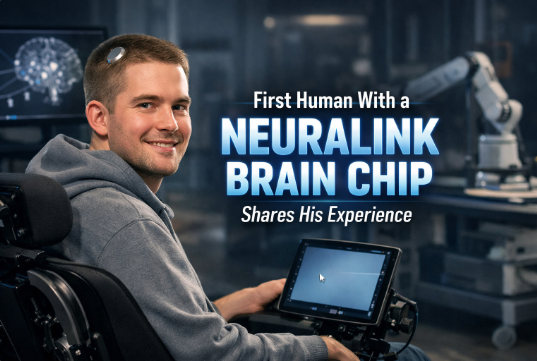
First Human With a Neuralink Brain Chip Shares His Experience
When a human being plugs into a machine, the story is never just about circuits and code. It’s about hope, risk, and the stubborn human urge to reach across limits we didn’t choose. Today, the “first human with a Neuralink brain chip” adds another chapter to that very old story, bringing us closer to a future where thoughts can move cursors, compose messages, and maybe—one day—lift the walls around paralysis. This post unpacks what that experience looks like from the inside: the surprising gains, the gritty realities, and the questions that are still wide open.
A new kind of first-person story
When the first patient publicly described living with the implant, what struck many viewers was how ordinary the extraordinary looked: a young man smiling into a webcam, a chessboard gliding across a screen, a cursor drifting under thought alone. That patient—Noland Arbaugh—spoke about using the system “like a superpower,” playing games, studying, and regaining a slice of autonomy that spinal cord injury had fenced off for years. He also made clear this is not magic. It is training, calibration, and patience layered over complex neuroengineering. Early demonstrations showed him controlling a laptop and playing long sessions of Civilization VI, illustrating both the immediacy and endurance of the connection between intention and action. These accounts, captured in livestreams and interviews, grounded the hype with a human voice—relief, curiosity, and, yes, skepticism, living side by side. (People.com)
What exactly got implanted?
Let’s translate the tech into human-scale terms. The device, often referred to as the N1 implant, sits flush with the skull. Ultra-fine, flexible threads—each thinner than a hair—reach into the brain’s motor cortex, the region that maps intention to movement. A custom robot inserts those threads with precision that human hands can’t match, aiming to avoid blood vessels and minimize inflammation. The implant records patterns of neuronal spikes associated with imagined motion and sends them wirelessly to a decoding system, which turns brain activity into pointer movements or selections on a screen. (ClinicalTrials.gov)
From a patient’s perspective, the ritual looks more like using a new input device than “becoming a cyborg.” You imagine moving a cursor left, and the decoder learns what your neural “left” looks like. You think “click,” and the system learns the neural rhythm of confirming a choice. It’s bodily, but not muscular; intentional, but not effortful in the usual way. As decoding improves, so does speed and accuracy. That’s why early users describe a learning curve that is surprisingly intuitive—the device adapts to you as you adapt to the device.
How did we get to human trials?
If you zoom out, the patient’s story sits inside a regulatory and scientific arc. In May 2023, the U.S. Food and Drug Administration granted an Investigational Device Exemption (IDE), allowing first-in-human studies to begin. By September 2023, recruitment for the PRIME Study opened, focusing on people with severe paralysis. These are feasibility studies: small, closely monitored, and designed to characterize safety and early performance. The essential bargain is honest: participants accept surgical and device risks today in exchange for potential independence gains—and for the data that may help future patients. (Neuralink)
A breakthrough, not a miracle: the patient’s mixed reality
Early reports from the first recipient emphasized life-changing usefulness and also the imperfections you’d expect from a version-one neurotech system. Neural decoding can drift with time; electrodes can lose signal; the human brain itself is plastic—changing with attention, fatigue, and mood. In spring 2024, Neuralink reported a setback in which some threads retracted from brain tissue, degrading signal quality. Engineers then pushed software adjustments to recover performance. That detail matters, not as scandal, but as sobriety: implants live at the shifting boundary of biology and hardware, and setbacks are part of the frontier. (The Guardian)
Yet even with hiccups, the patient described tangible wins: messaging friends, browsing, gaming, and studying with dramatically less assistance. Watch a pointer drift under pure intention and you can feel the paradigm shifting. This isn’t about typing contests; it’s about dignity, agency, and turning idle hours into active ones—reading, learning, connecting. (People.com)
What can the system do today?
In its current state, a modern implanted brain-computer interface (BCI) can:
Move a computer cursor in two dimensions.
Perform “clicks” or selections, sometimes via dwell time, sometimes via imagined gestures the decoder maps to discrete actions.
Enable on-screen keyboard typing. Speeds vary by user, day, and model updates, but have already crossed the threshold where texting, web browsing, and basic productivity tasks are practical.
Some implementations aim to control external devices as well: wheelchairs, robotic arms, or smart-home interfaces. Neuralink’s public roadmap has also flagged products with names that hint at ambition—“Telepathy” for cursor/typing control and other trademarks nodding toward sensory restoration or advanced control. But the distance from trademark to therapy is a canyon filled with experiments, failed prototypes, and regulatory work. For patients, the meaningful horizon remains near-term: consistent cursor control and text entry with minimal caregiver assistance. (Neuralink)
The ethics aren’t an afterthought; they’re the whole thought
Ethics in neurotechnology isn’t a checklist at the end of a paper; it’s the design spec for a technology that touches cognition and identity. Several themes keep showing up in the research literature and policy briefs:
Safety and reversibility. Brain surgery, no matter how careful, involves risk: bleeding, infection, inflammation, and long-term tissue response. Flexible electrodes reduce strain, but materials still live in a salty, reactive brain environment. What happens if a lead degrades? If software goes wrong? Who is responsible for device explantation—or for a patient stranded with outdated hardware? (ScienceDaily)
Privacy of thought. Even when BCIs decode only motor intention, any collection of neural data raises questions: who owns this data, how is it secured, and what prevents “function creep” toward monitoring attention or emotions? The specter of “brainjacking”—unauthorized access to neural streams—may be more sci-fi than clinical today, but cybersecurity for implants is a live field, not a solved one. (PMC)
Autonomy and equity. If these systems work, who gets them? Are they covered like a wheelchair or priced like a luxury gadget? Will rural hospitals get trained implant surgeons? Ethical distribution isn’t decoration; it determines whether neurotech shrinks or widens existing inequalities. Policymakers are beginning to engage these questions, but the gaps—reimbursement, training pipelines, long-term support—are real. (Consilium)
The patient’s day, zoomed in
A day with an implant doesn’t look like a sci-fi montage; it looks like a morning routine with a new step. After waking up, the user opens the BCI app, which handshakes with the implant and loads a decoder profile. Some sessions require quick recalibration: a few minutes guiding the system through imagined movements until accuracy locks in. Then the day unfolds with digital agency that was previously out of reach: browsing the news, texting family, queuing up a playlist, opening study notes. Sessions might be interleaved with rest—the brain tires, just like a hand does.
The most reported subjective effect is not exhaustion but relief: mental energy shifted from asking for help to doing it yourself. Independence is a powerful mood elevator. Yet the flip side exists: the weight of being a pioneer, of troubleshooting with engineers, of living with a surgical implant that the world is still learning how to maintain over years, not months.
The clinical guardrails that make this possible
For all the attention around one company, it’s the clinical framework that keeps the enterprise moored. U.S. trials progress through feasibility and pivotal stages under FDA oversight; investigational device exemptions grant permission to test while requiring rigorous adverse-event reporting. ClinicalTrials.gov entries spell out endpoints—safety, signal stability, functional communication benchmarks—so that enthusiasm runs alongside metrics. The boring paperwork is, frankly, the hero; it’s what translates a demo into a therapy. (ClinicalTrials.gov)
Why this feels different from earlier BCIs
BCIs aren’t new; labs have let volunteers move cursors and robotic arms for two decades. So why does this first-person account feel like a break from the past?
Full-stack design. Companies like Neuralink compress the stack—implant, electrodes, surgical robot, software—under one roof. Integration yields smoother user experience, faster iteration, and tighter safety loops.
Industrial repetition. Instead of bespoke lab rigs, we’re seeing pathway-to-product thinking: rechargeable, wireless implants; portable decoders; and setup processes measured in minutes, not hours.
Public narrative. A livestreamed patient session is qualitatively different from a conference paper. It builds a cultural “proof of possibility” that accelerates investment and scrutiny in equal measure.
The presence of a charismatic founder—Elon Musk—amplifies both the signal and the noise. Public interest spikes, but so do polarized takes. That’s fine. Science grows best under bright lights and sharp questions. (Bloomberg)
The limits you should keep in view
Hope without context can turn into hype. Here are the sharp edges the first human’s story does not erase:
Thread migration and longevity. Micro-movements of the brain, immune response, and material fatigue can degrade signal quality over months or years. Mitigations are improving, but “decade-long stability” remains a research goal, not a guarantee. (The Guardian)
Bandwidth and precision. A thousand electrodes sound like a lot, but the motor cortex contains millions of neurons. Decoders infer intention from sparse samples; clever algorithms help, yet there’s a ceiling until electrode density, placement, and signal quality climb. (bionic-vision.org)
Generalization. A system tuned for cursor control may not automatically generalize to speech synthesis or limb control. Each function demands specialized decoding and training. The “one device to do everything” narrative is premature.
What the first patient teaches us about outcomes that matter
When evaluating breakthrough tech, it’s tempting to chase lab metrics—bits per second, error rates, latency. The first patient’s account nudges us toward human metrics:
Self-directed time. Hours spent independently browsing, reading, or gaming are hours reclaimed from passivity. That autonomy is therapy in its own right.
Communication persistence. Being able to sustain a conversation—via messaging apps or email—without constant help restores social presence.
Cognitive flow. Long stretches of focused activity (studying, writing, gaming) are more than recreation; they rebuild habits of mind.
These outcomes won’t show up neatly in a spec sheet, but they’re the ones family members notice when they say, “You seem more like yourself.”
What comes next (and what to watch for)
As trials expand, expect three classes of updates:
Safety and durability disclosures. Watch for peer-reviewed data on infection rates, hardware reliability, and signal stability over 12–24 months. Adverse events aren’t failure; silence is.
Speed and usability milestones. Cursor control is a stepping-stone. Look for improvements in text entry rates, error correction, and hands-free switching between apps—hallmarks of real daily utility.
Ecosystem integration. The more BCIs work with standard OS features—accessibility APIs, on-screen keyboards, smart-home hubs—the less “special” the tech will feel, which is exactly the point.
None of this unfolds in a vacuum. Regulators, ethicists, disability advocates, and clinicians are increasingly vocal stakeholders, and their feedback is reshaping the path from lab to living room. (Consilium)
The emotional center of the story
Tech columns love metaphors about “merging with AI.” The first human’s voice cuts through with something simpler: “I could do this, and then I could do more.” That line carries quiet power. For people living with paralysis, independence often gets chipped away by a thousand tiny barriers—opening an app, typing a line, scrolling a page. A thought-driven cursor doesn’t cure paralysis; it changes the math of daily life. And changing the math changes the mood.
That dignity is why these trials exist. It’s also why candor matters. The first public recipient has been open about limitations, calibration needs, and the sheer weirdness of learning to “intend” a click. That honesty builds trust—not just with prospective participants, but with a public that will eventually help decide whether neurotech becomes part of standard care.
The company’s role—and the world beyond one company
It’s fair to focus on a single brand when a single patient goes first, but the field is larger. Academic groups and other startups have shown speech prostheses, robotic arm control, and high-speed typing in parallel efforts. The emerging consensus is that implanted (invasive) systems offer higher signal quality than noninvasive headsets, at the cost of surgery and maintenance. Where each approach wins may depend on what the user values most: performance or convenience, speed or simplicity.
For all the star power around one firm, what will scale this field is unglamorous: standards for data formats, interoperable software, training for neurosurgeons and rehab teams, insurance coverage, and open benchmarks that let the best ideas rise. The good news is that regulators, hospitals, and international bodies have begun drafting guidance for BCI safety and evaluation; the challenge is translating guidance into everyday clinical practice. (U.S. Food and Drug Administration)
A note on language—and why “first” is complicated
We tend to crown “firsts” like explorers, but medicine is a relay race. Before this patient, volunteers with other implanted BCIs had already shown remarkable feats—typing, robotic reach and grasp, speech decoding. The specific “first” here belongs to a particular implant design, surgical robot, and commercial program under the banner of one company. That caveat doesn’t dim the light of the moment; it refracts it across the wider community that made it possible.
Meanwhile, the “first-in-country” headlines keep coming—from the U.K. to other trial sites—as global studies broaden eligibility. Each new participant inserts their own chapter into the shared narrative, chiseling the prototype toward a therapy. (The Sun)
So, what does the first human say?
Stripped of tech jargon, the message is primal: “I can do more today than I could yesterday.” It’s joy and relief, tempered by surgery scars and software updates. It’s a promise to future patients that progress is not theoretical. And it’s a reminder to the rest of us that the brain is not a black box; it’s an organ that speaks in electricity, and we’re getting better at listening.
If you leave this post with only one thought, take this: breakthroughs feel inevitable only in hindsight. In the present tense, they feel like what this patient describes—exhilarating, imperfect, and worth it.
Sources and further reading
For readers who want the sober details behind the story:
PRIME Study background and recruitment, Neuralink updates. (Neuralink)
Technical and surgical context for the N1 implant and R1 robot. (ClinicalTrials.gov)
First-person demonstrations and interviews describing lived experience. (People.com)
Reported thread retraction and performance recovery—why durability is the key challenge. (The Guardian)
Ethical frameworks and EU policy horizons for BCIs; privacy, equity, autonomy. (PMC)
FDA guidance and regulatory guardrails for implanted neural interfaces. (U.S. Food and Drug Administration)
Ongoing coverage of new trial sites and international recipients. (The Sun)
SEO keyword paragraph (for site discoverability)
Neuralink brain chip, first human Neuralink patient, N1 implant, brain-computer interface (BCI), thought-controlled cursor, Elon Musk Neuralink, invasive neural interface, paralysis assistive technology, FDA investigational device exemption, PRIME Study, R1 surgical robot, neural decoding, speech and typing via brain signals, accessibility technology, assistive communication device, spinal cord injury technology, neural implant safety, BCI ethics and privacy, brain data security, neurotechnology breakthrough, clinical trial results, real-world Neuralink experience, Telepathy device, patient-reported outcomes, human augmentation debate, disability tech innovation, rehabilitation technology, next-gen accessibility tools, thought-to-text typing, Neuralink updates 2026. U.S. Food and Drug Administration (FDA)