
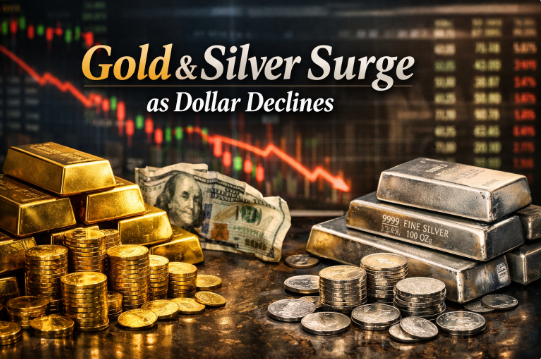
Gold and silver continue their gains as the dollar declines
The precious-metals market opened this week with a familiar drumbeat: gold and silver pushing higher while the U.S. dollar slipped. For investors, traders, and savers watching the tug-of-war between real yields, inflation expectations, and risk appetite, today’s action feels like the latest chapter in a long story about money, credibility, and the world’s appetite for safety. Below is a clear, human-centered look at why bullion is back in favor, how currency weakness amplifies the move, and what to watch as the next catalysts line up on the calendar.
A softer dollar is a tailwind for metals
Gold and silver are priced globally in dollars. When the dollar weakens against other major currencies, buyers outside the United States effectively see “cheaper” metal in their local currency terms. That tends to boost demand and, by extension, prices. A declining dollar often reflects expectations for slower U.S. growth, a lower path for interest rates, or both. In that environment, the opportunity cost of holding non-yielding assets like bullion falls, while the value of portfolio insurance rises. The result: a supportive backdrop for spot gold and spot silver.
There’s also a psychological piece. Currency weakness is a visible headline, a top-of-page number that anchors how investors feel about risk. When the dollar drops, the message many hear is: policy is easing, yields are peaking, and the hunt for alternatives is on. Precious metals often sit at the top of that shopping list.
Real yields, not just nominal headlines, steer gold
Investors sometimes obsess over the direction of policy rates, but gold responds most reliably to real yields—that is, nominal Treasury yields minus inflation expectations. Real yields capture the true alternative to holding metal. When real yields fall, the opportunity cost of holding gold drops, because you’re giving up less inflation-adjusted income by owning a non-yielding asset. A weaker dollar day often coincides with easing real yields, creating a double boost for bullion.
Silver reacts to many of the same macro levers, but with a twist: it straddles the line between precious and industrial. It can behave like gold when fear rises and like copper when manufacturing hopes brighten. That dual nature makes silver more volatile than gold during big macro shifts, which is why rallies tend to look steeper and pullbacks sharper.
Central-bank demand and credibility dynamics
Another pillar of support for bullion in recent years has been central-bank buying. Diversification out of dollar reserves, portfolio balance goals, and geopolitical hedging have kept official-sector demand resilient. This is the quiet bid under the market—the kind that doesn’t chase price intraday but shows up consistently across quarters. When the dollar declines, the incentive to diversify dollar reserves can look even more attractive on a relative basis, reinforcing the trend.
Credibility matters, too. When markets worry that inflation could prove sticky, that fiscal paths are widening deficits, or that geopolitical flashpoints could metastasize, safe-haven assets tend to catch a bid. Gold, with thousands of years of monetary history, benefits from that reflex. Silver, while more cyclical, can ride gold’s coattails on days when fear dominates.
Inflation and the policy path: why “higher for longer” can flip fast
For most of the last two years, the macro script featured hawkish central banks and higher policy rates. The surprise lately isn’t necessarily dovish policy; it’s the expectation that the next move is away from restrictive settings. Markets live in the future. If investors believe that inflation is trending toward target and growth is cooling, they will price in lower rates months before the first cut. That forward-looking discounting is one reason you can see gold rally while inflation readings are still mixed: the metal is front-running the policy turn, not reacting to yesterday’s print.
When the dollar slides, it often reflects that evolving policy story—either a narrowing rate differential with other major economies or an outright shift toward easing. Precious metals are one of the cleanest ways to express that view without picking a single currency pair.
Seasonal patterns, flows, and positioning
Seasonality can amplify underlying trends. Early in the year, jewelry demand and investment flows can provide a baseline bid. Exchange-traded funds (ETFs) focused on bullion frequently see renewed interest when macro narratives turn friendlier to safe-haven assets. Futures positioning adds another layer: when speculative net length is light, rallies can run longer as shorts cover and late longs chase.
Silver’s positioning can be even more stretched because its liquidity is thinner. That makes the metal prone to outsized intraday moves on relatively modest order flow. For traders, that’s an opportunity. For long-term investors, it’s a reminder to respect volatility and size positions accordingly.
Technical picture: where the charts line up with the story
While fundamentals frame the motive, technicals often set the tempo. Gold has spent recent sessions carving out higher lows, with dip-buyers defending key support zones that previously acted as resistance. That staircase pattern signals accumulation rather than distribution—a constructive sign when paired with a falling dollar. Momentum indicators have room to run without flashing classic “blow-off” warnings, and pullbacks toward prior breakout levels have been shallow, another bullish tell.
Silver remains the higher-beta sidekick. It has outperformed on green days and retraced faster on red ones, a hallmark of a strong but impatient trend. Watch the metal’s ability to hold its 50-day moving average and to reclaim swing highs: sustained closes above those marks keep the bullish structure intact. If silver can stay above recent breakout zones while the dollar remains under pressure, the path of least resistance remains higher.
Industrial tailwinds for silver: solar, electrification, and the supply side
Beyond macro and charts, silver’s industrial demand story continues to mature. Photovoltaics (solar panels) require silver paste for conductive pathways. As global installations scale, that creates a rising baseline for silver offtake that doesn’t depend on investor mood. Electrification in vehicles and grid infrastructure also leans on silver’s conductivity and reliability.
On the supply side, silver is often a by-product of mining for other metals. That means supply doesn’t automatically surge when price rises; it depends on whether those primary metals justify increased output. This lag keeps the silver market relatively tight during demand upswings, magnifying price moves and keeping the medium-term outlook constructive when the macro winds are favorable.
Geopolitics and risk hedging
Currency markets are the world’s mood ring. They swing on trade disputes, election cycles, sanctions regimes, and surprise policy headlines. When those headlines tilt toward uncertainty, demand for hedges rises. Gold is the simplest hedge to understand and implement. A declining dollar adds fuel to that impulse by making the hedge more affordable to non-U.S. buyers.
Silver benefits indirectly during such episodes. Investors seeking leveraged exposure to a safe-haven theme often choose silver because it offers more “movement per headline” than gold. That’s not always comfortable, but it is consistent.
What could derail the rally?
No trend is bulletproof. Three developments could stall or reverse the advance:
A sharp rebound in the dollar. If growth data surprises to the upside or rate expectations reset higher, the dollar could bounce. That would sap the mechanical currency tailwind and likely pressure metals.
A jump in real yields. Stronger-than-expected inflation alongside hawkish guidance can push real yields higher, raising the opportunity cost of holding gold and silver.
Positioning extremes. If speculative longs become crowded while ETF inflows stall, the market becomes fragile to negative surprises. That usually shows up as quick, deep pullbacks.
None of these risks negate the longer-term role of precious metals in a diversified portfolio, but they are the levers to watch for tactical timing.
Practical strategies across investor types
Long-term savers. Dollar-cost averaging into bullion exposure can smooth the ride. Consider a blend of physical allocation, reputable ETFs that hold allocated metal, and a small sleeve of miners for growth potential. Rebalance periodically; don’t let a hot streak silently distort your risk.
Active traders. Respect silver’s volatility. Use clear risk points—previous swing lows for longs, swing highs for shorts. Consider scaling entries rather than going all-in on the first breakout. When the dollar is trending lower, fading every dip in metals can work—until it doesn’t. Pre-define exit rules.
Income-oriented investors. Miners with disciplined capital allocation and dividends can bridge the gap between growth and cash flow. Just remember miners are an operational and equity bet layered on top of metal price risk; treat them differently than bullion.
Hedgers. If you’re hedging currency exposure or inflation risk, size your precious-metals allocation to the hazard you’re actually worried about. A modest allocation can blunt drawdowns without turning your portfolio into a one-theme wager.
Why today’s move matters beyond today
Markets are not just prices; they are aggregations of belief. A weaker dollar and stronger precious-metals complex tell a story about how investors see the next few quarters. The story isn’t simply “fear” or “greed.” It’s a composite of growth anxiety, policy recalibration, and a search for ballast. Gold and silver, different as they are, both function as ballast when waves pick up.
That ballast role becomes more important when traditional stock-bond correlations wobble. If bonds rally less on risk-off days than they used to—or if stocks and bonds sometimes fall together—investors look for other ways to diversify. Precious metals can step into that role, especially when currency dynamics lean in their favor.
Risk management: the unglamorous edge
In bull phases, it’s easy to forget the only edges that last: discipline and process. Define why you hold metals—hedge, trade, or core store of value—and match your tools to that purpose. If you’re trading, use stop losses and reduce position sizes into fast moves. If you’re investing, set rebalancing bands so you harvest gains without trying to nail the top. If you’re hedging, confirm that your allocation actually offsets the risk you fear rather than creating a new one.
For those using futures or options, remember that leverage magnifies both insight and error. Margin calls arrive faster than epiphanies. Keep dry powder; let the market pay you for patience rather than punishing you for urgency.
The path ahead: key catalysts to track
Inflation reports. Headline and core prints drive the real-yield narrative. Softer data tends to support metal prices; upside surprises can pressure them.
Policy meetings and speeches. Guidance on the rate path and balance-sheet policy shapes the dollar and yield curve.
Growth data. If leading indicators roll over, safe-haven demand can intensify. If growth stabilizes without re-accelerating inflation, the “soft-landing” scenario may leave metals consolidating gains.
ETF flows and positioning. Inflows confirm the trend’s breadth; futures data show whether speculators are stretched.
Geopolitical developments. Escalations or credible de-escalations can change safe-haven demand quickly.
Staying organized around those signposts turns noise into information. It also keeps today’s rally in context: supportive, yes; inevitable, never.
Bottom line
Gold and silver extending gains as the dollar declines is not a plot twist; it’s the logical outcome of falling real yields, shifting policy expectations, and an enduring desire for insurance when the macro seas feel choppy. The fundamental case—central-bank demand, tight silver supply, credible hedging utility—meshes with a technical backdrop of higher lows and constructive momentum. None of this guarantees a straight line, but it does sketch a map: as long as the dollar remains on the back foot and real yields stay contained, dips in precious metals are likely to attract buyers rather than panic.
A final reminder for portfolio architects: diversification is not a slogan, it’s a system. Metals don’t need to be the star of your portfolio to make a difference. They just need a seat at the table, especially on days like today when the currency wind is at their back.
SEO keywords paragraph: gold price today, silver price today, gold vs dollar, silver vs dollar, dollar index decline, gold rally 2026, silver rally 2026, spot gold analysis, spot silver analysis, precious metals outlook, real yields and gold, inflation hedge assets, safe haven assets, central bank gold buying, dollar weakness impact on commodities, gold technical analysis, silver technical analysis, support and resistance gold, COMEX gold futures, COMEX silver futures, ETF gold flows, silver industrial demand, photovoltaic silver demand, miners vs bullion, portfolio diversification with gold, how interest rates affect gold, how real yields affect gold, best time to buy gold, best time to buy silver, macroeconomic outlook 2026, recession risk hedge, treasury yields and gold, investing during dollar decline, precious metals investing guide, bullion vs mining stocks, long-term gold strategy, short-term silver trading, risk management for traders, inflation expectations and metals, geopolitical risk hedge, why gold rises when dollar falls.