
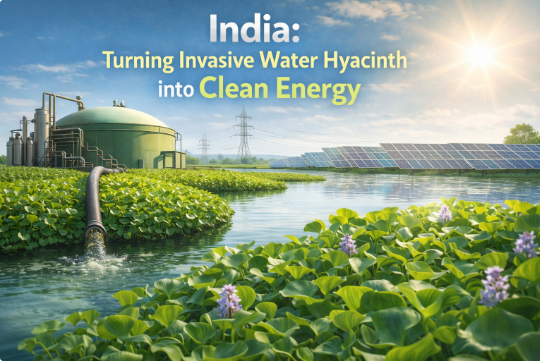
India: Generating Energy from the Invasive Water Hyacinth Plant
India’s lakes and backwaters are full of a plant with glossy leaves and lavender blooms that looks charming from a distance and nightmarish up close: water hyacinth (Eichhornia crassipes). It isn’t just invasive; it’s a green flood that suffocates waterways, smothers fisheries, clogs irrigation canals, and chews through municipal budgets. Yet wrapped inside this nuisance is a timely opportunity. With the right tech and policy nudge, India can turn this aquatic menace into clean energy—biogas for cooking, bioethanol for blending, and even briquettes for industrial heat—while cleaning up wetlands and creating livelihoods. That’s the elegant promise: solving an ecological problem and an energy problem at once.
The problem we already pay for
Water hyacinth thrives on nutrient-rich wastewater and loves the Indian climate. It doubles its biomass astonishingly fast, forming dense mats that block sunlight and strip oxygen from the water below. Fish populations plummet; mosquito breeding soars. Municipalities, lake authorities, and tourism boards end up paying for constant removal—cutting, dragging, piling—only to see it regrow. Put simply: India already spends to manage water hyacinth. The switch is to spend smarter, channeling that biomass into energy systems that deliver tangible returns. Some state and local initiatives, university labs, and NGOs have shown that this transition is not merely theoretical; it’s technically feasible and increasingly economical when paired with community-scale infrastructure and co-products. (IJIRT)
Why water hyacinth is (surprisingly) good energy feedstock
For a plant that floats, water hyacinth carries useful chemistry. It’s rich in cellulose and hemicellulose—the structural carbohydrates microbes and enzymes love. In biogas systems, its carbon-to-nitrogen (C/N) ratio can be balanced through co-digestion—mixing the chopped plant with cow dung or other organic residues—to optimize methane yields and prevent acidification. Fixed-dome digesters, familiar across rural India, can readily accept pretreated hyacinth slurries. Lab and pilot studies keep converging on the same point: with basic pretreatment and smart co-digestion, this weed turns into cooking gas. (MDPI)
Ethanol is the second big route. After hydrolysis breaks the plant’s complex carbohydrates into fermentable sugars, yeast can do the rest. Indian researchers have explored acid and enzymatic hydrolysis and reported pathways to improve sugar release and fermentation efficiency, pushing water-hyacinth-to-ethanol from proof-of-concept toward viable feedstock status—especially when the raw material is “free” because it’s a removal burden. (ScienceDirect)
Then there’s densified solid fuel. Pressed briquettes made from dried water hyacinth (often blended with agricultural residues) can substitute for coal or firewood in certain heat applications. While briquettes won’t displace grid power, they make sense for decentralized heating, small industries, and institutions that need a cheap, cleaner-burning solid fuel. The bonus: briquetting is labor-friendly and fits village-scale enterprises. (IJNRD)
The Indian water stories behind the science
Consider Loktak Lake in Manipur, a Ramsar wetland of international importance. Loktak’s ecology has been stressed by fluctuating water levels, “phumdi” proliferation, and invasive plants including water hyacinth. That proliferation is not just a biodiversity story; it’s a biomass story. Removal campaigns have periodically harvested large quantities of floating vegetation, and the logic of linking that harvest with energy projects (biogas or briquettes) is compelling: clean the lake and power homes. Loktak is emblematic of a pattern across the Northeast and beyond: wetlands drowning in plant mass that could be tapped for community energy if we connect the dots between environment and infrastructure. (ScienceDirect)
This is not limited to one state or one lake. Across India—from Kashmir’s Dal to reservoirs and lakes in Karnataka and Kerala—authorities struggle with recurring hyacinth blooms. When communities and schools in Mysuru spotlight turning hyacinth into biofuel, they’re responding to a lived reality: a weed that keeps coming back can also fuel a circular economy if captured and processed at source. (The Times of India)
How the energy pathways actually work
1) Biogas via anaerobic digestion.
The most practical near-term route at village scale is anaerobic digestion: shred hyacinth, mix with cow dung or market waste to correct C/N and moisture, feed a fixed-dome digester, and capture biogas for cooking or electricity with a micro-generator. The digestate—the nutrient-rich slurry left after microbes do their work—becomes organic fertilizer. The science backs co-digestion to raise methane yield and process stability. Imagine a lakeside cluster of households: the community cooperative contracts local fishers and youth groups to harvest hyacinth weekly, pays by weight, and feeds a 10–25 m³ digester. The gas displaces LPG cylinders or firewood for kitchens, and the digestate supports vegetable plots that benefit from cleaner water. Studies across South Asia and Africa indicate why this works: co-digestion with slaughterhouse rumen or cow dung boosts yields and buffers pH swings, while operating temperatures near 35–37 °C are ideal for biomethanation. (MDPI)
2) Bioethanol via hydrolysis and fermentation.
For ethanol, the workflow is more industrial: harvest, dewater, pretreat (acid or enzymatic), saccharify, ferment, and distill. Indian research teams—including at IIT Kharagpur—have probed process tweaks that improve sugar liberation and ethanol yield, such as optimizing acid concentration, temperature, and residence time, and exploring fungal inocula that perform well on lignocellulosic hydrolysates. While ethanol plants require capex and steady feedstock logistics, co-locating a small pretreatment-fermentation unit near chronic hyacinth hotspots could make sense, especially if paired with other cellulosic wastes (paddy straw, press mud, horticulture residues) to ensure year-round operation. (Biofuels International)
3) Briquetting for thermal applications.
Dried hyacinth is bulky; densification fixes that. Simple piston or screw presses can turn chopped, sun-dried material into fuel briquettes. Blending with sawdust or crop residues improves calorific value and mechanical durability. Facilities can be micro-enterprise scale, employing local women’s self-help groups for collection, drying, and packaging—an employment-rich complement to wet digestion and fermentation. (IJNRD)
From pilot to policy: what unlocks scale
India doesn’t suffer from a lack of pilots; it suffers from pilots that don’t scale. The key unlockers are predictable feedstock logistics, integration with sanitation and wetland management budgets, and guaranteed off-take of the energy or fuel produced.
Secure the feedstock chain. Harvesting is seasonal and spiky. Municipalities can tender multi-year contracts to local cooperatives for routine removal with per-ton incentives. Where feasible, mechanical harvesters reduce labor on thick mats; shallow coves may still need manual teams. Crucially, the energy facility must sit close enough to the water that trucks aren’t hauling soggy biomass long distances. A five-tonne-per-day biogas plant can thrive on a steady flow of chopped hyacinth mixed with dung or market waste, but “steady” is the operative word. (IIT Delhi Web)
Budget linkages, not silos. Instead of treating hyacinth removal as a cost center for lake authorities and biogas as a separate energy program, braid the budgets: every rupee spent on removal should be a rupee invested in feedstock for an energy unit. Likewise, link the digestate to horticulture or forest departments to distribute as soil amendment. When the same biomass flows through three budgets—environment, energy, agriculture—the numbers add up.
Assured offtake. For biogas, community kitchens and hostels provide anchor demand; for ethanol, policy blending mandates can backstop sales; for briquettes, tie-ups with small factories and brick kilns stabilize revenues.
Jobs, health, and climate co-benefits
Turning hyacinth into energy isn’t just a kilowatt story. It creates work: harvesting crews, digester operators, lab technicians, transporters, briquette press operators. Women’s groups can manage sorting, drying, packaging, and digestate distribution—steady incomes in places where seasonal work is the norm. Health improves too: fewer smoky chulhas if biogas grows; fewer mosquitoes if stagnant mats are cleared; better drinking water when eutrophication recedes. On climate, the calculus is favorable. Methane that would have escaped from rotting mats is captured and burned as energy; biomass displaces fossil LPG, coal, or diesel; restored wetlands re-sequester carbon in sediments and plants.
What about the trade-offs?
A fair question: won’t encouraging “use” of water hyacinth risk perverse incentives to keep it around? The solution is governance: removal volumes should be set by wetland restoration targets, not by energy quotas. Energy facilities must design for mixed feedstocks—pair hyacinth with crop residues and market waste—so plant utilization doesn’t depend on a permanent weed problem. Another concern is nutrient contamination: hyacinth often absorbs heavy metals and pollutants. For energy routes, that’s manageable—volatile metals don’t transit into methane or ethanol in problematic amounts—but digestate use should follow basic testing protocols before field application. When in doubt, digestate can be composted and used for non-edible landscaping or soil restoration rather than kitchen gardens.
Technology pointers that make or break a project
Pretreatment matters. For biogas, chopping and brief alkaline pretreatment can accelerate hydrolysis. For ethanol, careful control of acid concentration, temperature, and retention time maximizes fermentable sugars while minimizing inhibitors. Indian lab work—especially from institutes exploring fungal inocula—shows yield gains when pretreatment is tuned to this particular biomass. (Journal of Pure and Applied Microbiology)
Co-digestion is your friend. Few single feedstocks are perfect. Blending hyacinth with cow dung or rumen waste raises methane yields and stabilizes the biology, particularly near mesophilic temperatures (~35 °C). If slaughterhouse waste isn’t available, food-market organics also help balance the nutrient profile. (ijred.cbiore.id)
Close the loop on water. Dewatering is energy-intensive; design sites near the shoreline to minimize hauling, and reuse process water. Slurries from shredders can go straight to digesters; pressed solids can head to briquetting.
Modularity beats monoliths. Think clusters: a few 10–25 m³ digesters around a lake instead of one mega-plant. If one goes down for maintenance, the rest keep running; community ownership stays local; feedstock transport stays short.
Where India can lead in 2025 and beyond
India’s strength is not only scientific—though the bench science around saccharification, fermentation, and digester biology is robust—but organizational. The country knows how to run cooperatives, self-help groups, and decentralized infrastructure. That’s exactly the governance model hyacinth-to-energy needs. Marry neighborhood-scale digesters with municipal purchasing; pair university process know-how with startup grit; give women’s groups contracts for briquette operations; embed lake cleanup targets into power-and-fuel procurement.
Serious environmental stewardship makes for serious economic sense. Loktak’s floating phumdis and hyacinth mats, Dal’s weed-choked channels, and Mysuru’s struggling lakes can be stages where India demonstrates a circular economy at work: a cleaner waterway, a healthier community kitchen, a new line of income, a few cylinders of LPG not purchased, a few sacks of digestate nourishing vegetables instead of leaching into rivers. These are small wins individually, but they add up—and they compound when projects learn from each other.
A quick tour of the evidence
Peer-reviewed work has detailed how co-digesting water hyacinth with cow manure or rumen residues improves methane yields and process stability, while techno-economic analyses have modeled fixed-dome digesters as LPG replacements in rural India. Indian labs have also explored ethanol production, from acid hydrolysis to enzyme-assisted routes and fungal inoculants, reporting yield improvements and process parameters suitable for scale-up. Field-adjacent reports document five-tonne-per-day biogas initiatives using hyacinth as feedstock, and civic stories—from Manipur to Mysuru—show a rising public appetite for turning the weed problem into a fuel solution. Together, they support a simpler conclusion: India can, and should, make energy out of its water hyacinth problem. (MDPI)
What to do next—today
If you’re a city official, start by mapping your hyacinth hotspots and tonnage across seasons; match that with nearby organic co-feedstocks and candidate sites for digesters or briquetting sheds. If you’re in a university or startup, pick one weak link—pretreatment cost, enzyme reuse, inhibitor removal, briquette durability—and make it your obsession. If you’re an NGO, organize harvesters and negotiate fair per-ton contracts, plus revenue share on energy sales. And if you’re a citizen, keep the pressure on for joined-up thinking: wetlands, energy, and jobs belong in the same conversation. This isn’t speculative utopia. It’s a shovel-ready strategy hiding in plain sight on the surfaces of India’s lakes.
SEO keywords (single paragraph): India renewable energy, water hyacinth bioenergy, water hyacinth biogas India, bioethanol from water hyacinth, invasive species energy solution, circular economy India, wetland restoration India, Loktak Lake water hyacinth, Dal Lake weed removal, biogas plant India, anaerobic digestion India, co-digestion cow dung, fixed-dome digester, ethanol production India, lignocellulosic biomass, briquettes from water hyacinth, sustainable rural energy, clean cooking fuel India, waste-to-energy India, biomass pretreatment, fungal inoculum ethanol, community energy projects India, women’s self-help groups energy, lake restoration and energy, decentralized renewables India, climate action India, municipal solid waste co-digestion, affordable clean energy India, green jobs India, eco-friendly fuel India.