
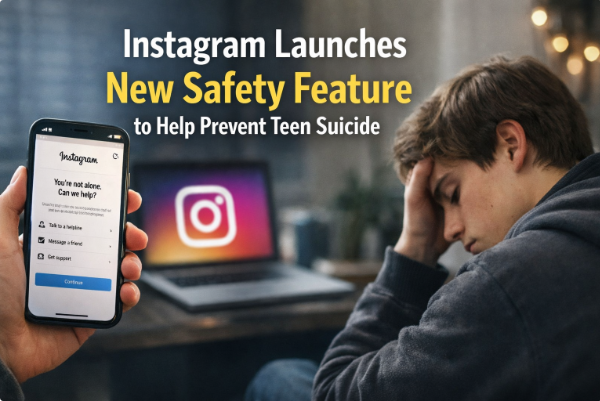
Instagram Launches New Safety Feature to Help Prevent Teen Suicide
In the strange modern ritual of parenting, we teach teenagers how to cross real streets—then hand them a device that can drop them into a thousand emotional alleyways before breakfast. Social media can be a lifeline (community, identity, support) and a landmine (comparison, harassment, spirals). The hardest part is that the danger is often quiet. A teen doesn’t always announce they’re struggling. Sometimes they search.
That’s the idea behind Instagram’s newest safety update, announced by Meta on February 26, 2026: Instagram will begin notifying parents who use parental supervision when their teen repeatedly searches for terms associated with suicide or self-harm within a short time window. (Facebook)
This isn’t a flashy “new feature” in the way social platforms usually mean it—no new filters, no shiny engagement gimmicks. It’s a digital safety feature aimed at something brutally real: teen suicide prevention and earlier intervention when warning signs appear. It also signals a broader shift in how major tech companies are trying (sometimes clumsily, sometimes sincerely) to treat online safety as more than just a PR checkbox.
What Instagram’s New Safety Feature Actually Does
Here’s the core of it:
If a teen repeatedly attempts to search Instagram for terms related to suicide or self-harm within a short period of time, Instagram will send an alert to their parent/guardian if the family is enrolled in Instagram’s parental supervision tools. (Facebook)
These parent alerts will arrive via email, text, or WhatsApp (depending on the contact information available), and also as an in-app notification. (Facebook)
Tapping the alert opens a full-screen message explaining that the teen has repeatedly searched for terms associated with suicide or self-harm. Parents will also be able to access expert resources to help them approach a potentially sensitive conversation. (Facebook)
Rollout starts next week for supervised accounts in the U.S., U.K., Australia, and Canada, with additional regions planned later in 2026. (Facebook)
The important nuance: Instagram says it designed this to balance safety with false alarms by using a threshold—meaning it’s not “one search and your parents get pinged.” It requires a few searches in a short span, and Meta says it analyzed search behavior and consulted its Suicide and Self-Harm Advisory Group to decide that threshold. (Facebook)
This is a very modern compromise: not full surveillance, not pure hands-off. More like a smoke detector—sometimes it goes off when you burn toast, but you still want it installed.
Why Search Behavior Matters in Teen Mental Health
A lot of digital safety tools focus on what teens post or who they message. But search is different: it’s often what people do when they’re alone, unsure, scared, or trying to name what they feel. Search can be a private signal of distress—especially for adolescents who don’t have the words (or the trust) to say things out loud.
From a prevention standpoint, the logic is straightforward: earlier detection can create earlier support, and that can matter. Globally, suicide remains a major public health issue; the World Health Organization notes that suicide was the third leading cause of death among 15–29-year-olds globally (2021 data). (World Health Organization) In the U.S., CDC reporting shows significant portions of high school students experience suicidal ideation and planning; for example, CDC summaries cite that 1 in 6 U.S. high school students reported making a suicide plan (most recent 2023 data in the referenced summary). (CDC)
Those numbers aren’t here to shock you—they’re here to underline a basic reality: a non-trivial number of teens are struggling, and not all of them are getting help quickly.
How This Fits Into Instagram Teen Safety and Parental Supervision
Instagram is positioning this update as part of its broader push around Teen Accounts and parental supervision. Teen-focused protections are designed to reduce unwanted contact, reduce exposure to sensitive content, and give parents guardrails without giving them full access to private conversations.
For example, Meta has described Teen Accounts as providing built-in protections that limit who can contact teens and what content they see, with extra restrictions for younger teens. (Facebook) They’ve also emphasized that in supervision tools, parents can’t read their teen’s messages, but they may get limited insights such as who their teen messaged in a recent period, and they can set daily usage limits. (Facebook)
The new suicide/self-harm search alert fits that same philosophy: it does not claim to reveal everything a teen does, but it tries to surface a specific risk pattern that might warrant support.
What Parents Will (and Won’t) See
It’s tempting to imagine this is a “parent dashboard of doom,” but the details suggest something narrower.
What parents get:
A notification that their teen has repeatedly tried searching for suicide/self-harm related terms within a short timeframe. (Facebook)
A prompt to view expert resources on how to approach the topic. (Facebook)
What parents don’t get (based on what Meta has described):
A transcript of private chats.
Full browsing history.
A guarantee that every distressed teen will trigger an alert (this depends on supervision being enabled and the teen’s behavior matching the threshold).
This distinction matters because safety tools fail in two opposite ways: they can be too weak (missing risk) or too intrusive (breaking trust, pushing teens into secrecy). Instagram is trying to thread the needle—whether it succeeds will depend on execution and how families use it.
The Big Ethical Tension: Safety vs. Privacy (And Trust vs. Control)
Teen safety features live inside a philosophical knife fight:
Teens need privacy and autonomy to mature.
Teens also need protection because their brains are still developing, and crises can be impulsive.
Parents want to help, but surveillance can backfire, especially if a teen feels trapped or punished for being honest.
So: does this kind of alert help, or does it teach teens to hide?
The “working theory” here (and yes, it’s a theory) is that limited, high-signal alerts can be helpful if they are paired with supportive parenting, not punitive reactions. The alert is basically a nudge: something might be going on—consider showing up gently.
Meta itself frames this as “erring on the side of caution,” acknowledging there may be false positives but arguing it’s an acceptable tradeoff for early intervention. (TechCrunch)
How Teens Might React (And Why That Reaction Matters)
Teens are not lab subjects. They are clever, social, and exquisitely sensitive to perceived control. Some will feel safer knowing a parent could be alerted. Others will feel exposed. And some will simply route around the feature by searching elsewhere.
That doesn’t make the feature useless; it means it’s one layer in a multi-layer safety approach. Think “seatbelt,” not “invincibility cloak.”
A realistic view is:
The feature could help families already using supervision who want guardrails.
It could surface risk in households where parents are supportive but unaware.
It could fail when parents respond with anger, shame, or punishment.
It could be irrelevant for teens whose distress doesn’t show up in Instagram search.
Tech can’t replace care. But it can sometimes interrupt silence.
Why This Announcement Is Also About Platform Accountability
Instagram, TikTok, and other social platforms have faced intense scrutiny over youth mental health, harmful content exposure, and algorithmic amplification. In that climate, “safety feature” announcements can feel like reputation management.
Still, it’s fair to judge features by what they do, not just why they were released. This update introduces a concrete mechanism: when a supervised teen repeatedly searches for high-risk terms, the system alerts parents and offers expert guidance. (Facebook)
That’s actionable. It’s measurable. It can be tested.
A useful question for the industry (not a rhetorical one, just a practical one) is: Will platforms start treating self-harm prevention like fraud prevention—something that triggers real-time interventions? We’re seeing hints of that direction.
What’s Next: AI Conversations and Expanded Notifications
One detail that’s easy to miss but important: Instagram says it is building similar parental notifications for teens’ conversations with AI, planned for later in 2026. (Facebook)
That matters because more teens are increasingly interacting with AI assistants (inside apps and outside them) when they’re lonely or distressed. If those conversations become another “search-like” signal, platforms may try to create safety tripwires there too. Done carefully, that could be helpful. Done recklessly, it could become a trust catastrophe. The design choices will matter: thresholds, context, resources, privacy boundaries, and whether the feature nudges toward help instead of punishment.
What This Means for Schools, Counselors, and Youth Mental Health Advocates
While this update is aimed at parents, it has broader implications:
School counselors and youth mental health professionals may see more families initiating conversations earlier—sometimes awkwardly, sometimes urgently.
Suicide prevention advocates will likely pressure platforms to expand beyond search signals into better content moderation and friction for harmful rabbit holes.
Digital wellbeing efforts may increasingly focus on “early warning” indicators instead of only banning content after it spreads.
It’s also a reminder that prevention is not a single intervention. It’s a system: supportive relationships, accessible care, crisis resources, healthy routines, and yes—safer digital environments.
A Practical, Human Way to Use This Feature (Without Becoming the Internet Police)
If you’re a parent reading this, the best “how-to” is not technical—it’s relational:
Treat the alert as concern, not evidence. A teen can search terms out of curiosity, empathy for a friend, or fear about their own feelings.
Start with care, not interrogation. “I got a notification that made me worry. I love you. Are you okay?” goes farther than “What did you do?”
Avoid punishment. If the response is shame or confiscation, you teach secrecy.
Use the expert resources. Meta says the alert provides access to guidance for approaching sensitive conversations. (Facebook)
Escalate to professional help when needed. Safety features are not therapists.
And if you’re a teen reading this: the existence of an alert doesn’t mean you’re “in trouble.” It means the adults in your life may be invited (imperfectly) to notice you sooner.
Crisis Support (Because This Topic Deserves Real-World Help, Not Just Blog Words)
If you or someone you know is in immediate danger or thinking about self-harm, seek urgent help from local emergency services or a crisis hotline in your country. In the U.S., you can call or text 988 for the Suicide & Crisis Lifeline, and outside the U.S. you can use the International Association for Suicide Prevention directory to find local resources. (TechCrunch)
The Bottom Line
Instagram’s new parental alerts for repeated suicide/self-harm searches are a serious attempt to build preventative safety infrastructure into a platform where teens spend real time living real emotional lives. The feature is limited to families using parental supervision, it uses a threshold to avoid one-off panic triggers, and it aims to connect parents with expert resources when a risk signal appears. (Facebook)
It won’t solve teen mental health. It won’t replace therapy, community, or safe home environments. But it might help in the moments that matter most: the quiet moments, before a crisis becomes a headline, when a teen is searching for words and a parent is searching for a way to show up.
SEO Keyword Paragraph (high-ranking, relevant keywords)
Instagram new safety feature, Instagram teen safety, teen suicide prevention, parental supervision tools, Meta Instagram update 2026, self-harm search alerts, mental health resources for teens, social media safety features, online safety for teenagers, digital wellbeing, Instagram Teen Accounts, cyberbullying prevention, youth mental health support, suicide awareness, responsible social media parenting, teen online privacy, preventing self-harm content, parental controls on Instagram, child safety online, Meta safety announcements 2026.