
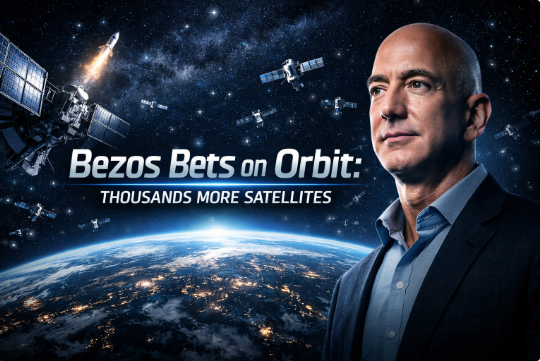
Jeff Bezos wants to launch thousands of new satellites into space
When Jeff Bezos says he wants to put thousands of new satellites into space, he’s not pitching a sci-fi sequel. He’s describing a vision in which broadband isn’t a privilege of geography but a utility as universal as electricity—delivered not by cables in the ground but by constellations of machines whispering to Earth from low orbit. The idea is simple to say and ridiculously hard to do. It demands precision manufacturing at scale, rockets that fly like commercial airliners, lasers that speak faster than storms can interrupt, and ground networks that can juggle millions of handoffs per minute. It’s also a high-stakes race, because the first companies to build robust, affordable service in low Earth orbit (LEO) will likely shape the next decade of the internet.
Today, 23-01-2025, the conversation centers on Bezos’ push to expand satellite broadband through a massive LEO constellation—best known under the umbrella of Amazon’s Project Kuiper—and the broader strategy webbing it together: launch capability via Blue Origin, cloud muscle through AWS, and a retail and logistics empire that’s terrifyingly good at operational scale. If you want to understand why “thousands of satellites” is more than a boast, you have to zoom in on the interplay of three engines: space hardware, network architecture, and business model.
Why “thousands” is the magic number
One satellite can broadcast to a lot of people. Thousands can shape coverage, capacity, and latency in ways that feel like fiber. The physics here is friendly: LEO satellites orbit a few hundred to roughly 1,200 kilometers up—far closer than traditional geostationary satellites parked at ~36,000 km. Closer means lower latency (the round-trip time for data) and less power per link. But because LEO craft whip around the planet every ~90 to ~120 minutes, any one satellite can only see a particular patch of Earth for a short window. To maintain continuous connectivity for every user at every latitude—and to keep enough bandwidth in crowded regions—you need a dense constellation.
“Thousands” also matters for resilience. Constellations degrade gracefully. If a satellite fails, neighboring craft can shoulder the load. Diversity isn’t just a buzzword; it’s how you keep video calls alive in a thunderstorm, route ships in mid-ocean, and stream a match while driving across the mountains. In short, a large mesh of small satellites approximates the reliability we expect on the ground.
The Blue Origin booster
Getting thousands of satellites up requires a launch cadence that looks less like a boutique space program and more like a global airline schedule. That’s where Blue Origin’s New Glenn comes into frame. Reusability means lower cost per kilogram and, perhaps more importantly, predictable slots on the calendar. If you own both the satellites and a big chunk of your launch pipeline, you’re not at the mercy of other providers’ availability. Control of the “space-to-space” interface (launch to orbit) lets you iterate faster on satellite design, payload upgrades, and replenishment of the fleet.
Satellite internet is a “learn by flying” business. Early batches teach you where interference creeps in, how thermal behavior changes across seasons, which antennas behave best in tropical rain, and how inter-satellite laser links perform over the poles. If Blue Origin can give Kuiper steady access to orbit, that feedback loop tightens. Faster loops mean faster improvements, and in a commodity market where the price per megabit trends downward, the team that learns quickest wins.
The AWS amplifier
Amazon’s secret superpower isn’t just logistics; it’s cloud orchestration. A LEO constellation is a network that never sits still. Satellites rise and set over users every few minutes. Beams are steered, frequencies are reused, traffic is load-balanced in real time across ground stations and backhaul. This is a choreographed chaos that looks suspiciously like a hyperscale cloud problem. Cue AWS.
Think of Kuiper’s network as a sky-wide content delivery network (CDN) with orbital caches. Traffic wants to reach the nearest reliable compute edge; satellites with inter-satellite links (ISL) act as optical backbones in the sky; ground gateways and points-of-presence tie into regions where AWS can crunch, route, and optimize. It’s not hard to imagine bundled enterprise offerings: Kuiper for connectivity, AWS Wavelength or CloudFront for edge compute, IoT Core for device management, and Private 5G/5G backhaul for campus networks. For maritime, aviation, and remote energy producers, that “one throat to choke” simplicity is business catnip.
The digital divide isn’t just rural
We talk about unconnected villages and remote farms, and they absolutely matter. But the “last-mile problem” is also an “unreliable-mile” problem inside cities—places where legacy copper chokes, where landlords block new fiber, or where disaster knocks terrestrial lines offline. LEO satellites can add an always-on redundant path: a standby line that kicks in the moment a backhoe meets a buried cable, or a monsoon floods a junction box. For banks, hospitals, logistics hubs, and media studios, five minutes of downtime can cost more than a year of subscription fees. Expect multi-path routers that blend fiber, 5G, and LEO links into one seamless pipe.
The hardware at home: terminals with a brain
User terminals—those pizza-box antennas on houses and RVs—are where satellites become the internet you feel. This is where supply chain, RF wizardry, and cost curves collide. The challenge: make phased-array antennas that electronically steer beams, at consumer-friendly prices, and that just work through dust, heat, sleet, and your neighbor’s Wi-Fi mayhem. Each generation usually gets cheaper, thinner, and smarter, folding in better beamforming, dual-band operation, and power management that won’t trip an off-grid solar system.
If Amazon applies its consumer hardware playbook (see Kindle, Echo, Fire TV), we’ll likely see a family of terminals: a durable fixed antenna for homes and small businesses; a portable unit for vans and field teams; and mobility kits for trucks, boats, and aircraft. Pair those with subscriptions tuned to real use: burst capacity for live events; pay-as-you-go for seasonal cabins; “SD-WAN-ready” plans for enterprises that need to stitch multiple sites into a single virtual network.
Spectrum, regulation, and the choreography with Earth
No constellation exists in a vacuum—radio frequencies are shared, coordinated, and regulated. That means filings with national regulators, coordination with the International Telecommunication Union (ITU), and constant engineering to minimize interference with terrestrial 5G and with other satellite providers. Expect beam shaping, dynamic power control, and geofencing near sensitive radio astronomy sites. This is where software smarts—again—carry the day: adaptive networks that sense, predict, and reconfigure in milliseconds.
There’s also the orbital ballet. When you deploy thousands of satellites, space safety and debris mitigation aren’t nice-to-haves. They’re moral and economic imperatives. Constellations typically include automated collision avoidance, low-drag designs that deorbit quickly at end-of-life, and materials and attitudes (satellite orientation strategies) that reduce reflectivity to protect astronomical observations. The companies that treat dark-sky protection and end-of-life disposal as first-class features will earn goodwill that marketing money can’t buy.
The competitive reality: Starlink and beyond
No analysis can pretend this arena is empty. SpaceX’s Starlink is the clear incumbent in LEO broadband—deployed at scale, iterating fast, selling to consumers, enterprises, and governments. If Bezos is launching “thousands,” it’s partly because the benchmark has already been set high. But the race isn’t just about who can put up more satellites; it’s about who can deliver better price-to-performance, who can serve enterprise SLAs, who can integrate with cloud and edge compute, and who can do all of that sustainably.
Two things can be true at once: Starlink’s head start is huge, and there’s room for more than one global provider. The terrestrial telecom market proved that networks compete, peer, and differentiate. In LEO, differentiation might look like specialized enterprise portals, data sovereignty features for regulated industries, tiered latency guarantees, and “cloud-native” hooks that let developers steer traffic across orbit like they steer it across availability zones.
Money, margins, and the long-game
Building a global constellation is capital-intensive. Rockets, satellites, factories, ground stations, spectrum coordination, user terminals—it’s a colossal capex party, followed by opex to maintain and refresh the fleet. The path to profit winds through scale (lower cost per satellite), reusability (lower cost per launch), vertical integration (fewer middlemen), and product bundles (higher average revenue per user).
Here’s the quiet advantage for Amazon: bundling. Imagine a small business plan that includes Kuiper connectivity, AWS credits, and discounts on fulfillment or last-mile delivery analytics. Or a retail chain that links stores via LEO and runs POS, video analytics, and inventory forecasting at the edge, all billed through one invoice. That kind of integration turns a connectivity product into a platform.
Use cases that go beyond “Netflix on a hilltop”
Disaster response: When earthquakes, wildfires, or floods take down towers and fiber, LEO terminals can spin up pop-up connectivity for hospitals, shelters, and incident command centers.
Precision agriculture: Fields become data observed from IoT sensors and drones, uplinked through LEO where cellular coverage is spotty. Real-time analytics can control irrigation, pest response, and harvest timing.
Maritime and aviation: Ships and planes are literal moving targets. Phase-array mobility terminals and ISLs can keep bandwidth steady across oceans and polar regions.
Media and live events: Trucks and backpacks with bonded connections (5G + LEO) enable low-latency contribution feeds from anywhere, reducing reliance on satellite trucks or fragile local uplinks.
Energy and mining: Remote operations can connect rigs, safety systems, and AR/VR maintenance tools without building out new terrestrial infrastructure.
Government and defense: Secure overlays, traffic segmentation, and multi-orbit redundancy can create resilient national-scale backbones.
Skepticisms worth taking seriously
Let’s not hand-wave the hard parts.
Space sustainability: Even with responsible design, more satellites increase conjunctions (close approaches). Enforcing best practices—autonomous collision avoidance, rapid deorbit after failure, transparency in ephemerides—has to be table stakes.
Astronomy impacts: Brightness mitigation and coordinated observing windows aren’t optional; they’re part of being a good space neighbor. Reflectivity control and orientation strategies need to be baked into satellite design, not patched later.
Affordability: The promise only lands if pricing is accessible. Tiered plans and community Wi-Fi hubs can help, as can partnerships with governments to subsidize service in educational and healthcare settings.
Energy use: Ground terminals and satellites draw power. Designing for efficiency matters—from solar-friendly home units to power-aware routing in orbit and on the ground.
Vendor lock-in: A vertically integrated giant pairing connectivity with cloud can spook customers who fear lock-in. The antidote is open standards, exportable data, and multi-cloud support.
These critiques don’t sink the vision; they sharpen the engineering and governance that will make it durable.
The human story behind the hardware
It’s tempting to talk about this as a chess match between billionaires. That misses the point. Connectivity is a multiplier of human potential. A LEO constellation is not just a market share quest; it’s a tool for classrooms without fiber, clinics without stable backhaul, artists in rural towns streaming to global audiences, and entrepreneurs running a Shopify store from a jungle lodge. The story becomes compelling when we imagine ordinary lives bending toward opportunity because a patch of sky got smarter.
Bezos has always gravitated toward long horizons: from two-day shipping to autonomous warehouses, from e-readers to voice AI, from suborbital tourism to reusable heavy lift. Pushing thousands of satellites into orbit is consistent with that pattern: bet big on infrastructure, then let a thousand use cases bloom. Whether you admire or critique the strategy, it’s hard to deny the gravitational pull it exerts on the future of the internet.
What to watch next
Launch cadence: How frequently can new satellites reach orbit, and how quickly do replenishment waves arrive?
Terminal pricing: Do home and mobility units hit mass-market price points without sacrificing performance?
Enterprise features: SLAs, peering, private routing, observability tools, and integrations with AWS networking and edge.
Sustainability metrics: Measured albedo reductions, deorbit timelines, conjunction avoidance transparency.
Partnerships: Deals with telecoms for 5G backhaul, with governments for rural access, and with industry verticals (maritime, aviation, media) for tailored solutions.
If those dials move in the right direction, “thousands of satellites” won’t read as extravagance; it will look like the necessary architecture for a planet-scale network.
Final thought on 23-01-2025
The internet’s next leap won’t be a new app on your phone; it will be a new shape in the sky. Thousands of small, smart satellites will stitch together a more resilient, lower-latency, more inclusive network. Jeff Bezos wants to help build that sky. The gamble is audacious, the execution brutally complex, and the stakes—economic and human—undeniably high. That’s exactly why it’s worth paying attention. The future of connectivity is leaving the trench in your street and aiming for orbit.
SEO Keywords (for discoverability): Jeff Bezos satellite internet, Project Kuiper, Amazon Kuiper constellation, Blue Origin New Glenn launches, low Earth orbit satellites (LEO), satellite broadband service, Starlink competitor, satellite internet for rural areas, high-speed low-latency internet, inter-satellite laser links, AWS edge computing integration, 5G backhaul via satellite, enterprise SD-WAN over LEO, space sustainability and orbital debris, dark-sky astronomy protection, satellite user terminals phased array, maritime and aviation connectivity, disaster recovery satellite internet, digital divide solutions, affordable satellite Wi-Fi, FCC spectrum coordination, ITU filings for LEO, global satellite network coverage, cloud-native networking in space, IoT over satellite, remote work connectivity, broadband alternatives to fiber, best satellite internet 2025, Kuiper vs Starlink comparison.