
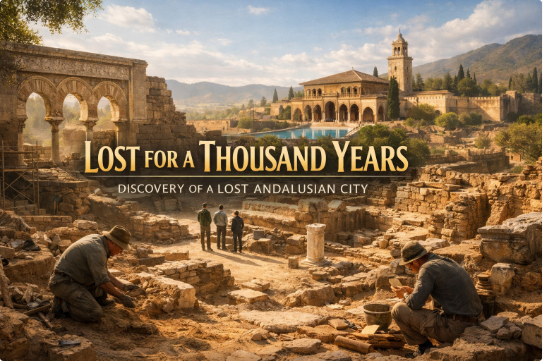
Lost for a Thousand Years: Discovery of a Lost Andalusian City
For centuries, historians and travelers have combed the river valleys and hilltops of southern Spain searching for traces of Al-Andalus—the brilliant, multi-lingual civilization that once connected the Iberian Peninsula to North Africa, the Mediterranean, and the wider Islamic world. This week, archaeologists and remote-sensing specialists have unveiled persuasive evidence for a lost Andalusian city concealed beneath farmland and scrub, its footprint preserved like a ghost in the soil. The announcement has electrified the fields of Islamic Spain archaeology, medieval Iberian history, and cultural heritage preservation, promising to rewrite parts of the map and expand how we understand daily life in the 10th to 12th centuries.
A city hiding in plain sight
The rediscovery began not with a shovel but with data—the kind of high-resolution LiDAR (Light Detection and Ranging) imagery and GIS mapping that have revolutionized archaeology worldwide. From above, what looked like unremarkable terrain revealed geometric anomalies: rectilinear foundations, curving street lines, and a defensive perimeter traced by subtle changes in elevation. Seasonal crop-mark patterns—greener stripes where buried walls retained moisture—strengthened the case. Field teams then walked the site methodically, gathering pottery sherds, fragments of glazed ceramics, pieces of roof tile, and slivers of glass that together suggested continuous occupation over several centuries.
Preliminary analysis points to a planned urban settlement laid out on a grid, with a Friday mosque at its center, a suq (market district) aligned along a main thoroughfare, and residential blocks organized around interior courtyards. The distribution of slag and ash indicates a light-industrial quarter with pottery kilns and metalworking shops; concentrations of animal bone and fish scales near a streambed point to a bustling food economy. The picture that emerges is not a lonely outpost but a node in a network—an Andalusian city plugged into the trade arteries of the Guadalquivir Basin and beyond.
Why this discovery matters
The Iberian Peninsula in the Middle Ages was not a static checkerboard of cultures but a dynamic ecosystem of towns, fortresses, farms, and monasteries with multilingual and multiconfessional populations. The palimpsest of Umayyad, Taifa, Almoravid, and Almohad rule left layers of architecture and administration that still shape Spanish landscapes and city plans today. Yet many mid-sized towns that once balanced rural hinterlands with urban crafts vanished during later conflicts, economic shifts, or river course changes. Finding one of these places intact—its bones undisturbed by heavy modern construction—offers an unprecedented laboratory for studying:
Urban planning in Al-Andalus: street widths, water-management systems, drainage, and neighborhood organization.
Craft production and trade: kiln technologies, fabric typologies of ceramics, and exchange links to Seville, Córdoba, and North Africa.
Religious and civic space: the layout of mosques, possible madrasas, bathhouses (hammams), and administrative buildings.
Foodways and environment: archaeobotanical and zooarchaeological remains that reveal diets, farming regimes, and climate responses.
Each of these questions connects to broader debates about Mediterranean connectivity, Islamic art and architecture, and the transformation of medieval Iberia during the Reconquista and the centuries that followed. In short, the discovery is not just local news; it’s a continental story with global ripples.
How archaeologists recognized a city
The pathway from anomaly to credible city runs through comparative method, careful stratigraphy, and multiple lines of evidence. Specialists in remote sensing flagged wall lines and street grids with a LiDAR-based digital terrain model. Soil scientists then sampled targeted spots, testing for phosphate signatures that cluster where humans lived, worked, and kept animals. Ground-penetrating radar (GPR) refined the picture, revealing dense reflectors consistent with stone foundations and floors. Only after this non-invasive prelude did the team open a set of small, controlled test trenches.
Those trenches found what technology had promised: mortared stone walls bonded with earthen material, plaster fragments with faint pigment from interior decorations, and floors made of packed marl. In one locus, excavators uncovered a niche aligned toward the southeast—likely part of a mihrab wall within a small oratory. In another, they found channels for qanat-style water distribution, an efficient low-gradient system for bringing water across short distances. Radiocarbon dating of charred seeds and short-lived wood samples provides a preliminary window of occupation between the late 900s and mid-1100s, a period of intense political experimentation and artistic flowering in Al-Andalus.
Threads that tie the city to the wider world
Material culture is the city’s passport. Among the surface finds are green-and-manganese glazed bowls, cordoned jars, and lusterware fragments that speak to skilled craftsmanship and commercial links. A few pieces bear script in Kufic and early Naskh, potentially dedicatory or owner’s marks. The presence of amphora sherds typical of coastal trade suggests the flow of fish sauces, oils, or wine (for non-Muslim residents), while weighing stones hint at standardized transactions in the marketplace.
Small objects can transform interpretation. A bone gaming piece suggests leisure culture; an iron arrowhead and a stirrup might indicate mounted patrols or a garrison; spindle whorls and needles spotlight textile production. Together, these finds paint the portrait of a complete community: artisans, traders, scholars, children, shepherds, and cooks—ordinary lives lived in an extraordinary moment of history.
Faith, learning, and the built environment
At the city’s core, the Friday mosque anchors not only worship but community governance, education, and dispute mediation. The suspected mosque footprint—forecourt, arcaded prayer hall, and minaret foundation—echoes regional typologies known from Córdoba and smaller Taifas. Nearby, stone basins and subterranean channels imply a hammam, an essential social institution that bridged hygiene and sociability. Streets around the central square show shopfront thresholds with wear patterns where doors once pivoted and merchants displayed wares.
Residential spaces follow a familiar Andalusian grammar: introverted houses organized around an interior patio, fountains or cisterns for water storage, and stucco ornament in higher-status homes. Such architecture regulated microclimate—cooler in summer, warmer in winter—and extended family networks. Over time the city grew by infill: partitions subdivided large houses, narrow lanes turned into covered passages, and small courtyards sprouted ovens or workshops. Archaeologists can watch these changes stratigraphically, reading walls the way historians read charters.
Water is destiny: the environmental puzzle
No Andalusian settlement thrived without clever water management. Cisterns tucked beneath courtyards, clay pipes, and channel cuttings indicate a multi-source water strategy: rain capture, local springs, and perhaps a small aqueduct tapping a seasonal stream. Sediment cores from a nearby marsh reveal pollen spectra dominated by olive and cereal, pointing to a mixed agro-pastoral economy where groves lined the slopes and fields quilted the plains. Charcoal fragments tell a subtler story of fuel use, with shifts from hardwood to scrub species over time—possible signals of population pressure or changing fuel economies as kilns and forges demanded heat.
Understanding these environmental rhythms matters for today’s climate-stressed world. Medieval Andalusian farmers practiced dryland strategies, terracing, and drought-resilient planting cycles—knowledge still valuable for contemporary sustainable agriculture in southern Europe and North Africa.
Why cities vanish—and how they survive underground
The city’s disappearance may owe more to economics and geopolitics than to catastrophe. As power centers shifted and new trade corridors opened or closed, some towns lost tax bases and administrative privileges. River silting could have choked access; a new fortress downriver might have diverted protection and patronage. Eventually, the site was abandoned, its stone robbed for later farms and chapels, its plan softened by plows. Paradoxically, that quiet burial preserved it. Without the deep foundations of a modern town above, the archaeological layers remained coherent and legible, a time capsule waiting for 21st-century methods to open it.
Community engagement and ethical stewardship
Great discoveries are fragile if the communities who live with them feel excluded. The project team has partnered with local landowners, schools, and municipal authorities to craft a heritage management plan that balances research access, conservation, and economic opportunity. Proposed actions include protective zoning, site guardianship training, and a phased approach to excavation that avoids over-exposing delicate features. There’s talk of a visitor trail guided by augmented-reality overlays, enabling people to visualize streets and buildings without erecting intrusive reconstructions.
Crucially, the team stresses open data. Publishing 3D models, orthophotos, and artifact catalogs ensures transparency and invites collaboration—from ceramic specialists in Granada to environmental archaeologists in Lisbon and historians of Islamic law in Fez. When heritage becomes a shared resource, it grows in value for everyone.
Technology at the frontier of discovery
What makes this find emblematic of modern archaeology is the fusion of digital tools with careful excavation. Photogrammetry captures trenches millimeter by millimeter; RTI (Reflectance Transformation Imaging) teases inscriptions from eroded surfaces; portable XRF offers rapid, non-destructive chemical characterization of metals and pigments. The project’s GIS doesn’t just store data; it tests hypotheses, modeling how sunlight, wind, and noise flowed through streets and how residents might have moved across the urban fabric at different times of day.
Next steps include ancient DNA (aDNA) sampling from animal bone for herd management insights, isotopic analysis of human teeth (if burials are identified) to trace mobility and diet, and microarchaeology of floors to detect residues of cooking, dyeing, or craft work. Every technique adds another layer to the story of Andalusian urbanism and the cultural crossroads it embodied.
Tourism, sustainability, and the risk of success
With visibility comes pressure. Heritage tourism can fund conservation and enliven local economies, but it can also strain infrastructure and commodify the past. Planners are exploring low-impact tourism models that prioritize slow travel, guided small-group visits, and seasonal dispersal to avoid peak-season bottlenecks. Partnerships with local artisans—ceramicists, woodworkers, textile makers—can channel interest into living crafts rather than mass-produced souvenirs. Done right, the city’s rebirth can help sustain the landscapes and communities that protected it for a millennium.
What this means for the history of Al-Andalus
History often defaults to capital cities and courts, but civilizations are made in the spaces between: market towns, workshops, and household courtyards where ideas and techniques travel hand to hand. This lost Andalusian city re-centers that vantage point. The alignment of its streets, the balance of sacred and commercial spaces, the fingerprints of women’s labor in textiles and food preparation, the adaptive hydrology—all these details enrich the big narratives of tolerance and conflict, innovation and continuity. They move us beyond clichés toward a granular understanding of how people actually lived.
For students, teachers, and travelers, the site becomes a teachable place. Imagine a class tracing Arabic-Romance loanwords through everyday objects found on site; a seminar comparing Moorish architectural patterns with later Mudéjar forms; a workshop on GIS for cultural heritage using the site’s open datasets. The discovery doesn’t just fill a gap on the map; it opens a door for new kinds of learning.
Looking ahead: careful excavation, careful storytelling
As the team heads into expanded field seasons, expectations will be managed by method. Archaeology is slow for a reason: contexts must be recorded precisely, features conserved as they’re revealed. The most exciting finds may be microscopic: seeds that rewrite farming calendars, soot that traces ancient kitchens, mortar that fingerprints quarry sources. Whether or not a spectacular inscription emerges, the accrued weight of small evidence will give this city its voice.
Storytelling will need the same care. The past is not a stage set but a complex reality where multiple groups coexisted, collaborated, and sometimes clashed. Presenting the site with nuance—acknowledging debates, uncertainties, and the provisional nature of interpretation—will build trust with both the scholarly community and the public. In a world hungry for easy narratives, this rediscovery invites us to appreciate the texture of truth, the layered, cross-cultural story of Al-Andalus.
Practical information for readers and researchers
Those interested in following the project should watch for peer-reviewed publications, field reports, and public talks from the interdisciplinary team. Local authorities are coordinating with conservation laboratories to stabilize recovered materials, while museums in the region consider how best to curate context-rich exhibitions that foreground process as much as product. Students with backgrounds in archaeology, history, anthropology, conservation science, environmental studies, or digital humanities will find opportunities to participate through field schools and internships that emphasize both scientific method and ethical practice.
Travelers planning routes through Andalusia can already appreciate the broader context by visiting established sites and museums in Córdoba, Seville, Jaén, and Granada, where displays of ceramics, inscriptions, and architectural fragments set the stage for understanding this new discovery. Regional cuisine—olive oils, citrus, almonds, honey—echoes agricultural patterns that reach back to medieval irrigation and terrace farming. The continuities between past and present are as edible as they are visible.
A city returns to the world
The ground has kept its secrets for a thousand years, but secrets don’t last forever—especially when satellites, sensors, and patient science help us ask the right questions. What rises now from the soil is not just stone but memory: of markets that chimed with barter, of prayers that braided voices with birdsong, of paths worn smooth by sandals on errands ordinary and sacred. To stand at the edge of those streets, even in imagination, is to glimpse a living Andalusian city at the height of its powers—confident, connected, and creative. Rediscovering it is more than an archaeological event. It is a reminder that the past still inhabits the present, shaping rivers, recipes, and place-names, and that careful, collaborative work can bring a vanished world back into view.
SEO Keywords (single paragraph): lost Andalusian city, discovery of a lost city in Spain, Al-Andalus archaeology, Islamic Spain archaeology, medieval Iberia history, Moorish architecture, Andalusian urban planning, LiDAR archaeology Spain, GIS mapping heritage, Guadalquivir Basin settlement, Umayyad period Spain, Taifa kingdoms archaeology, Almoravid Almohad history, medieval mosque excavation, hammam archaeology, qanat water system Iberia, Andalusia cultural heritage, Seville Córdoba Granada history, Moorish ceramics lusterware, medieval trade routes Spain, archaeobotany Iberia, zooarchaeology Spain, sustainable heritage tourism Andalusia, open data archaeology, Spanish medieval city rediscovery, Islamic art and architecture Spain, reconquista era towns, crop-marks archaeology, ground-penetrating radar Spain, digital humanities cultural heritage, best places to visit Andalusia history, historical travel southern Spain, archaeology news 2025 Spain, cultural tourism Andalusia, Mediterranean trade medieval, heritage conservation Spain, remote sensing archaeology Europe, ancient DNA isotopes Iberia, medieval irrigation terrace farming, Andalusian crafts and markets.