
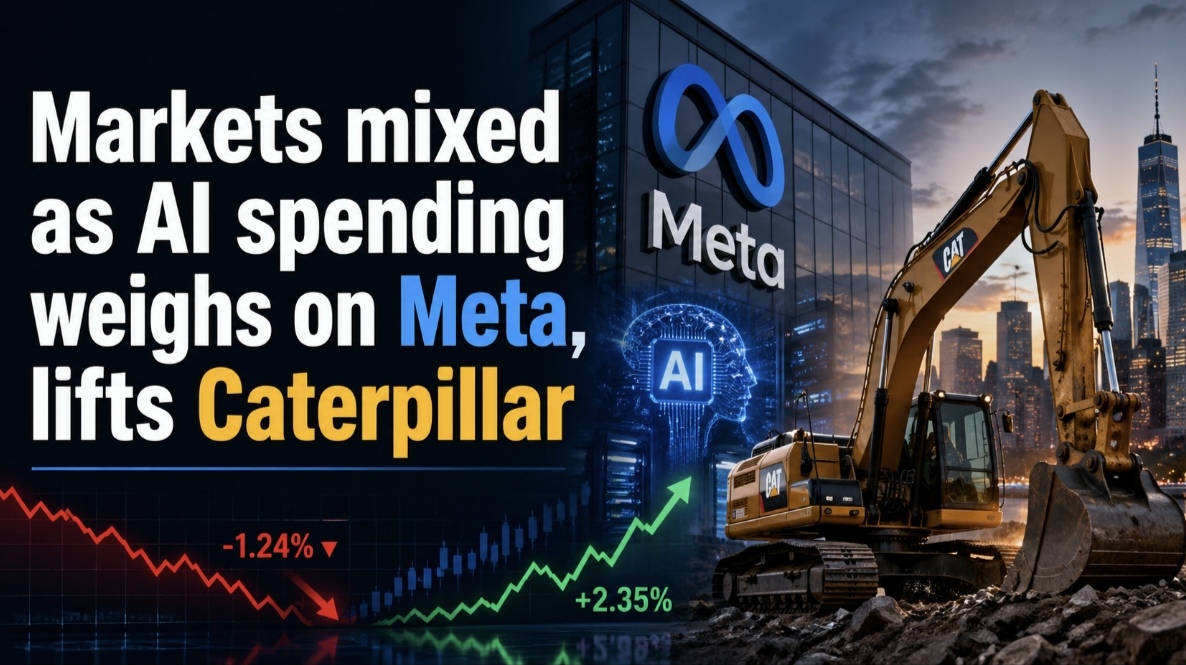
Markets Mixed as AI Spending Weighs on Meta, Lifts Caterpillar
On April 30, 2026, the stock market told a very modern story: artificial intelligence is still one of the biggest engines in global equities, but investors are becoming far more selective about who benefits first and who has to pay the bill. That tension showed up clearly in the day’s trading. Meta came under pressure after increasing its already massive spending plans for AI infrastructure, while Caterpillar moved higher as investors embraced the idea that the AI boom does not only help software platforms and chipmakers, but also the companies that build the physical backbone of the new digital economy. Reuters reported that Wall Street was mixed overall, with industrial names helping the Dow while some large technology shares lagged amid concerns about the rising cost of AI expansion.
That contrast matters because it captures where the market is right now. For most of the AI trade, investors were willing to reward nearly any company that promised bigger AI ambitions. In 2026, that enthusiasm is becoming more disciplined. The market is still excited about artificial intelligence, machine learning, data centers, cloud infrastructure, and automation, but it now wants proof that spending will create near-term revenue, higher margins, or durable competitive advantage. If a company announces huge AI capital expenditure without giving investors confidence on the payoff timeline, the stock can struggle. If another company shows that AI demand is already translating into orders, backlog growth, and higher profits, the stock can rally. That is exactly why Meta and Caterpillar moved in opposite directions even though both stories were tied to the same AI megatrend.
Meta’s result was a reminder that even strong earnings are not always enough when expectations are shaped by spending discipline. Reuters reported that Meta raised its 2026 capital expenditure forecast to $125 billion to $145 billion, up from $115 billion to $135 billion, as it doubles down on artificial intelligence infrastructure. The company still posted first-quarter revenue of $56.31 billion, beating expectations, but investors focused on the bigger spending bill rather than the headline revenue beat. That reaction speaks volumes about the current market mood. Investors are not rejecting AI. They are asking whether the scale of spending across Big Tech is getting ahead of visible returns.
This is where the Meta story becomes especially important for anyone following Meta stock, AI spending, Big Tech earnings, or the broader stock market today narrative. Meta is not simply spending more on servers, chips, and computing capacity because it wants to experiment. It is spending because the race for advanced AI tools, personalized recommendation systems, ad targeting improvements, and next-generation consumer products now requires enormous data center capacity. In other words, AI is no longer a side project for companies like Meta. It is becoming core infrastructure. The challenge for investors is that infrastructure-heavy growth often compresses confidence before it expands future earnings. Markets tend to celebrate the payoff later than they price in the cost.
The broader backdrop makes that concern even sharper. Reuters reported earlier this week that four of the biggest technology companies are on track to spend around $600 billion on AI this year, a historic level of outlay that is testing Wall Street’s patience even as investors continue to believe in the long-term promise of the technology. That means Meta’s spending plan is not being judged in isolation. It is being evaluated as part of a much larger conversation about AI monetization, capital intensity, free cash flow pressure, and whether the current phase of the AI boom is rewarding builders, sellers, or enablers first. This is why market reactions around earnings season have become more nuanced: a company can be right strategically and still be punished tactically if investors think the spending curve is too steep.
Caterpillar, by contrast, gave investors the kind of AI exposure they increasingly like: grounded, visible, and tied to real-world demand. Reuters reported that Caterpillar raised its annual and long-term revenue forecasts as demand for power generation and construction equipment surged alongside the AI-driven data center buildout. The company’s order backlog climbed to a record $62.7 billion, and management said it now expects power generation equipment sales to triple by 2030 from 2024 levels. In a market looking for practical beneficiaries of AI, that was a powerful message. Caterpillar was not promising a future platform or a still-forming monetization strategy. It was showing investors that AI demand is already producing orders, backlog, and earnings.
The quarterly numbers reinforced that argument. Reuters reported that Caterpillar posted first-quarter 2026 profit of $5.54 per share, beating analyst expectations of $4.62, while revenue jumped 22% year over year to $17.42 billion, the company’s strongest growth in roughly four and a half years. Construction revenue rose 38%, and the power and energy segment increased 22%. Those are not abstract signals. They show that the AI boom is feeding demand far outside the usual technology names, particularly in the areas needed to build, energize, cool, and support large-scale data centers. That gives Caterpillar a compelling place in the AI investment narrative, especially for investors looking beyond semiconductors and software.
This is one of the most interesting shifts in the AI stock market story. In the first phase, winners were mostly obvious: chip designers, cloud providers, and software companies with direct exposure to generative AI. In the next phase, the winners may be broader and more industrial. AI requires electricity. It requires backup power. It requires site preparation, heavy equipment, construction execution, logistics, and long-term maintenance. That is why companies like Caterpillar are suddenly being discussed not just as cyclical industrial stocks, but as strategic plays on data center infrastructure, power generation, and AI supply chain growth. The market is beginning to price in that second-order effect, and Caterpillar’s earnings helped validate it.
The mixed market action on April 30 also reflected a more complicated macro environment. Reuters said the S&P 500 and Nasdaq were still on track for their biggest monthly gains since 2020, helped by strong corporate earnings, but the session itself remained uneven as oil prices spiked, technology shares showed mixed reactions to results, and investors weighed the implications of persistent inflation and higher-for-longer interest rates. The same report noted that industrials such as Caterpillar helped lift the Dow, while Meta and Microsoft weakened on concerns about rising AI-related costs. In other words, the market was not broadly risk-off. It was rotating inside the AI theme, rewarding visible beneficiaries and pressuring companies that appear to be accelerating spending faster than immediate returns.
That macro setting matters because it changes how investors interpret earnings. When money is cheap and inflation is calm, markets often give management teams more time to invest. When oil prices are elevated, inflation stays above target, and the Federal Reserve remains cautious, the tolerance for open-ended spending drops. Reuters reported that inflation remained above 3%, while the Fed held rates steady in a notably divided decision. That is not the ideal environment for a “trust us, the payoff will come later” narrative. It is a much better environment for companies that can say, “the demand is already here, here is the backlog, and here is the profit.” That difference helps explain the market’s split reaction to Meta and Caterpillar.
For Meta, the market’s skepticism does not necessarily mean the strategy is wrong. In fact, it may mean the opposite: the company likely believes the AI race is so important that underinvesting would be more dangerous than overspending. But public markets often separate strategic necessity from short-term shareholder comfort. A larger capex range can be interpreted as ambition by management and as risk by investors at the same time. That tension is now central to the Meta earnings story, the Meta stock forecast debate, and the broader question facing every hyperscaler: how much AI infrastructure spending is enough, and how much is too much before monetization catches up?
For Caterpillar, the enthusiasm comes from being positioned one layer deeper in the value chain. The company is benefiting from the physical buildout of AI rather than from the direct software race. That can be an attractive place to be when investors want exposure to structural growth but also want tangible order flow and diversified end markets. Caterpillar still faces challenges, including tariffs and manufacturing cost pressure; Reuters said the company absorbed $710 million in unfavorable manufacturing costs in the quarter, largely due to tariffs, though it lowered its projected tariff impact for the year to $2.2 billion to $2.4 billion. Even with those headwinds, investors focused on the strength of demand and the improved growth outlook.
The bigger lesson for readers, investors, and anyone searching for insight on Wall Street today, U.S. stock market news, or AI stocks to watch is that the market is entering a more mature phase of the AI trade. Excitement remains high, but the benchmark has changed. It is no longer enough to say AI is important. Companies now need to show where they sit in the value chain, how the spending will be funded, when revenue will arrive, and whether demand is theoretical or already visible in the numbers. April 30 offered a clean example of this transition. Meta represented the expensive front edge of the AI race. Caterpillar represented the picks-and-shovels side of the same boom. The market treated them very differently.
For everyday readers, there is also a more human takeaway here. AI can sound abstract when it is discussed only in terms of models, software, and tech valuations. But the market’s reaction to Meta and Caterpillar makes the trend easier to understand. Artificial intelligence is not just changing apps, search, ads, or enterprise software. It is changing what gets built, where capital flows, which factories get busier, how power demand grows, and which industrial companies suddenly become essential to the next phase of digital expansion. That is why one of the most interesting market stories of 2026 is not simply “tech wins from AI.” It is “the whole economy is reorganizing around AI, and the winners may come from very different sectors.”
So, are markets mixed because investors are losing faith in AI? Not at all. The opposite may be true. Markets are mixed because AI is becoming real enough, large enough, and expensive enough to force tougher judgment. Investors are distinguishing between companies that must spend heavily now to secure future dominance and companies that are already collecting revenue from the buildout. On April 30, 2026, Meta fell into the first category and Caterpillar into the second. That divergence is likely to define many more trading sessions ahead, especially as earnings season continues and Wall Street keeps asking the same question in different ways: who is funding the AI revolution, and who is getting paid from it today?
SEO keyword paragraph: Markets mixed on April 30, 2026 as AI spending, Meta stock, Caterpillar stock, Wall Street earnings, stock market today, U.S. stock market news, S&P 500, Nasdaq, Dow Jones, Big Tech earnings, Meta earnings, Caterpillar earnings, artificial intelligence stocks, AI infrastructure, data center demand, capital expenditure, digital advertising, industrial stocks, power generation, data center construction, market volatility, investor sentiment, Federal Reserve outlook, inflation concerns, earnings season, AI boom, stock market analysis, and tech vs industrials remained the key themes shaping investor decisions and search interest.