
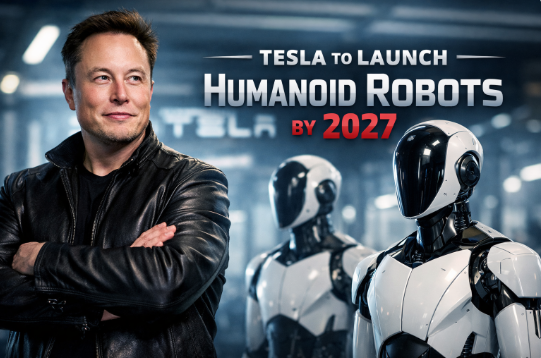
Musk announces that Tesla plans to launch humanoid robots by the end of 2027
The future just knocked—politely, on carbon-fiber knuckles. In a move that could redefine what a “Tesla product” means, Elon Musk announced that Tesla plans to launch humanoid robots by the end of 2027. This isn’t just another chapter in the company’s high-velocity saga; it’s a genre shift. For years, Tesla stretched the definition of a carmaker into that amorphous shape we call a “technology company.” With humanoid robots on the horizon, the company is now asking a bigger question: what if mobility isn’t about cars moving people, but about robots moving through the world for us?
From cars to capabilities: what “launching a humanoid robot” really means
A “launch” in robotics is not a single day on a product calendar. It’s a convergence: reliable hardware, safe autonomy, useful software, and a price point that doesn’t make CFOs and families flinch. Tesla’s announcement frames 2027 as the moment these pieces align. Think of it as a promise that by the end of that year, a general-purpose biped will be capable enough to be useful and safe enough to be trusted outside a lab or demo stage.
Humanoid form factors are notoriously hard. Legs introduce balance problems that wheels politely avoid. Hands add dexterity challenges that industrial arms solve with specialized end effectors. And the world is a chaotic place: stairs, slippery floors, cluttered apartments, pets with opinions. “Humanoid in the wild” is the robotics equivalent of doing your first piano recital on a speedboat. That’s why the 2027 target matters—it implies Tesla believes it can cross the chasm from impressive prototypes to dependable assistants.
Why humanoid robots, and why Tesla?
Tesla’s pitch is deceptively simple: the company already builds high-volume electric platforms, has deep stacks in computer vision and autonomy, and runs massive data infrastructure that trains models from real-world edge cases. Replace “roads” with “rooms,” “lanes” with “hallways,” “pedestrians” with “humans wielding dish soap,” and the software challenge starts to rhyme. Cameras, neural nets, and onboard compute are already Tesla’s native language. Humanoid robots are the next sentence.
In business terms, the overlap is compelling. Motors, batteries, power electronics, thermal management, manufacturing automation—these are Tesla’s playgrounds. A humanoid robot is, at its core, an energy-efficient, highly articulated electric machine that needs endurance, balance, and brains. A shared supply chain and manufacturing muscle could reduce time-to-market and cost per unit. If Tesla can make a robot with the repeatability of a Model 3 door panel and the reliability of its powertrains, 2027 stops looking like a moonshot and starts looking like a product deadline.
The jobs a robot can do (and the jobs a robot should do)
Let’s be honest: the first wave of general-purpose humanoids won’t teach your kids calculus or counsel you on mortgages. But they can make a dent in a long list of physical tasks that are dull, dirty, or dangerous. Picture early roles like:
Back-of-house logistics: bin picking, kitting, palletizing, and moving inventory across warehouses. If you’ve ever watched humans spend hours walking back and forth fetching parts, you see the opportunity.
Manufacturing assistance: tending machines, transferring components between stations, scanning for anomalies with a machine vision “sixth sense,” logging data, and doing quality checks that benefit from consistent, tireless attention.
Facilities and maintenance: restocking supplies, cleaning, inspecting HVAC equipment, monitoring leaks or unsafe conditions, and handling nighttime checks when staffing is tight.
In-home basics (carefully staged): carrying groceries, loading laundry, tidying spaces, and assisting with mobility aids—areas where reliability and safety are paramount and deployments will likely be supervised at first.
The phrase “by the end of 2027” carries an implicit humility: the initial feature set will be useful but bounded. Expect a phased rollout where capabilities expand via software updates, new grippers, and third-party attachments. The early market fit won’t be “everything everywhere all at once.” It’ll be targeted workflows with measurable ROI.
Safety isn’t a feature; it’s the product
A humanoid robot shares space with humans. That means the “safety case” isn’t a checkbox—it’s a dissertation. Think layered safeguards:
Mechanical design for harm reduction: rounded edges, compliant actuators, controlled torque, and force limits that keep interactions gentle even in failure modes.
Perception redundancy: overlapping camera fields of view, depth sensing, and consistent self-diagnostics for blind spots or sensor degradation.
Policy learning with guardrails: reinforcement learning that’s fenced by rule-based constraints (for example, “never exceed X newtons near a human joint”), plus on-device anomaly detection to stop motion when predictions go out of distribution.
Explainability and logs: a record of decisions, trajectories, and confidence scores, essential for post-incident analysis and constant improvement.
For home deployments, privacy is table stakes. Edge processing and local “eyes-only” modes—where video never leaves the device—will be key differentiators. The robot must be a helper, not a roaming surveillance camera.
The battery-brain trade: engineering the body for the mind
Humanoids are where energy budgets meet compute budgets. You need high-frequency control loops for balance, tactile feedback for manipulation, and vision models that parse messy, unstructured scenes in real time. Every watt poured into neural nets is a watt not available for the knees. Two engineering levers will define 2027:
High-efficiency actuation: lightweight gear trains, low-backlash transmissions, and regenerative braking on joints. The goal is biological thriftiness: convert joules to useful work with as little waste heat as possible.
Optimized AI stacks: model compression, sparsity, and hardware acceleration tailored to robot perception and control. Expect custom silicon or at least highly tuned accelerators that run multimodal models without frying the battery. The same obsession that squeezes kilometers from kWh in cars will squeeze hours from Wh in robots.
This is also a human-factor story. A robot that lasts eight hours and gracefully recharges between tasks is a teammate. A robot that dies after 90 minutes is a charger’s full-time job.
The economics: where the ROI lives
Robots aren’t bought for vibes; they’re bought for outcomes. The business case will crystallize around:
Labor scarcity and consistency: late-night shifts, high-turnover roles, and repetitive tasks where training costs eat margins.
Quality and traceability: robots can measure, log, and photograph every step, enabling defect reduction and audit trails in regulated industries.
Uptime and flexibility: unlike fixed automation, a humanoid can be re-tasked via software. That’s CapEx that behaves like OpEx—valuable in volatile markets.
Pricing will define adoption speed. If a humanoid robot can deliver the work equivalent of a few full-time roles at a total cost of ownership that undercuts alternatives (including maintenance and downtime), demand will outrun supply. If not, we’ll see limited pilots while the cost curve catches up. Either way, 2027 is the year the spreadsheet gets a say.
The software soul: from demos to dependable skills
The viral demo—folding shirts, pouring water, walking a balance beam—wins eyeballs. The market wants something less cinematic and more boring: repeatable task libraries that don’t fail on Tuesday. Expect Tesla to ship:
A core set of “skills”: walk, grasp, lift, carry, place, open, close, push, pull, sense, and signal. Each with tunable parameters (force, speed, confidence thresholds) and safety envelopes.
A behavior composer: drag-and-drop or code-first workflows to chain skills into routines—“stock shelf,” “clear table,” “inspect valve.”
Vision-language grounding: say “load the dishwasher” and the robot maps that to objects, surfaces, and actions using a multimodal model trained on mountains of annotated data and synthetic scenes.
Continuous improvement pipeline: every deployment becomes a data source. Failures feed retraining; edge successes become new defaults. The flywheel spins.
If Tesla opens a partner ecosystem—third-party grippers, perception plugins, or specialized behaviors—humanoid robots get the app-store tailwind that powered smartphones. The most useful capabilities may come from developers who don’t work at Tesla at all.
Ethics without hand-waving
The shift from screens and wheels to arms and legs forces us to ask sharper questions:
Consent and control: who approves tasks that affect people? A nursing home robot shouldn’t move residents without explicit consent protocols and supervision.
Bias and access: will richer households and well-funded facilities get the most capable helpers first, widening care gaps? How do we avoid encoding socioeconomic bias into “who gets help” and “what help is offered”?
Labor transition: robots will change job descriptions, not simply eliminate them. The humane path is reskilling: create roles for robot operators, workflow designers, and maintenance techs, and make those roles accessible.
Security: a robot is a computer that can lift things. Strong authentication, air-gapped modes, clear “safe posture” states, and fast emergency stops are mandatory. A hacked robot is not a plot device; it’s a risk category.
These aren’t optional discussions bolted on at the end. If humanoids become common, the social contract updates with them.
Competitive pressure: the rising tide of bipedal ambition
Tesla isn’t marching alone. Robotics labs and startups around the world are closing the gap between compelling demos and steady on-the-job performance. The race is not just about who ships first; it’s about who ships something that you’ll keep using six months later. Tesla’s advantages—scale, supply chain, data flywheels—will collide with rivals’ advantages—specialized manipulation research, nimble iteration, and deep customer focus in niche verticals. Competition is good. It pressure-tests claims, accelerates timelines, and raises the bar for safety.
What 2027 could look like on the ground
If Tesla hits its target, here’s a plausible day-in-the-life snapshot:
Morning in a factory: robots walk the aisles before shifts start, scanning for spills or obstructions. A handful deliver kits to stations, tuning their path as people arrive. One detects an unusual vibration in a motor housing, flags maintenance, and prevents a failure that would have cost a day of downtime.
Afternoon in logistics: two robots unload small parcels from a truck, feed a sorter, and re-stack bins. When an item doesn’t match its barcode, the system snaps images, isolates the anomaly, and routes it for human review.
Evening at home: a supervised unit assists an older adult: carrying laundry downstairs, reaching top shelves, and fetching a dropped phone. It never leaves the apartment’s private network and politely declines any request it can’t do safely.
None of this is science fiction. It’s science friction—the sanding down of a thousand edge cases until reliability becomes boring. Product-market fit in robotics feels like that: a horizon of boredom that’s actually the most exciting thing possible.
A realistic optimism
Tesla setting a 2027 launch date is a signal, not a guarantee. Robotics punishes hubris and rewards iteration. We should expect slips in specific features, targeted pilot programs before broad release, and many “we learned the hard way” patches. That’s fine. The milestone that matters is not a press conference—it’s the moment a customer calculates that the robot is not just amazing; it’s worth it.
If Tesla succeeds, it won’t merely add a product line. It will help inaugurate a new class of general-purpose machines woven into daily life—at work, at home, and anywhere humans need an extra pair of legs and hands. The story we start writing in 2025 could read, in hindsight, like the beginning of the “personal computer” of the physical world: a platform for embodied software.
What to watch from now till launch
Between this announcement and the end of 2027, a few markers will tell you whether the timeline is holding:
Factory deployments at scale: not one or two units in a carefully staged line, but dozens, then hundreds, doing repetitive work with uptime measured in weeks, not hours.
A developer program: SDKs, APIs, simulation tools, and a library of tasks that third parties can extend. Platforms beat products.
Safety certifications: external audits, compliance with emerging standards, and public test results that quantify risk and mitigation.
Price transparency: even a range tells you where the cost curve sits—and whether the early units are pilot-only or broadly accessible.
Service infrastructure: spare parts pipelines, field technicians, and remote diagnostics. Robots will need the equivalent of roadside assistance—“roomside assistance,” if you like.
These signals will matter more than sizzle reels. When they line up, 2027 looks less like a cliff and more like a slope we’ve been climbing for years.
Final thought: the shape of the next decade
Humanoid robots don’t replace human purpose. They redistribute friction. If we aim them at the right frictions—danger, drudgery, and scarcity—we free up attention for creativity, care, and connection. That’s the real promise behind a 2027 launch date. Not the spectacle of legs and arms, but the quiet, durable gains that come from embodied intelligence doing useful work. The best robots will be the least dramatic ones: reliable, respectful, and relentlessly helpful.
If Tesla hits its mark, the future won’t arrive with a drumroll. It’ll clock in, get to work, and make our world slightly less cluttered, slightly safer, and a lot more interesting.
SEO keywords (single paragraph): Elon Musk, Tesla humanoid robot, Tesla Optimus, humanoid robots 2027, AI robotics, general-purpose robots, robotics market growth, artificial intelligence in manufacturing, warehouse automation, robot safety, computer vision, machine learning, neural networks, bipedal robots, electric actuators, robot manipulation, industrial automation, logistics automation, home robotics, elder care technology, assistive robots, ethical AI, privacy in robotics, energy-efficient robots, battery life optimization, robot hardware, software updates, developer ecosystem, robot SDK, multimodal AI, reinforcement learning, edge computing, human-robot interaction, HRI, autonomous systems, Tesla innovation, future of work, Industry 4.0, smart factories, digital transformation, robotics ROI, cost of ownership, safety certifications, product launch timeline, 2027 technology trends, tech announcement, next-gen robotics, AI assistants, computer vision models, AI chips, supply chain, manufacturing technology.