
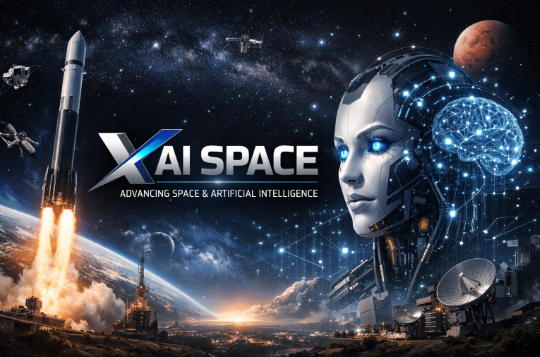
Musk merges space and artificial intelligence businesses into a single entity
On 03-02-2026, the technology world watched a long-foreshadowed plotline snap into place: Elon Musk folded his space venture and his artificial-intelligence gamble into one colossal private company. In practical terms, the move fuses SpaceX with xAI, consolidating rockets, satellites, global connectivity, real-time social distribution, and cutting-edge AI research under a single roof—and a single balance sheet. It’s a vertical-integration swing on a historic scale, carrying an eye-popping combined valuation widely reported at about $1.25 trillion and explicitly framed as a prelude to a blockbuster IPO later this year. (Reuters)
What exactly merged—and why it matters
The substance of the deal is simple to state and complex to digest. SpaceX, already the world’s most formidable launch provider, with a rapidly expanding satellite internet business via Starlink, is absorbing xAI, the lab behind the Grok large-language model and its real-time integration with the social platform X. That gives one private company a flywheel that spins from orbit to timeline: rockets deploy satellites; satellites deliver bandwidth; bandwidth feeds an AI stack and a global social graph; the AI stack, in turn, powers products, services, and analytics that can ride on top of satellite connectivity and social distribution. It’s a closed loop of hardware, networks, data, and algorithms—an end-to-end “space-to-cloud-to-screen” pipeline. Reported details underscore the scale: a $1 trillion SpaceX valuation, roughly $250 billion for xAI, and a combined enterprise that now towers over most public tech companies by private-market estimates. (Reuters)
The thesis: space-based AI as the next computing platform
At the heart of the consolidation is a specific vision: move compute closer to the power source and further from terrestrial constraints. Musk and company have argued that AI’s ballooning energy appetite collides with grid limitations, land use, and cooling challenges; a portion of AI compute, they contend, can migrate to space—solar-rich, uninterrupted, and thermally advantageous orbits—then beam results down through high-throughput links. In this telling, Starship isn’t just a cargo hauler; it’s the freight train for orbital data centers. This isn’t hand-waving: reporting tied to the merger points directly to plans for space-based AI compute and satellite-enabled data centers, with SpaceX’s heavy-lift capabilities as the linchpin. Whether the economics pencil out at scale is a live debate, but the strategy is coherent: integrate launch, satellites, networking, and inference into one stack. (The Washington Post)
Why combine now? Timing, money, and momentum
The timing is no mystery. First, SpaceX has operational momentum, recurring revenue from launches, and a fast-maturing Starlink business—an earnings engine that can bankroll more audacious bets. Second, xAI, like all frontier-model labs, faces a simple curve: capability improves as a function of compute and data; compute and data cost money. A merger brings deeper pockets and a more defensible moat. Third, lining up structure and story ahead of a public offering is classical corporate choreography; it lets prospective investors underwrite a consolidated narrative rather than puzzle over cross-holdings and inter-company contracts. Lastly, there’s a geopolitical and regulatory window: consolidate before the constraint net tightens, then negotiate from a position of scale. Multiple outlets link the combination to an anticipated IPO in 2026—framed as one of the year’s signature market events. (Reuters)
What changes on the ground (and in orbit)
In the near term, daily life across the combined org will look like a series of integration sprints. Expect model training pipelines to plug directly into Starlink’s network fabric; expect spacecraft autonomy software to borrow directly from terrestrial AI research; expect the Grok product to lean on a more robust real-time data firehose, including signals from satellite connectivity and the social graph. You can also expect the combined company to pitch new offerings at enterprise and government customers: hardened, low-latency edge AI delivered over satellite; AI-enabled mission planning; detection, tracking, and characterization services for Earth observation; and secure, resilient comms where fiber is fragile or absent. Reporting around the deal explicitly calls out enhanced Starlink capabilities, orbital compute, and an integrated platform spanning AI, space, and social distribution. (Reuters)
The valuation question
That $1.25 trillion headline number is both a valuation and a narrative device. On fundamentals, SpaceX has tangible cash flows (launch cadence, Starlink subscriptions, government and commercial contracts). xAI has intangible torque: a brand, a user-visible product in Grok, and the promise that comes with owning a leading-edge model and a river of data. Private-market marks distill those into a single price tag. Bulls will say the price reflects a flywheel few can replicate; bears will stress execution risk, regulatory overhang, and the possibility we’re pricing in multiple “best cases” at once. The largest-ever M&A framing and comparisons to dot-com-era mega-deals don’t settle the matter, but they do situate the move in the history books. (Reuters)
The regulatory gauntlet
Make no mistake: marrying a premier defense-adjacent launch provider with an AI lab and a social platform invites scrutiny. SpaceX’s relationships with NASA and the United States Department of Defense are central to US space policy; Starlink has been a tool of geopolitics; X sits at the messy intersection of speech, safety, and public discourse; and production-scale AI raises industry-wide questions about safety, IP, and competition. Expect the Federal Communications Commission to probe satellite-spectrum consequences, and the U.S. Securities and Exchange Commission to take a fine-tooth comb to disclosures ahead of any listing. Early coverage names likely regulatory and national-security checkpoints, and analysts are already gaming out conditions that might be attached to approvals. (Reuters)
Strategic synergies (that actually look real)
Network + model: Starlink’s tens of thousands of orbiting nodes are already an invaluable distribution layer. Marry that to a frontier model with live data access and you have a differentiated edge-compute story that cloud incumbents will find hard to match.
Launch + logistics: The cost and cadence of deployment matter. If your AI roadmap depends on frequent, heavy-lift insertions of comms sats, sensors, or data-center hardware, owning the launcher is the cheat code.
Product velocity: Grok’s “real-time” posture is only as good as its pipes. Integration with X for signal and Starlink for reach could raise the product’s ceiling—assuming safety and trust frameworks keep pace.
Defense and civil markets: From ISR (intelligence, surveillance, reconnaissance) to disaster response to remote commerce, vertically integrated space-AI makes for crisp procurement stories. One vendor, one SLA, one accountability chain.
Coverage across mainstream outlets consistently emphasizes these vectors: enhanced Starlink capabilities, social-platform integration, and the move toward orbital compute. (The Washington Post)
The hard parts (they’re nontrivial)
Physics and costs: Space is unforgiving. Orbital data centers sound elegant but could be heavy, maintenance-intensive, and latency-constrained for certain workloads. Thermal management in vacuum is its own discipline; repair cycles are not cheap.
Model race economics: Training frontiers models is capital-intensive. Competitors—from hyperscalers to open-source collectives—aren’t standing still. If inference margins compress, synergy math must pick up the slack.
Governance and conflict of interest: Multiple roles across multiple companies can blur lines. Add the sensitivities of defense work and social-platform moderation, and governance gets thorny. Early reporting flags potential friction with government oversight given SpaceX’s contracts. (Reuters)
Public perception: A conglomerate that controls rockets, satellites, AI, and a public square will draw existential questions along with investor enthusiasm. That conversation will influence regulators, partners, and talent pipelines.
What it means for customers and competitors
For global consumers, the most visible change may be speed and coverage. If Starlink’s network gains new AI-enhanced routing, compression, or caching schemes, real-time apps in rural or contested regions could feel less “distant.” For enterprises, particularly those with remote operations, the pitch becomes “AI at the edge without the edge”—compute where you are, connectivity everywhere you go. For governments, the sales deck writes itself: resilient comms, autonomous systems, and taskable analytics, designed and delivered by one vendor with a flight-proven launch system.
Competitively, hyperscalers will counter with terrestrial scale, software ecosystems, and AI studio platforms; satellite incumbents will differentiate on niche orbits and sovereign guarantees; defense primes will emphasize integrated mission-systems credibility. But no competitor currently controls the entire ladder from super-heavy launch to global consumer social feeds. That uniqueness is the bet.
The IPO drumbeat
Across outlets, one through-line is that this merger is stage dressing for a 2026 listing. Whether the entity floats the whole cluster or carves out a tracking stock tied to Starlink or an AI-satellite unit, public investors will want clarity on segment reporting, margins by business, capex cadence, and regulatory contingencies. Expect roadshow slides heavy on unit economics for launches, ARPU and churn for Starlink, model-training cost curves for xAI, and scenario planning for orbital compute. Media coverage explicitly frames the deal as “ahead of a mega IPO.” (Reuters)
Echoes of earlier Musk consolidations—fair comparison?
Skeptics will remember the 2016 Tesla–SolarCity tie-up, pitched as synergy and derided by some as a bailout. Reporting around today’s deal includes similar criticisms: that profitable space operations are being used to stabilize a cash-hungry AI endeavor. There are differences: SpaceX is larger, more profitable, and more diversified than Tesla was in 2016; Starlink is a subscription platform with scale; and AI, love it or loathe it, is currently the gravity well of the tech capital markets. Still, the analogy is instructive—and regulators will be aware of it. (Le Monde.fr)
Safety, openness, and the culture war around AI
AI safety and governance won’t pause for a cap table change. If anything, stakes rise. Merged scale demands merged safeguards: red-team protocols for models used in satellite ops, content integrity systems for social feeds turbocharged by live AI, and clear boundaries on governmental use. Transparent engagement with civil society and researchers will matter, especially given the new entity’s reach. The company’s critics point to Grok’s prior moderation controversies; defenders point to the benefits of one accountable steward rather than a patchwork of vendors. The truth will ride on policy choices and engineering discipline. (The Guardian)
The near-term roadmap to watch
Starship cadence and payload mix. Launch frequency and the emergence of “non-traditional” payloads—compute modules, energy hardware, laser backbones—will be the visible tell that orbital AI plans are real. (The Washington Post)
Starlink performance metrics. Latency distributions, uptime in harsh environments, and enterprise SLAs will reveal how aggressively AI is being used for network optimization. (Reuters)
Grok product velocity. Look for faster model refresh cycles, tight integrations with X for real-time events, and features that explicitly cite Starlink-enabled improvements. (The Washington Post)
Regulatory filings. Any S-1 or equivalent disclosures will crystallize segment economics and risk factors—must-reads for investors and partners. (Reuters)
The bigger picture: platforms, not products
Seen from a distance, this merger isn’t about a single product. It is about owning a platform stack that begins with the physics of launch and ends with the psychology of the timeline—a stack that moves bits and atoms, senses and speaks, uplinks and answers. If the combined company executes, it could compress the time between insight and action for customers across continents and orbits. If it stumbles, the same integration that powers the flywheel could turn into a tangle of dependencies. That’s the high-variance future of platform bets.
Bottom line
“Musk merges space and artificial intelligence businesses into a single entity” isn’t a marketing tagline; it’s a new corporate shape with real technical and policy consequences. The thesis is bold: build an AI-native, space-powered network that can learn, reason, and deliver across the planet. The risks are obvious: regulation, execution, capital intensity, public opinion. The opportunity, however, is historic: a privately built infrastructure that collapses distance—between Earth and orbit, between signal and sense, between a question and the answer that rides a beam of light back down. Today’s merger creates the vehicle. The next year will show whether it has the thrust to leave gravity behind. (Reuters)
SEO keywords (one paragraph): Elon Musk merger, SpaceX xAI merger, SpaceX acquires xAI, Musk AI and space consolidation, Starlink satellite internet, Grok AI chatbot, X social media platform, space-based AI data centers, orbital compute, Starship heavy-lift rocket, SpaceX IPO 2026, $1.25 trillion valuation, vertical integration in tech, AI satellite network, global connectivity, aerospace innovation, AI infrastructure, defense and government contracts, FCC spectrum regulation, SEC IPO filing, satellite edge computing, real-time AI, low-latency communications, AI safety and governance, enterprise satellite services, launch cadence, subscription revenue, hyperscaler competition, frontier model training, satellite backhaul, privatized space economy, AI-powered network optimization, sustainable AI energy, solar-powered compute, autonomous space robotics, earth observation analytics, resilient communications, regulatory scrutiny, national security considerations, tech conglomerate strategy, Musk business empire. Tesla, Inc. Neuralink The Boring Company