
NASA’s $20 Billion Initiative for Establishing a Permanent Lunar Surface Base
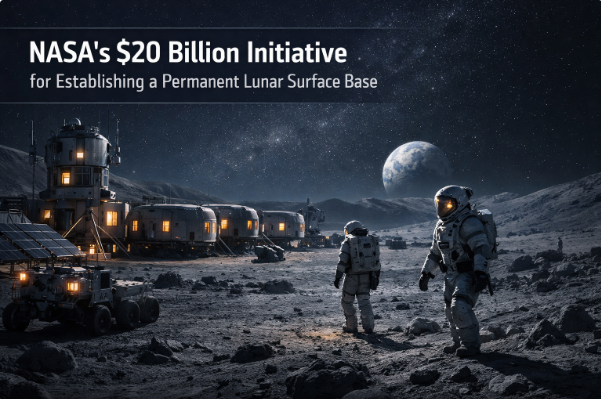
As of March 25, 2026, NASA’s vision for the Moon has moved beyond symbolic flag-planting and short-duration landings. The agency is now openly talking about an enduring human presence, a phased lunar base, repeatable surface missions, and infrastructure that can support life, science, logistics, mobility, and eventually a permanent foothold on the lunar surface. In that sense, the idea behind a “$20 billion initiative” is not science fiction anymore. It is the practical direction of the Artemis era: build capability landing by landing, turn the Moon into an operating environment instead of a one-time destination, and use that experience to prepare for Mars. (NASA)
What makes this moment so compelling is that NASA is no longer presenting the Moon as a brief revisit to Apollo’s legacy. The language has changed. The architecture has changed. The cadence has changed. NASA’s latest updates describe at least one lunar surface landing every year after the renewed mission flow matures, while a new phased strategy is being shaped specifically around building a Moon base. That is a major strategic shift. It means the agency is thinking in terms of sustained lunar operations, not isolated triumphs. For readers searching terms like NASA lunar base, permanent Moon base, Artemis lunar surface base, and human settlement on the Moon, this is the clearest signal yet that lunar permanence is becoming the core objective. (NASA)
The financial scale behind this push is enormous. NASA’s FY2026 budget materials say the administration proposal allocates more than $7 billion for lunar exploration, with major line items tied directly to Moon-to-Mars transportation, Human Landing System development, surface suits, mobility systems, and related exploration architecture. The budget request includes $1.747 billion for the Human Landing System, $642 million for xEVA and Human Surface Mobility, and $864 million for a new Commercial Moon-to-Mars Infrastructure and Transportation program, including $250 million for CLPS. Even before you add future-year funding, logistics, operations, or partner contributions, this is clearly a multi-billion-dollar lunar infrastructure campaign. (NASA)
If you want to understand why the “$20 billion” framing resonates, look at the Human Landing System alone. NASA’s Office of Inspector General reported this month that since HLS began in 2019, NASA has already obligated $6.9 billion for development and estimates total HLS spending will reach $18.3 billion through fiscal year 2030. That figure covers only one of the biggest components required to put astronauts on the Moon and let them live and work there temporarily. It does not include the full surface ecosystem: rovers, spacesuits, habitats, communications, power, logistics, and precursor robotic deliveries. So while the exact headline number is shorthand rather than an official NASA program title, the overall scale of the lunar base effort is absolutely in that territory.
The most important reason this lunar strategy matters is location. NASA’s Artemis architecture is centered on the lunar South Pole, a region that offers some of the most valuable real estate in the solar system. Concept studies tied to Artemis Base Camp point to South Pole lighting conditions that are more favorable for long-duration solar-powered operations than the Apollo equatorial landing zones, and NASA’s broader lunar plans keep focusing on that region for science, mobility, and future infrastructure. The South Pole also matters because of its potential access to water ice and other volatiles, resources that could support life support systems, fuel production, and long-duration exploration. In other words, this is not just where astronauts land; it is where a lunar economy could start. (NASA Technical Reports Server)
NASA’s latest public plan lays out a three-phase path to a real Moon base. Phase One is about building, testing, and learning. NASA says it will use Commercial Lunar Payload Services (CLPS) deliveries and the Lunar Terrain Vehicle (LTV) program to increase the tempo of lunar activity and send instruments, rovers, and technology demonstrations that improve mobility, communications, navigation, surface operations, and power generation. This is the foundation-building phase, where NASA learns how to operate reliably on the Moon before committing to heavier permanent infrastructure. It is also where the commercial sector becomes indispensable, because frequent robotic deliveries are how the lunar surface gets mapped, tested, and prepared. (NASA)
Phase Two moves from exploration to early infrastructure. NASA describes this stage as the point where lessons from early missions turn into semi-habitable systems, recurring logistics, and regular astronaut operations on the lunar surface. This is where the Moon stops being a destination and starts becoming a workplace. NASA also says this phase will include major international participation, including JAXA’s pressurized rover and potentially other partner contributions involving transportation and scientific infrastructure. That matters for two reasons: it distributes cost and technical risk, and it turns the lunar base into a multinational platform rather than a purely domestic project. (NASA)
Phase Three is where the word permanent starts to carry real operational meaning. NASA says that as cargo-capable Human Landing Systems come online, the agency will begin delivering the heavier infrastructure needed for a continuous human foothold on the Moon. In current public descriptions, that includes Italian Space Agency multi-purpose habitats, Canadian lunar utility contributions, added habitation opportunities, logistics expansion, and surface mobility systems that allow the base to evolve from periodic expeditions into something far more durable. This is the pivot point between “frequent lunar missions” and a genuine permanent lunar surface base. (NASA)
A permanent lunar base cannot exist without transportation, and that is why the Human Landing System remains so central. NASA’s Artemis campaign is designed to use commercial landers to move crew between lunar orbit and the surface. The OIG describes HLS as the capability that enables astronauts to descend to the Moon, live and work there temporarily, and then return to lunar orbit. NASA’s updated Artemis architecture also now uses a new 2027 test mission in low Earth orbit to exercise commercial lunar systems before an Artemis IV landing in 2028, while the agency says it wants at least one lunar surface mission per year after that. It is a more operational, systems-engineering-driven approach, and it reflects NASA’s attempt to reduce mission risk before committing to sustained surface buildout.
Just as important as landing is what happens after touchdown. NASA’s Extravehicular Activity and Human Surface Mobility Program is developing the next-generation spacesuits, human-rated rovers, tools, and support systems that astronauts need to survive and work outside a spacecraft on the Moon. This is a crucial detail for anyone following lunar habitat or Moon base technology trends: a base is not just walls and airlocks. It is an integrated operational ecosystem. Suits determine how long crews can work. Rovers determine how far crews can travel. Mobility systems determine how much science can be done, how much cargo can be moved, and how quickly the footprint of a lunar outpost can expand. (NASA)
The Lunar Terrain Vehicle is one of the clearest symbols of this shift from mission to infrastructure. NASA says the LTV will be contracted as a service from industry rather than owned outright by the agency, and that it will combine advanced power management, autonomous driving, communications, and navigation capabilities. It can also be remotely operated between crew missions to move cargo and science payloads across the surface. That is a huge operational advantage. It means lunar hardware does not have to sit idle when astronauts leave. A rover that works between missions is not just transportation; it is continuity. It extends the productivity of the base and starts to make the Moon feel less like a campsite and more like an active frontier installation. (NASA)
NASA’s longer-term habitat concepts show how serious the agency has been about surface permanence for several years. Technical work on Artemis Base Camp describes a core architecture built around the Lunar Terrain Vehicle, a pressurized rover, a surface habitat, power systems, and in-situ resource utilization technologies. In those concept studies, the surface habitat serves as the communications hub, science facility, repair site, supply node, and operational home base for astronauts. NASA studies also describe evolvable habitation concepts capable of supporting longer stays and increasing self-sufficiency over time. That is exactly how real frontier settlements are built: not all at once, but by layering mobility, shelter, repair, storage, life support, and energy into a durable system. (NASA Technical Reports Server)
Power and resources are where the dream of a Moon base becomes either feasible or fantasy. NASA’s budget and technical planning emphasize advanced surface power systems as essential for sustained presence on the Moon and Mars, while Artemis Base Camp studies discuss the long-term role of in-situ resource utilization, including extracting water and oxygen from lunar materials. The Moon is harsh, dusty, dark for long periods in some locations, and unforgiving to equipment. A permanent outpost therefore needs energy resilience, environmental control, communications, thermal management, and eventually a way to reduce dependence on every kilogram launched from Earth. The more the lunar base can produce, repair, or recycle locally, the more realistic permanent occupation becomes. (NASA)
Commercial partnerships are another reason this strategy has traction. NASA’s CLPS initiative is explicitly designed to use commercial vendors to send science and technology payloads to the Moon, laying the groundwork for a long-term human presence. The OIG’s 2024 review says CLPS has a contract ceiling of $2.6 billion through 2028, with NASA aiming for repeated delivery opportunities that can support both science and future Artemis needs. This matters for SEO-minded readers searching commercial lunar missions, lunar economy, or private sector Moon base development because it shows NASA is not trying to do everything inside a traditional government-only acquisition model. It is deliberately creating a market, and markets are what turn exploration into permanence. (NASA)
International cooperation gives the lunar base even more strategic weight. NASA’s March 2026 Moon-base announcement explicitly references contributions from JAXA, the Italian Space Agency, and the Canadian Space Agency in future phases of lunar surface development. That is not just diplomatic window dressing. A multinational lunar base spreads cost, increases redundancy, expands technical depth, and makes the base more politically durable across administrations. It also reinforces the Moon as a geopolitical proving ground. The first truly functional, continuously developing lunar base will not only be a scientific asset; it will be a statement about industrial capacity, alliance structure, and leadership in cislunar space. (NASA)
Of course, the road ahead is still difficult. NASA’s own oversight reports make clear that schedules, integration complexity, safety, workforce alignment, hardware readiness, and transportation risk are all major issues. Artemis architecture is also evolving quickly. NASA has said it intends to pause Gateway in its current form and shift toward infrastructure that more directly supports sustained surface operations, while also transitioning beyond SLS and Orion after Artemis III in the FY2026 budget proposal. Those are not minor choices. They show an agency trying to rebalance cost, speed, and mission utility in real time. A permanent Moon base is still a hard engineering problem, not an inevitable outcome. (NASA)
Still, the larger direction is unmistakable. NASA’s Moon to Mars Architecture defines a roadmap for long-term human-led exploration, and Artemis is increasingly being treated as the operational engine that turns that roadmap into hardware on the lunar surface. The Moon is the proving ground where NASA can test long-duration habitation, surface operations, remote mobility, crew health systems, logistics chains, and resource utilization before attempting the far longer and less forgiving journey to Mars. That is why a permanent lunar surface base matters so much. It is not the final prize. It is the launchpad for the next era of space exploration. (NASA)
So when people talk about NASA’s “$20 billion initiative” for a permanent Moon base, the most accurate interpretation is this: NASA is assembling a vast, interconnected lunar campaign whose cost, scope, and ambition are all large enough to reshape human spaceflight. The recent budget request, the HLS spending trajectory, the lunar mobility systems, the robotic cargo pipeline, the phased base strategy, and the international buildout all point in the same direction. The future of the Artemis program is no longer just about returning to the Moon. It is about staying there, working there, building there, and learning how humanity can turn an alien surface into a permanent operational frontier. (NASA)
For SEO strength, close the post with a naturally optimized paragraph like this: NASA lunar base, permanent lunar surface base, Artemis program, Moon base, Artemis Base Camp, lunar habitat, lunar South Pole, human lunar exploration, lunar surface infrastructure, Human Landing System, Commercial Lunar Payload Services, lunar terrain vehicle, Moon to Mars architecture, lunar economy, lunar resources, in-situ resource utilization, lunar exploration, space exploration, future Moon missions, and sustainable human presence on the Moon are now central to the conversation about how NASA plans to establish a long-term foothold beyond Earth and transform the Moon into the next major frontier for science, technology, and human expansion into deep space.