
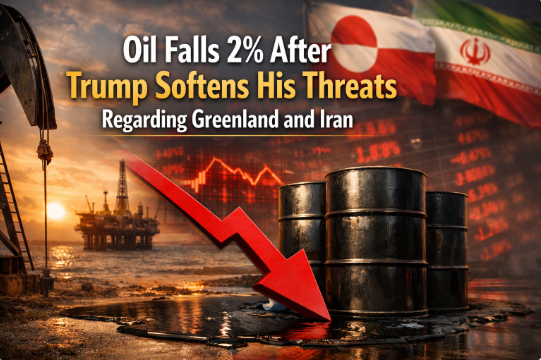
Oil falls 2% after Trump softens his threats regarding Greenland and Iran
The oil market loves drama until it doesn’t. After a week of hand-wringing over headlines and social feeds, crude prices slipped roughly 2% today as traders recalibrated their risk models in response to a notable softening in rhetoric from former U.S. President Donald Trump regarding both Greenland and Iran. In markets, tone can be a catalyst as powerful as barrels and pipelines. When political heat cools, risk premiums tend to melt—and that’s what today looked like: a collective exhale that nudged Brent and WTI lower, trimmed volatility, and pushed attention back toward fundamentals like demand, inventories, and OPEC+ discipline.
What changed—and why traders cared
Geopolitics often moves oil not by what happens, but by what might happen. Recent comments had stirred worries about supply routes and diplomatic escalation, adding a premium to prices. Today’s shift in tone—interpreted by traders as a step away from immediate confrontation—reduced the probability of short-term supply disruptions. When the market assigns a lower chance to negative tail events, implied risk falls, and prices tend to follow. That’s the quick and dirty of a 2% slide.
Under the surface, several mechanisms clicked into place:
Risk premium compression: The geopolitical add-on embedded in futures and options prices shrank as headline risk cooled.
Position unwinds: Momentum funds and discretionary macro traders who had added length on the earlier rhetoric trimmed exposure.
Options dynamics: With implied volatility easing, dealers hedging short gamma positions had less need to chase upside, which often dampens intraday spikes.
None of this happens in a vacuum. Sentiment is the glue. When it loosens, prices can slip faster than fundamentals would suggest.
Fundamentals step back into the spotlight
The oil market still cares about barrels: production, consumption, and storage. Today’s decline invited a re-examination of the core supply–demand balance.
OPEC+ adherence and guidance: While the alliance has proven capable of engineering scarcity when needed, compliance varies by member and by month. If rhetoric risks recede, traders tend to refocus on whether quotas are truly biting and which producers might be quietly stretching output.
U.S. shale responsiveness: The shale patch remains the most flexible marginal supplier. Even if drilling discipline has improved, high-grading and efficiency gains can quickly bring incremental barrels when prices justify it. A 2% drop doesn’t change project economics overnight, but it nudges boardrooms toward caution.
Global demand signals: Freight, aviation kerosene uplift, and petrochemical margins paint a nuanced picture. Demand growth persists, but unevenly—robust in some regions, fragile in others. When fear recedes, slow-burn demand questions regain center stage.
In other words, geopolitics sets the scene; fundamentals write the script.
The dollar, rates, and the macro weather
Oil is priced globally in dollars, so the greenback matters. A firmer dollar can pressure crude by making each barrel more expensive for non-U.S. buyers, while rate expectations shape everything from industrial activity to consumer travel. Today’s 2% move unfolded against a backdrop of mixed macro signals: sticky-but-easing inflation, central banks leaning dovish in guidance if not in action, and bond markets sniffing at slower growth without calling a recession. That cocktail supports a cautious, range-bound view for crude—particularly when the geopolitical temperature dial turns down.
There’s also the equity angle. Energy stocks often serve as a sentiment translation layer for commodity moves. When crude drifts lower on reduced risk premiums, integrated majors typically hold up better than pure-play E&Ps, thanks to refining and chemicals buffers. That rotation showed up again today as investors favored cash-flow resilience over torque.
What “softened threats” actually do to the market psyche
Words aren’t barrels, but they affect barrels’ perceived future. The earlier, sharper rhetoric had raised the specter of sanctions, shipping hazards, and diplomatic tit-for-tat that could have spilled into the Strait of Hormuz calculus or complicated Arctic resource narratives. The softening today served as a de-escalation signal. Traders don’t need ironclad peace; they just need lower odds of near-term trouble. Price is a probability distribution, and when the fat tail thins, the average drops.
This is why you’ll often see crude jump on harsh statements and then bleed back as the policy path clarifies. Markets price the direction of travel of the conversation as much as the conversation itself.
Inventories, maintenance, and the “quiet” supply stories
With the spotlight swinging away from confrontation, the market reacquainted itself with the quieter—but potent—drivers:
Seasonal maintenance: Turnarounds at refineries affect crude runs, product inventories, and crack spreads (the difference between product and crude prices). Maintenance windows can temporarily slacken crude demand, amplifying the effect of any sentiment-driven pullback.
Stock levels: Inventories remain the scoreboard for balance. Draws suggest tightness; builds whisper of slack. A 2% slip puts added focus on the next weekly data prints, where even small surprises can steer short-term direction.
Shipping and freight: Rates for VLCCs (very large crude carriers) and the spread between Brent and Dubai or WTI can hint at route preferences and arbitrage flows. Narrowing spreads can reduce incentive for long-haul shipments, subtly adjusting regional balances.
Where this leaves OPEC+, Iran, and the broader supply map
Softened rhetoric doesn’t erase structural realities. OPEC+ still faces the classic cartel puzzle: cut too much and you lose market share; cut too little and you lose price. Iran’s export path, always a function of geopolitics and enforcement, interacts with that puzzle. If tensions fade at the margin, enforcement uncertainty eases, and the market may assume higher steady-state flows. That assumption, even before barrels materially change, can pressure prices as traders front-run what they consider likely.
Meanwhile, non-OPEC producers—from the U.S. to Brazil and Guyana—keep adding capacity. These growth areas chip away at the cartel’s ability to singularly set the tone. None of this is sudden, but when the fear premium falls, structural supply growth becomes more visible.
The investor lens: positioning and portfolios
Today’s pullback offered a stress test for several investor archetypes:
CTA / trend-followers: With signals flipping from short-term overbought to neutral, some mechanical selling reinforced the move.
Macro funds: The thesis that “geopolitics will put a floor under oil” loses a bit of shine when headlines cool. Exposure often shifts toward relative-value trades—long refined products vs. crude, or selective bets in gas liquids.
Dividend seekers: Integrated majors’ dividends and buybacks cushion commodity beta. On days like this, investors often rotate toward balance-sheet strength and downstream resilience.
Portfolio managers also watch correlations. If oil’s volatility ebbs while equities steady, cross-asset risk budgets can expand—another reason why a 2% slide on cooling rhetoric may feel oddly constructive for broader markets.
ESG, energy transition, and the long arc
One day’s move doesn’t rewrite the energy story. Yet every geopolitical de-escalation reminds investors that policy risk cuts both ways. When the conversation is quieter, capital allocators revisit transition pacing: how quickly EV adoption grows, how grid investments unlock renewable integration, and how carbon pricing schemes evolve. In a calmer news cycle, valuations deviate more on execution than on fear.
For oil companies, this environment favors credible medium-term plans: disciplined capex, methane mitigation, and measured diversification into low-carbon opportunities. Reducing geopolitical noise doesn’t eliminate fossil demand; it simply lowers the “panic bid” for barrels and places a premium on operational excellence.
What to watch next
If today’s 2% slide was phase one—repricing the headline risk—the next phases will be about data and policy specifics:
Statements and follow-through: Markets will parse whether the softer tone becomes sustained policy posture or a one-day detour.
Inventory data: Weekly stock numbers in the U.S. and OECD remain the cleanest read on balance. Expect sharper reactions to surprises while sentiment resets.
OPEC+ communications: Any tweaks to quotas, compliance nudges, or “shadow” guidance can either reinforce or counteract the current drift.
Macro prints: PMIs, inflation updates, and travel metrics like jet fuel demand will determine whether the demand side leans supportive or ambivalent.
Shipping and spreads: Watch Brent–WTI, front-to-back time spreads, and freight—quiet signals that often move before headlines do.
A human note on headline fatigue
Days like this are a reminder that markets are run by humans with neurons, not robots with perfect foresight. After a stretch of elevated tension, the collective psyche gets tired. When the rhetoric cools, the market doesn’t just revise spreadsheets; it sighs. That’s partly why the drop felt orderly rather than panicked. Traders didn’t abandon a bullish thesis so much as downgrade urgency.
The human side matters for readers and investors alike. It’s tempting to treat every headline as destiny, but most of the time the world walks back from edges rather than over them. Energy markets, perhaps more than any other, price edges first and steps second. Today priced the step back.
Bottom line
Oil’s 2% decline today reads like a repricing of risk rather than a verdict on demand or a new supply shock. As the geopolitical temperature around Greenland and Iran cooled, so did the market’s need to pay up for insurance against worst-case scenarios. With the fear premium lighter, attention rotates back to OPEC+ behavior, U.S. production elasticity, inventories, and the macro path for growth and currency. In short: fewer fireworks, more spreadsheets. Calm isn’t bearish or bullish—just different. And different means fundamentals will have more say in where crude goes next.
Meta description (SEO-ready)
Oil prices fell about 2% on 23-01-2025 as markets reacted to a softer tone from Donald Trump on Greenland and Iran, easing the geopolitical risk premium and refocusing attention on OPEC+, U.S. shale output, inventories, and global demand signals.
Suggested slug
oil-falls-2-percent-trump-softens-threats-greenland-iran-23-01-2025
FAQ (structured for rich results)
Why did oil fall 2% today?
Because the market reassessed geopolitical risk after a softer tone in rhetoric about Greenland and Iran, reducing the immediate risk premium embedded in prices and shifting focus back to fundamentals.
Does this mean demand is weakening?
Not necessarily. Today’s move was primarily about sentiment and probability, not a sudden demand shock. Inventory data and macro prints will offer clearer guidance.
What should investors watch next?
OPEC+ communications, U.S. inventory reports, refining margins, and currency moves. Those signals will likely determine whether crude stabilizes or extends its pullback.
One-paragraph SEO keyword booster
Oil price today, crude oil falls 2%, Brent price update, WTI futures analysis, Donald Trump news impact on oil, Greenland geopolitics and energy markets, Iran tensions and crude supply, OPEC+ production cuts, U.S. shale output outlook, global oil demand forecast, energy stocks performance, refinery margins and crack spreads, oil inventories and EIA report, dollar strength and commodity prices, Brent vs WTI spread, oil market volatility, risk premium compression, Middle East shipping routes, Strait of Hormuz risk, macroeconomic data and oil demand, energy transition and ESG investing, 2025 oil market outlook, petroleum industry trends, commodity trading strategies, oil futures positioning, oil and gas news, hydrocarbon supply-demand balance, oil price forecast 2025, energy market fundamentals, geopolitical risk and crude prices.