
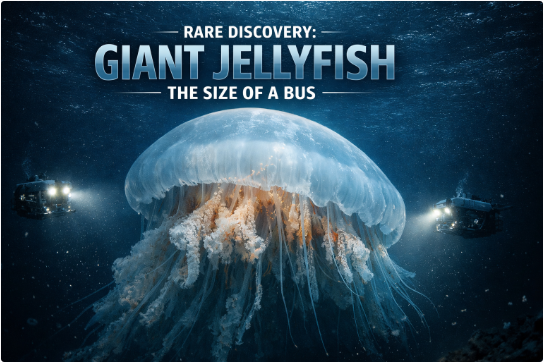
Rare discovery… Deep-sea cameras capture a jellyfish the size of a bus.
There are headlines that make you blink, rub your eyes, and read again just to make sure your brain didn’t invent them out of boredom. “Deep-sea cameras capture a jellyfish the size of a bus” is one of those. It sounds like science fiction until the video rolls: a cathedral of translucent tissue gliding through black water, bell as wide as a city lane, tendrils drifting like slow lightning. For a few mesmerizing minutes, the deep ocean gives up one of its secrets; then the animal melts back into darkness, and we’re left grasping for metaphors big enough to hold it.
This is not your neighborhood jelly. This is a leviathan from the twilight and midnight zones—depths where sunlight fails, pressure would crush an airplane, and life gets weird in the most delightful ways. The footage, taken by autonomous deep-sea cameras several kilometers below the surface, shows a gelatinous giant with a bell estimated to rival a city bus in length, cruising with a poise that makes ballet look clumsy. Its pulsing locomotion whispers a lesson humans routinely forget: you can be vast and still move with grace.
The moment the abyss blinked back
The ocean contains multitudes, and most of them have never met a human. Our species insists on bulldozing through ecosystems with lights, noise, and nets, but the deep sea is a different fortress. Down there, “observation” requires patience—and technology that can lurk quietly without spooking sensitive creatures. The cameras that captured this giant were built for stealth: low-light sensors, passive drifting rigs, and red illumination that many deep-sea organisms barely notice. Instead of chasing the unknown, the expedition did the opposite—went still, dimmed the lights, and let the unknown come close.
What the lenses witnessed is pure oceanic theater. The jellyfish drifts in from the edge of visibility, a pale ring enlarging until you realize that ring is just the bell’s rim. It pulses once, twice, and the water around it rolls like silk. Its tentacles—impossible to count, likely meters upon meters long—trail in languid, ghostlike loops. It isn’t hunting in the frantic sense; it’s harvesting, like a drifting orchard, letting tiny animals wander into an invisible fence of stinging cells called nematocysts. Predation, perfected: effortless, silent, utterly effective.
Meet the giant you didn’t know you needed to respect
Most people think “jellyfish” and picture a moon jelly at the beach or a painful brush with a translucent pancake. Those are the coastal cousins. The deep ocean hosts lineages that make our mental file folders seem laughably small. This bus-sized titan shares a blueprint with the jellies we know—bell, tentacles, gelatinous mesoglea—but stretches it to mythical proportions. The bell’s architecture resembles a slow-breathing umbrella, channeling water through internal canals that distribute nutrients across the animal’s fragile body. The tissue looks delicate, but at depth, delicacy is durability: a soft, water-rich body resists crushing pressure better than rigid shells.
What about digestion, you ask? Jellyfish are digestive improvisers. Food particles captured by tentacles ride mucus escalators toward oral arms and into a central cavity, where enzymes get to work. No chewing, no drama. For a giant like this, the strategy scales: imagine a floating field of sticky, stinging strings funneling krill, copepods, and the occasional unlucky fish toward a metabolic core. It’s the ocean’s version of a passive income stream.
Big jellyfish, bigger ecosystem story
Size in the deep ocean isn’t a party trick; it’s an ecological strategy. When resources are patchy, being big can help you store energy, travel farther with each pulse, and extend your reach with mile-long tentacles. Gigantism shows up again and again down there—squid with dinner-plate eyes, amphipods like thumb-sized tanks, sea spiders that stretch like scaffolding. A jellyfish the size of a bus fits this pattern: a vast net, low metabolic burn, and the patience of abyssal time.
The ecosystem upside is huge. A giant jellyfish acts as habitat and hunter at once. Small fish shelter among tentacles, grabbing free rides and leftover snacks without triggering the stinging cells designed for smaller prey. Parasitic and commensal species make homes on the bell’s surface, turning one animal into a drifting apartment complex. When the giant finally dies—whether by age, disease, or some deeper predator—it becomes what marine biologists poetically call a “jelly-fall,” nourishing a rain of scavengers on the seafloor. Even in death, abundance.
How we filmed a ghost in a pressure cooker
Capturing this footage demanded tech tuned to the abyss. Remote camera landers slipped down the water column, each one a quiet observer. Modern deep-sea rigs use ultra-sensitive, low-noise sensors to work in almost total darkness. Traditional white lights scatter and scare; the trick is to use red or far-red wavelengths, which many deep-sea animals can’t perceive, then enhance the signal digitally. Housing all this in pressure-resistant shells is an engineering love letter to physics—every seam, O-ring, and bolt designed to shrug off tons per square inch.
Add to that careful deployment. The teams released the rigs into chasms where seamounts interrupt slow currents, letting nutrient-rich water pool like invisible lakes. These are biological hotspots, gathering pelagic life the way an oasis gathers desert birds. The cameras didn’t need to search; they needed to wait.
The wisdom of slow science
Headlines are breathless; real discovery breathes slowly. Years of sonar mapping, currents modeling, and meticulous planning led to a handful of minutes of video that changed how we imagine a jellyfish. In science, patience isn’t passivity; it’s precision. You learn where to look by accepting how little you know, then narrowing ignorance with data. The deep ocean rewards that humility with brief, gorgeous concessions.
A humanized truth sits here too: awe is a nutrient. We don’t just learn facts from moments like this; we recalibrate our sense of proportion. It’s hard to cling to petty certainties when you’ve watched a giant jellyfish drift by like a moon caught in a current. That feeling—call it existential vertigo, call it wonder—makes us better thinkers and, frankly, better neighbors to our planet.
“Why haven’t we seen it before?”
Because the ocean is very, very good at secrets. More than 60% of Earth’s surface is deep ocean—waters below 200 meters, where sunlight thins to blue gloom and then to black. We’ve mapped Mars with more detail than our own seafloor. Expeditions cost millions. Gear fails. Weather bullies. And some residents of the abyss are masters of “nope.” They sense vibrations, pressure waves, electric fields, and light gradients with sensitivity that puts our eyes and ears to shame. If you intend to film them, you must become functionally invisible.
There’s also behavioral nuance. Many deep-sea creatures follow vertical migrations linked to phases of the moon and seasonal productivity at the surface. The giant jellyfish may appear in certain layers of the water column for brief windows, then sink into colder strata where our equipment rarely lingers. The ocean is not a static place; it’s a living, heaving three-dimensional maze where time matters as much as coordinates.
Bioluminescence: light as language
In the footage, faint glows appear along the jelly’s margin, like distant lightning behind fog. If you’ve never met bioluminescence, here’s your introduction: it’s life making light on purpose. In the deep sea, bioluminescence functions as billboard and booby trap, greeting card and getaway smoke. Some jellies flash to startle predators. Others release glowing mucus to say “wrong snack, buddy.” Predators use light to lure prey; prey use it to call bigger predators on their predators. It’s tactical gossip.
A creature this large could employ luminescence for multiple reasons. A slow shimmer might help align tentacles in the dark, or coordinate pulses of the bell. Brighter streaks could signal stress or deter approach. There’s poetry, too: light in the abyss isn’t just illumination—it’s punctuation, shaping where the story pauses and where it rushes forward.
What did the cameras actually measure?
From the video, researchers can estimate bell diameter, pulse frequency, and relative tentacle length. Frame-by-frame analysis establishes swimming speed and turning radius. Water turbidity tells you how much particulate matter—the ocean’s airborne dust—swirls in the scene, hinting at local productivity. If acoustic sensors were running, you might correlate the jelly’s pass with echoes from mid-water scattering layers, those migrating clouds of tiny organisms that rebound sonar like phantom seafloors. Even without a physical specimen, the footage offers a data buffet: morphology, behavior, habitat, and interactions with nearby fauna.
In a perfect world, we’d also capture environmental DNA (eDNA)—fragments of genetic material shed by organisms into the water. A filter the size of a deck of cards, run through a few liters, can tell you which species have haunted the neighborhood recently. If a later expedition nets eDNA matching jellyfish lineages known to get enormous, we suddenly have a name to attach to a silhouette.
Why this matters for climate and conservation
Jellyfish are more than stinging beaches and poetic nuisances. They are major players in the “biological pump,” the process by which carbon captured by photosynthesizing plankton at the surface sinks to the deep ocean. Gelatinous predators eat carbon-rich prey, poop dense pellets, and when they die, their bodies sink fast. Downward carbon transport matters: the deep ocean is Earth’s vastest carbon bank. Understanding who lives there and how much they eat, excrete, and export is essential for accurate climate models.
There’s also the practical matter of stewardship. Deep-sea mining proposals loom over seafloor regions that remain largely unstudied. Noise, sediment plumes, and habitat disruption could ripple up the water column in ways we’re not equipped to predict. A bus-sized jellyfish doesn’t care about our profit margins, but it will feel our caution—or lack of it. The more charismatic the deep sea becomes to the public, the harder it is to treat it like a blank slate for extraction. Charisma isn’t science, but it can be conservation’s best ally.
The culture of awe: how stories shape science
Let’s be honest: most people will never read a technical paper about gelatinous zooplankton. They will watch a thirty-second clip of a ghostly giant and feel the scalp-tingling reminder that we share a planet with unthinkable strangeness. That feeling opens doors. It draws students to marine biology programs, persuades donors to fund expeditions, and convinces policymakers that the deep sea is not an abstraction. Wonder is a gateway drug to stewardship.
There’s also humility in rewriting our mental map of “possible.” Every time the deep ocean flips a new card—a transparent fish with a see-through head, a snailfish living below 8,000 meters, a jellyfish big enough to block a driveway—we recalibrate. Certainty relaxes its grip. Curiosity gets the wheel. That’s healthy science and healthy citizenship.
Frequently asked (and delightfully weird) questions
Could it be a new species?
Absolutely. The deep sea is a biodiversity jackpot, and many taxa are known from a handful of sightings. Even within known genera, individuals can reach sizes no one predicted, especially in environments with stable temperatures and slow metabolisms.
Does it sting humans?
At those depths, we’re safe—unless you plan to swim thousands of meters down in a wetsuit, in which case “stings” are the least of your concerns. That said, giant tentacles are studded with nematocysts designed to immobilize prey. Respect is warranted.
What eats a bus-sized jellyfish?
Large predators—squid, fish, turtles closer to the surface, and perhaps even deep-diving mammals—may sample gelatinous prey. Scavengers on the seafloor relish jelly-falls, creating feeding frenzies of worms, crustaceans, and opportunistic fish.
How old was it?
Hard to tell. Jellyfish age is tricky without growth rings or hard parts. In stable, cold environments, growth can be slow and steady, leading to large sizes over time. Lifespan likely spans months to years, not decades, though exceptions exist.
Technology pushing into the blue unknown
Today’s deep-sea exploration blends elegant software with rugged hardware. AI helps filter hundreds of hours of video, flagging unusual shapes or movement patterns so human analysts don’t go cross-eyed. Machine learning classifiers trained on known jellyfish silhouettes can suggest candidates for “giant, pay attention” with increasing accuracy. Lidar-style acoustic systems can map gelatinous animals without harming them, turning the water column into a dynamic 3D scene rather than a flat sonar smear.
On the mechanical side, next-gen ROVs and autonomous underwater vehicles (AUVs) can hold station without thrusters roaring—critical when your subject is shy. Battery chemistry improvements grant longer missions. Fiber-optic tethers stream high-bit-rate video to research vessels in real time. And yes, the housings still look like props from a science-fiction set: spheres and cylinders that shrug at pressures that would crumple a tank.
The jellyfish as metaphor, the ocean as mirror
There’s a human habit of borrowing meaning from the natural world. We see a giant jellyfish and imagine omens, monsters, gods. But the real story is more compelling: life explores the possible spaces physics allows. In the abyss—cold, dark, high-pressure—gelatinous bodies dominate because they are cheap to build and resilient to squeeze. Big bells and long tentacles succeed because they turn sparse calories into motion and meals. The jellyfish is not a metaphor for mystery; it’s a manifestation of math and evolution, which somehow feels even more magical.
Yet metaphor does sneak in. The creature’s slow pulse resembles collective breath. Watching it invites you to match your cadence, to trade hurry for drift, to remember that vastness can be gentle. In a century of speed, the deep sea stays devoutly unhurried, and its largest citizens move like time itself.
What comes next
Discovery is a beginning, not a mic-drop. The footage will be analyzed, cross-referenced with museum records, compared against previous ROV sightings, and perhaps used to guide targeted sampling in the same region. If researchers recover tissue—by gentle net or opportunistic snag—genetic sequencing can place the giant on the tree of life with more confidence. Meanwhile, teams will refine their equipment: quieter motors, dimmer lights, smarter triggers that wake cameras when a large object enters the frame. The goal is not to collect trophy footage, but to build a reliable picture of who lives where, in what numbers, doing what.
And somewhere below the waves, another giant pulses on, entirely unconcerned with our curiosity. The abyss is under no obligation to reveal itself, but it sometimes indulges us. We should meet that generosity with care.
How to talk about this without the hype hangover
Hype is a sugar rush; science prefers complex carbs. It’s tempting to declare “largest jellyfish ever!” after a single video, but records need replication. The smarter sentence is the one you can defend a year from now: deep-sea cameras captured a jellyfish of extraordinary size, likely spanning bus-scale dimensions, revealing behavior and morphology rarely documented at depth. That sentence won’t trend as fast, but it will age well. And in a world full of hot takes, durable truth is its own kind of thrill.
A closing invitation to wonder
Stand, for a moment, in the ship’s quiet. Imagine the deck lights are off, the winch is silent, and the night air tastes like salt and patience. Somewhere below, a gelatinous cathedral passes through a cone of almost-light, and a camera blinks. That blink becomes a story, the story becomes a question, and the question unlocks a thousand more. This is how exploration actually works—not as a sprint to conquest, but as a long conversation with a planet that still has secrets. The bus-sized jellyfish is one line in that dialogue. It reminds us that Earth is not done being astonishing.
Key takeaways for readers and fellow ocean nerds
The discovery: Autonomous deep-sea cameras recorded a jellyfish with a bell and trailing structures reaching bus-like dimensions in the midnight zone.
Why it matters: Giant gelatinous predators influence carbon cycling, mid-water food webs, and our baseline understanding of deep-sea biodiversity.
How it was captured: Passive, low-light rigs with pressure-resistant housings and red illumination minimized disturbance, enabling rare, close-range footage.
Next steps: Frame-by-frame analysis, potential eDNA sampling, and follow-up dives will clarify taxonomy, behavior, and ecological roles.
Bigger picture: Awe is not fluff; it’s the ignition spark for education, conservation, and policy that treats the deep sea as a living system rather than a resource bin.
When the highlight reel of the 21st century’s discoveries plays back, there will be plenty of exoplanets and particle physics and microbiome revolutions. Save a few frames for the abyss. The deep ocean is writing plot twists we couldn’t have imagined, using characters—like a bus-sized jellyfish—that drift quietly, pulse by pulse, across the stage of the world.
SEO keywords (one-paragraph list): deep-sea jellyfish, giant jellyfish, bus-sized jellyfish, deep ocean discovery, deep-sea cameras, autonomous underwater vehicle, ROV, AUV, midnight zone, hadal zone, bioluminescence, marine biology, ocean exploration, abyssal ecosystem, gelatinous zooplankton, carbon cycle, biological pump, ocean conservation, deep-sea biodiversity, underwater video, rare marine species, deep-sea predator, nematocysts, jellyfish tentacles, jelly-fall, eDNA, remote camera lander, low-light sensors, pressure-resistant housing, underwater robotics, ocean stewardship, climate change and oceans, marine science news, underwater photography (no flash), pelagic ecosystem, midwater food web, deep-sea research, sustainable ocean policy, marine life documentary, ocean mysteries, unexplored ocean, deep-sea habitats, marine wonder, oceanic leviathan, giant invertebrate, deep-sea wildlife, ocean news 2026, latest marine discoveries, rare ocean footage.