
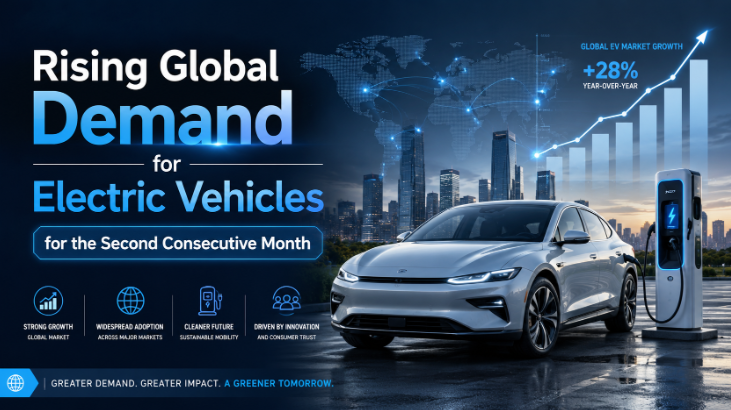
Rising Global Demand for Electric Vehicles for the Second Consecutive Month
Global demand for electric vehicles is rising again, and this time the movement feels more practical than promotional. For years, electric cars were discussed as the future of mobility, a cleaner alternative for environmentally conscious drivers, technology lovers, and early adopters. But in 2026, the story is becoming more direct: people are looking at fuel prices, monthly running costs, government incentives, charging access, battery range, and resale value — and more buyers are deciding that an electric vehicle makes financial and lifestyle sense.
The latest market data shows that global demand for electric vehicles increased for the second consecutive month in April 2026. Registrations of new battery-electric vehicles and plug-in hybrid electric vehicles rose by 6% year over year to around 1.6 million units. Although April was 9% lower than March’s record level, the broader message is clear: the global EV market is not disappearing, slowing into irrelevance, or remaining limited to a small group of premium buyers. It is moving into a more mature, competitive, and regionally diverse phase. (Reuters)
One of the strongest drivers behind this renewed electric vehicle demand is the pressure of high petrol prices. When gasoline becomes expensive, consumers start calculating differently. A car is no longer judged only by its purchase price, brand, or design. Buyers begin asking how much it costs to drive every week, how stable energy prices are, how much maintenance will be required, and whether the vehicle can protect them from future fuel-market volatility. Electric vehicles are benefiting from that shift because charging can be cheaper and more predictable than relying on petrol, especially for households that can charge at home or at work.
This does not mean that the EV market is growing evenly everywhere. The electric vehicle industry in 2026 is being shaped by very different regional conditions. Europe is showing strong momentum, with EV registrations rising significantly as governments, automakers, and infrastructure investors continue pushing the transition toward low-emission mobility. China remains the largest and most influential electric vehicle market in the world, but domestic demand has faced pressure after changes to subsidies and tax incentives. North America, meanwhile, is dealing with weaker EV registrations after policy shifts and the removal of some federal tax benefits. (Reuters)
Europe is currently one of the clearest bright spots for electric vehicle growth. In April 2026, European EV registrations increased by 27%, supported by regulatory pressure, consumer incentives, and long-term investments in the electric mobility ecosystem. This growth is not only about passenger cars. It reflects a broader transformation involving charging networks, battery supply chains, renewable energy integration, fleet electrification, and stricter emissions rules. For European buyers, the decision to switch to an electric car is increasingly connected to lower running costs, urban access rules, corporate sustainability targets, and the growing availability of affordable EV models. (Reuters)
The European market also shows how important policy consistency can be. When consumers believe incentives will remain reliable, charging networks will expand, and resale markets will strengthen, they are more willing to buy electric vehicles. Businesses also respond to predictable regulation by investing in fleets, charging stations, software platforms, and battery services. This creates a cycle where better infrastructure supports more demand, and stronger demand encourages more infrastructure investment.
China’s role in the global electric vehicle market is more complex. It remains the global manufacturing powerhouse for electric cars, batteries, and EV components. Chinese automakers are expanding aggressively into Europe, Asia, Latin America, the Middle East, and Africa. However, China’s domestic registrations fell in April 2026 after some policy support was reduced. At the same time, Chinese EV exports surged, showing that China’s influence over global electric mobility is no longer limited to its own consumers. More than ever, Chinese electric vehicle brands are competing internationally on price, range, battery technology, and charging speed. (Reuters)
This export strength matters because affordability remains one of the biggest barriers to EV adoption. Many consumers like the idea of electric cars, but they still worry about upfront prices, battery replacement costs, charging availability, and long-distance travel. Chinese manufacturers have helped push global EV prices downward by increasing competition and offering more models across different price segments. As more affordable electric vehicles enter global markets, EV adoption can expand beyond wealthy urban consumers and into middle-income households, ride-hailing fleets, delivery companies, and small businesses.
North America presents a different picture. EV demand has faced pressure due to the removal of tax credits and uncertainty around future regulations. This shows that electric vehicle adoption still depends heavily on policy design, especially in markets where EVs remain more expensive than comparable petrol or hybrid vehicles. A sudden reduction in incentives can delay purchases, weaken consumer confidence, and slow the transition. However, the long-term direction remains difficult to ignore. Automakers continue investing in battery plants, electric trucks, charging networks, and software-defined vehicles because electrification is still central to the future of the auto industry.
The recent increase in global EV demand also reflects a deeper change in consumer psychology. Early EV marketing focused heavily on environmental responsibility. That message still matters, especially for younger buyers, cities, and companies with sustainability commitments. But the strongest mainstream appeal now combines sustainability with practicality. Drivers want lower running costs, quiet performance, modern technology, fewer mechanical parts, and protection from fuel-price shocks. Electric vehicles are no longer only a climate choice; they are becoming a cost-management choice.
Battery technology is another major reason global EV demand continues to rise. Newer electric vehicles offer longer ranges, faster charging, improved safety systems, and better battery warranties. Consumers who were once worried about range anxiety are now seeing models that can cover daily commutes, weekend trips, and even long-distance travel with fewer compromises. Fast-charging technology is also advancing quickly, with major automakers and battery companies competing to reduce charging times and improve convenience. BYD, for example, has promoted ultra-fast “flash-charging” technology as a way to make EV charging feel closer to the experience of refueling a petrol vehicle. (Financial Times)
Charging infrastructure remains one of the most important factors for future EV growth. In markets where public chargers are reliable, easy to find, and simple to pay for, consumers feel more confident about buying electric cars. In markets where charging networks are fragmented, slow, or poorly maintained, EV adoption can face resistance. Home charging is still the most convenient option for many EV owners, but public charging is essential for apartment residents, taxi drivers, delivery fleets, tourists, and long-distance travelers. The next phase of electric vehicle demand will depend not only on better cars, but on better charging experiences.
The global EV market is also expanding beyond the traditional power centers of China, Europe, and the United States. India, Southeast Asia, Latin America, the Middle East, and Africa are becoming increasingly important for future electric mobility growth. The International Energy Agency reported that electric car sales increased by more than 20% in 2025 to 21 million units, with one in four cars sold worldwide being electric. The same report highlighted strong growth in India, Southeast Asia, Latin America, and other emerging markets, proving that the EV transition is no longer limited to rich economies. (IEA)
Africa is an especially important region to watch. Rising fuel prices and fuel shortages are encouraging some countries to accelerate electric vehicle adoption. Ethiopia, for example, has become a notable case after banning imports of gasoline and diesel cars and increasing its focus on electric mobility. In 2025, Africa imported more than twice as many EVs from China as it did in 2024, showing that the continent’s electric vehicle market is beginning to move from theory to reality. (AP News)
For businesses, the rise in EV demand creates opportunities far beyond car sales. Charging station companies, battery recyclers, renewable energy developers, software providers, insurance firms, fleet operators, logistics companies, and real estate developers are all connected to the electric vehicle ecosystem. Hotels, shopping malls, office buildings, and residential communities that install EV chargers can attract higher-value customers and future-proof their properties. Delivery companies and ride-hailing platforms can reduce operating costs by shifting to electric fleets. Energy companies can build new revenue streams through smart charging and grid services.
For automakers, the second consecutive monthly increase in global EV demand is both encouraging and demanding. It proves that consumers are still interested in electric vehicles, but it also shows that the market is becoming more competitive. Brand loyalty alone will not be enough. Automakers must offer better range, better pricing, better software, better after-sales service, and stronger charging partnerships. They must also adapt to regional differences. What works in Germany may not work in India. What sells in China may need adjustment for the Gulf, Africa, or Latin America. The winning EV brands will be those that understand local infrastructure, local incomes, local driving habits, and local policy incentives.
The increase in plug-in hybrid electric vehicle sales also deserves attention. Some consumers are not ready to move directly from petrol cars to fully battery-electric vehicles. Plug-in hybrids offer a bridge: electric driving for short daily trips and a combustion engine for longer journeys. While some environmental advocates argue that full battery-electric vehicles are the cleaner long-term solution, plug-in hybrids can still play a practical role in markets where charging infrastructure is developing slowly. For many drivers, the transition to electric mobility will happen in stages rather than all at once.
Still, the direction of travel is increasingly clear. Electric vehicles are moving from a niche category into the mainstream car market. They are being shaped by fuel prices, climate regulation, consumer economics, battery innovation, global trade, and industrial policy. The second consecutive monthly rise in global EV demand is not just a short-term sales headline. It is a signal that the market is adapting to uncertainty and that buyers are continuing to see value in electrification.
The real challenge for 2026 and beyond will be maintaining momentum. EV demand can rise quickly when fuel prices are high and incentives are strong, but sustainable long-term growth requires affordability, charging reliability, battery supply stability, and consumer trust. Governments need to avoid confusing policy changes that make buyers delay decisions. Automakers need to deliver models that meet real household budgets. Charging companies need to make public charging easier and more dependable. Energy providers need to prepare grids for higher electricity demand from transport.
For consumers, the current moment is one of comparison. Petrol vehicles are familiar, but their running costs are exposed to global oil-market shocks. Electric vehicles require a different mindset, but they offer lower operating costs, quieter driving, and increasing model variety. As more people experience EVs through friends, taxis, rentals, corporate fleets, and used-car markets, hesitation is likely to decline. Trust grows when technology becomes visible in everyday life.
In the end, rising global demand for electric vehicles for the second consecutive month shows that the EV transition is not a straight line, but it is still moving forward. Some regions are accelerating, others are slowing, and policy changes continue to influence buyer behavior. Yet the broader trend remains powerful: transportation is becoming more electric, more software-driven, more connected to energy markets, and more influenced by environmental regulation. For drivers, companies, and investors, the message is simple: electric vehicles are no longer just part of the future. They are increasingly part of the present.
SEO Keywords Paragraph:
Rising global demand for electric vehicles, electric vehicle market 2026, EV sales growth, global EV demand, battery electric vehicles, plug-in hybrid electric vehicles, electric car registrations, EV adoption, electric mobility, sustainable transportation, clean energy vehicles, electric vehicle industry, EV market trends, global electric car sales, EV charging infrastructure, battery technology, affordable electric cars, fuel prices and EV demand, Europe EV sales, China electric vehicle exports, North America EV market, electric vehicle investment, green mobility, zero-emission vehicles, future of transportation, electric cars 2026, EV battery innovation, fast charging technology, renewable energy transportation, and sustainable automotive industry are among the most important high-ranking keywords connected to the latest growth in global electric vehicle demand.