
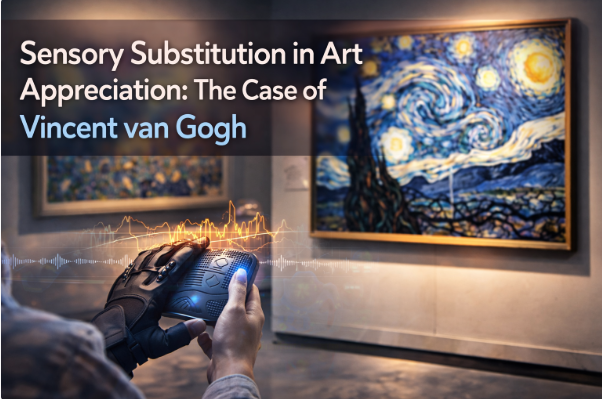
Sensory Substitution in Art Appreciation: The Case of Vincent van Gogh
On March 22, 2026, one of the most exciting conversations in both art and accessibility is no longer just about who gets into museums, but how people experience art once they are there. That is where sensory substitution in art appreciation becomes so powerful. At its core, sensory substitution means using one sense to help carry information usually delivered through another. In practice, that can mean translating visual form into touch, turning spatial detail into audio, or using smell and texture to deepen understanding of a painting. In museum settings, this idea is becoming increasingly important because it shifts the goal from passive accommodation to active, meaningful participation. Rather than treating art appreciation as something limited to sight alone, sensory substitution invites a richer question: how can a painting be felt, heard, sensed, and emotionally understood? (University of Glasgow)
This question becomes especially compelling when we place Vincent van Gogh at the center of the discussion. Van Gogh is one of the few artists whose work already feels intensely physical, even before we think about accessibility. His paintings are known for movement, texture, emotional urgency, and bold color relationships. The Van Gogh Museum describes his artistic evolution as a shift from darker, muted tones toward vivid color contrasts, while works such as Self-Portrait with Grey Felt Hat are noted for their complementary colors and long brushstrokes that intensify one another. His Sunflowers series, meanwhile, demonstrates how he could create eloquence from variations of a single hue, painting a vase of sunflowers with “three shades of yellow and nothing else.” That matters for accessibility because Van Gogh’s work is not only visual; it is already deeply structural, material, and expressive. It lends itself naturally to multisensory interpretation, tactile art access, and inclusive museum design. (Van Gogh Museum)
When people hear the phrase sensory substitution, they sometimes imagine a cold technological fix, as if one sense is being mechanically swapped for another. But in art appreciation, the concept is far more human than that. It is not about “replacing” sight in a simplistic way. It is about building new pathways into meaning. A raised surface can communicate composition. A textured relief can make brushstroke direction legible through the fingertips. A carefully written audio description can reveal spatial relationships, mood, line, and gesture. Sound can suggest rhythm, intensity, or atmosphere. Scent can anchor memory and emotional association. In other words, sensory substitution in the museum is not only functional; it is interpretive. It recognizes that art is not a file to be decoded but an experience to be entered. That is why the subject matters so much for museum accessibility, blind and low-vision inclusion, and the future of inclusive art education. (University of Glasgow)
Research in accessible art technologies supports this shift. A 2021 open-access study on accessible visual artworks found that interactive multimodal guides using audio plus tactile relief models improved confidence, independence, and understanding for blind and visually impaired participants. The authors argue that tactile graphics alone often struggle to convey the complexity of visual artworks, while multimodal approaches can better support autonomous exploration. A 2025 study on interactive multimodal tangible interfaces for museums reached a similar conclusion, highlighting the need for strong sensory detail, concise audio guidance, and user control in the design of accessible experiences. These findings matter because they move the discussion beyond good intentions. They show that multisensory museum experiences are not just ethically desirable; they are practically effective. (MDPI)
Van Gogh’s work provides an ideal case because it sits at the meeting point of image and sensation. Think about what people often respond to first in a Van Gogh painting: not the iconography alone, but the pressure of the paint, the visible direction of the strokes, the pulse of the composition, and the emotional temperature created by color. In Self-Portrait with Grey Felt Hat, the Van Gogh Museum highlights how he set complementary colors against each other and used directional strokes to animate the surface. In Sunflowers, the museum emphasizes both the limited palette and the expressive power achieved within it. These are exactly the kinds of qualities that can be translated into haptic interpretation, audio storytelling, and multisensory art experiences. Van Gogh’s paintings are unusually well suited to tactile reproduction because their drama does not depend only on illusionistic depth; it depends on structure, energy, repetition, contrast, and feeling. (Van Gogh Museum)
The most persuasive evidence for this idea is not theoretical. It already exists in the museum world. The Van Gogh Museum in Amsterdam has made accessibility a long-term mission through its Accessible Van Gogh project, working with blind and partially sighted visitors, deaf visitors, and visitors who use mobility aids. For blind and partially sighted visitors, the museum offers audio description and accessible-print resources. More importantly, it developed Feeling Van Gogh, a free program launched in 2015 for blind and partially sighted visitors and their companions. In 2016, the program and a 3D reproduction of Sunflowers were given a permanent place in the museum. The museum explains that visitors can feel Van Gogh’s brushstrokes and even smell the sunflowers, turning one of the most famous paintings in the world into a tactile and olfactory encounter. This is sensory substitution in action, and it is also something more: art accessibility as cultural dignity. (Van Gogh Museum)
That example matters because it changes the emotional logic of museum access. Too often, accessibility is framed as secondary support added after the “real” experience has already been designed for sighted visitors. The Van Gogh Museum’s approach suggests a better model. A tactile reproduction is not merely a backup copy. Audio description is not merely a supplement. Smell is not a gimmick. Together, they create a coherent interpretive environment in which a visitor can build a relationship with the work through multiple channels. In a Van Gogh context, that matters enormously. His paintings are full of sensation: sun-warmed yellows, restless skies, vibrating outlines, and surfaces that seem to move even when still. A multisensory approach does not dilute that power. It often makes it more explicit. (Van Gogh Museum)
There is also a broader philosophical lesson here. Traditional museum culture has often privileged vision as the “highest” or most authoritative way to know art. Sensory substitution quietly challenges that hierarchy. It suggests that art appreciation is not owned by a single sense. Touch can reveal contour, density, scale, and direction. Audio can reveal sequence, emphasis, and emotional framing. Smell can trigger association and memory. Even for sighted audiences, multisensory design can deepen engagement by slowing people down and asking them to attend differently. Van Gogh is especially powerful in this context because his art already blurs boundaries between seeing and feeling. People do not simply “look at” Van Gogh; they speak of being moved, overwhelmed, lifted, or unsettled by him. Sensory substitution formalizes that intuition. It turns emotional access into a design principle. (University of Glasgow)
For museums, educators, and digital creators, the Van Gogh case points toward a set of practical lessons. First, tactile reproductions should not be oversimplified; they need enough volume, texture, and spatial logic to preserve artistic meaning. Second, audio should be concise, layered, and controllable by the user, giving both formal and contextual information. Third, accessibility works best when designed with end users rather than merely for them. The 2025 museum study stresses user involvement and user control, while the Van Gogh Museum explicitly states that it collaborates with target groups and accessibility experts to improve its offerings. That is the difference between symbolic inclusion and real inclusion. A successful accessible art exhibit is not just technically compliant; it is co-designed, interpretable, and emotionally respectful. (ScienceDirect)
Van Gogh also teaches us something about the future of digital accessibility in art. As 3D printing, haptic interfaces, localized audio, and interactive museum guides become more sophisticated, the line between exhibition design and assistive technology is getting thinner. We are moving toward a world in which a visitor might explore a relief model, trigger object-specific audio through touch, compare textures across paintings, or use scent cues to understand symbolism and atmosphere. The 2021 multimodal guide research shows how on-demand audio combined with touch-sensitive reliefs can support independent exploration without requiring Braille proficiency, which is especially important given that Braille literacy is not universal. This matters for search terms like accessible museum technology, haptic art experience, multimodal museum interface, and assistive technology for art appreciation. The future of the museum is not only digital. It is sensory-aware. (MDPI)
At a deeper level, the case of Vincent van Gogh reminds us that accessibility is not separate from beauty. It is one of the ways beauty becomes shareable. Van Gogh painted with extraordinary urgency, but also with a desire to communicate. His Sunflowers were not accidental exercises; the Van Gogh Museum notes that they held special meaning for him and were linked to gratitude. When a museum allows visitors to feel the structure of those flowers, hear the story of the composition, and even smell the subject, it is doing more than making information available. It is extending Van Gogh’s communicative project across different bodies and different perceptual routes. That is why sensory substitution in art appreciation should not be treated as a niche topic. It belongs at the center of conversations about art inclusion, museum innovation, disability culture, and human-centered design. (Van Gogh Museum)
The phrase “the case of Vincent van Gogh” is therefore exactly right. Van Gogh is not just an artist used as an example. He is a test case for how museums can transform a visually dominant tradition into a more democratic and embodied one. His art shows why some paintings can translate powerfully across senses. The museum practices built around his work show that this translation is already possible. And the research around tactile-audio interfaces shows that it can be designed thoughtfully, evaluated rigorously, and improved over time. For site owners, educators, museum professionals, and readers interested in art accessibility for blind and visually impaired audiences, this topic is compelling because it combines emotional resonance with innovation, history with technology, and cultural heritage with inclusion. (Van Gogh Museum)
Ultimately, the lesson is simple but profound: great art does not become less powerful when it is opened to more senses. It becomes more fully human. In the case of Van Gogh, sensory substitution reveals that art appreciation is not confined to the eye. It can live in the hand that traces a sunflower petal, in the ear that hears a brushstroke described with care, in the memory awakened by scent, and in the mind that assembles these sensations into meaning. On March 22, 2026, that feels like more than an accessibility trend. It feels like the future of art itself: multisensory, inclusive, emotionally intelligent, and built for a wider public. (University of Glasgow)
SEO keyword paragraph: sensory substitution in art appreciation, Vincent van Gogh accessibility, Van Gogh Museum accessibility, multisensory art experience, tactile art appreciation, art for blind and visually impaired visitors, accessible museum design, inclusive museum experience, sensory substitution examples, haptic art experience, audio description art museum, tactile reproduction of paintings, Feeling Van Gogh, Sunflowers tactile experience, assistive technology for museums, museum accessibility technology, blind and low vision art access, multisensory museum exhibits, accessible art education, inclusive art appreciation, Van Gogh Sunflowers accessibility, tactile museum experience, audio tactile interface art, 3D printed art accessibility, museum innovation accessibility, disability inclusion in museums, human-centered museum design, cultural accessibility, accessible art blog, SEO art accessibility content.