
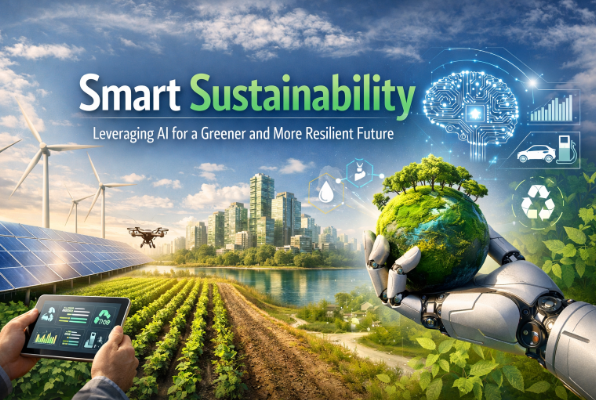
Smart Sustainability: Leveraging AI for a Greener and More Resilient Future
Sustainability used to be treated like a feel-good side quest—nice to have, easy to postpone, hard to measure. Now it’s a full-on systems problem with real deadlines: climate volatility, resource constraints, supply chain fragility, rising energy costs, and growing regulatory pressure. The twist is that we finally have a tool that can operate at “systems scale” with us: artificial intelligence.
But let’s be clear and not slip into techno-mythology. AI won’t “solve climate change” the way a magic wand solves a fairy-tale curse. What AI can do—when paired with credible data, good governance, and human judgment—is accelerate better decisions: faster forecasting, tighter optimization, smarter maintenance, more transparent reporting, less waste, and more resilient infrastructure. In other words: smart sustainability.
This blog is a humanized, practical deep dive into how AI for sustainability is reshaping climate action in 2026—from energy efficiency and renewable energy optimization to climate risk modeling, circular economy, smart cities, and ESG reporting. We’ll look at where AI is already delivering measurable impact, where it’s still hype, and how organizations can adopt it responsibly without greenwashing—or accidentally increasing emissions via inefficient compute.
Why “Smart Sustainability” matters now
Sustainability today isn’t only about being “green.” It’s about resilience—the ability of communities, businesses, and governments to absorb shocks and recover quickly. Think: heatwaves stressing power grids, floods disrupting logistics, droughts driving food price volatility, or geopolitical shifts rerouting energy supply. Resilience is sustainability under pressure.
AI helps because modern sustainability problems are messy and interconnected. Energy systems connect to transportation. Transportation connects to urban planning. Urban planning connects to buildings. Buildings connect to supply chains, materials, and grid demand. Humans can reason about these systems—but we struggle to optimize them continuously, in real time, under uncertainty. Machine learning and predictive analytics can, provided the underlying data is accurate and the objective function (what we optimize for) reflects real-world values and constraints.
Smart sustainability isn’t “AI everywhere.” It’s AI applied where it moves the needle:
Cutting emissions by improving energy management
Reducing waste through smart resource optimization
Strengthening climate adaptation by forecasting hazards and planning responses
Improving trust through reliable ESG compliance and auditable reporting
Designing products and supply chains for the circular economy
That’s the framework: measurable impact, responsible deployment, and real resilience.
AI for energy: turning efficiency into a competitive advantage
Energy efficiency is still the quiet champion of decarbonization. It’s not glamorous, but it’s immediate: the cheapest, cleanest kilowatt-hour is the one you never use. AI has become an efficiency amplifier—especially in buildings and industrial operations, where small improvements scale into large savings.
Smart buildings and AI-driven energy management
Commercial buildings waste energy in surprisingly mundane ways: HVAC running when rooms are empty, poor scheduling, miscalibrated equipment, and slow detection of faults. AI-powered building management systems use occupancy prediction, weather forecasts, and historical usage patterns to optimize heating, cooling, and ventilation dynamically. Add IoT sensors and you get continuous feedback—like giving the building a nervous system.
The sustainability upside is obvious: lower energy use and lower emissions. The resilience upside is underrated: smarter systems can respond to grid stress, reduce peak demand, and maintain comfort with less power during disruptions.
Industrial optimization and predictive maintenance
Industry is where energy use gets intense. AI helps by optimizing processes (temperature, pressure, throughput) and by predicting equipment failures before they turn into downtime, waste, or safety risks. Predictive maintenance reduces scrap, extends asset life, and prevents energy-hungry “limping” operation modes where failing equipment consumes more power for less output.
If you’re chasing real-world KPIs, these are the ones that matter:
Lower energy intensity (kWh per unit output)
Reduced unplanned downtime
Higher yield with less material waste
Lower maintenance cost and fewer emergency replacements
This is sustainability with receipts.
Renewable energy + AI: making clean power more reliable
Renewables are growing fast, but variability is the tax you pay for weather-dependent generation. AI doesn’t eliminate variability—but it makes it predictable and manageable.
Forecasting solar and wind generation
AI forecasting models use meteorological data, satellite imagery, and historical performance to predict renewable output hours or days ahead. Better forecasting reduces the need for fossil-based “backup” generation and improves grid stability. In grid operations, accuracy isn’t a nice-to-have; it’s the difference between smooth balancing and expensive, high-emission emergency dispatch.
Smart grids, demand response, and energy storage optimization
A smart grid is basically a coordination problem: generation, storage, and consumption must match, continuously. AI helps orchestrate:
When to charge and discharge batteries
How to shift flexible demand (like EV charging or industrial loads) away from peak times
How to route power efficiently and detect anomalies
This is where demand response becomes a genuine climate tool. Instead of building more generation, we shape demand intelligently. In practice, that means utilities and large facilities can reduce peak load, avoid blackouts, and integrate more renewables without destabilizing the grid.
AI in transportation: decarbonizing mobility without breaking the schedule
Transportation emissions are sticky because mobility is non-negotiable. People and goods need to move. The sustainability win comes from making movement more efficient and electrified, while maintaining reliability.
Route optimization and logistics efficiency
Logistics is a perfect AI playground: many variables, constant change, expensive mistakes. AI-driven routing reduces fuel use by minimizing distance, congestion delays, and empty miles. It also improves delivery predictability—another resilience boost.
In supply chains, optimization extends beyond routes:
Demand forecasting to avoid overproduction and waste
Inventory optimization to reduce warehouse energy and spoilage
Supplier risk analytics for disruption planning
This is where AI in supply chain becomes sustainability infrastructure, not just a cost-saving tactic.
Electrification and charging intelligence
EV adoption is rising, but charging can stress local grids if unmanaged. AI can schedule charging when electricity is cleaner and cheaper, coordinate fleet charging, and use vehicle-to-grid strategies where supported. This aligns three goals that rarely cooperate: cost, emissions, and reliability.
AI for circular economy: designing out waste
The circular economy asks a deceptively simple question: why are we still extracting, producing, and discarding like resources are infinite and landfills are harmless? AI helps because circularity requires information: what materials are in products, where they go, when they return, and how to recover them economically.
Smarter materials and product design
AI-assisted design tools can evaluate material choices, durability trade-offs, and lifecycle emissions earlier in product development. Pair that with life cycle assessment (LCA) modeling and you can optimize for sustainability before production locks in decisions.
Waste sorting and recycling optimization
Computer vision systems are already improving recycling lines by identifying materials more accurately. Better sorting increases recovery rates and reduces contamination—raising the economic viability of recycling. Municipalities also use analytics to optimize collection routes and adjust schedules based on fill levels, reducing fuel and improving service.
Circular economy is where sustainability becomes tangible: less waste, lower raw material extraction, and reduced embodied carbon.
Climate risk and resilience: AI as an early-warning system
If sustainability is “do less harm,” resilience is “survive what’s coming.” With climate impacts becoming more frequent and severe, AI-supported climate risk analytics are helping organizations and cities prepare.
Climate hazard modeling and scenario planning
AI enhances climate modeling by learning patterns in large datasets—temperature trends, precipitation shifts, flood likelihood, wildfire risk signals. This supports:
Infrastructure planning (where to build, reinforce, or relocate)
Insurance and financial risk assessment
Emergency response planning and resource allocation
Done responsibly, this is a public good: fewer surprises, faster response, better preparedness.
Disaster response and humanitarian logistics
During disasters, AI can help process satellite imagery to identify damaged areas, estimate needs, and prioritize response routes. But this requires care: models must be validated, bias must be addressed, and decisions must remain accountable. In emergencies, “confidence” without correctness is dangerous.
ESG reporting and carbon accounting: from spreadsheets to trustworthy systems
Many organizations want to reduce emissions—but can’t measure them well. That’s how sustainability turns into vague pledges and glossy PDFs. AI can assist by automating data collection, categorizing emissions sources, detecting anomalies, and generating audit-ready reports.
Cleaner data pipelines
AI can map invoices, utility bills, logistics records, and procurement systems into structured emissions data. It can flag gaps and inconsistencies—helpful for Scope 1, Scope 2, and Scope 3 emissions tracking.
Reducing greenwashing risk with traceability
The more automated and auditable the pipeline, the harder it is to accidentally (or intentionally) misreport. That matters because regulations and investor scrutiny are rising. ESG compliance is shifting from “marketing” to “risk management.” AI can help, but it must be used with transparent methodology, version control, and independent verification where required.
Responsible AI: sustainability doesn’t excuse sloppy ethics
Here’s the paradox: AI can reduce emissions, but AI can also consume significant energy—especially if you’re training giant models unnecessarily or running inefficient inference at scale. Smart sustainability includes making AI itself sustainable.
Green AI and efficient computing
Organizations should prefer:
Efficient architectures and right-sized models
Distillation and optimization for inference
Running workloads on cleaner grids when possible
Measuring compute-related emissions and including them in reporting
“Bigger model” is not a synonym for “better outcome.” Optimization is a virtue again.
Data ethics, bias, and accountability
Sustainability tech can fail socially even if it succeeds technically. If an AI system allocates resources unfairly, misclassifies communities in risk models, or enables surveillance under the banner of “smart cities,” it can harm people. Ethical guardrails matter:
Human oversight for high-impact decisions
Bias testing and transparent assumptions
Clear accountability (who is responsible when the model is wrong?)
Privacy protections for sensor-heavy environments
The planet doesn’t benefit from solutions that erode human rights. That’s not sustainability; that’s just future-shaped harm.
How to adopt AI for sustainability without getting lost
If you’re building a roadmap, treat this like any serious transformation program—not a hackathon.
Start with outcomes, not tools
Pick measurable targets: energy intensity reduction, emissions reduction, water savings, waste diversion, downtime reduction, resilience metrics. Then ask: where does AI improve decisions?Fix the data plumbing
Most “AI projects” fail because data is fragmented, low quality, or inaccessible. Invest in data governance early: definitions, ownership, access controls, and continuous quality checks.Pilot where feedback loops are short
Energy optimization, predictive maintenance, routing, and anomaly detection typically show results quickly. Build credibility with early wins.Scale with governance
As you scale, you need model monitoring, audit logs, security, privacy controls, and alignment with ESG frameworks. Sustainability is too important to run on vibes.Make it human
Train teams, involve operators, and design interfaces that help real people make better decisions. The best sustainability AI is the kind that quietly improves daily work instead of demanding worship.
The future: sustainability as an operating system
In 2026, sustainability is no longer a department—it’s an operating principle. AI is becoming the coordination layer that helps organizations run cleaner, leaner, and more resilient systems. The real shift is cultural: moving from quarterly sustainability reporting to continuous sustainability management; from reactive crisis response to proactive climate adaptation; from abstract targets to operational metrics.
Smart sustainability means using AI to do what humans struggle to do at scale: optimize complex systems under uncertainty, while staying accountable to real-world values. The future will belong to the organizations and cities that treat sustainability as engineering—measured, iterated, and improved—rather than as branding.
And yes, there’s poetry in that. Not the soft-focus kind. The kind where you make the numbers bend—emissions down, efficiency up, resilience strengthened—because the world is weird, constraints are real, and we’re finally learning to build like we plan to live here.
SEO keywords paragraph (end of blog):
AI for sustainability, smart sustainability, sustainable AI, green AI, artificial intelligence for climate change, climate tech, ESG reporting, ESG compliance, carbon accounting, Scope 1 Scope 2 Scope 3 emissions, renewable energy optimization, smart grid technology, energy efficiency solutions, AI energy management, predictive maintenance, smart buildings, circular economy innovation, waste reduction technology, sustainable supply chain, AI in supply chain, logistics route optimization, climate risk modeling, climate adaptation strategies, resilience planning, smart cities sustainability, IoT and sustainability, net zero strategy, decarbonization solutions, environmental sustainability, sustainable business strategy, data-driven sustainability, clean energy transition, carbon footprint reduction.