
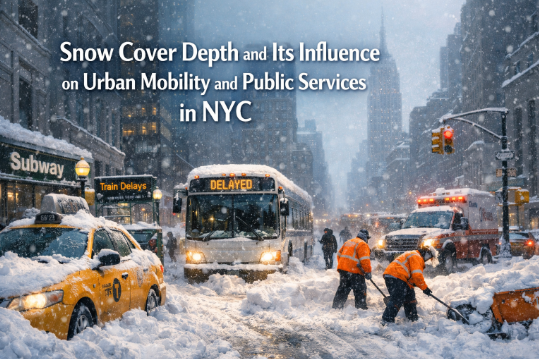
Snow Cover Depth and Its Influence on Urban Mobility and Public Services in NYC
New York City is a machine that runs on friction. People rubbing shoulders on subway platforms, buses nudging into traffic, delivery vans double-parking like it’s a competitive sport, and pedestrians threading the needle between scaffolding poles and dog walkers. Most days, that friction is just the city being the city. But add snow cover depth—not just “it snowed,” but how much snow is actually sitting on the ground—and NYC’s whole operating system starts showing its quirks.
Snowfall totals make headlines, but snow depth is the part that decides what tomorrow looks like. A quick inch that melts by noon is a mild inconvenience. Four inches that get compacted by foot traffic, refrozen overnight, and piled into corners by plows? That’s when the city’s mobility network becomes a live experiment in physics, logistics, and public policy. Snow cover depth changes traction, visibility, travel times, curb access, sidewalk safety, and emergency response speed. It also changes human behavior: commuting choices, trip cancellations, school attendance, shopping patterns, and how boldly someone steps off a slushy curb.
This matters because NYC isn’t one “city” so much as a stack of moving systems: MTA subway and bus service, NYC DOT street operations, DSNY snow plows and salt trucks, FDNY and EMS response routes, school transportation, sanitation pickups, and the day-to-day public services that keep nine million people functioning in tight space. Snow cover depth is the invisible hand pushing on all of them.
Why “Snow Cover Depth” Is the Metric That Actually Runs the Show
People often think in terms of snowfall rate or storm totals. Urban operations teams think in terms of accumulation on surfaces, which is why snow cover depth is the more practical metric for urban mobility. Depth tells you:
whether plows can clear to pavement or just rearrange slush
whether salt will work efficiently or get diluted by meltwater
whether intersections become ice bowls
whether bus tires keep grip on grades and bridges
whether curb cuts disappear and accessibility takes a hit
whether pedestrians are walking on sidewalk or spilling into traffic lanes
In NYC, depth interacts with microclimates. Waterfront areas can see different accumulation than inland streets. Tall building corridors channel wind and drift snow into uneven piles. Bridges and overpasses freeze first, making a “2-inch citywide snow” behave like a “6-inch problem” on key connectors.
The Street Layer: Plowing, Snowbanks, and the Geometry of Getting Around
Street mobility in a snow event is basically a geometry problem with a budget. As snow cover depth increases, usable road width shrinks. Plows push snow toward curbs, but those snowbanks don’t politely vanish. They become temporary infrastructure—blocking parking, narrowing travel lanes, swallowing bike lanes, and hiding crosswalk markings.
At low depths (think 1–2 inches), traffic slows but flows. At moderate depths (3–6 inches), the issues compound: lane markings disappear, turning radii get weird, and drivers start improvising. At higher depths (6 inches and beyond), you can get “plowable” roads but “unusable” curbs—meaning vehicles can move, but curb access becomes chaotic. That’s when deliveries suffer, paratransit gets delayed, and pickup/drop-off zones turn into slush wars.
Snowbanks also change visibility. A high pile near an intersection can block sightlines for drivers and pedestrians. That’s a subtle but serious safety issue—particularly around schools, hospitals, and major bus stops. The snow itself isn’t the only hazard; it’s the reshaped city around it.
The Sidewalk Layer: Pedestrian Safety, ADA Access, and the Real Mobility Crisis
Here’s the blunt truth: during snow cover events, walking becomes the most fragile part of the system, even though NYC is fundamentally a pedestrian city. Sidewalk clearing is split between city operations and property responsibilities, and the result can be uneven. Snow cover depth turns sidewalks into obstacle courses: narrow footpaths carved through drifts, slush puddles that soak shoes to the soul, and refrozen ridges that behave like booby traps.
For many residents—especially seniors, parents with strollers, and people with mobility devices—the problem isn’t “getting to the subway,” it’s getting to the corner. Snow depth can erase curb cuts and tactile paving, making intersections inaccessible. That affects ADA compliance in practice, not just on paper. It also pressures public services: when sidewalks aren’t passable, people rely more on paratransit, rideshare, or emergency assistance, which then faces its own snow-related delays.
And because pedestrians will still move (this is NYC; we don’t hibernate), when sidewalks fail, people spill into the street. That creates a dangerous hybrid zone where vehicles and pedestrians compete for the same narrowed space. Urban mobility becomes less about speed and more about survival instincts.
NYC Public Transit in Snow: Subways, Buses, and the “Last Mile” Trap
The NYC subway is famously resilient to snow compared to many cities. Trains run underground for much of the system, and track snow depth isn’t the main issue—except in open-cut sections, yards, and elevated lines where drifting snow and ice can mess with switches and power systems. Still, the subway’s biggest snow problem is often not the tunnel; it’s access.
Snow cover depth affects the station experience: stairs get slick, platforms get wet from tracked-in slush, entrances get narrowed by shoveled piles, and elevator access can be compromised by snowbanks. Riders who depend on accessible stations can find their routes effectively “broken” even if trains are running.
Buses, meanwhile, are directly bullied by snow depth. Buses need traction, clear lanes, and predictable curb access. A bus route can be “operational” and still function badly if stops are buried in snowbanks. Riders may have to step into the street to board, which is unsafe and slows dwell times, cascading into delays. Snow depth also interacts with NYC’s bus lanes: if lanes aren’t cleared well, buses get trapped in the same congestion as cars, defeating the point of transit priority when it matters most.
This creates the classic last-mile problem in winter form: the subway might be okay, but getting to it is harder; buses might run, but boarding is messy; and the whole system becomes less predictable—exactly what commuters hate.
Bike Lanes and Micromobility: When Snow Depth Erases a Transportation Option
NYC has invested heavily in bike lanes and micromobility. Snow depth tests how real that commitment is. A bike lane covered by 4 inches of snow might as well not exist. Worse, plowed snow often gets pushed into bike lanes, turning them into storage for the city’s winter leftovers. That forces cyclists into traffic lanes, where road width is already reduced.
For essential workers who bike—often because it’s affordable, fast, and reliable—snow depth can suddenly remove a primary commuting mode. Citi Bike availability can drop due to station access issues and dock clearing. E-scooters and other micromobility options (where present) face traction and battery performance issues in cold conditions. So snow depth doesn’t just slow mobility—it reshapes mode choice, usually toward less efficient options like private cars or ride-hailing, which then increases congestion.
Emergency Response: Snow Depth as a Time Tax on FDNY, EMS, and NYPD
When snow cover depth rises, every minute becomes more expensive. Emergency response depends on clear routes, navigable intersections, and address visibility. Snowbanks can hide hydrants, signage, and curb numbers. Narrowed roads can trap ambulances behind stuck vehicles. Double-parked cars (a year-round NYC tradition) become even more obstructive when lanes are already reduced by snow.
For EMS, the challenge is both driving and reaching the patient. If sidewalks are impassable, responders may have to carry equipment longer distances, climb over snow piles, or navigate icy steps. That increases response time and physical strain. For fire response, hydrant access matters. When hydrants are buried, minutes can be lost—minutes that don’t negotiate.
Snow depth also increases slip-and-fall injuries, which can spike calls. So the system faces both slower movement and higher demand. That’s the kind of math that keeps city operations managers awake at 3 a.m. watching radar.
Sanitation and Snow Operations: DSNY, Salt Logistics, and the “Second Storm” Problem
NYC sanitation crews do heroic work during winter events, but snow depth doesn’t just create a “during the storm” challenge. It creates what you might call the second storm: the days after, when piles freeze, melt, refreeze, and turn into permanent urban geology.
Plowing is about clearing travel lanes, but the follow-up work—salting, clearing crosswalks, breaking up ice ridges, hauling snow in extreme events—determines how quickly the city returns to normal. Snow cover depth directly affects salt strategy. Salt works best within certain temperature ranges and becomes less effective in very cold conditions. Too much snow can dilute salt; too little salt can allow refreeze. Meanwhile, salt runoff affects waterways and infrastructure over time, so agencies balance immediate safety with long-term impacts.
Garbage and recycling pickup can also be disrupted by snowbanks blocking curb access. That can lead to sanitation backlogs, which is not just an aesthetic problem—it’s a public health one, especially if bags pile up and attract pests.
Schools, Healthcare, and Public Services: The Ripple Effects You Don’t See From a Window
Snow depth doesn’t just influence commute times; it influences whether the city’s care systems can operate smoothly. School openings depend on transportation safety, sidewalk conditions, and staffing. Even if roads are passable, if students and staff can’t safely walk to school or access buses, attendance drops and operations suffer.
Healthcare services face similar issues. Outpatient appointments get canceled. Home health aides and caregivers may not reach clients. Pharmacies may have delayed deliveries. Hospitals remain open, but staffing becomes a mobility puzzle: who can get in, who is stranded, and how quickly shifts can be covered.
Public services—libraries, municipal offices, community centers—may reduce hours or close if snow depth makes access unsafe. That disproportionately affects residents who rely on these services for warmth, internet access, childcare support, or social services. In winter, access is equity.
Neighborhood Differences: How Snow Depth Hits the Outer Boroughs Differently
NYC snow impact is not evenly distributed. Dense Manhattan corridors may get cleared quickly due to priority routes and high pedestrian volume. Some outer-borough neighborhoods may see slower clearing on side streets, which matters because those areas often rely more on buses, cars, and longer walks to transit.
Hilly streets in parts of the Bronx or Staten Island can become traction nightmares. Industrial zones and delivery-heavy corridors in Queens and Brooklyn can get clogged with truck traffic that struggles in snow depth. Meanwhile, communities with fewer resources may have more difficulty clearing sidewalks quickly, increasing fall risks and reducing mobility for vulnerable residents.
Snow depth turns the city into a patchwork of micro-realities. Two neighborhoods can experience the same storm and live in different worlds the next morning.
What NYC Can Do Better: Practical Strategies That Start With Measuring Depth
A nerdy but useful point: the more precisely you measure and communicate snow depth impacts, the better the city functions. Storm response isn’t just hardware (plows, salt) but information: which routes are clear, which subway entrances are accessible, which bus stops are usable, where snowbanks are blocking crosswalks.
Some strategies that consistently matter in big cities like NYC:
Prioritize clearing bus stops and sidewalks near transit hubs, not just road lanes.
Treat bike lane clearing as a mobility priority, not an optional extra.
Improve hydrant visibility and clearing coordination, especially in high-risk zones.
Make accessible routes (curb cuts, elevator approaches, ramps) a first-tier objective.
Use better public updates that focus on ground conditions (depth, refreeze risk), not just snowfall totals.
Snow cover depth is a real-world metric that translates directly into lived experience. If the city communicates it clearly and responds to it strategically, residents can plan better—and public services can operate with fewer surprises.
The Big Takeaway: Snow Depth Is a Systems Test
In NYC, winter weather isn’t just weather. It’s a stress test for mobility networks, public infrastructure, and civic coordination. Snow cover depth determines whether your commute is mildly annoying or genuinely risky. It shapes whether buses function, whether sidewalks stay walkable, whether emergency vehicles move quickly, and whether public services remain accessible.
The city will always be chaotic—this is New York, after all. But snow depth exposes which chaos is unavoidable and which chaos is fixable with smarter planning, better prioritization, and a relentless focus on the most vulnerable link in the chain: the last 200 feet between someone’s door and the street.
SEO keywords paragraph (one paragraph): NYC snow cover depth, New York City snow depth, winter storm NYC, urban mobility NYC, NYC public services during snow, MTA service in snow, NYC bus delays snow, subway accessibility winter, DSNY snow removal, NYC plowing and salting, sidewalk clearing NYC, ADA accessibility snow, NYC emergency response snow, FDNY EMS snow routes, NYC DOT winter operations, snowbanks curb access, pedestrian safety in snow, bike lanes snow clearing NYC, Citi Bike winter, last-mile transit winter, school closures NYC snow, sanitation pickup snow delays, winter travel tips NYC, traffic congestion snow NYC, urban infrastructure winter resilience, snow and public safety NYC, winter preparedness New York City.