
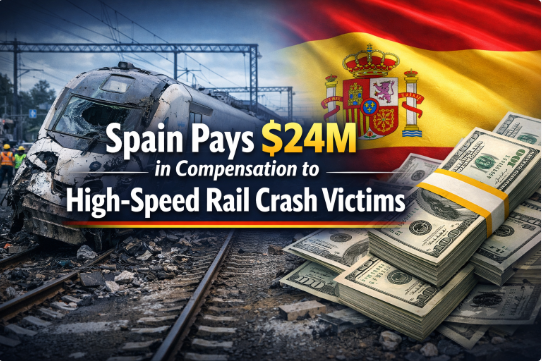
Spain pays $24 million in compensation to victims of a high-speed train accident
Spain has announced a $24 million (€20 million) compensation package for victims of the deadly high-speed train crash near Adamuz, in the province of Córdoba—an accident that killed 45 people and injured more than 150 earlier this month. The decision, confirmed by Transport Minister Óscar Puente, aims to get meaningful financial support to families and survivors quickly, without forcing them to wait years for court rulings or insurance disputes. (Reuters)
What the compensation includes
Under the plan, the family of each person who died will receive €216,000 within a maximum of three months. That figure is structured as a blend of €72,000 in tax-exempt government aid, €72,000 as an advance insurance payment, and an additional €72,000 from mandatory passenger travel insurance tied to rail travel in Spain. Injured passengers will receive graded compensation ranging from €2,400 to €84,000, depending on the severity of their injuries and medical prognosis. (Reuters)
The minister framed the package around urgency and dignity. As he put it, ordinary administrative timelines “do not always respond to the vital urgency of a tragedy like this,” and victims should not have to shoulder bureaucratic delays on top of grief and recovery. The timeline and structure are designed to front-load aid so that families can cover immediate expenses—funerals, travel, lost income—and survivors can access medical care and rehabilitation without financial paralysis. (The Straits Times)
Why this payout matters now
The Adamuz crash is Spain’s deadliest rail disaster since 2013, a stark statistic that underscores both the rarity of high-fatality incidents on modern European networks and the shock to public confidence when they occur. The government’s move is meant to address that public anxiety with something concrete: a transparent, time-bound compensation plan that blends state support and private insurance into a single, predictable envelope. (Reuters)
In the first days after mass-casualty events, families face intense logistical and financial burdens—everything from identifying remains and arranging repatriation to navigating hospitals and specialized clinics. By committing to clear amounts and a short delivery horizon, the Spanish authorities seek to head off the prolonged uncertainty that has marred other transport tragedies in Europe. (Reuters)
The human toll behind the numbers
Numbers can feel clinical, but they map onto real lives. Behind the tally of 45 dead are parents, partners, and professionals whose absence will echo through households and workplaces. More than 150 injured passengers face recoveries that may take months or years, from orthopedic surgeries and neurorehabilitation to the less visible aftermath of trauma. Early and predictable compensation does not replace accountability or long-term support, but it can stabilize households at their most vulnerable moment—when paychecks stop, medical bills start, and the future looks uncertain. (Reuters)
What we know about the crash
The collision unfolded after one high-speed train derailed and struck an oncoming service near Adamuz, roughly 30 minutes north of Córdoba, on the evening of January 18, 2026. Drone footage and on-the-ground images from the scene showed mangled rolling stock and extensive emergency operations across a rural stretch of line. The precise technical cause is still being investigated by Spanish authorities and rail-safety experts. Early public statements have avoided premature conclusions, emphasizing a methodical inquiry into track integrity, rolling stock, and signaling systems. (Reuters)
In the wake of the crash, frontline responders worked through the night amid difficult terrain. Amid the devastation, there were rare glimmers of relief—like the widely reported rescue of Boro, a schnauzer–water dog mix, four days after the crash, a story that resonated precisely because it stood out against so much loss. (Reuters)
Accountability, safety, and public trust
Compensation is only one part of a complete response. The other pillars are truth—determining what failed—and prevention—ensuring it doesn’t happen again. The minister has faced mounting political pressure after a sequence of rail incidents and service disruptions that, while not all comparable in scale, collectively raise questions about risk management and maintenance oversight. Opposition leaders have publicly pressed for resignations; commuters in regions like Catalonia have voiced their own safety frustrations after separate operational failures and strikes. The government’s message is that the network remains fundamentally safe, while independent and internal investigations proceed. (Reuters)
For the public, the test will be in transparent findings and credible corrective actions—not only in the accident’s root-cause analysis but also in the follow-through: track inspections, weld and joint audits, rolling-stock checks, driver training refreshers, and contingency planning for exceptional weather or infrastructure stress. These are the unglamorous, engineering-heavy tasks that rebuild confidence. When the final accident report is published, its recommendations—and how quickly they’re implemented—will be the clearest signal of lessons learned.
How the compensation compares
Europe has no single uniform standard for rail-accident compensation; arrangements vary by country, insurer, carrier, and the legal findings that follow an inquiry. What Spain has outlined for Adamuz—€216,000 per deceased victim and scaled payouts for injuries delivered within three months—sits at the higher and faster end of initial state-plus-insurance responses in recent years. The choice to combine direct public aid with advances on private insurance is particularly significant because it shortens the time between need and payment, while preserving the longer-term rights of families to pursue additional claims if negligence or regulatory breaches are later established through the investigation and courts. (Reuters)
What families and survivors should expect next
Verification & documentation. Families will have to submit identity documents, relationships to victims, and banking information; injured passengers will need medical documentation that supports the severity tiers used to calculate payouts. Authorities have promised to streamline this paperwork to minimize repeated trauma. (Reuters)
Coordination between agencies and insurers. The payment path integrates government relief with mandatory travel insurance and advance insurance payouts. That means coordination between ministries, the rail operator(s), and insurers to confirm eligibility and disburse funds without duplication. The government has committed to doing the heavy lifting here so victims don’t get bounced between desks. (Reuters)
Timelines and appeals. The three-month outer limit for payments sets an expectation; families and survivors should keep records of communications and submissions, and seek support from legal aid groups or victim associations if delays occur or if they believe their injury banding doesn’t reflect their medical reality. (The Straits Times)
Long-term rights. This initial compensation does not extinguish future legal avenues. If the investigation establishes specific failures—whether in infrastructure, rolling stock, signaling, or oversight—families may have grounds for additional civil claims. Today’s package is a floor, not a ceiling.
The broader rail-safety conversation
High-speed rail has an excellent safety record across Europe, yet low-probability, high-impact events like Adamuz demand humility and relentless attention to systems engineering. Modern rail safety is a layered architecture: infrastructure quality (rails, sleepers, ballast, welds), rolling-stock design (energy absorption, couplers, bogies), signaling and speed enforcement, and human factors (training, fatigue management). Investigations typically look not just for a single failure but for chains of vulnerability—small deviations that line up with tragic precision.
Following Adamuz, several technical issues are likely to get special scrutiny:
Track condition and weld integrity. Investigators will analyze joints and welds near the derailment point, checking for metallurgical defects, thermal expansion stresses, or maintenance gaps.
Wheel-rail interaction. Data from onboard recorders can reveal oscillations, dynamic forces, and whether a developing fault (e.g., a flat spot or bearing issue) played a role.
Signaling and train protection systems. Even if a derailment was the initiating event, the system’s ability to protect the opposite track and prevent a secondary collision is crucial.
Emergency response protocols. Coordination between national police, firefighters, medical services, and local authorities will be evaluated for speed, communication, and resource allocation—an area where Spain has historically excelled, based on large-scale incident preparedness.
While the public conversation sometimes races to blame, the technical process is intentionally slower. The best safety improvements come from evidence-based, non-punitive learning: find the root causes, fix them, and publish the fixes.
Signals Spain is trying to send
By moving decisively on compensation, Spain signals three priorities:
Care for victims: Front-loaded payments and clear amounts show compassion translated into policy. (Reuters)
Administrative competence: A unified plan that integrates government aid and insurance reduces red tape and restores some trust in the system. (Reuters)
Commitment to answers: Public officials have repeatedly emphasized the ongoing investigation and the expectation of transparent results that will drive improvements. (The Straits Times)
Whether those signals land will depend on execution—on payments arriving as promised, on an inquiry that is thorough and independent, and on visible corrective actions across the rail network.
Voices from Spain—and beyond
The Adamuz disaster has sparked mourning and solidarity across Spain, from moments of silence in city halls to volunteer blood drives in Andalusia. It has also revived debates about infrastructure spending, contractor oversight, and the cumulative effect of small service failures on the rail brand. Newsrooms across Europe have treated the story as a regional shock, both for the scale of the loss and for what it might teach other high-speed networks about resilience and redundancy. As reporters have noted, even positive outliers in safety must continuously invest to stay that way. (euronews)
What to watch in the coming weeks
Interim accident findings. Expect technical updates as investigators review data recorders, track fragments, and maintenance logs.
Payment progress. The three-month window becomes a benchmark for accountability; media outlets will track whether funds land on schedule and whether injury banding aligns with medical realities. (The Straits Times)
Policy responses. Depending on emerging findings, watch for targeted inspections, accelerated maintenance programs, or capital plans that address any systemic vulnerabilities flagged by the inquiry.
Bottom line
Spain’s $24 million compensation package is not a final chapter; it is a necessary first step—one that blends compassion with administrative clarity. For families and survivors, it offers immediate stability amid chaos. For the broader public, it is a promise that the state is listening and that accountability won’t be deferred to a distant court date. The real test lies ahead, in the rigor of the investigation and the speed with which its recommendations are implemented. If Spain meets that test, the legacy of Adamuz will be safer rails as well as solemn remembrance. (Reuters)
SEO Keywords (one-paragraph list): Spain train crash compensation, Spain pays $24 million to victims, Adamuz high-speed train accident Córdoba, Spanish rail disaster 2026, Óscar Puente compensation package, €216,000 per victim Spain, injured passenger payouts €2,400 to €84,000, Spain deadly train crash since 2013, high-speed rail safety Spain, Spanish government aid train victims, mandatory passenger travel insurance Spain, train accident investigation Adamuz, Spain transport ministry response, victims’ families compensation Spain, European rail accident compensation, Spain news 28 January 2026, high-speed train collision Córdoba province, Adamuz crash inquiry updates, Spain emergency response rail crash, legal rights train crash victims Spain.