
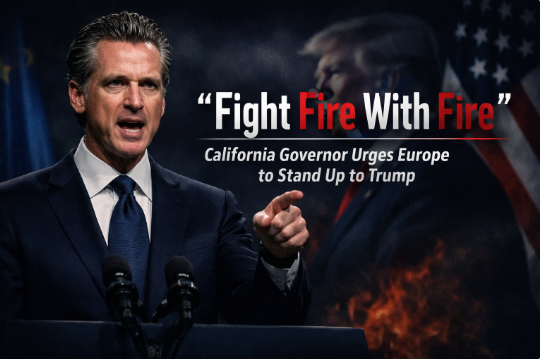
“Stop appeasing him and fight fire with fire… the Governor of California calls on Europeans to stand up to Trump.”
A message that travels across the Atlantic
On a day thick with headlines and thin on patience, a blunt message from California ricochets across the Atlantic: stop appeasing, start answering back. The phrasing is deliberately unsugared—“fight fire with fire”—and it lands in Europe like a challenge, not a courtesy. Whether you agree with the wording or wince at the heat, there’s a practical question at the core: what should European leaders do when confronted by a pugnacious American presidency that treats politics as a contact sport? The California vantage point is useful here. It’s a place that has spent years building climate alliances with European cities, courting clean-tech capital from Berlin to Copenhagen, and locking elbows with Brussels on digital regulation and privacy. When a governor from that ecosystem says Europe should steel its backbone, the subtext is simple: values are only as real as the costs you’re willing to bear to defend them.
Europe’s strategic dilemma in plain language
Appeasement is a loaded historical term. In modern policy, it usually looks more like tactical quiet—soft-pedaled diplomatic language, wait-and-see trade stances, delayed responses in multilateral forums. The argument against appeasement is not that restraint is weak, but that unilateral bluster tends to fill any vacuum. If a White House—any White House—operates on escalation and spectacle, then a purely reactive Europe ends up playing away games on a field chalked by someone else. “Fight fire with fire,” in a policy sense, doesn’t mean matching insult for insult; it means matching leverage with leverage, and speed with preparedness. That’s sanctions packages drafted in advance rather than in panic. That’s tariff response frameworks pre-modeled and communicated privately to avoid confusion. That’s joint statements that are actually joint—France, Germany, Italy, Spain, Poland, and the Nordics—so markets don’t spend a week guessing who blinked.
The political toolkit: carrots, sticks, and timers
When transatlantic politics turns kinetic, Europe’s best instruments aren’t theatrical—they’re technical. Three tools matter most:
Time-boxed negotiations. Deadlines discipline politics. If Washington floats a tariff or demands an about-face, Europe’s response should set a hard clock: 30 days of structured talks with clear off-ramps and on-ramps. This turns brinkmanship into a calendar item, not an existential crisis.
Symmetric trade triggers. The European Union already wields considerable trade law muscle. Announcing tailored, proportional countermeasures—narrow, data-backed, and reversible—signals seriousness without torpedoing supply chains. The trick is to select sectors where European alternatives exist or where diversification is already underway.
Coalitions that make markets listen. The G7, NATO, and OECD are more than logos. When Europe moves in concert with Canada, Japan, and key emerging partners, the market reads it as a durable signal rather than a momentary press hit. That changes corporate lobbying dynamics inside Washington faster than any podium broadside.
Climate, tech, and security: three battlegrounds where Europe can lead
Climate and energy. California and Europe have long run a relay race on climate policy—vehicle emissions standards, cap-and-trade systems, and carbon disclosure rules. If Washington shrugs at climate commitments, Europe can harden its Carbon Border Adjustment Mechanism, accelerate green-hydrogen corridors from Iberia to Central Europe, and deepen subnational climate pacts with U.S. states and cities that still want in. That undercuts the “jobs vs. climate” framing by building real jobs around transatlantic clean supply chains.
Technology and platforms. The Digital Services Act and Digital Markets Act are not just alphabet soup; they’re templates. A posture of “fighting fire” here means Europe keeps enforcing, publicly and evenly, while inviting U.S. states—California chief among them—to align on privacy standards and AI safety benchmarks. Joint technical working groups beat Twitter fights every time.
Security and deterrence. In NATO, credibility is measured in capabilities deployed and logistics rehearsed, not adjectives. European capitals can lock in defense spending targets, standardize ammunition and spare parts procurement, and deepen rail, port, and energy resilience. The point isn’t to antagonize Washington; it’s to ensure Europe’s deterrence calculus is sovereign enough that any U.S. wobble becomes a nuisance, not a catastrophe.
The rhetoric vs. the work
Strong words are accelerants. They light up headlines and juice social feeds. The problem is that heat without airflow smothers the flame. If Europe wants to “stand up,” the choreography is less glamorous: spreadsheets, simulations, and contingency memos. Pre-cleared regulatory responses shorten decision time from weeks to hours. Reverse-briefings keep parliaments in the loop so the politics doesn’t crack under pressure. Even the comms needs engineering: single-page explainer decks in all major languages so the public sees policy logic, not just posture. Fighting fire with fire is really about readiness over indignation.
A human-level read on transatlantic friction
Under the grand strategy, there’s the human texture. Workers who fear a tariff ping-pong will delete their overtime. Farmers who worry a retaliatory list might land on their crops. Students who wonder whether visas will tighten because moods did. Political theater can make people feel like pawns. A more humanized approach acknowledges those anxieties out loud and shows the guardrails. If a measure is temporary, say it. If it’s reversible, define the criteria. If support will cushion those who carry the cost, publish the timelines and portals. People can shoulder tough policy if they are treated as citizens, not spectators.
Power is contagious—so is panic
One reason the California message resonates is entrepreneurial muscle memory. In tech and climate finance, momentum compounds. The same is true for politics. A Europe that moves quickly—clarifying its red lines, corralling its allies, and absorbing a hit without flinching—becomes more powerful on the second day than it was on the first. The opposite is also true: hesitation metastasizes. Markets punish ambiguity. Extremists feast on drift. If you dislike the metaphor of fire, think physics: force applied early reduces the energy required later. Strategic firmness is an economy of motion.
What about dialogue?
There’s a caricature that “fight fire with fire” means shouting louder. The smarter reading is: negotiate, but with leverage visible on the table. Dialogue is essential; it just works better when both sides can see the cost of stalemate. Track-two diplomacy—between legislators, governors, business leaders, and universities—keeps the transatlantic tissue alive even when top-line politics decides to cosplay as a wrestling match. California’s own history of subnational pacts with European regions on climate and research shows how to keep oxygen in the room. Conversations don’t have to stop just because microphones get spiky.
Europe’s comparative advantages (use them!)
Europe is at its best when it acts like a system: rule-of-law institutions, high-trust standards bodies, cross-border logistics, and a research base that can pivot from lab to deployment. The continent’s regulatory craft—so often mocked as bureaucratic—is a superpower when geopolitics turns erratic. Setting the standard sets the market. If Washington swings wildly, Europe can stabilize expectations by proving that the rules will hold—a steady lighthouse in a jumpy sea. That draws capital, talent, and long-term contracts. Strategy, meet compounding.
The cost question, answered plainly
Will there be costs to standing firm? Yes. The point is not to deny them but to shape them. If a tariff lands, cushion the shock with targeted relief. If a sector gets singled out, speed up diversification credit lines and export insurance. Use the moment to operationalize resilience that would have taken years of parliamentary committee hearings otherwise. The measure of success isn’t zero pain; it’s whether the pain buys durable autonomy and a stronger negotiating position next time.
A note on tone: steel without swagger
Europe doesn’t need to mimic America’s volume to be heard. It needs precision and predictability. This is where the California nudge is useful. It’s less about theater, more about tempo. Do the homework in advance. Publish the playbook. When a provocation arrives, respond inside a pre-announced framework with pre-validated options. That’s the quiet version of “fight fire with fire”—the kind that burns clean and doesn’t smoke out your own living room.
Citizens, not algorithms, decide whether democracies hold
Across the Atlantic, the loudest argument for democratic resilience isn’t a podium—it’s the daily competence of institutions. When leaders say “don’t appease,” the deeper invitation is to rebuild citizen confidence: functioning ports, steady energy prices, understandable utility bills, fair enforcement of competition rules, trustworthy elections. If that works, demagoguery has less purchase because life already makes sense. A sturdy democracy is less flammable.
From message to mandate
Today’s headline will fade; the structural lesson shouldn’t. Europe can transform reactive politics into strategic routine: pre-negotiated coalitions, data-driven countermeasures, and citizen-first communication. The California governor’s admonition is a spark. What matters is whether Europe uses it to light lamps—practical, steady lamps—rather than another bonfire of outrage. The future favors those who prepare, not those who perform.
SEO keywords (one paragraph): California Governor Europe message, stand up to Trump analysis, fight fire with fire politics, anti-appeasement strategy Europe, transatlantic relations 2025, EU response to US tariffs, European trade strategy, NATO and EU coordination, climate policy cooperation California Europe, digital regulation EU DSA DMA, strategic autonomy Europe, resilience against populism, European sovereignty and markets, tariff retaliation framework, sanctions policy EU, US-EU diplomatic relations, Davos political commentary, humanized political blog, policy analysis for SEO, trending political keywords Europe, international relations blog SEO, geopolitics 2025, EU trade and security, California clean tech partnerships, EU carbon border adjustment mechanism, GDPR and privacy leadership Europe, EU-US technology standards, global governance commentary, democratic resilience Europe, opinion editorial SEO.