
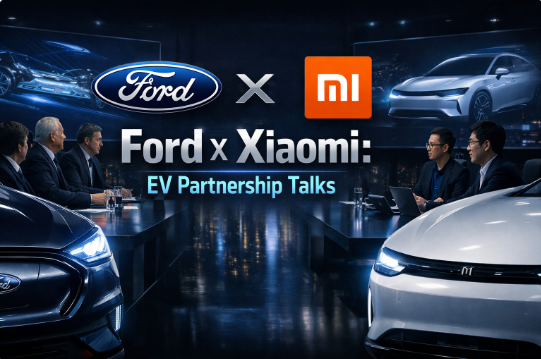
Talks between Ford and Xiaomi on a partnership in the electric vehicle sector
If you had “Detroit meets Beijing’s gadget king” on your 2026 bingo card, take a bow. Reports today suggest that talks have taken place between Ford and Xiaomi about a potential electric-vehicle partnership—an idea that lands right at the crossroads of manufacturing muscle and software-first design. The rumor mill didn’t spin out of thin air: preliminary discussions have been reported by respected outlets, with the added complexity that public denials and geopolitical headwinds may still turn this into an automotive Schrödinger’s cat—both alive and not yet alive. Still, the strategic logic is compelling enough to unpack in full. (Financial Times)
What’s reportedly on the table—and why it matters
Ford brings century-old know-how in vehicle development, safety certification, scaling factories, dealer networks, and service. Xiaomi brings a blitzkrieg pace in consumer software, hardware integration, and an EV brand that’s behaving like a phone on wheels. Even the personal tastes of leadership hint at mutual respect: Jim Farley has praised Xiaomi’s first EV and has been open about learning from Chinese EV upstarts—which might help explain why such talks are even conceivable in the current climate. (Car and Driver)
In the most charitable reading, a partnership could look like a joint venture that leverages Ford’s manufacturing footprint and Xiaomi’s software ecosystem, in-car OS, and rapid OTA (over-the-air) iteration cycle. It could also be narrower: software co-development, infotainment integration, or a specific project like a midsize EV where Ford provides the platform and Xiaomi handles the cabin tech stack and user experience. The boldest scenario would be U.S.-built EVs with a Xiaomi-flavored operating system, but that vision runs straight into political tripwires (we’ll get to those).
The strategic jigsaw: platform, batteries, software, and speed
The modern EV stack is really four stacks woven together:
Vehicle platform: chasses, crash structures, compliance—where Ford is strongest.
Battery tech: chemistry, pack design, thermal management—where Ford is building capabilities, including controversial licensing ties with China’s Contemporary Amperex Technology Co. Limited (CATL). (Financial Times)
Software & UX: the interface, app ecosystem, voice/AI assistants, seamless pairing—Xiaomi’s home turf, honed through years of phones, wearables, and IoT.
Manufacturing cadence: the ability to redesign fast, retool fast, and launch fast—Chinese EV brands have been lapping Western OEMs here, and Xiaomi has imported its smartphone playbook into cars.
Marrying these strengths could create an EV that feels like a flagship smartphone inside and behaves like a Ford on the road and in the service bay. That’s not a small promise. It’s also not cheap or simple. Integrating software-defined vehicle (SDV) platforms across security domains, infotainment, driver assistance, and cloud services is notoriously hard—especially when regulatory regimes require local data handling and cybersecurity compliance.
The elephant herd in the room: policy, tariffs, and “de-risking”
Even if both companies love the idea, they have to navigate the United States and China—two markets, two policy philosophies, and a widening moat of tech restrictions. In the U.S., import tariffs on Chinese-built vehicles are sky-high, and scrutiny of Chinese automotive tech is intensifying. That’s before you consider the optics of any American car brand “opening the door” for a Chinese entrant via a JV. Political blowback over Ford’s broader China battery ties has already been loud, and congressional voices are watching every new move. (Financial Times)
On the other side, China is the most competitive EV arena on earth. Any deal that meaningfully touches Chinese manufacturing or software would need careful structuring to pass data-security, IP, and export-control tests in both jurisdictions. This is why some observers think a narrowly scoped partnership—say, co-developing infotainment for non-U.S. markets or licensing software layers that can be re-certified for U.S. use—might be the first domino rather than a full U.S.-assembly JV right out of the gate.
Why the timing is both perfect and perilous
The 2026 market is weird: EV growth is slowing in some Western markets; hybrid sales are roaring back; and capital discipline has become fashionable again. Analysts have already dubbed this year an “EV winter” for legacy automakers facing high costs and price-cut pressure. In that weather, a deal that raises software quality and lowers BOM (bill of materials) costs looks attractive. But the same macro backdrop also makes boards skittish about controversial moves—especially ones that could complicate tax credits or anger regulators. (Bloomberg)
Yet Xiaomi is in a very different season. Its EV division is scaling fast, its software-centric design resonates with digital natives, and it has shown an ability to treat the car like a hub in a broader device ecosystem. Deliveries surged through 2025, and 2026 targets remain ambitious. A tie-up with a U.S. legacy brand could turbocharge credibility in markets where the Xiaomi badge is better known for phones than for safety ratings and winter-range tests. (EV.com)
Positioning against Tesla, BYD, and the rest of the pack
A Ford–Xiaomi partnership would ripple across the global competitive chessboard:
Tesla remains the benchmark for software-defined vehicles, in-house electronics, and global scale. A Ford–Xiaomi pairing would be a direct attempt to close the software delight gap while keeping the comfort, ride, and North American distribution that Ford already owns.
BYD is the cost killer, integrating batteries and power electronics with frightening efficiency. If Ford seeks batteries from BYD (as reported for hybrids outside the U.S.), we could see a world where Ford triangulates: BYD for packs, Xiaomi for software, Ford for integration. That’s a complex supply web—and a political conversation in itself. (CnEVPost)
European automakers—VW Group, Stellantis, and others—are also pushing into software platforms and cost-down EV architectures. A Ford–Xiaomi accord would pressure them to accelerate partnerships of their own, lest they be out-iterated on UX while still paying old-world cost premiums.
What might a deal actually look like?
Working hypothesis (clearly labeled as such): a phased approach.
Phase 1: Software integration pilots
A Ford EV (or future platform) adopts Xiaomi infotainment layers or voice/assistant services in select markets. Data residency is localized; cybersecurity is audited to U.S. and EU standards; app stores are curated per region. This is the least politically fraught way to begin and can be marketed as “choice for the customer”—Android Automotive-style flexibility without a full merger of souls.Phase 2: Co-engineered cabin electronics
Joint work on displays, compute units, and a developer SDK for third-party apps (think navigation, streaming, productivity). OTA cadence is standardized; metrics like daily active users and feature adoption become KPIs alongside the usual warranty metrics.Phase 3: Platform co-development or a JV vehicle
If the politics allow—and that’s a big if—a single model could launch with Ford manufacturing and Xiaomi OS, carrying a jointly curated brand experience. U.S. production would be necessary to thread tariffs and tax credits; strict compartmentalization of data would be essential. Whether this goes ahead depends on Washington, Lansing, and Brussels as much as on Detroit and Beijing.
In each phase, supply chain transparency and IP guardrails are non-negotiable. Lessons from battery-plant licensing—where U.S. lawmakers have probed what, exactly, a Chinese partner retains in royalties, process know-how, or future control—will color any software or JV blueprint. (Reuters)
The customer POV: why this could be good (or not)
From a driver’s seat perspective, a Ford–Xiaomi EV could feel like this:
Instant familiarity: If you’re already in Xiaomi’s device universe, your identity, preferences, and apps follow you into the car. Seamless phone-car handoff, less pairing drama, smarter voice commands.
Faster feature rollout: Software features ship monthly, not annually. Navigation improves via cloud learning; parking, charging, and energy planning get smarter as data accrues.
Lower price for tech: Phone-style BOM discipline might bring down the cost of high-end displays and compute—if the supply chain can pass security audits and meet local-content rules.
Trade-off risks: Data privacy worries, app store fragmentation, and long-term support questions matter. Also, if geopolitics shift suddenly, you don’t want your car’s core features to be collateral damage.
Why some insiders think this remains a long shot
There’s a reason legacy OEMs usually license tech rather than co-own it with a powerful software brand: control. When the problem is building a car that lasts 15 years, you need stable standards and the authority to update or patch across the fleet without external vetoes. Regulators, meanwhile, are wary of foreign control in critical systems—especially anything that touches telemetry or driver-assist. The recent heat around Ford’s battery licensing highlights how even narrowly scoped agreements face heavy political weather. (Financial Times)
And then there’s the market mood. With an “EV winter” narrative and rising financing costs, CFOs prize optionality. A fully fledged JV is the opposite of optionality. It’s a commitment ceremony in a year when everyone is practicing escape drills. (Bloomberg)
The signal inside the noise
Regardless of how these talks end, the signal is that the car industry’s center of gravity keeps tilting toward software value and smartphone-grade UX. Even the loudest skeptics acknowledge how quickly Chinese EV brands iterate. Farley’s public admiration for Xiaomi’s first EV wasn’t a throwaway line; it reflects a reality Western OEMs can’t ignore: customers now compare cars the way they compare phones. If Ford can compress its software timeline by partnering—without torching political capital—it will try. If Xiaomi can amplify credibility and reach with a blue-oval ally—without losing product control—it will listen. (Car and Driver)
Bottom line (for now)
Yes, talks have reportedly happened—though shape, scope, and survivability are still uncertain. (Financial Times)
Politics loom as large as engineering. Battery deals and data rules are already flashpoints. (Financial Times)
The strategic upside is obvious: better software, faster iteration, potential cost relief, and a product that feels truly digital-native.
The execution risk is bigger than a battery pack. It’s brand governance, app ecosystems, and the choreography of two giants dancing under two flags.
As the story evolves, watch for pilot programs rather than splashy JV announcements, carefully worded software press releases rather than platform-sharing bombshells, and a heavy emphasis on data localization and supply chain transparency. That’s what a pragmatic win would look like in 2026, and it’s where real customer value could sneak in while the politics shout.
Sources & context: Reports of preliminary talks between the companies, as well as the broader political and battery-supply backdrop, have been covered by outlets including Financial Times, Reuters, and Bloomberg. Additionally, public remarks and coverage of leadership attitudes toward Chinese EVs, including Xiaomi’s first model, have been noted by automotive media. (Financial Times)
SEO keywords (single paragraph): Talks between Ford and Xiaomi, Ford Xiaomi partnership, Ford Xiaomi EV joint venture, Ford Xiaomi electric vehicle deal, Ford Xiaomi software-defined vehicle, EV partnership news 2026, U.S. China EV cooperation, Ford EV strategy, Xiaomi SU7 integration, Xiaomi in-car OS, Ford battery supply CATL, BYD battery partnership Ford, EV winter 2026 analysis, Ford tariffs and tax credits, U.S. EV tax credits compliance, electric vehicle software platform, OTA updates automotive, connected car ecosystem, EV manufacturing in the United States, China EV market expansion, global EV competition 2026, Tesla competitor analysis, hybrid and EV strategy, automotive supply chain security, data localization in cars, infotainment and app ecosystem, LFP batteries in EVs, EV cost reduction strategies, next-gen EV platforms, Ford digital cockpit, Xiaomi automotive ambitions.