
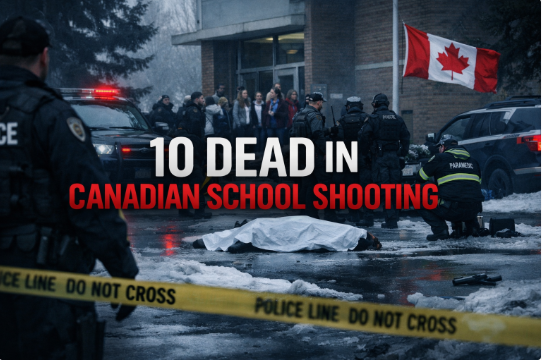
Ten people killed after a woman opened fire at a school in Canada
A quiet Rocky Mountain town woke up to sirens and sorrow. By late morning, the scale of the tragedy was becoming clear: ten people were dead after a woman opened fire at Tumbler Ridge Secondary School, with additional victims found at a nearby residence. Authorities say more than two dozen others were injured, at least two critically. It is one of the deadliest school shootings in Canadian history, a sentence that reads like a contradiction in a country often held up as a model of gun regulation and public safety. (Reuters)
What we know so far
Police and emergency responders converged on the school within minutes. A public alert initially described the suspect as a woman wearing a dress with brown hair. Authorities later confirmed she died of an apparent self-inflicted wound on school grounds. Inside the school, officers found multiple victims; another died en route to the hospital, and two more were discovered at a residence linked to the incident. While the exact motive remains unclear, the pattern is painfully familiar: a community thrust from routine into chaos, families separated by lockdowns and roadblocks, and a news cycle that reduces lives to a rising tally. (Reuters)
Initial reports from responders and health officials indicate more than 25 injured, with patients airlifted from the region as local clinics and hospitals activated mass-casualty protocols. Schools in the district have suspended classes for the week while investigators secure the area and counselors set up crisis lines for students, staff, and families. (The Washington Post)
The town behind the headlines
Tumbler Ridge is small, remote, and tight-knit, the kind of place where the line between neighbor and family tends to blur. People here know one another—the store clerks, the teachers, the bus drivers. When tragedy strikes a town this size, there are no true bystanders. The grief is communal, and it is personal. The images we’ve seen today—RCMP vehicles sealing the perimeter, students escorted out in single file, parents rushing to reunification sites—are now part of the town’s story, even as residents try to reclaim their routines, their schools, and their sense of safety. (The Guardian)
The timeline and the response
By all accounts, the response was swift. Officers were on scene within minutes of the first emergency call, and specialized units followed as reports of casualties mounted. Local hospitals moved quickly to triage patients with gunshot wounds and trauma-related injuries; critically injured victims were airlifted under escort. Such speed matters. In mass casualty events, survival often turns on minutes and on the choreography between dispatchers, first responders, and medical staff—the human network that has to function flawlessly even when nothing else is. (The Guardian)
The national response was immediate as well. Flags across the country were lowered, and leaders issued statements of grief and support. Prime Minister Mark Carney addressed the country, thanking first responders and promising support for victims’ families. David Eby, the premier of British Columbia, called the attack “unimaginable” and pledged resources for the community. Words don’t rebuild what was lost, but they mark a commitment: there will be accountability, assistance, and remembrance. (The Guardian)
Facts, not rumors
In the first hours after any mass shooting, chaos breeds rumor. Eyewitness accounts conflict; social feeds amplify fragments; speculation tries to fill the silence where facts should go. For clarity, we rely on verified reporting from outlets with standards and sources. Today’s confirmed details—ten dead including the suspect, a second scene at a nearby residence, more than two dozen injured—are consistent across coverage by Reuters, The Guardian, and The Washington Post. The emphasis may vary, the quotes may differ, but the core remains: a female suspect, rapid police response, and a community now in crisis care. (Reuters)
The human cost
Numbers give a shape to tragedies like this, but they do not convey scale. The true measure is in the lives interrupted: the student who now flinches at the slam of a locker; the teacher whose classroom, once a place of curiosity and mischief, now holds a memory they don’t want and cannot set down; the parents who will never again worry about small things because the largest fear has already happened. The school will reopen one day—most do—but there will be new rituals: bag checks, drills, counselors on speed dial, memorials at the edge of the soccer field. Grief lingers, but so does care. The casseroles arrive. The childcare chains activate. The town becomes a web of practical kindness.
Trauma specialists often recommend limiting news exposure, keeping routines, and naming feelings explicitly—“I’m afraid,” “I’m angry,” “I’m numb”—as first steps toward integration. For kids, age-appropriate language matters: answer the questions asked; don’t lend fears they haven’t imagined. For adults, community is a protective factor. If you can, choose a person to check in on and a person to check in with. Healing is social before it is solitary.
A woman with a gun in a school: breaking a pattern, not the pattern
Because mass shooters skew male, a female suspect arrests attention. It’s a statistical outlier, not a contradiction. Research catalogs male dominance in mass shooting data, but rare exceptions exist. The key takeaway isn’t a scoreboard of anomalies; it’s the tragic universality of access plus intent. Canada’s legal environment is stricter than that of many countries, but no law is a forcefield. The question that follows is uncomfortable and necessary: where did the system fail—screening, storage, reporting, response—and what can be strengthened without delay?
Historical context: Canada and gun violence
Violent rampages are rarer in Canada than in some other countries, but history has its grim bookmarks. The 1989 massacre at a Montreal engineering school and the 2020 Nova Scotia killings reshaped policy debates and public memory. Today’s attack belongs to that unwanted lineage. It will renew calls for enforcement and oversight, and it will test the capacity of federal and provincial governments to turn grief into improvements that are visible at the school doors and audible in the training rooms. Early coverage frames the Tumbler Ridge attack as among the deadliest school shootings in Canadian history, second only to earlier landmark tragedies. (The Washington Post)
The RCMP’s role and the investigative path ahead
The Royal Canadian Mounted Police (RCMP) leads a complex investigation now spanning multiple scenes, with tasks ranging from ballistics analysis to digital forensics to interviews with students and staff. Detectives will reconstruct the suspect’s movements, examine how the weapon was obtained, and map any warning signs—social posts, messages, prior incidents—that might have been missed or minimized. They will cross-reference emergency call logs with surveillance footage and body-worn camera timelines to evaluate what went right, what went wrong, and how to refine protocols for small, remote communities where resources are thin and distances are long. Preliminary public statements stress that there is no further threat to the public and that the investigation is active. (The Guardian)
Media literacy and compassionate consumption
Coverage of violence is a paradox: it informs and it injures. We need verified updates to stay safe and civic-minded, and yet repeated exposure to raw details can magnify anxiety and erode trust. The rule of thumb: check fewer times, from better sources. Follow official RCMP updates and statements from provincial authorities; read round-ups from established international outlets like Al Jazeera English for global framing, and Canadian outlets for local nuance. Resist the rumor mill. If a detail makes you angry and demands instant sharing, give it five minutes and a second source. The truth can handle scrutiny. Lies prefer speed. (Al Jazeera)
Policy talk without performative heat
Moments like this invite a pendulum swing between fatalism and absolutism. Neither helps. Policy is wonky by design: licensing standards, safe-storage rules, red-flag processes, reporting and escalation pathways in schools, mental health funding, and rural health infrastructure for trauma care. None of these sound flashy on a debate stage, yet they are precisely the gears that can grind tragedy down. The conversation Canada will have in the coming weeks—how to reinforce what worked and repair what didn’t—will be most productive if it keeps its eye on implementation. Which budget lines fund school counselors? How do rural clinics staff on-call trauma teams? What’s the turnaround for background checks? When are drills useful, and when are they harmful? The answers aren’t ideological; they’re operational.
Schools, safety, and the everyday
For families wondering what Monday will look like when school resumes, here’s the pattern observed in communities that have endured mass shootings:
Staggered reopening. Portions of the campus may remain closed while investigators finish their work. Classes might meet in alternate spaces or temporary modular rooms.
Visible support. Counselors, therapy dogs, and peer support teams often line the hallways for weeks. Students are encouraged—but not forced—to speak.
Transparent adjustments. Expect changes to entry procedures, visitor policies, and emergency drills. If something feels different, ask: administrators are often eager to explain the “why,” not just the “what.”
Academic grace. Extensions, pass/fail options, and reduced testing loads are common. Trauma impairs concentration; good schools model humane expectations.
The most important thing adults can do for kids is to model calm, curious engagement with reality: it’s safe to ask questions; it’s okay not to have the answers right away; and it’s normal to lean on one another. Recovery is not a straight line. It’s more like a spiral—sometimes you feel you’re back at the beginning. You aren’t. You’re tracing the same space from a different height.
Witness and memory
There will be vigils. There will be photographs of the lost—sports uniforms, prom dresses, the candid silliness of youth—printed on candlelit posters. In time, there may be scholarships or a memorial garden, a plaque where morning light catches etched names. Collective remembrance resists the numbing logic of repetition. It says: these were people, not just numbers; this place was loved; this mattered. The work of journalists and community historians will help ensure that what happened in Tumbler Ridge on a winter morning in 2026 is recorded with care and accuracy, and that the full measure of the town’s response—its steadiness, its kindness, its insistence on looking after one another—stands alongside the account of violence.
How to help, concretely
When official fundraisers launch (often via school boards or municipal channels), they tend to be the safest avenue for donations. Verify before you give; impersonation scams appear quickly after high-profile disasters. Local organizers may request specific items (gift cards for groceries, taxi vouchers for families traveling to hospitals, funds for counseling co-pays). If you’re in British Columbia, consider giving blood; surge demand after mass casualty events strains supply. Not everyone can donate money or blood. Time counts too—meals, rides, childcare, a promise to check in on someone every few days for the next month.
The story isn’t over
Today’s headlines capture the shock. The real story will unfold in the weeks to come, long after cameras leave. It will be written by the students who return to classrooms, by teachers who carry both syllabus and sorrow, by parents who refuse to let fear define their children’s world, and by a community that finds new rituals of care. Policy will matter. So will patience. So will the boring, beautiful work of making places feel safe again: fixing a broken lock, replacing a shattered window, reopening a library.
Our responsibility as readers is to stay present without growing numb, to demand competent policy without succumbing to cynicism, and to honor complexity without evasion. Grief is not the end of the story. It is a beginning that no one wanted—but it can be a beginning of better things we build together.
Key verified details (for readers seeking a concise update)
Fatalities: Ten people are dead, including the suspect; victims were found at the school and at a nearby residence. (Reuters)
Injuries: More than two dozen were injured; at least two were in critical condition and airlifted for treatment. (The Washington Post)
Suspect: Described in an initial alert as a woman; later found deceased from an apparent self-inflicted wound. (Reuters)
Response: Police arrived within minutes; schools in the area are closed for the week while counseling services are deployed. (The Guardian)
National reaction: Leaders expressed condolences; flags were lowered across Canada. (The Guardian)
About our sources
For this report we drew on corroborated information from multiple reputable outlets, including Reuters, The Guardian, The Washington Post, and Al Jazeera English—and we will update our understanding as law enforcement releases official findings. (Reuters)
SEO keywords (one-paragraph cluster): Canada school shooting, Tumbler Ridge Secondary School shooting, British Columbia school shooting, female shooter Canada, mass shooting in Canada 2026, RCMP update Tumbler Ridge, Mark Carney statement shooting, David Eby response, latest news Canada school attack, gun control in Canada debate, victims identified in Tumbler Ridge, community vigil British Columbia, counseling resources for students, timeline of school shooting Canada, what happened at Tumbler Ridge, verified updates RCMP, national reaction to Canadian school shooting, deadly school shootings in Canada history, live updates and developments, trauma support after school shooting.