
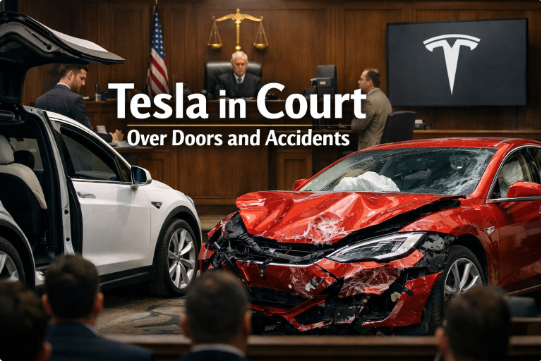
Tesla in court over doors and accidents
If you’ve ridden the modern rollercoaster of electric vehicles, you’ve felt the Tesla effect: a blend of exhilaration, anxiety, and the sense that you’re sitting inside a computer on wheels. That mix is exactly what’s now playing out in courtrooms. Plaintiffs, regulators, and advocates are asking hard questions about Tesla’s doors, accident patterns, and the company’s distinctive approach to safety, software, and accountability. Today’s story unpacks those questions in a way that respects the people involved—drivers, passengers, first responders—while also examining the engineering choices behind the headlines. It’s a human story first, a technology story second, and a legal story throughout.
Why doors matter more than you think
Car doors aren’t just panels with hinges; they’re part of a complex safety system. They’re connected to side-impact beams, airbags, latches, intrusion sensors, and emergency release mechanisms. In an EV, they also interact with high-voltage architecture and software-driven locks. Tesla’s design language—flush handles, minimal mechanical clutter, software-mediated entry—offers aerodynamic gains and futuristic vibes. But those same design choices have been questioned by critics who argue that, in certain crash or fire scenarios, any extra step between a rescuer and a latch can cost precious seconds.
Proponents counter that Tesla vehicles include multiple fail-safes, internal mechanical releases, and instructions for first responders. They point to crash-test ratings, stout battery enclosures, and real-world data showing robust occupant protection in many accidents. The legal friction happens in the narrow space between “generally safe” and “specifically insufficient in this scenario.” Courts are built for that nuance: they ask not whether a product is perfect, but whether a particular design choice was reasonably safe, reasonably communicated, and reasonably foreseeable in how it might fail.
The court cases at the center of attention
When people say “Tesla in court over doors and accidents,” they’re referring to clusters of lawsuits and claims that share common themes:
Emergency egress and flush handles: Some suits allege that door handles or lock logic hindered quick exit or rescue after a crash or thermal event. The legal question: did the design or instructions create unreasonable risk in foreseeable conditions?
Power loss logic: In severe impacts, cars can lose power. Plaintiffs sometimes argue that software-gated doors or windows behave unpredictably when modules go offline. Tesla points to manual releases and emergency pull tabs; plaintiffs counter that placement, labeling, or training weren’t adequate—or that the manual solutions are too hard to find under stress.
Autopilot/driver-assist context: While not strictly a “door” issue, courts sometimes treat advanced driver-assistance systems (ADAS) as “context setters” for crashes. If ADAS contributed to an impact, the downstream question becomes whether occupants could exit promptly—so doors and ADAS can get braided together in the narrative of a single case.
Because legal filings are precise to each crash’s facts—impact geometry, speed, damage path, fire behavior, visibility, the occupant’s ability to reach handles—there is no single “smoking gun” or blanket verdict. Instead, cases advance one fact pattern at a time, generating a mosaic that slowly clarifies best practices for human-machine interfaces in emergencies.
The design trade-offs behind sleek doors
Flush handles are aerodynamic (range matters) and reduce ice buildup and wind noise. They also signal premium minimalism, a big part of Tesla’s brand. But traditional handles are tactile and obvious, especially to bystanders sprinting to help. The user-experience problem is that emergencies are cognitively messy: smoke, adrenaline, darkness, and odd car angles. A system that’s intuitive in a calm driveway can feel cryptic at night with airbags deployed.
Engineering teams try to bridge this gap with redundancy (software + mechanical releases), discoverability (clear markings), and training (manuals, prompts, in-app tutorials). Over-the-air updates can also tweak lock behavior, add on-screen diagrams, or refine how the car defaults after an impact. Courts then ask whether these steps meet a reasonable standard given foreseeable chaos. Reasonableness, not perfection, is the legal anchor.
What plaintiffs tend to argue
Foreseeability: EV fires are rare but memorable. It’s foreseeable that a rescuer may have seconds, not minutes, to act. If a handle confuses a bystander, was that risk sufficiently mitigated?
Adequacy of warnings and instructions: Are emergency releases clearly labeled, physically accessible, and consistent across models? Did owners receive conspicuous guidance (not just fine print) on how to escape without power?
Human factors under stress: Under crash stress, dexterity plummets. Plaintiffs argue that any emergency control must be gross-motor simple: pull, push, kick—no guesswork. If software introduces latency or rules (e.g., child locks, vehicle state) that complicate escape, plaintiffs see a design defect.
Comparative alternatives: If safer alternatives (e.g., mechanically dominant handles with aerodynamic covers, illuminated egress cues, standardized rescue decals) were feasible, plaintiffs say failing to adopt them is negligence.
What Tesla and supporters tend to argue
Overall safety record: Tesla points to strong occupant protection in many crashes, high marks in certain tests, and massive real-world fleet miles. A product can be broadly safe even if discrete scenarios go badly.
Redundancy and manuals: Vehicles include mechanical releases and multiple exit paths. If owners skip manuals, is that the manufacturer’s fault? Tesla can also argue that it continually improves instructions and software through over-the-air updates.
Comparative risk: Every design has trade-offs. Traditional handles can snag, ice up, or add aerodynamic drag. Minimalist doors reduce those issues and, with training, are reasonably safe.
Driver responsibility and causality: In ADAS-related crashes, Tesla emphasizes that driver-assist is not self-driving and that misuse or inattention caused the primary impact. Door questions, they say, are secondary to collision causality.
The human cost behind the technical debate
Legal briefs can be dry, but the stories are not. Families remember smoke, a jammed latch, a hand groping for a lever in the dark. First responders remember heat and seconds. Engineers remember trade-off charts and deadlines. Regulators remember patterns: the same confusion popping up in different zip codes. And investors remember risk: legal exposure, recall costs, reputational damage. The courtroom gathers all of them and demands a shared language.
That shared language needs to acknowledge trauma without flattening facts, to weigh design decisions without pretending any car can predict every crash. It also needs humility. Humans do panic. Software can lock up. Mechanical parts can deform. Good design assumes failure elsewhere and still gives people a fighting chance.
What to watch for next
Human-factors evidence: Expect more expert testimony on how people perceive controls in smoke and darkness. Think aviation-style studies: can a naive helper open the door within five seconds? Ten? With gloves? With low dexterity?
Standardized rescue cues: The industry may converge on universal symbols, glow-in-the-dark decals, or surface texturing that screams “PULL HERE” even to someone who’s never seen an EV. Fire departments love standardization; juries do, too.
Software defaults post-crash: Lawsuits can nudge manufacturers to change how doors behave after impact—e.g., automatically unlock, pop handles out, illuminate cut zones, drop windows slightly, or play an audio cue for rescuers.
Over-the-air (OTA) settlements: An intriguing EV twist: a settlement might include an OTA update. Rather than only damages, parties could agree to a software change that modifies egress behavior or enhances user prompts. It’s remedial design in real time.
Documentation that’s actually read: Expect design teams to experiment with short, video-based crash-escape tutorials in owner apps, on-screen “test your emergency exit” prompts, dealership walk-throughs, and even QR codes printed on door frames.
Safety advice that helps—today
Regardless of lawsuit outcomes, drivers and families can take practical steps:
Learn the manual releases: In every Tesla model, note where the mechanical pulls live—front and rear. Practice (gently) in daylight so your hands remember in the dark.
Prep your family: Kids, grandparents, and regular passengers should know how to exit without power. Treat it like a seatbelt drill.
Store a rescue tool: A small glass-breaker/seatbelt-cutter can be lifesaving, EV or not. Mount it within arm’s reach of the driver and front passenger.
Share first-responder guides: Many automakers publish rescue sheets showing cut zones and manual releases. Print and keep one in the glove box.
Keep software current: OTA updates may refine post-crash behavior and egress prompts. Install them promptly.
How the legal landscape could reshape EV design
Courts don’t write code, but they do articulate duties: duty to warn, duty to design against foreseeable misuse, duty to minimize harm. Those duties often push industries toward fail-open principles in emergencies. For EVs, that could translate into:
Mechanically dominant egress: Even if software mediates daily use, emergency exit could default to purely mechanical latches that are obvious, tactile, and operable with one tug.
Multimodal cues: Tactile ridges, bright contrast colors on concealed levers, and simple icons that remain visible through smoke or ash.
Rescuer-friendly external access: Standardized external release points—clearly marked—allow bystanders to open doors even if the car is unpowered.
Crash-state UX: When airbags deploy, the interface could switch to “rescue mode”: doors unlock, interior lights strobe softly, windows crack open slightly, and a voice prompt says where to pull.
Audit trails: Post-crash logs that show door state, lock status, and egress attempts could bring clarity in court and guide better designs.
Accountability and the promise of iteration
One reason EVs inspire both devotion and scrutiny is their software soul. Software means iteration. If litigation highlights blind spots, good-faith manufacturers can respond with updates measured in weeks, not years. That’s a social contract worth nurturing: if owners share data, and companies share fixes, everyone gets safer. Courts, far from being anti-innovation, can become accelerators of better safety through the very pressure they apply.
At the same time, accountability matters. If a design systematically confuses helpers in those critical first moments, “most of the time it’s fine” isn’t a defense—it’s a warning. People don’t crash on graphs; they crash on roads. Juries listen to people.
A balanced way to read these cases
When you skim headlines about “Tesla in court over doors and accidents,” resist two temptations: don’t dismiss plaintiffs as anti-tech, and don’t assume any innovation is reckless by default. Real safety lives in the space between. The most responsible stance is curiosity plus empathy: What exactly failed? Could the design have anticipated that? Were the warnings clear? Did a later update fix the risk? Can the fix be standardized industry-wide?
That stance honors everyone involved: the families who deserve answers, the engineers who want to build the safest machines possible, the regulators who shepherd public trust, and the investors who need consistent rules of the road. Doors are not glamorous, but they’re the hinge between everyday convenience and life-or-death clarity. Getting them right is an engineering challenge, a legal obligation, and a moral imperative.
Bottom line
Tesla’s courtroom chapters on doors and accidents aren’t the end of EV optimism; they’re the necessary friction of an industry growing up. As cases unfold, expect clearer standards for emergency egress, stronger human-factors design, and software updates that make the next crash more survivable than the last. If the process feels slow, remember: safety is a staircase, not a switch. Each case writes one more step.
SEO keywords (one paragraph): Tesla lawsuit, Tesla doors, Tesla accidents, Tesla door handle lawsuit, Tesla emergency egress, Tesla safety, Tesla Autopilot cases, electric vehicle safety, EV fires, product liability, automotive defect litigation, Tesla Model 3 doors, Tesla Model Y doors, Tesla Model S handles, crash safety standards, first responder EV guide, over-the-air updates, ADAS liability, car door design, door latch failure, vehicle recall news, NHTSA investigations, consumer safety advocacy, automotive UX, human factors engineering, emergency exit design, EV crash survivability, vehicle fire response, legal accountability in tech, software-driven vehicles, driver-assistance systems, Tesla risk management, courtroom updates on EVs, auto safety regulations, high-voltage battery safety, occupant protection, rescue tools for cars.