
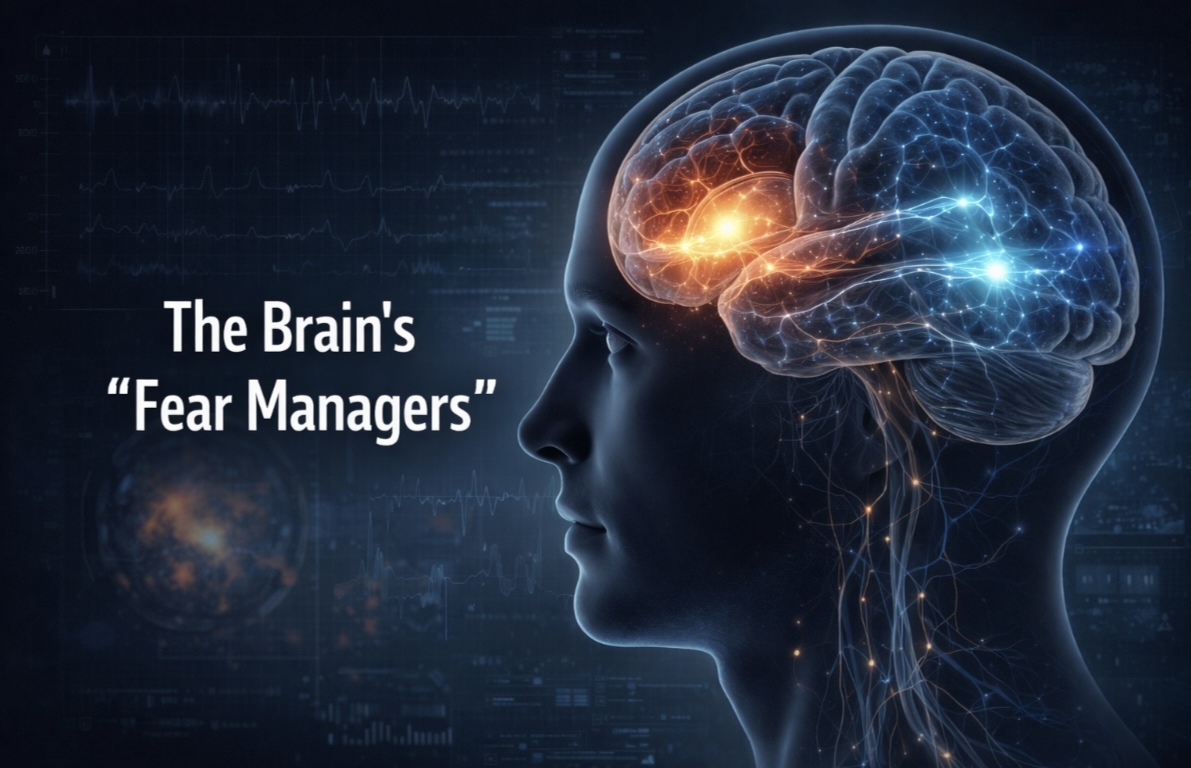
The Brain’s “Fear Managers”
Fear has a bad reputation. Most of us think of it as the feeling that steals our sleep, tightens our chest, and makes ordinary challenges seem bigger than they are. But fear is not the enemy. In fact, fear is one of the brain’s most intelligent protective systems. It exists to help us survive, react quickly, and stay alert when something in our environment feels uncertain, threatening, or overwhelming. The real story is far more interesting than the simple idea that fear just “happens” to us. Behind every racing heartbeat, every cautious pause, and every sudden wave of anxiety, there is a team of brain regions working together like internal supervisors. These are the brain’s “fear managers,” the neural systems that detect danger, interpret risk, store emotional memories, and decide whether the threat is real, exaggerated, or already over.
When people talk about fear, they usually mention the amygdala first, and for good reason. The amygdala is often described as the brain’s alarm center. It helps scan for signs of danger and rapidly flags anything that resembles a threat. This process can happen before we fully understand what we are seeing or feeling. That is why fear can feel so immediate. You hear a loud bang, and your body reacts before your mind catches up. You read a troubling message, and your stomach drops before you’ve finished processing the words. The amygdala is fast, efficient, and deeply committed to your survival. It is not concerned with comfort. It is concerned with protection. In that sense, it acts like a vigilant security manager, always asking, “Could this hurt us?”
But the amygdala does not work alone. Fear is not managed by one part of the brain, but by a network. The hippocampus, for example, plays a major role in memory and context. It helps your brain determine whether something is dangerous based on where you are, what has happened before, and what the current situation resembles. If the amygdala sounds the alarm, the hippocampus steps in and says, “Let’s compare this to past experience.” That is why a smell, a song, a place, or even a season can trigger fear. The hippocampus connects present experience to old emotional memory. This can be helpful when it reminds you to avoid real danger, but it can also create distress when the brain confuses the past with the present. In anxiety, trauma, and chronic stress, the hippocampus may help revive old fear patterns even when the actual threat is no longer there.
Then there is the prefrontal cortex, one of the brain’s most important regulators. If the amygdala is the alarm system, the prefrontal cortex is the wise executive. It evaluates evidence, weighs consequences, and helps calm the fear response when the danger is not as severe as it first appeared. This is the part of the brain you use when you tell yourself to slow down, breathe, think clearly, and assess the situation rationally. It is involved in emotional regulation, decision-making, impulse control, and cognitive resilience. A healthy prefrontal cortex does not eliminate fear. Instead, it helps you respond to fear with perspective. It asks better questions. Is this threat immediate? Is this memory shaping my reaction? Am I safe right now? The strength of this system often determines whether fear becomes useful information or overwhelming emotional noise.
The body is involved too, because fear is not just a thought. It is a full-body event. Once the brain detects danger, the hypothalamus helps activate the autonomic nervous system, especially the sympathetic nervous system, which prepares the body for fight, flight, or freeze. Hormones and stress chemicals begin to circulate. Heart rate increases. Muscles tense. Breathing changes. Attention narrows. Blood flow shifts toward systems needed for fast action. This is why fear can feel physical even when the threat is psychological. Your brain is not distinguishing perfectly between a charging animal, a painful memory, a work crisis, or social rejection. If it interprets something as threatening enough, your body responds. That response is not weakness. It is the biology of survival.
Understanding these fear managers matters because modern life constantly activates systems that evolved for immediate physical danger. Today, many threats are social, emotional, digital, or anticipatory. People fear failure, embarrassment, uncertainty, illness, loneliness, rejection, financial instability, and loss of control. The brain often processes these experiences through the same protective networks it uses for more direct threats. That means your brain may react intensely to an email, a deadline, a conflict, or an intrusive thought because it interprets uncertainty as risk. In a world full of nonstop information, noise, comparison, and stress, the fear system can become overworked. It was designed to help us survive emergencies, not to live in a perpetual state of low-grade alarm.
This is where the concept of chronic stress becomes important. When the brain’s fear managers are activated too often, they can start to reshape the way we think and feel. Chronic stress can make the amygdala more reactive, which means the brain becomes quicker to detect danger and slower to feel safe. At the same time, prolonged stress can weaken the regulatory abilities of the prefrontal cortex, making it harder to think clearly under pressure. The hippocampus can also be affected, which may interfere with emotional memory processing and contextual judgment. This combination can create a feedback loop where the brain becomes increasingly efficient at fear and less effective at calming itself. Over time, that can contribute to anxiety symptoms, emotional exhaustion, hypervigilance, burnout, sleep problems, and difficulty concentrating.
This does not mean the brain is broken. It means the brain is adaptive. One of the most hopeful things about neuroscience is that the brain changes in response to repeated experience. This principle, often called neuroplasticity, means that fear patterns can be reinforced, but they can also be retrained. The brain’s fear managers learn from repetition. If you repeatedly avoid something, the brain may conclude that the thing must truly be dangerous. If you gradually face it with support, safety, and regulation, the brain can begin to update its prediction. This is why exposure therapy, mindfulness practices, breath regulation, journaling, cognitive behavioral therapy, and healthy routines can make such a meaningful difference. They are not superficial wellness trends when used properly. They are ways of teaching the brain new evidence.
Fear itself is not always a problem. In many situations, fear is wise. It can sharpen awareness, heighten perception, and motivate preparation. Fear before a presentation can push you to practice. Fear in a dangerous environment can keep you alert. Fear after repeated red flags can help you leave a harmful situation. Healthy fear is informative. It points to what matters, what needs attention, and what deserves caution. The problem begins when fear stops being proportional. When it generalizes too widely, lingers too long, or dominates decision-making, it can distort reality. That is when the fear managers need support. Not suppression, but support.
One common misunderstanding is that brave people do not feel fear. In truth, courage is often the result of a well-regulated fear system, not the absence of fear. Bravery happens when the prefrontal cortex, emotional awareness, and self-trust work together to move forward despite discomfort. This is an important message in mental health conversations. People struggling with anxiety are not failing to be strong. Their brain is trying very hard to protect them, sometimes too aggressively. That distinction matters because shame makes fear worse. Compassion helps regulate it. When we understand fear as an overprotective biological system rather than a personal defect, we create room for healing.
The social brain also plays a role in fear. Humans are wired for connection, and the brain is deeply sensitive to social cues. Rejection, exclusion, criticism, and disapproval can activate intense emotional responses because belonging has always mattered for survival. That is why public speaking, conflict, or vulnerability can feel terrifying even when there is no physical danger. Your brain’s fear managers may interpret social threat as something deeply consequential. This is not irrational in the broad evolutionary sense. It reflects how closely survival, connection, and identity have been linked throughout human history. For many people, emotional pain is not “just in the mind.” It is processed as a meaningful threat that deserves attention.
Sleep, nutrition, movement, and safety all influence fear regulation more than people realize. A sleep-deprived brain is generally more emotionally reactive and less able to regulate stress. Poor sleep can lower resilience and intensify anxious thinking. Physical inactivity can leave stress energy trapped in the body. Inconsistent meals, excess caffeine, or chronic overstimulation can amplify the nervous system’s sensitivity. On the other hand, restorative sleep, regular exercise, stable blood sugar, social support, and calming routines can help the brain interpret the world as more manageable. This is not simplistic advice. It is foundational brain care. Fear management is not just about thinking differently. It is also about helping the body feel safer.
Mindfulness is especially relevant here because it changes your relationship to fear. Instead of being swallowed by every anxious thought or bodily sensation, mindfulness teaches you to observe what is happening with less immediate identification. You notice the racing heart, the tension, the catastrophic thought, the urge to escape, but you do not automatically treat each one as a command. This strengthens the regulatory role of the prefrontal cortex and can reduce the intensity of the fear response over time. Mindfulness does not tell the brain that fear is stupid. It tells the brain that fear can be noticed, named, and tolerated without immediate panic. That alone can be transformative.
Trauma adds another layer to this discussion. In trauma, the brain’s fear managers may become especially sensitive because they have learned, through real experience, that the world can become unsafe without warning. The brain may over-detect danger because over-detection once improved survival. In that context, fear is not overreaction in a shallow sense. It is a learned survival strategy. Trauma-informed care recognizes this by avoiding blame and focusing on safety, predictability, embodiment, and gradual restoration of control. Healing does not come from commanding the brain to “get over it.” It comes from helping the nervous system experience enough consistency and safety to update its expectations.
It is also worth noting that fear is shaped by personality, environment, genetics, upbringing, and life history. Some people are born with more sensitive nervous systems. Some grow up in unpredictable homes. Some accumulate stress over years. Some live in conditions where vigilance is necessary. The brain’s fear managers are influenced by all of this. That is why fear responses vary so much from person to person. What feels manageable to one brain may feel overwhelming to another. Comparison is rarely useful here. Personalized support is far more effective.
The good news is that the brain is always listening to patterns. Small repeated signals of safety matter. Slowing your breath, naming your feeling, moving your body, limiting overstimulation, building routines, seeking therapy, practicing self-compassion, getting sunlight, resting well, and challenging catastrophic thinking are not trivial acts. They are messages to the nervous system. They say: we are here, we are present, and we can assess this more accurately. Over time, those messages help retrain the fear managers to respond with more balance.
So when fear rises, it may help to stop asking, “What is wrong with me?” and start asking, “What is my brain trying to protect me from?” That question changes everything. It introduces curiosity where shame used to live. It turns a spiral into an inquiry. It invites partnership with your own biology. The brain’s fear managers are not cruel. They are cautious. They are scanning, remembering, forecasting, and preparing. Sometimes they get it right. Sometimes they overestimate the threat. But their purpose is not to sabotage you. Their purpose is to keep you alive.
And perhaps that is the most human part of all this. Fear is not proof that you are fragile. It is proof that your brain is working, predicting, protecting, and doing its best with the information it has. The goal is not to become fearless. The goal is to become more skillful with fear. To understand its language. To recognize when the alarm is accurate and when it needs recalibration. To build a brain and body relationship rooted not in panic, but in trust. When you do that, fear stops being just a force that controls you. It becomes a signal you can understand, manage, and move through with greater clarity, resilience, and self-awareness.
SEO keywords paragraph: brain fear managers, fear response in the brain, amygdala function, prefrontal cortex and anxiety, hippocampus and emotional memory, neuroscience of fear, how the brain processes fear, fight or flight response, nervous system regulation, stress and anxiety, chronic stress effects on the brain, trauma and the brain, emotional regulation, mental health awareness, anxiety symptoms, neuroplasticity and fear, mindfulness for anxiety, brain health, fear management, stress response, psychological safety, brain and behavior, emotional resilience, understanding anxiety, how to calm the nervous system, fear and survival, mental wellness, brain science, cognitive behavioral therapy, healing from trauma, managing fear naturally.