
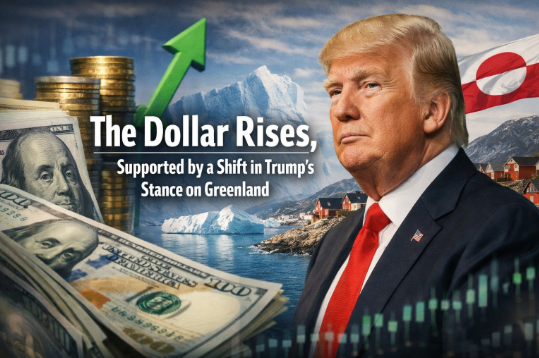
The dollar rises, supported by a shift in Trump’s stance on Greenland
Markets are magpies: they spot something shiny—an unexpected headline, a turn of phrase—and swoop. Today’s glint came from Washington’s evolving rhetoric on Greenland. After months of hard-edged talk, the tone out of the White House hinted at a more transactional, less confrontational approach to the world’s largest island—a strategic prize tucked under the protective umbrella of Denmark. Traders, who have been living on a diet of uncertainty calories, read that as a reduction in geopolitical tail risk. The result: the U.S. dollar caught a bid, risk sentiment improved, and the global macro story took an Arctic detour.
“Greenland” might sound like a niche subplot, but in macro, small hinges swing heavy doors. Any shift in U.S. posture that narrows the probability distribution of bad outcomes—tariffs, sanction spirals, bruising transatlantic spats—can reprice currencies fast. A softer diplomatic line translates into lower volatility premia, which supports the dollar in a world where it remains the deepest haven and the primary invoice currency of trade. That’s the human truth behind today’s ticker tape: markets don’t crave victory; they crave clarity.
Why Greenland, why now?
Greenland is not just cartographic drama—a continent-sized island hovering on maps like a misplaced cloud. It sits on top of buried treasure: rare earths, critical minerals, hydrocarbons, and a coastline that, in a warming world, will matter more for shipping routes and Arctic security. The U.S. already has a long-standing footprint at Thule Air Base. Layer in NATO commitments, Russian activity in the High North, and China’s global materials strategy, and you get a geopolitics-meets-commodities plotline that would make any macro fund manager sit up straighter.
When the tone from Washington cools—even subtly—markets infer fewer tariff threats, fewer retaliatory frictions with Europe, and less chance of currency-war posturing. That relief rally showed up first in equities, then in credit spreads, and finally, in the dollar. The message from price action: investors see a path away from escalation, and they’re willing to own dollars while they wait for the next shoe to not drop.
The dollar’s mechanics: yield, growth, and fear
The dollar’s strength rarely has a single author. Three co-authors shared the byline today:
Yield differentials. As the dust settled, Treasury yields nudged higher at the front end on “risk-on” positioning and a modest paring back of worst-case hedges. A firmer front end typically props up the dollar against low-yielders because carry (the interest you earn holding a currency) becomes more attractive. EUR/USD softened as rate differentials looked a bit less euro-friendly; USD/JPY climbed with U.S. yields and a calmer VIX.
Growth expectations. A less combative diplomatic stance lowers the odds of transatlantic trade flare-ups just as U.S. growth shows resilience. That cocktail favors the dollar in the short run because the greenback is still the world’s “all-weather” asset. If global growth surprises higher, the dollar can benefit from capital inflows chasing U.S. assets; if growth disappoints, the dollar benefits from safe-haven flows. That’s the dollar smile in action.
Volatility premia. Markets price not just what will happen, but what might. When policy tone shifts from brinkmanship to bargaining, the “fat tails” of bad scenarios thin out. Lower implied FX volatility reduces the cost of being long dollars for hedgers, and it emboldens real-money accounts to add exposure without overpaying for options.
Euro, yen, and pound: how the majors reacted
EUR/USD: The euro slipped as traders judged that a thaw across the Atlantic reduces the odds of tit-for-tat trade skirmishes that would have forced the European Central Bank into louder dovishness. With energy inventories decent and a mild winter narrative floating around, Europe’s growth drag is less about weather and more about industrial demand. A quieter U.S.–EU backdrop removes one obvious headwind—helpful for Europe—yet paradoxically near-term supportive of the dollar because it keeps U.S. risk appetite alive while rate differentials still lean America’s way.
USD/JPY: The dollar’s rise against the yen followed the classic playbook: rising U.S. yields plus calmer global risk equals a softer JPY. The Bank of Japan remains tentative on normalization, and unless we see a sharp uptick in Japan’s wage growth, carry trades keep a tailwind. If the Arctic story fades from headlines, USD/JPY could consolidate; until then, the path of least resistance favors the dollar on dips.
GBP/USD: Sterling traded heavy as well. For the pound, external shocks often land via risk sentiment and the U.K.’s current account dynamics. A more stable U.S.–Europe line deprioritizes the U.K. in the “policy risk” league table, but with U.S. yields stickier and the Federal Reserve still projecting a higher-for-longer stance than markets once dreamed of, cable’s rallies may be choppy.
Commodities and the Arctic angle
A dialed-down tone on Greenland is not just a diplomatic memo—it’s a commodities story. Greenland’s rare-earth potential is a wildcard in the long game of supply chain security. When the U.S. sounds less combative, miners and strategic-materials investors can model scenarios that involve investment partnerships rather than export restrictions and emergency stockpiles. That reduces the geopolitical premium embedded in metals. Oil’s reaction was more nuanced: crude eased as the “risk-off” bid faded, but Arctic security still adds a structural floor—shipping lanes, search-and-rescue capacity, and icebreaker fleets aren’t built overnight.
For the dollar, softer commodities are a quiet friend. Lower input costs cushion U.S. inflation, allowing the Fed to stay patient without ceding growth momentum. If energy prices drift, the greenback gets breathing room; if they spike, the dollar often catches a haven bid anyway. Heads the dollar wins, tails it doesn’t lose much.
The Fed’s shadow over the Arctic
No currency story escapes the Federal Reserve’s gravity well. Chair and colleagues have been threading a needle: acknowledge disinflation progress without declaring victory, and keep optionality alive. A reduction in global policy risk dovetails with the Fed’s message. Less noise from the geopolitical channel means the committee can focus on domestic labor-market cooling and sticky services inflation. The market’s read today was simple: the Fed won’t rush to slash; growth isn’t falling off a cliff; the dollar can stay buoyant while the data roll in.
If incoming prints keep showing resilient consumption and gradually cooling core measures, the dollar’s floor firms. If inflation flares or payrolls reaccelerate, the notion of “higher-for-longer” gets new life—also dollar-positive near term. Either way, a less combative Greenland posture removes a variable that could have forced risk-premia wider at an awkward time.
Risk, narrative, and the way markets feel
Humanized markets are story-driven. Traders don’t just compute; they emote. The Greenland thread spooked investors because it wrapped strategic minerals, alliance politics, and tariff threats into a single knot. Untying part of that knot—by signaling negotiation rather than escalation—doesn’t create euphoria; it creates relief. Relief is underrated. It narrows bid-ask spreads, lifts liquidity, and lets asset allocators move from firefighting to planning. You saw that today in the dollar’s steady climb rather than a vertical spike: a measured exhale, not a gasp.
Sentiment shifts like these also travel along social pathways. When skeptics stop shorting headlines, momentum traders stop leaning into stress, and real-money accounts feel safe adding exposure to U.S. paper, the dollar benefits from a chorus of small decisions rather than one grand bet. That’s durable.
What to watch next
1) Concrete policy signals. Words move markets, but actions set the trend. Watch for formal readouts with Denmark and NATO allies, any mention of investment frameworks in Greenland’s mining sector, and clarity on tariff posture. Every communiqué that leans toward cooperation reduces FX risk premia.
2) European response. The euro’s fate isn’t just about the Fed. If Brussels leans into industrial policy around critical minerals and signs security-adjacent agreements that include the U.S., EUR volatility could compress. Ironically, that creates a friendlier environment for dollar strength in the short run as global investors rotate into U.S. equities without fearing a transatlantic breakdown.
3) Energy and shipping data. Arctic news can be a stealth driver of freight rates and insurance premia. If insurers assign lower risk to North Atlantic routes because the diplomatic temperature cools, the cost channel to European inflation improves at the margin—again nudging euro-dollar dynamics.
4) Treasury issuance and term premium. Even with improved risk mood, supply matters. Auction outcomes feed directly into yield differentials. A strong bid for the long end supports the “stable dollar” narrative; weak demand could cap the rally.
Strategy sketches (not investment advice)
Dollar bulls will highlight narrowing tail risks plus decent U.S. growth and stickier front-end yields. The playbook favors long USD versus low-yielders (EUR, JPY) on dips, with tight stops around event risk.
Dollar bears may argue that once the relief fades, attention swings back to U.S. fiscal arithmetic and the eventual Fed easing cycle. If European PMIs stabilize and China stimulus whispers get louder, the dollar could top out.
Hedgers—corporates, especially—get a nicer window. Lower implied vol makes options insurance cheaper. If your cash flows live at the mercy of EUR/USD or USD/JPY, today’s repricing is an invitation to tidy up risk.
A human note on policy and power
It’s easy to treat Greenland as a chessboard square. People live there. Communities, languages, economies, ecologies. When markets cheer a softened stance, part of what they’re cheering—whether they know it or not—is the preference for agreements over ultimatums. Diplomacy doesn’t always deliver quick wins, but it does limit the damage done by overconfident governments and underpriced certainty. The dollar’s rise, in this telling, is less a triumph of one currency and more a sigh of relief that the grown-ups found the conference room.
Bottom line
The dollar rallied because a volatile geopolitical narrative edged toward pragmatism. In currency markets, fewer unknown unknowns are worth a lot. Improved tone on Greenland trims the probability of tariffs and diplomatic blowups, nudges yields and risk appetite, and invites capital back into U.S. assets. It’s not fireworks; it’s signal strength. And in markets, a stronger signal is often all you need.
SEO keywords paragraph:
US dollar rises, strong dollar today, forex market analysis, DXY index, EUR/USD outlook, USD/JPY forecast, GBP/USD analysis, Federal Reserve policy, interest rate differentials, safe-haven currency, risk sentiment, Treasury yields, global markets rally, Trump Greenland stance, US–EU trade relations, NATO and Arctic security, Denmark and Greenland diplomacy, rare earth minerals supply chain, commodities and currencies, energy prices, shipping routes Arctic, currency volatility, FX hedging, macroeconomic outlook, stock market rebound, inflation trends, core PCE, U.S. growth resilience, European economy, ECB policy, Bank of Japan, dollar smile theory, tariff risk, sanctions risk, market sentiment shift, investor confidence, geopolitical risk premium, currency trading strategies, technical and fundamental analysis, financial news today, international trade policy, Arctic geopolitics, mining investment, global supply chains, central bank decisions, dollar index forecast, currency markets update.