
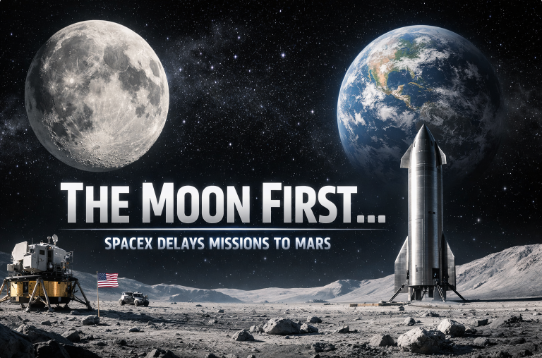
The Moon first… SpaceX postpones its plans for missions to Mars
On February 8, 2026, the spaceflight narrative shifted in a way that feels both pragmatic and poetic. After years of declarations about sending Starship toward the Red Planet, SpaceX has reportedly told investors that it will prioritize the Moon before Mars, targeting a March 2027 uncrewed lunar landing and pushing its Mars ambitions to a later date. This pivot reframes timelines for deep-space exploration, reshuffles expectations for commercial space, and—crucially—aligns more tightly with the growing cadence of NASA’s Artemis program and the near-term engineering milestones Starship still needs to conquer. (Reuters)
A strategic reset that still points outward
For years, Mars has been the north star for Elon Musk and SpaceX’s engineering culture, a galvanizing destination meant to justify fully reusable super-heavy launchers, on-orbit refueling, and rapid ship reusability. But spaceflight rewards the teams who iterate in public and tighten loops between test, failure analysis, and redesign. By placing a public marker on “Moon first, Mars later,” SpaceX is not abandoning Mars—it’s sequencing risk, cost, and capability. The new plan emphasizes a near-term lunar demonstration as a proving ground for the same technologies required for interplanetary travel: high-cadence launch ops, precision landing of large vehicles, long-duration cryogenic storage, and tanker-based orbital refueling. Reuters, citing a Wall Street Journal investor briefing, reports that the company sees the lunar shot as a faster, better-scoped way to validate Starship’s critical systems before returning to the more punishing Mars environment. (Reuters)
Context matters: Artemis delays and lunar momentum
This recalibration also lands in a week when Artemis II—NASA’s first crewed trip around the Moon in over half a century—was delayed into March after a hydrogen leak during a wet dress rehearsal, a reminder that systems at this scale are intricate and merciless to hurry. Those schedule ripples push timelines across the lunar ecosystem and underscore why a tightly coupled Starship-Moon focus could be the most realistic way to unlock near-term wins. (Reuters)
Artemis is not a one-and-done mission; it’s a multi-flight architecture that needs reliable heavy-lift providers, human landing systems (HLS), and the choreography of crewed Orion vehicles, lunar landers, and Gateway infrastructure. SpaceX’s Starship HLS is already a core element of that plan. Prioritizing an uncrewed lunar landing in 2027 is therefore not just brand management; it’s an operational handshake with America’s return to the Moon. (Reuters)
Why “Moon first” is technically sound
1) Orbital refueling is the linchpin.
Mars missions using Starship require on-orbit refueling: multiple tanker launches topping up a depot or directly fueling a Mars-bound ship. This is one of the program’s hardest steps—cryogenic propellants boil off, valves must hold after multiple chill-down cycles, plumbing needs to work flawlessly in microgravity, and fluid transfer must be loss-tolerant. A lunar mission needs refueling too, but the mission delta-V and thermal margins are more forgiving than pushing a fully fueled vehicle to trans-Mars injection. SpaceX and outside reporting have repeatedly flagged orbital refueling as a critical hurdle; tackling it first in a lunar profile sensibly de-risks the Mars campaign. (Reuters)
2) The Moon is a closer, faster feedback loop.
Lunar transfer windows, short comms latency, and the ability to retask ground teams quickly all translate into a higher learning rate. Launch-abort-iterate cycles are brutal for Mars: planetary alignments come on a two-year cadence, and any mishap can strand hardware millions of kilometers away. For engineering cultures built on rapid iteration, the Moon offers tighter timelines to test precision landing, thermal protection, and RCS (reaction control system) logic under real conditions, then fold the data back into Starship builds that are already churning off the line. That is a practical path to maturing the heat shield, landing legs, and methalox (liquid methane/liquid oxygen) engine operations at scale.
3) It aligns with customers and cash flow.
While Mars fuels the mythos, the Moon has near-term customers. Artemis is government-funded, multi-year, and money-moving. Demonstrations that unblock Artemis milestones translate into real revenue and sustained political momentum. Investor briefings reportedly emphasized that a 2027 uncrewed lunar landing is a tractable target that can coexist with Starship’s other workhorses—Starlink launches, commercial payloads, and the inevitable cadence of test vehicles. That portfolio logic tends to trump brute-force ambition. (Reuters)
How we got here: from “Mars in 2026” to a lunar pivot
As recently as May 2025, Musk publicly rated the odds as roughly “50–50” for an uncrewed Starship Mars attempt by late 2026, contingent on test-flight progress and particularly on mastering in-space refueling. That bet implicitly acknowledged the schedule hazard: miss the favorable late-2026 Mars window and you’re often waiting close to two years. It’s not hard to read the pivot as recognition that the technical slope and the calendar both argued for a refocus. (Reuters)
Meanwhile, press analyses this week point to a corporate emphasis on the lunar campaign in 2027, with some outlets describing additional corporate moves (like a reported xAI transaction) as part of a wider strategic picture—though the Mars/Moon sequencing itself stands on engineering grounds regardless of corporate structure. The headline is the same across reputable wire services: SpaceX delays Mars plans to focus on the Moon first. (Reuters)
What changes—and what doesn’t
The Mars objective remains the endgame.
Nothing about this week suggests SpaceX has cooled on Mars. In fact, a lunar demonstration that nails refueling and precision landing would accelerate Mars credibility. The same Raptor engines, the same thermal protection tiles, the same autogenous pressurization systems, and the same guidance logic get exercised on the way to the Moon. The win condition is technology readiness, not a press conference.
The brand narrative gets sharper.
“Moon first” is easy to measure. A 2027 uncrewed landing is a clear milestone. Stakeholders—from the FAA to NASA, from investors to suppliers—prefer checklists to slogans. Expect public roadmaps to get more granular around tanker flights, depot demonstrations, and lunar descent rehearsals.
Artemis coupling tightens.
Artemis II’s slip into March is a reminder that lunar systems across agencies and contractors remain schedule-sensitive. A Starship lunar emphasis gives Artemis more options, more redundancy, and more political lift. It also means that when Artemis III targets a human landing, the Starship ecosystem will have a fresher playbook to work from. (Reuters)
The engineering milestones to watch in 2026–2027
1) A successful on-orbit cryogenic transfer test.
This is the big one. Watch for a dedicated propellant transfer demo—moving super-cold methane and oxygen between two Starships or between a depot and a lander. Expect announcements about boil-off mitigation, insulation advances, and zero-g fluid management. Independently, enthusiasts and analyst communities have discussed possible dates; what matters is official confirmation and telemetry-backed performance. (Reddit)
2) High-energy Starship reentries with intact TPS.
To earn lunar credibility, Starship needs to prove it can shrug off higher-energy reentries without losing significant TPS (thermal protection system) acreage. Look for test flights that explicitly exercise the hottest portions of the flight envelope and post-flight inspections that show improved tile retention and shock-interaction resilience.
3) Precision landing and deep-throttle Raptor control.
The Moon’s dust and low gravity create nasty coupling between engine plumes and regolith, potentially eroding landing pads and sandblasting hardware. SpaceX’s landing architecture for Starship HLS differs from the Earth-returning cargo/crew variants, but deep-throttle Raptor control and propulsive landing logic remain core. Expect terrain-relative navigation updates and plume management strategies.
4) Booster reusability at industrial cadence.
None of this scales without rapid reuse. The more often Super Heavy lands, relaunches, and returns data on engine turnaround and structural margins, the faster the entire stack matures. The lunar plan will soak up dozens of launches for tankers and depots; cadence is a capability.
Why this is still a win for Mars advocates
The Red Planet is unforgiving. Long cruise times, radiation exposure, autonomous EDL (entry, descent, landing) at hypersonic speeds, global dust storms—Mars gives no free passes. A lunar proving campaign disciplines the system without burning Mars windows. It gives the team room to iterate transfer lines, quick-disconnects, header-tank logic, and thermal management for cryogens in sunlight and shadow. If the system can move thousands of kilograms of propellant in space and land a skyscraper-sized ship on the Moon without a landing pad going full popcorn machine, then the confidence to resume Mars attempts grows—and grows with evidence.
Moreover, the Moon isn’t merely a practice field. It is a market. In-situ resource utilization (ISRU)—extracting and electrolyzing lunar water ice for hydrogen and oxygen—could gin up a local supply chain that makes Starship’s interplanetary work cheaper and more repeatable. In other words, lunar infrastructure is not a detour; it’s a multiplier.
The broader competitive landscape
Globally, lunar ambitions are heating up. The United States, China, India, and Japan are all staging robotic or crewed exploration, navigation networks, and commercial partnerships. A decisive, repeatable, privately operated lunar landing architecture would give the U.S. ecosystem—NASA, primes, and new-space entrants—a significant competitive edge in lunar logistics, surface power, and telecom. Reports underscore that SpaceX’s lunar focus slots neatly into this geopolitical race, without closing doors to Mars. (Reuters)
What this means for investors and the space economy
Capital efficiency and mission sequencing are not just MBAspeak; in rocketry, they’re synonymous with survival. By clustering near-term milestones around the Moon, SpaceX can prove unit economics for repeated Starship flights: reduced costs per ton to cislunar space, higher launch cadence, and data-driven maintenance cycles. That evidence loop supports future financing not only for Starship but for the Starlink constellation’s next generations, potential lunar relay networks, and—eventually—Mars cargo flights.
Some coverage this week has also referenced a reported xAI acquisition in the background of these changes. Whether or not those details bear directly on flight plans, the throughline is that data-rich operations—from ground test telemetry to on-orbit prop transfer diagnostics—are fertile ground for AI. High-fidelity modeling and anomaly detection could shave months off test cycles. The lunar focus provides a near-term laboratory for exactly that. (Reuters)
A realistic timeline to watch
Here’s how an evidence-based, Moon-first trajectory might flow from now through late 2027:
Early–mid 2026: Multiple Starship test flights with incremental targets: stable max-Q margins, hot-stage ring refinements, booster recovery reliability, TPS durability. Public milestones likely include propellant transfer pathfinders and demonstrations of on-orbit loitering for cryogenic stability (venting behavior, boil-off rates, autogenous pressurization behavior). Community chatter has suggested a mid-2026 refueling demo; official dates will matter more than rumor. (Reddit)
Late 2026: If refueling and on-orbit loiter hit their marks, expect a polishing phase on lunar-profile guidance, navigation, and control (GNC), including descent engine throttling, landing sensor validation, and potential surface simulation tests.
By March 2027: The target for an uncrewed Starship lunar landing, per multiple reports. Execution here anchors Starship as a lunar workhorse and sets the stage for later crewed HLS demonstrations that flow into Artemis III. (Reuters)
None of those steps is trivial. Each will be telegraphed by a fog of static fires, hop tests, partial successes, and post-flight imagery. The key is trendline, not headline.
The messaging: a more credible promise
Space exploration is a marathon run at sprint pace. When Musk spoke in 2025 of a “50–50” shot at Mars by late 2026, it effectively priced in the unknowns around refueling and reentry. The latest update transforms that probabilistic posture into a structured plan. By stating a clear lunar objective with a calendar month attached, SpaceX has made a falsifiable promise. That’s healthy. It sets the stage for transparent scoring: did the refueling demo work to spec? Did the TPS hold up under higher-energy profiles? Did the guidance system put the vehicle down where the simulations said it would?
And if the answers are yes, then the Mars window that follows—whenever it is—will be met by a more mature machine, a better-briefed regulator, and a program with fewer unknown unknowns. That’s how you trade time for certainty in aerospace.
What readers should take away
SpaceX is not walking away from Mars. It’s reordering the queue. The Moon becomes the place to retire risk, validate refueling, and align with Artemis milestones. (Reuters)
Near-term lunar capability is the fastest route to long-term Mars capability. The same technologies—Raptor engines, TPS, cryogenic propellant management, precision landing—must all work at scale.
The schedules are dynamic. Artemis II’s shift into March is a real-time example. Expect dates to flex as systems close on performance. (Reuters)
Watch for official refueling demos. When a credible, instrumented prop transfer happens on orbit, you’ll be watching the doorway to both the lunar landing and the eventual Mars push swing open. (Reuters)
Final thought: a wiser path to the same horizon
“The Moon first” is not retreat; it’s rehearsal at full scale. In the 1960s, engineers often said, “test what you fly, fly what you test.” Starship’s path has always taken that mantra and strapped it to a super-heavy booster. By choosing the Moon as the next big proof point, SpaceX is folding reality into ambition: near-term customers, near-term physics, and near-term telemetry. That’s how you get to Mars—by making the next mission so achievable that success becomes a habit.
SEO keywords paragraph: SpaceX delays Mars mission, Moon first strategy, Starship lunar landing 2027, Elon Musk SpaceX news, NASA Artemis program update, orbital refueling demonstration, Starship HLS timeline, Artemis II delay March 2026, reusable rockets and Moon missions, SpaceX investor briefing WSJ, cryogenic propellant transfer in space, Starship TPS heat shield upgrades, Super Heavy booster reusability, precision landing on the Moon, cislunar logistics and infrastructure, lunar south pole exploration, NASA SpaceX partnership, Starlink launch cadence, human landing system milestones, interplanetary mission architecture, methane oxygen engines Raptor, on-orbit propellant depot, Moon to Mars roadmap, commercial spaceflight trends 2026, deep-space exploration planning.