
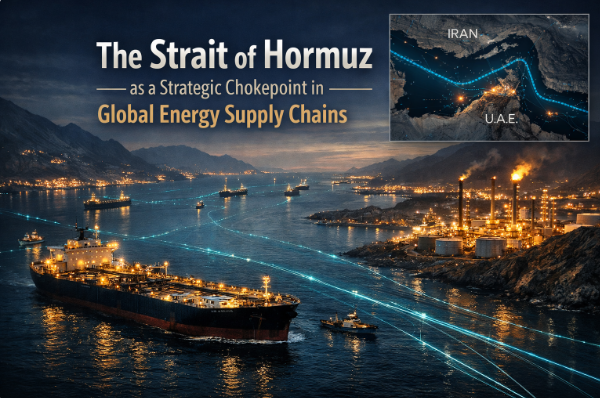
The Strait of Hormuz as a Strategic Chokepoint in Global Energy Supply Chains
If global energy markets had a “pressure point,” it would be the Strait of Hormuz—a narrow maritime corridor where geography, economics, and geopolitics squeeze together so tightly that even small disruptions can send shockwaves through oil prices, LNG shipping schedules, insurance premiums, and national security calculations. The Strait of Hormuz isn’t merely a line on a map between the Persian Gulf and the Gulf of Oman; it’s a strategic chokepoint that helps determine how reliably hydrocarbons reach refineries, power stations, petrochemical plants, and consumers across Asia, Europe, and beyond. In a world still heavily dependent on fossil fuels—despite accelerating energy transition policies—Hormuz functions like a valve in the global energy supply chain. When that valve looks threatened, the entire system re-prices risk.
At its narrowest navigable points, the Strait is constricted enough that commercial traffic concentrates into well-defined shipping lanes, typically managed through traffic separation schemes. That physical bottleneck matters because modern energy logistics are not forgiving. Crude oil supply chains are timed to refinery runs; LNG cargoes are slotted into regasification capacity and power demand peaks; petrochemical feedstocks are coordinated with downstream production. When a chokepoint is stable, the system feels smooth and almost invisible. When it is unstable, the system becomes loudly visible: futures markets jump, freight rates climb, and governments start talking in the language of strategic reserves, naval patrols, and supply diversification.
Why the Strait of Hormuz Matters to Global Energy Security
The Strait of Hormuz is often described as one of the most critical shipping routes for crude oil exports and refined petroleum products coming out of the Persian Gulf. That statement is not hype—it’s a reflection of how global oil trade is geographically “lumpy.” Major producers in the Gulf region load vast volumes of crude and condensate onto tankers, and many of those tankers must pass through Hormuz to reach key demand centers. On the natural gas side, LNG exports from Gulf terminals also depend on safe passage through this corridor. The result is that Hormuz becomes an energy security multiplier: the more concentrated the flow, the higher the strategic value, and the greater the sensitivity to disruption.
Energy security isn’t only about whether oil exists in the ground. It’s about whether energy can move from production to consumption at the right scale, at the right time, and at an affordable cost. The Strait of Hormuz sits at the intersection of those three requirements. If shipping is delayed, the market can tighten quickly. If shipping is perceived as risky, costs rise through insurance and security premiums. If shipping is blocked, the market scrambles for alternatives that may not exist in sufficient quantity.
Chokepoints, Not Just Barrels: The Supply Chain Logic
It’s tempting to talk about the Strait purely in terms of “X million barrels per day,” but the deeper story is supply chain design. Global energy supply chains resemble a network: upstream extraction flows into midstream transport, which flows into downstream refining, storage, and distribution. A chokepoint is where network redundancy collapses—where many paths become one.
What makes chokepoints dangerous is not only the possibility of a full closure. Partial disruptions can be enough: heightened inspections, rerouting, delays from security incidents, temporary restrictions, or even a rise in geopolitical risk perception. Markets are forward-looking. If traders believe a disruption is more likely, they price that probability into crude benchmarks, freight indices, and refined product spreads. That’s why “risk” can become a real cost long before any ship actually stops moving.
In practical terms, the Strait affects:
Oil prices (Brent-linked pricing, regional benchmarks, and refined product cracks)
LNG spot prices (through supply timing and route risk)
Tanker freight rates (VLCC and product tanker economics)
Marine insurance premiums (war risk and kidnap & ransom components)
Inventory strategies (strategic petroleum reserves and commercial stockpiles)
Corporate planning (hedging, sourcing diversity, and contractual flexibility)
Geopolitics and the Strait: A Persistent Risk Premium
The Strait’s strategic importance ensures that it sits under a permanent geopolitical spotlight. This is where political rivalry, deterrence posture, and maritime security operations intersect. Regional tensions, diplomatic breakdowns, sanctions regimes, and proxy dynamics can all influence perceived risk. Even when no actor intends to “close” the Strait, miscalculation and escalation are always on the menu—because chokepoints compress decision time. When ships are tightly packed into constrained lanes, a minor incident can become a major headline.
From the perspective of global markets, the exact political details matter less than the recurring pattern: risk in Hormuz is never zero. That baseline risk produces a structural premium. In calm periods, it is small and easy to ignore. In tense periods, it balloons—especially if multiple risk factors stack at once: elevated regional tensions, new military deployments, cyber incidents, or attacks on energy infrastructure.
For energy importers, this matters because risk premium behaves like a tax on consumption. For energy exporters, it matters because it can complicate revenue stability and long-term investment. For shipping companies, it matters because it directly changes costs and routing decisions. And for policymakers, it matters because the Strait is one of the few places where the physical energy economy meets the strategic security economy in a single, narrow corridor.
How Disruptions Propagate: From Strait to Gas Pump
A useful mental model is to imagine the Strait as a “systemic risk node.” When something goes wrong, consequences cascade through multiple layers:
Immediate shipping impact: delays, rerouting, temporary stoppages, slower transits, or convoy-like behavior.
Freight and insurance repricing: underwriters adjust premiums; charter rates move; shipowners demand higher compensation.
Commodity market reaction: crude futures and options price volatility rises; spreads widen; refiners hedge more aggressively.
Physical market tightening: if delays persist, refineries draw down inventories; spot cargoes become scarce.
Downstream inflation: transport fuels and petrochemicals become more expensive, filtering into broader consumer prices.
This is why the Strait is not merely a regional security issue; it’s a global macroeconomic sensitivity. It can shape inflation expectations, trade balances, and even political stability in energy-importing nations.
Alternatives and Bypass Routes: Diversification Has Limits
When analysts discuss Hormuz risk, they often pivot to bypass routes: pipelines that move crude to ports outside the Strait, storage hubs, alternative suppliers, and strategic stockpiles. These tools matter—but they have constraints.
Pipelines can reduce exposure, but their capacity is finite, and they’re not universally available for every producer. Alternative suppliers exist, but they can be more expensive, logistically distant, or limited in spare capacity. Strategic petroleum reserves (SPR) can buffer short-term shocks, but they are not a permanent substitute for steady flow; they are an emergency brake, not a new engine. Commercial inventories can cushion disruptions, but maintaining large inventories is costly, and many markets have trended toward efficiency and “just-in-time” logistics.
So diversification reduces vulnerability, but it rarely eliminates it. Hormuz remains strategically potent because it concentrates not only volumes but also optionality—the ability for producers and buyers to adjust flows flexibly.
The LNG Dimension: Why Natural Gas Also Cares About Hormuz
The natural gas story is sometimes overshadowed by crude oil, but LNG markets have become more globally integrated and more price-sensitive. LNG cargoes are essentially floating energy packets whose value depends on timing, destination flexibility, and spot market conditions. If a key route becomes risky or delayed, LNG supply timing can change, which affects power generation costs, industrial fuel switching, and regional gas pricing.
Because many power systems rely on gas to balance intermittent renewables, LNG reliability is increasingly a grid stability factor. In other words: the Strait’s strategic value grows as gas becomes a “bridge fuel” in energy transition pathways. Even if long-term decarbonization reduces fossil fuel demand, the next decade can still be highly sensitive to logistical disruptions—especially during peak demand seasons.
Maritime Security, Technology, and the Future of Route Risk
Energy logistics is not static. Shipping is becoming more digitized, and that creates new resilience opportunities—and new vulnerabilities. Tracking systems, port analytics, automated scheduling, and digital documentation can make trade more efficient. But cyber risk, spoofing, and disruptions to navigation or port operations can create novel forms of chokepoint stress. A future disruption may not look like a dramatic blockade; it could look like intermittent digital chaos that slows throughput, creates safety concerns, and triggers precautionary delays.
At the same time, the tools for managing risk are evolving:
Enhanced surveillance and maritime domain awareness can deter certain threats.
Route planning and dynamic risk assessment can help operators decide when to transit.
Hedging strategies in derivatives markets can reduce price exposure.
Contract design (force majeure clauses, destination flexibility, and alternative delivery options) can distribute risk.
The key point: the Strait’s importance is likely to persist, but the risk landscape may become more complex—mixing physical security, geopolitical signaling, and digital infrastructure reliability.
The Energy Transition Paradox: Why Hormuz Still Matters in a Decarbonizing World
There’s a seductive narrative that renewables and electrification will make chokepoints irrelevant. Reality is messier. The energy transition is uneven, region-specific, and infrastructure-constrained. Oil and gas remain foundational to transport, petrochemicals, aviation, shipping, and industrial heat. Even as the share of renewables grows, fossil fuels can still set marginal prices in many systems—especially during demand spikes or when renewable output is low.
Also, the transition itself requires materials and industrial processes that currently depend on hydrocarbons: mining equipment runs on diesel, global shipping consumes bunker fuel, and petrochemicals feed into everything from insulation to wind turbine components. So the Strait can remain strategically relevant not because the world is ignoring decarbonization, but because the world is trying to decarbonize while still operating a massive legacy energy system.
Think of it like replacing the engines of a plane while it’s in flight. You can do it, but you become intensely aware of which bolts you really shouldn’t drop.
What Businesses and Policymakers Can Do: Practical Risk Management
For companies exposed to energy supply chain disruptions—airlines, shipping firms, manufacturers, utilities, and traders—Hormuz risk is a board-level topic. The goal isn’t to predict the next headline; it’s to build operational resilience so the business doesn’t panic when headlines arrive.
High-value moves often include:
Supply diversification: multiple sourcing regions for crude grades or LNG contracts.
Inventory strategy: balancing carrying costs against disruption risk.
Financial hedging: using futures, options, and swaps to manage price volatility.
Contractual flexibility: clauses and delivery terms that reduce single-route dependence.
Scenario planning: stress tests that simulate shipping delays, price spikes, and freight surges.
Energy efficiency: lowering overall exposure by reducing consumption intensity.
For governments, the toolbox is broader:
Strategic petroleum reserves and emergency coordination
Maritime security partnerships and de-escalation channels
Infrastructure investment in storage, regasification, and grid flexibility
Demand-side policies that reduce vulnerability to supply shocks
None of these tools removes the Strait from the map. But together, they can reduce how violently the map’s narrowest lines can move the world’s biggest markets.
The Strait of Hormuz in One Sentence (Because the Internet Demands It)
The Strait of Hormuz is a strategic chokepoint where concentrated oil and LNG shipping flows meet geopolitical risk, making it a decisive factor in global energy security, price volatility, and supply chain resilience.
Final SEO Keyword Paragraph (Use on Your Site)
Strait of Hormuz, strategic chokepoint, global energy supply chains, global energy security, oil shipping routes, LNG shipping, crude oil exports, Persian Gulf oil, maritime security, tanker traffic, energy market volatility, Brent crude prices, oil price risk premium, supply chain disruption, geopolitical risk, energy trade routes, shipping lane security, marine insurance premiums, VLCC freight rates, refined petroleum products, strategic petroleum reserves, energy infrastructure resilience, energy logistics, oil and gas transportation, Middle East energy exports, global oil trade, LNG spot market, energy security strategy, energy supply chain risk management, diversification of energy supply, pipeline bypass routes, decarbonization and energy transition, petrochemical supply chain, energy importers, energy exporters, global commodity markets, disruption scenarios, critical maritime chokepoints