
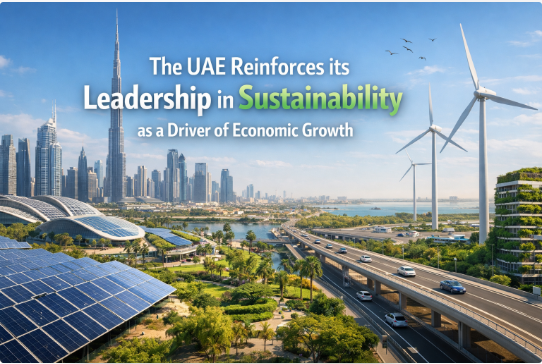
The UAE reinforces its leadership in sustainability as a driver of economic growth
The United Arab Emirates has spent the past decade turning sustainability from a vision into a competitive edge—and as of 19-01-2025, the results are unmistakable. What began as a national commitment to diversify beyond hydrocarbons has matured into a powerful growth engine that attracts foreign direct investment, spurs innovation across sectors, and positions the UAE as a global testbed for climate tech. This is not sustainability as a side project. It is sustainability embedded in infrastructure, finance, policy, and culture—carefully designed to create jobs, reduce risk, and future-proof the economy.
Sustainability as an economic strategy, not a slogan
Around the world, sustainability strategies too often live on paper. The UAE’s approach is different: it pursues measurable transformation with business outcomes in mind. The national Net Zero by 2050 strategic initiative anchors policy direction; robust regulatory frameworks and market-friendly incentives then catalyze private-sector participation. In practice, this means long-term power purchase agreements that de-risk investment in renewables, clear standards for green finance that mobilize capital at scale, and public-private partnerships that turn master plans into steel-in-the-ground projects. The result is a cycle where sustainable projects attract investors, investors fund innovation, innovation lowers costs, and lower costs unlock more projects—a virtuous loop of green growth.
Renewable energy hubs that scale
Flagship projects are the most visible proof of momentum. The Mohammed bin Rashid Al Maktoum Solar Park outside Dubai has become shorthand for affordability and scale in solar energy, helping the UAE secure some of the world’s most competitive solar tariffs. In the Western Region, the Barakah Nuclear Energy Plant—the first of its kind in the Arab world—adds a large, steady stream of clean baseload power to the grid, complementing the intermittency of wind and solar. Abu Dhabi’s Masdar City, once known chiefly as an experiment in sustainable urbanism, now doubles as a clean-tech investment platform with global reach, channeling capital into solar, wind, green hydrogen, and energy efficiency projects from Central Asia to Sub-Saharan Africa.
Each of these assets delivers more than electrons. They create skilled jobs in engineering, construction, digital operations, and maintenance. They nurture local supply chains—everything from drone inspection services to advanced materials. And they give manufacturers long-term price certainty, encouraging industrial expansion underpinned by reliable, low-carbon electricity.
Green hydrogen and the emergence of clean industrial corridors
As heavy industry and long-haul transport seek decarbonization pathways, green hydrogen has moved from prospect to plan. The UAE’s competitive solar resources, port infrastructure, and proximity to demand centers in Europe and Asia make it a natural exporter of hydrogen-derived fuels such as ammonia and e-methanol. Pilot plants, offtake MoUs, and feasibility studies are knitting together an ecosystem that includes electrolyzer manufacturers, EPC firms, maritime operators, and certification bodies. Ports in Abu Dhabi and Dubai are positioning as hydrogen-ready logistics hubs, while airlines and fuel providers explore sustainable aviation fuel (SAF) blends and e-fuels to decarbonize air travel.
The strategic payoff is twofold. First, the UAE reduces exposure to future carbon border adjustments and climate-related trade frictions. Second, it captures a value-added role in tomorrow’s energy supply chains—selling not just molecules, but expertise, standards, and integrated solutions.
Smart cities, circular economy, and water stewardship
Urbanization is the UAE’s natural laboratory for climate-resilient design. District-cooling networks cut peak electricity demand; smart meters and AI-enabled energy management systems optimize building performance; and transit-oriented development improves urban livability while lowering emissions. The circular economy is advancing through mandates and market incentives: construction-and-demolition waste recycling supports the booming real-estate sector; waste-to-energy facilities complement recycling and reduce landfill use; and Extended Producer Responsibility schemes steer packaging toward reuse and recovery.
Water remains a strategic priority in a desert climate. Investments in energy-efficient desalination—especially reverse osmosis powered by clean electricity—are decoupling water security from high-carbon power. Non-revenue water reduction programs and precision agriculture are limiting waste, while treated sewage effluent is increasingly reused for landscaping and industry. The nexus of water, energy, and food security is being treated as a systems challenge, with digital twins, satellite monitoring, and data platforms enabling more granular management.
From ESG compliance to value creation
Global investors no longer view environmental, social, and governance factors as a compliance checkbox. In the UAE, ESG has matured into a lever for capital access and cost of funds. Abu Dhabi and Dubai’s financial centers encourage sustainability disclosure, while green bonds and sukuk channel capital into renewable energy, green buildings, and low-carbon transport. Local banks have adopted sustainability-linked lending frameworks, tying interest rates to measurable performance on emissions, energy efficiency, or safety metrics. Corporate boards increasingly include sustainability expertise, and management teams use science-based targets to set direction and quantify impact.
The economic upside is tangible. Companies that can verify robust emissions data and credible transition plans enjoy better terms from lenders and insurers. Export-oriented manufacturers reduce the risk of future carbon tariffs. Real-estate portfolios with green building certifications see stronger occupancy and asset valuations. And the talent market responds: skilled professionals—from data scientists to sustainability strategists—are choosing employers that align with their values and offer purpose-driven career tracks.
Innovation ecosystems and the startup multiplier
Sustainability is also an innovation magnet. The UAE’s free zones and accelerators have carved out specialized tracks for climate tech, agritech, water tech, and industrial decarbonization. Venture capital funds are allocating more to hardware-plus-software plays where the UAE’s infrastructure can serve as a “living lab.” Think sensor-rich buildings that self-optimize, AI that forecasts solar output down to the minute, bio-based materials for desert construction, and carbon management platforms that measure, monitor, and monetize emissions reductions.
Crucially, pilots are easier to launch when regulators are open to sandboxes and when public entities act as early adopters. Airport authorities testing SAF supply chains, utilities trialing grid-scale batteries, and municipalities digitizing waste collection—all of these create commercial references that young companies need to scale. Every successful pilot lowers the perceived risk for the next contract, accelerating time-to-market.
Tourism, culture, and the brand of sustainable excellence
A destination’s brand increasingly hinges on climate credibility. The UAE’s hospitality sector has moved beyond towel-reuse placards to comprehensive decarbonization roadmaps. New properties are designed to green building standards; legacy resorts retrofit chillers, lighting, and controls; and destination management companies incorporate low-emissions mobility and nature-based experiences. Cultural institutions—from museums to performing arts venues—track their footprints and share progress with visitors, turning sustainability into part of the story visitors take home.
Nature-based solutions complement urban initiatives. Mangrove conservation and restoration projects protect coastlines, enhance biodiversity, and sequester carbon, while protected desert reserves integrate research, education, and eco-tourism. These efforts contribute to climate resilience and offer high-quality offsets to balance hard-to-abate emissions in sectors like aviation and heavy transport.
Skills, education, and the green jobs pipeline
Economic transformation depends on human capital. Universities and vocational institutes across the UAE have launched programs in renewable engineering, environmental science, sustainable finance, and data analytics. Micro-credentialing platforms help mid-career workers pivot into growth areas such as solar O&M, building commissioning, ESG reporting, and lifecycle assessment. Apprenticeships and industry partnerships ensure curricula map to real-world demand—meaning graduates land roles that drive immediate impact.
The jobs themselves are high-value. Grid planners who can integrate distributed energy resources; sustainability controllers who translate carbon data into CFO-ready insights; materials scientists designing low-carbon cement; and logistics experts who can operationalize hydrogen corridors—all are in rising demand. For the wider economy, this means higher productivity and a deeper domestic skills base, reducing reliance on imported expertise.
Digital infrastructure as the hidden accelerator
Data is the bloodstream of the green transition. The UAE’s investments in cloud, edge computing, and fiber connectivity allow real-time optimization across buildings, grids, ports, and factories. Smart contracts on regulated platforms can verify renewable energy certificates and carbon credits. Satellite data and IoT networks feed machine-learning models that forecast demand, detect leaks, and schedule predictive maintenance. For businesses, the payoff is lower operating cost, better asset utilization, and verifiable impact reporting that satisfies customers, regulators, and investors.
Cybersecurity is part of this equation. As critical infrastructure becomes more connected, robust defenses protect continuity and investor confidence. By building security into the architecture—from identity management to network segmentation—the UAE strengthens resilience while scaling digital solutions.
Policy consistency and international cooperation
Investors crave certainty, and the UAE has provided durable signals: long-term emissions targets, integrated energy strategies, and mechanisms to measure progress. Taxonomies and disclosure guidelines reduce confusion and green-washing risk. Cross-border partnerships extend the country’s influence—co-investing in renewable projects abroad, collaborating on standards for hydrogen certification, and sharing best practices on water and agriculture. This internationalism is pragmatic: climate and trade are entwined, and alignment with major markets ensures Emirati goods and services remain competitive as the global economy decarbonizes.
The bottom line: sustainability is profitable
Strip away the acronyms and policies and the story is straightforward. Clean power can be cheaper than legacy alternatives. Efficient buildings have lower operating costs and higher retention. Transparent ESG data lowers financing costs and improves risk management. Future-ready infrastructure attracts tenants, tourists, and talent. All of this compounds into GDP growth that is cleaner, more resilient, and better aligned with where global demand is heading.
Businesses choosing the UAE for expansion in 2025 aren’t doing so purely out of environmental altruism. They’re doing it because the market functions: power is dependable and increasingly decarbonized; supply chains are efficient; regulators are accessible; and financial markets reward credible transition plans. The country’s sustainability leadership has become a market advantage—an economic flywheel that spins faster as more actors participate.
What to watch next
Several themes will shape the next phase. Expect rapid scaling of energy storage to complement solar and nuclear capacity, deeper electrification of transport and industry, broader adoption of digital MRV (measurement, reporting, and verification) for carbon accounting, and continued growth in green finance instruments that tie capital costs to performance. Green hydrogen projects will consolidate around bankable offtakes, and circular economy frameworks will expand into textiles, electronics, and food systems. Corporate buyers will sign more long-term clean power agreements to de-risk their energy budgets, and public procurement will increasingly prioritize low-carbon materials, further catalyzing market demand.
For organizations charting their own roadmap in the UAE, the playbook is clear: set science-based targets, electrify wherever feasible, secure clean electricity through PPAs or certificates, measure and disclose performance with audit-ready data, shift capex toward efficiency and resilience, and collaborate across your value chain. The infrastructure is ready, the policy environment is supportive, and the talent base is growing.
Conclusion
As of 19-01-2025, the UAE’s leadership in sustainability is not just a climate story—it is an economic success story. By aligning national goals with market incentives, blending world-class infrastructure with bold experimentation, and opening the door to global collaboration, the country has made sustainability a driver of competitive advantage. The lesson for the region and beyond is simple: when clean energy, circularity, and digital intelligence move from strategy decks into daily operations, growth follows. The UAE is already living that future—and building an economy designed to thrive in it.
SEO Keywords (one paragraph): UAE sustainability, UAE economic growth, Net Zero 2050 UAE, renewable energy UAE, Dubai Clean Energy Strategy, Mohammed bin Rashid Al Maktoum Solar Park, Barakah Nuclear Energy Plant, Masdar City sustainability, green hydrogen UAE, hydrogen economy Middle East, sustainable aviation fuel UAE, ESG investing UAE, green finance Dubai DIFC ADGM, sustainability-linked loans UAE, circular economy UAE, waste-to-energy UAE, water desalination renewable energy, smart cities UAE, district cooling Dubai, energy efficiency buildings UAE, carbon accounting UAE, corporate PPAs UAE, climate tech startups UAE, sustainable tourism UAE, mangrove restoration UAE, biodiversity projects UAE, sustainable logistics UAE ports, hydrogen corridors UAE, sustainable manufacturing UAE, low-carbon cement UAE, digital MRV carbon UAE, green bonds and sukuk UAE, sustainable supply chains Middle East, clean power UAE, COP legacy UAE, sustainability jobs UAE.