
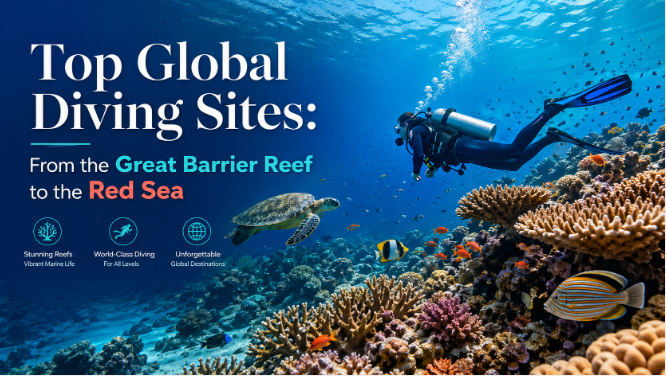
Top Global Diving Sites: From the Great Barrier Reef to the Red Sea
There is something almost impossible to explain about the first deep breath underwater. The noise of the surface disappears, time slows down, and the ocean opens into a world that feels at once ancient, silent, and intensely alive. For divers, that feeling becomes an obsession. It is why people travel across continents for a single drift dive, why they wake before sunrise to board liveaboards, and why the search for the best scuba diving destinations in the world never really ends. From the enormous coral landscapes of Australia to the luminous reefs of Egypt, the world’s top diving sites are not just places to visit. They are experiences that stay in the body and memory long after the gear is rinsed and packed away. The Great Barrier Reef, in particular, remains one of the planet’s defining marine wonders, recognized by UNESCO for its extraordinary scale and biodiversity. (UNESCO World Heritage Centre)
No conversation about top global diving sites can begin anywhere other than the Great Barrier Reef diving scene. Stretching along Australia’s northeast coast, the reef spans more than 2,300 kilometers and offers an underwater landscape of coral gardens, giant clams, marine turtles, reef fish, and seasonal encounters that draw everyone from first-time divers to seasoned underwater photographers. Australia’s official tourism guidance highlights that the reef is home to more than 1,600 species of fish and six of the world’s seven marine turtle species, while UNESCO describes it as the world’s largest collection of coral reefs. That combination of scale, accessibility, and marine life is what makes the Great Barrier Reef one of the most searched and most dreamed-about scuba diving holidays on Earth. (australia.com)
What makes the Great Barrier Reef so compelling is not only its fame, but its range. Some divers want easy outer reef day trips with warm water, bright coral, and relaxed conditions. Others want more remote reef systems, overnight experiences, or advanced dives where pelagic action and dramatic drop-offs begin to replace the gentler postcard image many people expect. That flexibility is part of the destination’s enduring power. It can feel like a perfect entry point for beginner divers, yet still reward experienced travelers hunting for iconic coral reef diving. Even its atmosphere changes depending on where and how you dive: one moment you are drifting over bommies covered in life, and the next you are hovering in blue water watching the reef fall away beneath you. Official Australian tourism sources continue to position it as one of the world’s great marine travel experiences, not just for snorkeling but for serious dive travel as well. (Queensland)
And yet, if the Great Barrier Reef represents scale, the Red Sea diving experience represents clarity, color, and contrast. The Red Sea has long held a near-mythic status among divers because it delivers so much in one region: vivid coral reefs, excellent visibility, warm water, steep walls, drift dives, and world-famous wrecks. PADI’s current destination guides emphasize the region’s vibrant reefs, crystal-clear conditions, and abundant marine life stretching across Egypt, Sudan, and Saudi Arabia, while also noting the Red Sea’s continuing appeal for beginners, reef lovers, and wreck divers alike. It is one of those rare places where a diver can enjoy both beauty and adrenaline in the same trip, often within the same day. (PADI)
For many travelers, Egypt remains the most recognizable gateway to the Red Sea, and with good reason. Scuba diving in Egypt has become a bucket-list experience because it balances accessibility with spectacle. Bright coral walls, schooling fish, reef sharks, barracudas, and historic wreck sites create an environment that feels cinematic from the moment you descend. There is also a distinct quality to the light in the Red Sea. The water often appears impossibly blue, while the reefs glow in warm tones that make every dive feel sharper and more vivid. For underwater photographers, it is a gift. For new divers, it is reassuring. For advanced divers, it is addictive. That is why the Red Sea continues to rank among the best diving spots in the world for travelers who want reliability, variety, and truly memorable reef scenery. (PADI)
If the Great Barrier Reef and Red Sea are the icons most travelers recognize first, Raja Ampat diving is the destination divers tend to speak about with a certain reverence. Located in Indonesia’s Bird’s Head Seascape, Raja Ampat is widely celebrated for astonishing marine biodiversity and reef health. The Raja Ampat Marine Park Authority describes the region as part of the heart of the Coral Triangle and says it has the richest marine biodiversity on Earth. For divers, that translates into a sensory overload of soft corals, reef fish, macro life, schooling species, and reef structures that seem too alive to be real. Raja Ampat does not usually feel like a place you simply “tick off.” It feels like a place that changes your expectations of what the ocean can be. (kkprajaampat.com)
The appeal of Raja Ampat lies in its density of life. Even an ordinary dive there can feel extraordinary because the reef is so active at every depth. Tiny critters hide in coral folds, clouds of anthias shimmer over pinnacles, and larger species move through the blue with a steadiness that makes the whole ecosystem feel intact and balanced. For divers searching terms like best coral reef diving, marine biodiversity diving, or Indonesia scuba diving, Raja Ampat is often the answer that rises to the top. It is not always the easiest destination to reach, and that remoteness is part of its magic. You arrive with effort, and the reward is an underwater environment that still feels deeply wild. At the same time, recent reporting has also underscored the importance of conservation in Raja Ampat as tourism and industrial pressures increase, making responsible dive travel especially important there. (kkprajaampat.com)
Then there is the Galapagos diving experience, which belongs in a category of its own. If Raja Ampat is about density and reef richness, the Galapagos is about power, current, and large-animal encounters. Dive operators focused on Darwin and Wolf consistently describe these remote northern islands as legendary for schooling hammerheads, Galapagos sharks, and seasonal whale shark encounters, while also warning that the conditions can be demanding. That is precisely why the Galapagos holds such status among advanced divers. It is not just beautiful; it is dramatic. You do not go there for a casual swim above a coral garden. You go because you want to feel the force of an ocean ecosystem built around pelagic life, current, and unpredictability. (Galapagos Sky)
A dive in the Galapagos can feel less like tourism and more like entering a living migration route. The water may be cooler, the visibility more variable, and the conditions more technical than in tropical reef destinations, but the payoff is unforgettable. Schooling hammerheads in the distance become dozens, then hundreds. A whale shark passes through the blue and suddenly the rest of the dive is rewritten around that single moment. It is the kind of place that turns even highly experienced divers quiet afterward. In search terms, the Galapagos dominates phrases like best shark diving in the world, advanced scuba diving destinations, and liveaboard diving trips, and deservedly so. It rewards preparation, patience, and skill with encounters very few destinations can match. (Galapagos Sky)
Another site that belongs on any serious list of world-class dive sites is Palau Blue Corner. PADI describes Blue Corner as world-famous, noting that its strong currents attract large schools of fish and bigger predators feeding on the activity. That dynamic is exactly what makes Palau so electrifying. Blue Corner is not merely a scenic reef. It is an underwater intersection, a place where current shapes behavior and behavior shapes spectacle. Divers descend, drift into position, and watch the water column come alive with movement. It is one of those iconic locations where every experienced diver seems to have a story, and no two stories sound exactly the same. (PADI)
Palau also illustrates an important truth about the best scuba diving destinations: elite dive sites are not always the easiest or calmest. Often, they are the places where conditions create intensity. Strong currents can be challenging, but they also attract life. That is why sites like Blue Corner stay fixed in the global diving imagination. They offer that rare feeling that something big could happen at any moment. Reef sharks may appear out of nowhere. Schools can shift direction without warning. The whole site can transform in seconds. For divers who crave energy, action, and unforgettable drift diving, Palau remains one of the strongest answers to the question of where to dive next. (PADI)
For travelers drawn to graceful megafauna rather than current-heavy adrenaline, the Maldives diving scene offers a different kind of magic. Conservation sources focused on manta rays in the Maldives note that reef mantas are year-round residents moving across the atolls with the monsoons and shifting plankton conditions. That helps explain why the Maldives has become one of the world’s most desirable destinations for divers and snorkelers who dream of close, elegant encounters with mantas, as well as the chance to see whale sharks and channel life in the Indian Ocean. The Maldives tends to feel softer, more fluid, and more dreamlike than destinations built around wrecks or shark walls. It is still thrilling, but the emotion is often wonder rather than raw intensity. (Maldives Manta Conservation Programme)
Socorro, by contrast, brings the intensity back in a very different form. Located in Mexico’s Revillagigedo Archipelago, Socorro diving is strongly associated with giant oceanic mantas, sharks, dolphins, and a liveaboard-only format that adds to its sense of remoteness. Current dive-season guides note that the main season runs from November to May and emphasize the destination’s reputation for large pelagic encounters. Socorro has become one of the premier names in big animal diving because it feels wild, isolated, and deeply oceanic. This is not reef diving in the traditional sense. It is the open-water theater of the Pacific, where charismatic animals become the main event. (Liveaboard.com)
What ties all of these destinations together is not just that they are famous. It is that each offers a distinct emotional signature. The Great Barrier Reef gives you scale and natural wonder. The Red Sea gives you color, visibility, and variety. Raja Ampat gives you biodiversity at an almost overwhelming level. The Galapagos gives you pelagic drama. Palau gives you current-driven action. The Maldives gives you fluid elegance and manta encounters. Socorro gives you remoteness and giant animal magic. When divers search for the top diving sites in the world, they are not only searching for beauty. They are searching for the feeling that suits them best: serenity, excitement, challenge, abundance, photography, macro life, sharks, wrecks, mantas, or coral walls. Each of these destinations answers a different version of that desire. (australia.com)
There is also a growing awareness in 2026 that the future of global dive travel depends on how responsibly divers move through these places. The Great Barrier Reef remains globally significant but continues to face climate-related stress, while Raja Ampat has recently been part of wider debates over how to protect extraordinary marine ecosystems from mounting pressure. That does not mean divers should stop going. It means the modern dive traveler should choose operators carefully, respect local rules, avoid careless wildlife interactions, and support businesses that treat reefs as living systems rather than disposable attractions. The best dive trip is no longer just about what you can see underwater. It is also about how lightly you leave your mark. (Reuters)
In the end, the world’s greatest dive sites are not interchangeable pins on a map. They are chapters in a lifelong underwater journey. One diver may fall in love with the sunlit reefs of the Red Sea and return every year. Another may save for years to finally descend at Darwin and Wolf. Someone else may dream only of the Great Barrier Reef, not because it is trendy, but because it represents the first image they ever had of coral reef diving. That is the enduring beauty of scuba travel: every destination offers a different doorway into awe. And once you have experienced even one truly exceptional dive site, the ocean has a way of calling you toward the next. (australia.com)
For SEO strength, naturally weave this keyword-rich closing paragraph into your post or use it as the final section: top global diving sites, best scuba diving destinations, Great Barrier Reef diving, Red Sea diving, scuba diving in Egypt, Raja Ampat diving, Galapagos diving, Palau Blue Corner, Maldives diving, Socorro diving, liveaboard diving trips, best coral reef diving, shark diving destinations, manta ray diving, underwater photography travel, dive holiday ideas, world-class dive sites, coral reef adventures, marine biodiversity travel, scuba diving holidays, best dive spots in the world, advanced scuba diving destinations, beginner-friendly dive destinations, sustainable dive travel, and global underwater adventures are all highly relevant search terms that can help this blog attract readers looking for unforgettable ocean experiences and expert guidance on where to plan their next dive trip.