
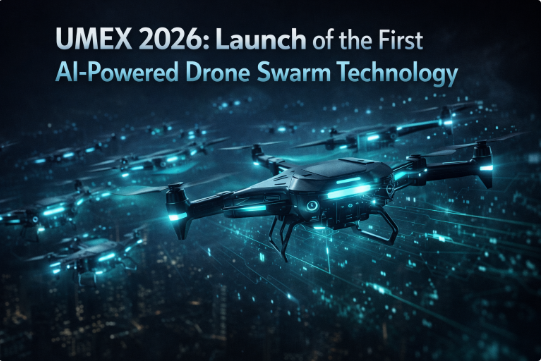
UMEX 2026: Launch of the First AI-Powered Drone Swarm Technology
The unmanned systems world is entering a new chapter. With the launch of the first AI-powered drone swarm technology at UMEX 2026, what once felt like science fiction is rapidly becoming a practical, scalable solution for complex, real-world missions. This post unpacks what the launch means, why it matters, how the core technology works, and where it’s headed next. Whether you’re a defense program manager, a public-safety leader, an energy operator, or an innovation-minded investor, this human-centered deep dive gives you the context and vocabulary to make sense of the watershed moment crystallizing around UMEX 2026 in Abu Dhabi.
Why the UMEX 2026 launch is a turning point
For years, drones excelled at single-aircraft missions—mapping a construction site, inspecting a pipeline, filming a live event. AI-powered swarming changes the game by coordinating dozens or even hundreds of autonomous drones that adapt to conditions in real time, collaborate on tasks, and complete missions faster and more safely than any single aircraft or manually piloted team. The UMEX 2026 launch is pivotal because it shows that swarming is no longer just a lab demo. It’s now a field-ready, interoperable capability designed for BVLOS (Beyond Visual Line of Sight) operations, multi-domain interoperability, and human-on-the-loop oversight.
Just as important, the launch underscores a shift from “drones as tools” to “drones as teammates.” The swarm is designed to self-organize, share workload, recover from failures, and learn—not as isolated gadgets, but as a cohesive, resilient system that actively helps human operators achieve better, safer outcomes.
What “AI-powered swarm” actually means
Let’s make the technology legible. An AI-powered drone swarm is a networked collective of UAVs (unmanned aerial vehicles) that:
Perceive the environment using on-board sensors (EO/IR cameras, radar, LiDAR, RF sniffers) and data from peers.
Reason collaboratively using edge AI—lightweight neural networks running on-board—to classify objects, detect anomalies, and update local maps.
Decide on task allocation and flight paths through a distributed autonomy layer, so the swarm can continue operating even if a few drones drop offline.
Communicate via mesh networking (with cellular 4G/5G/Private 5G—and future-ready 6G hooks) plus resilient line-of-sight radios for contested or congested RF environments.
Coordinate with a human mission commander using explainable AI dashboards that surface confidence scores, rationales, and safe overrides.
The result is multi-agent intelligence: a hive that sees more, reacts faster, and plans better than any single drone.
Inside the core tech stack
1) Perception & fusion
Each aircraft runs sensor pipelines that fuse video, depth, and RF data into a shared picture. SLAM (Simultaneous Localization and Mapping) enables precise navigation in GPS-poor environments—urban canyons, under dense canopies, or around metallic infrastructure. The swarm’s global map is updated in near real time using peer-to-peer state sharing, which dramatically reduces blind spots.
2) Distributed autonomy
Instead of a single brain orchestrating everything, decision-making is decentralized. Agents negotiate roles—some mapping, others tracking objects of interest, others relaying comms—and reassign tasks dynamically. This fault tolerance is crucial: if one node fails, the mission adapts without waiting for a human to micromanage.
3) Edge AI & on-device learning
The swarm uses quantized neural networks optimized for onboard compute, with low-latency inference that supports sense-and-avoid, target recognition, and route replanning at the edge. Paired with federated learning, models improve across the fleet without centralizing sensitive data, preserving data sovereignty and privacy.
4) Mesh networking & spectrum agility
Connectivity is the lifeblood of a swarm. Adaptive radios select links based on latency, bandwidth, and interference, hopping across channels to sidestep congestion and gracefully degrading to store-and-forward behaviors when disconnected. That keeps mission data flowing even in rugged terrain or contested electromagnetic environments.
5) Safety, explainability, and control
Human operators remain on the loop, not out of it. Mission consoles present transparent decision traces—the “why” behind each action—along with geofencing, no-fly constraints, and hard safety interlocks. If autonomy drifts beyond approved parameters, the system triggers safe-mode behaviors or hands control back to the operator.
What the UMEX 2026 launch demonstrates
The launch showcases three crucial qualities:
Scale: Coordinated flight of dozens of small UAVs completing a complex mission (search, classification, mapping) in minutes rather than hours.
Resilience: Live fails tolerated—single or multiple aircraft intentionally “lost” during the demo—while the swarm reconfigures and completes tasks without operator panic.
Interoperability: Open APIs, support for STANAG-style data formats, and U-Space/UTM integration for safe airspace sharing with crewed aircraft and other drones.
This isn’t a stunt. It’s a blueprint for operational reality across public safety, defense, infrastructure, and enterprise logistics.
Human-centered benefits: faster, safer, more precise
The biggest impact lands on people at the mission edge:
First responders get a skyful of help. In disaster response, the swarm rapidly maps debris fields, identifies heat signatures, prioritizes routes for ambulances, and maintains continuous overwatch so teams aren’t walking blind into unstable structures.
Energy utility crews avoid high-risk climbs. Swarms scan transmission lines, substations, wind turbines, and offshore assets, flagging anomalies and automatically generating maintenance-ready reports.
Environmental teams scale conservation. In wildlife monitoring or coastal protection, distributed drones track patterns across wide areas—poaching hotspots, illegal fishing, or algae blooms—without exhausting limited staff.
Smart cities gain living maps. Swarms can update 3D twins of urban districts, monitor construction compliance, and support large-event crowd safety with privacy-preserving analytics.
In each case, the technology amplifies human judgment rather than replacing it, letting experts tackle harder problems in less time.
Use cases that move the needle
Search & rescue (SAR): A swarm divides a grid, shares detections, triangulates signals, and converges on points of interest far faster than line-search teams or a single helicopter.
Wildfire operations: Drones fly ahead of the fireline, measure heat, and map wind shifts. Others serve as comms relays when towers fail, helping ground crews decide where to hold or retreat.
Perimeter security: For airports, ports, refineries, or data centers, swarms patrol autonomously, verify alarms, and assess threats in seconds.
Precision agriculture: Multi-agent scouting detects pests and nutrient stress, coordinating spot-sprays with variable-rate prescriptions that reduce chemical use and protect yields.
Defense & MUM-T (manned–unmanned teaming): Swarms expand the reach of crewed aircraft and ground units, providing reconnaissance, decoys, and electronic support while humans set rules of engagement.
Safety, ethics, and regulation—designed in, not bolted on
AI swarms bring both promise and responsibility. The UMEX 2026 launch emphasizes:
Privacy-by-design: On-device redaction, differential privacy for analytics, and strict access controls to protect sensitive footage and personally identifiable information.
Airspace compliance: Integration with UTM/U-Space, remote ID, and geofencing ensures cooperation with civil aviation authorities.
Mission accountability: Every decision is logged and auditable. That means clear incident forensics, better training data, and continuous improvement cycles.
Human oversight: Operators define intent and constraints. The swarm provides options and confidence levels; people approve the plan and retain veto power.
These commitments help align the technology with public trust and long-term adoption.
What makes this “first” significant
Plenty of teams have experimented with multiple drones. What’s different here is the production-grade integration: distributed autonomy, edge AI, mesh networking, explainable control, and interoperability standards unified into a system you can deploy, maintain, and scale. The “first” is not about a single trick. It’s about a mature stack that solves the last-mile issues—safety cases, certification pathways, fleet management, and operator training—that turn a demo into a dependable product.
The operator experience: from micromanaging to goal-setting
Legacy drone operations require joystick-heavy micromanagement. The new model is intent-based control:
Define the mission goal (“Map a 6 km² floodplain and identify trapped vehicles”).
Set constraints (altitude bands, noise thresholds, privacy zones, RF restrictions).
Approve the auto-generated plan with resource allocation, time estimates, and contingency branches.
Monitor explainable status cards per agent—task, confidence, battery health, link quality—with one-tap overrides.
This humanized workflow reduces cognitive load, shortens training time, and boosts operator-to-aircraft ratios, which is the economic lever that makes swarms viable for everyday use.
Data handling: from raw feeds to decisions
The value of a swarm is the insight it delivers, not raw gigabytes. The UMEX 2026 system includes:
Onboard triage, prioritizing frames and telemetry with the highest novelty or risk.
Streamlined pipelines into GIS, CMMS, SIEM, or EAM tools—so maps, alerts, and work orders land where teams already work.
Model lifecycle management with versioning, A/B testing, and rollbacks to keep performance sharp as conditions change.
In short, the swarm translates pixels into plans.
Cost, sustainability, and time-to-value
Swarms drive down per-mission costs in three ways:
Parallelism: Many tasks at once, less clock time.
Automation: Fewer hands on sticks, more missions per operator.
Preventive insights: Early detection of faults avoids expensive downtime and emergency repairs.
On sustainability, every mission shifted from fossil-fuel ground or air assets to battery-powered UAVs reduces emissions. Battery health analytics and smart charging extend cell life and minimize waste.
Challenges that still matter (and how they’re being solved)
RF congestion and jamming: Diversified links, adaptive power, and frequency hopping help, but teams still need robust EMCON practices in contested areas.
Adverse weather: IP-rated airframes and conservative flight profiles expand windows, yet lightning, icing, and gale-force winds remain hard limits.
Edge compute constraints: Quantization and pruning are great, but payload-class GPUs or NPUs remain power-hungry. Expect hybrid inference—edge for urgent tasks, backhaul for heavy lifting when bandwidth allows.
Standards alignment: Harmonizing across ISO, ASTM, and regional civil aviation rules is complex. The good news: the UMEX 2026 system leans into open formats and modular compliance packages to simplify certification and cross-border operations.
What this means for buyers and builders
If you’re evaluating adoption in 2025–2026, prioritize:
Interoperability: Demand open APIs and evidence of integrations with your mapping, maintenance, or security stack.
Safety cases: Look for documented SORA-style risk assessments, robust geofencing, and clear operator training pathways.
Scalability: Ask for proof of multi-dozen-aircraft missions with live agent loss and recovery.
Explainability: Ensure operators get line-of-sight into the swarm’s reasoning, not just black-box outputs.
Lifecycle support: Clarify how models are updated, audited, and rolled back—and who owns the data.
For builders—startups and established OEMs alike—the message is equally clear: open ecosystems will win. Hardware lock-in slows innovation; modular stacks accelerate it. The UMEX 2026 launch plants a flag for that future.
A glimpse at tomorrow’s roadmap
Expect near-term evolution across five fronts:
Heterogeneous swarms: Fixed-wing scouts, multirotor mappers, and ground robots (UGVs) working together, with task-aware handoffs and shared situational graphs.
MUM-T at scale: Tighter coordination with crewed assets, including dynamic no-conflict corridors and cooperative sense-and-avoid for mixed formations.
Richer sensing: Affordable hyperspectral and SAR sensors expanding what swarms can see through smoke, cloud, and foliage.
Autonomy assurance: Formal verification and runtime monitors proving safety claims in diverse environments—key for regulators and insurers.
AI co-pilots for operators: Natural-language mission planning (“Survey the south levee, prioritize areas with prior seepage alerts”), with the console translating goals into constraints and tactics.
The human story at the center
It’s easy to get lost in the acronyms. The deeper story is human: firefighters making smarter moves under pressure; lineworkers avoiding risky climbs; wildlife rangers protecting habitats at scale; city planners designing safer, smarter streets with live, privacy-preserving data. AI-powered drone swarms won’t replace human judgment. They’ll amplify it—offloading repetitive scanning, stitching the aerial picture together, and surfacing the choices that matter.
The UMEX 2026 launch turns that promise into a credible plan. It’s the start of an era where autonomy isn’t about removing people from the loop; it’s about putting them in a stronger position—better information, clearer options, faster response, safer outcomes.
Final take
With the first AI-powered drone swarm technology launching at UMEX 2026, the unmanned systems sector crosses an important threshold. The technical ingredients—edge AI, distributed autonomy, mesh networking, explainable controls—are finally integrated, interoperable, and operational. The benefits are immediate: faster missions, safer crews, lower costs, higher insight quality. The challenges are real, but solvable with disciplined engineering and responsible governance. For organizations ready to move, the advice is straightforward: pilot early, learn fast, standardize on open interfaces, and design for human-centered outcomes. The future isn’t a single drone doing everything; it’s a cooperative swarm doing the right things—together.
SEO Keywords (single-paragraph list to improve discoverability): UMEX 2026, AI-powered drone swarm, autonomous drones, drone swarm technology, unmanned systems Abu Dhabi, BVLOS operations, edge AI for drones, mesh networking UAV, distributed autonomy, explainable AI dashboard, UTM U-Space integration, geofencing drones, STANAG interoperability, MUM-T manned unmanned teaming, multi-agent robotics, swarm intelligence, disaster response drones, public safety drone swarm, energy infrastructure inspection UAV, precision agriculture drones, wildfire aerial mapping, search and rescue drones, drone fleet management, remote ID compliance, sense-and-avoid, 5G private networks for drones, 6G-ready UAV connectivity, federated learning on drones, SLAM mapping UAV, hyperspectral drone sensors, SAR imaging drones, digital twin mapping, smart city aerial analytics, environmental monitoring drones, perimeter security drones, counter-UAS awareness, drone data pipeline, GIS integration, CMMS EAM integration, AI drone compliance, airspace safety drones, sustainable UAV operations, human-on-the-loop autonomy, intent-based mission planning, drone swarm interoperability, open API drones, drone swarm launch UMEX, first AI drone swarm system, advanced drone technology 2026, drone industry trends, future of unmanned systems.