
Uncovering Prehistoric Mysteries: Dinosaur Traces Discovered in Bolivia
There’s a particular kind of thrill that comes from realizing the past didn’t just happen—it left receipts. Not metaphorical ones. Literal, toe-by-toe, heel-to-mud evidence that enormous animals once strolled, sprinted, slipped, and even swam across landscapes that now sit high in the Bolivian Andes. Today’s paleontology headline out of South America isn’t a single dramatic skeleton posed like a museum superstar. It’s something arguably more intimate: movement. Behavior. A prehistoric commute frozen in stone.
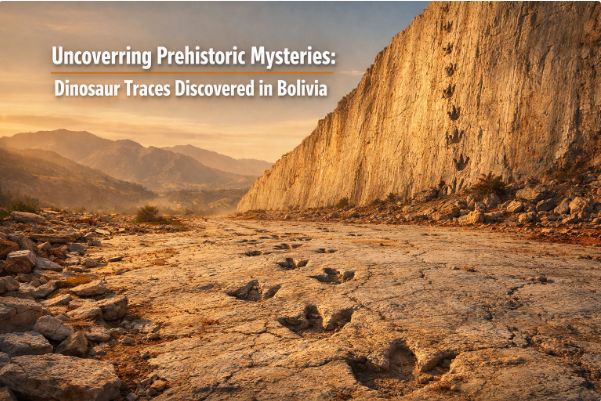
In central Bolivia, researchers have documented what is being described as the largest dinosaur tracksite in the world, located at Carreras Pampa inside Torotoro National Park. The numbers are wild: more than 16,600 theropod footprints alongside 1,378 swim tracks, plus tail traces and other features that capture a surprisingly dynamic snapshot of life near an ancient shoreline roughly 70 million years ago during the Late Cretaceous. (Phys.org)
And that’s the core reason this discovery is so compelling: footprints don’t just tell us that dinosaurs existed. They tell us what dinosaurs were doing—how fast they moved, whether they traveled alone or in groups, how they navigated soft sediment, and how a living ecosystem flowed along a watery edge long before humans were a gleam in evolution’s eye.
Bolivia’s Dinosaur Footprints Are Not New—But This Scale Is
Bolivia is already famous among paleontology lovers for track-rich sites like Cal Orck’o near Sucre, where thousands of footprints climb a near-vertical wall (thanks to tectonic uplift). But the Carreras Pampa track surface adds something different: sheer density and behavioral variety across multiple localities in one study area. In the new documentation, the research team reports tracks spread across nine study sites, producing a footprint record that sets multiple “world record” claims—not just for the number of prints, but also for continuous trackways, tail traces, and swimming traces preserved together. (EurekAlert!)
That matters because fossil footprints—known as ichnofossils—are one of the best windows into the day-to-day realities of extinct animals. Bones can tell you anatomy. Teeth can tell you diet. But tracks can tell you: “something big ran here,” “something turned sharply here,” “something was partially buoyant here,” and “multiple individuals moved the same direction like they had a purpose.”
In other words: this isn’t just a fossil site. It’s an ancient story written in mud.
What Exactly Was Found at Carreras Pampa?
Let’s zoom into the headline numbers, because they’re the kind of stats that make even seasoned scientists blink twice:
1,321 trackways (sequences of footprints forming paths)
289 isolated tracks
16,600 theropod footprints total
280 swim-trackways totaling 1,378 swim tracks
tail traces associated with some trackways
localized bird tracks alongside the dinosaur traces (Phys.org)
Most of these are attributed to theropods—bipedal, three-toed dinosaurs (the broader group that includes famous predators, and is also evolutionarily linked to modern birds). The tracks range from tiny impressions under 10 cm to larger ones above 30 cm, implying a range of body sizes moving through the same area at different times. (EurekAlert!)
There’s also something visually poetic in the geological context: the prints sit alongside ripple marks in the sediment—classic signatures of shallow water movement. That’s one reason researchers interpret the environment as an ancient shoreline (think beach or lake margin), where wet sediment periodically captured footprints and then rapidly preserved them under new layers. (Phys.org)
The “Swim Tracks” Are the Real Nerd-Candy
Footprints are amazing, sure. But swim tracks? Those are extra delicious because they imply buoyancy—an animal moving through water deep enough that its full weight wasn’t always on the ground.
A swim track forms when a dinosaur is floating or partially swimming and occasionally taps the bottom with its toes, leaving elongated or scratch-like marks rather than clean step prints. At Carreras Pampa, researchers recorded an unmatched number of these traces, suggesting repeated episodes of dinosaurs moving through shallow water or along submerged margins. (Phys.org)
That opens a surprisingly cinematic set of possibilities:
Theropods wading along the shoreline hunting smaller prey
Individuals crossing water channels during seasonal changes
Dinosaurs moving in a corridor where mudflats alternated between exposed and submerged
Brief slips into deeper water where “walking” became “paddling”
It’s hard to overstate how rare it is to find such a thick behavioral cross-section preserved in one region. Paleontology often deals with fragments. This is closer to a full paragraph.
Directional Clues: A Prehistoric Highway Along the Shore
One of the most intriguing observations is that many tracks show a consistent northwest–southeast orientation, implying repeated movement parallel to the ancient shoreline. (EurekAlert!)
Why does that matter? Because directionality hints at patterns: habitual travel routes, migration corridors, hunting behavior, or social movement.
Modern ecology offers suggestive analogies. Along lake margins today, some animals move perpendicular to water (crossing open ground quickly), while others patrol parallel to shore to maximize encounters with prey. Researchers discussing Carreras Pampa note that while modern analogs aren’t perfect, the parallel movement could indicate a high-traffic zone where dinosaurs repeatedly used the shoreline edge as a reliable route—like a natural highway etched into the landscape. (Phys.org)
And here’s the quietly mind-bending part: some footprint alignments might suggest group movement—multiple individuals heading the same direction in loosely coordinated ways. It’s not definitive proof of pack behavior (footprints are not a reality TV camera), but it’s a solid clue that dinosaurs were not simply random solitary monsters wandering aimlessly. They were animals with routines.
Tail Traces and Sharp Turns: When the Ground Becomes a Motion Capture Studio
Bones fossilize as objects. Tracks fossilize as actions.
At Carreras Pampa, some trackways include tail drag marks—sinuous impressions that appear alongside deep footprints—plus evidence for sharp turns and changes in stride. (EurekAlert!)
This matters for two reasons:
It preserves posture and movement. Tail traces can imply moments when the animal’s tail dipped low—maybe due to slipping, slowing, shifting weight, or moving through softer sediment.
It preserves conditions. Deep tracks versus shallow tracks can reveal changes in substrate moisture and consistency. One day the surface might be firm and crisp; another day it might be a sucking mudflat where every step sank.
This is why tracksites are such a treasure for dinosaur behavior research. They give paleontologists a way to reconstruct not only the animals but the “physics of the moment.”
Why Bolivia Keeps Producing World-Class Tracksites
Bolivia’s geology has been unusually generous to ichnology (the study of traces like tracks). The country contains track-bearing formations spanning the Triassic, Jurassic, and Cretaceous, but many sites remain underpublished or underdocumented—sometimes because of funding constraints, accessibility, or the sheer scale of terrain. (EurekAlert!)
Torotoro National Park, in particular, is a hotspot because erosion and exposure reveal track layers, while the highland climate can slow some forms of surface destruction. That said, exposure is a double-edged sword: the same forces that reveal tracks can also erode them away.
Which brings us to the practical side of the wonder.
Conservation and Responsible Geotourism: Protecting Bolivia’s Fossil Heritage
When a tracksite becomes famous, it becomes vulnerable. Increased visitation can be great for local economies and scientific awareness—but it can also accelerate damage through:
foot traffic directly on track surfaces
vibration and micro-fracturing
unauthorized “souvenir” collecting
unregulated development nearby
For Bolivia, the opportunity is big: paleontology tourism done responsibly can support conservation, fund local guides, and increase protective infrastructure in places like Torotoro. The risk is equally real: once a footprint erodes, it’s gone forever. The dinosaur isn’t coming back to redo the step.
The best practice playbook is already known from global fossil parks:
elevated walkways and controlled paths
interpretive signage to keep visitors off sensitive surfaces
community-led stewardship programs
scientific mapping and digital documentation (photogrammetry, 3D models)
enforced regulations against vandalism and collecting
When these are in place, a fossil site becomes something rare: a living classroom where science, culture, and local prosperity align.
What This Discovery Adds to Dinosaur Science
So what do we learn, scientifically, from “a lot of footprints”?
A surprising amount:
1) Behavior is real, not speculative
With footprints, we can infer running versus walking, group directionality, turning, tail contact, and swimming/wading—not with perfect certainty, but with a higher confidence than many bone-only interpretations. (EurekAlert!)
2) Ecosystems were busy, not barren
The density suggests a “high-traffic” shoreline—an active interface between land and water where animals repeatedly moved, possibly because resources concentrated there. (EurekAlert!)
3) Small-to-medium theropods may have dominated this corridor
A large share of trackmakers appear to fall into a moderate size range, implying the area wasn’t only a playground for giants. That paints a richer picture: lots of mid-sized predators (and perhaps opportunists) sharing a shoreline landscape, potentially interacting with birds and other creatures. (Sci.News: Breaking Science News)
4) South America’s fossil record keeps expanding in unexpected ways
Popular culture often treats dinosaur science like it happens mainly in North America and parts of Asia. Finds like this are a reminder that South America—especially the Andes region—holds enormous paleontological value, both for bones and for trace fossils. (EurekAlert!)
The Human Side: Why Footprints Hit Differently
There’s a psychological reason dinosaur footprints captivate people more viscerally than a rib cage under glass. A footprint is an event. It’s the exact place where an animal touched the Earth.
When you stand near a trackway—especially one that shows multiple steps—you’re seeing time unfold: step-step-step, a direction, a pace, a purpose. It collapses the abstract gulf between “70 million years ago” and “right here.” It’s not just prehistoric mystery; it’s prehistoric presence.
Bolivia’s Carreras Pampa tracksite takes that feeling and multiplies it by thousands. It’s a reminder that Earth’s history is not a set of disconnected chapters—it’s a continuous, messy, beautifully recorded process, and sometimes the planet preserves the most human-like evidence imaginable: a trail.
Final Takeaway: Bolivia’s Dinosaur Traces Are a Global Paleontology Moment
As of 19-03-2026, the dinosaur track discoveries at Carreras Pampa in Torotoro National Park stand out not only for record-breaking numbers but for what they represent: an exceptional behavioral archive of Late Cretaceous life along an ancient shoreline. With 16,600 footprints, 1,378 swim tracks, and evidence of turning, tail dragging, and consistent movement direction, Bolivia has delivered one of the most vivid dinosaur “activity logs” ever documented. (Phys.org)
And the bigger message is this: the prehistoric world isn’t just something we dig up. Sometimes it’s something we follow—one fossilized step at a time.
SEO keyword paragraph (use as-is at the end of your blog post): Dinosaur traces discovered in Bolivia, Bolivia dinosaur footprints, Torotoro National Park dinosaur tracks, Carreras Pampa tracksite, largest dinosaur tracksite in the world, dinosaur footprints South America, Cretaceous dinosaur tracks, theropod footprints, fossilized dinosaur footprints, dinosaur swim tracks, Late Cretaceous shoreline trackways, ichnofossils Bolivia, paleontology discovery Bolivia, dinosaur behavior evidence, ancient coastline dinosaur tracks, Bolivia fossil sites, Cal Orck’o dinosaur tracks, geotourism Bolivia Torotoro, dinosaur trackways and tail traces, best dinosaur track sites in the world.