
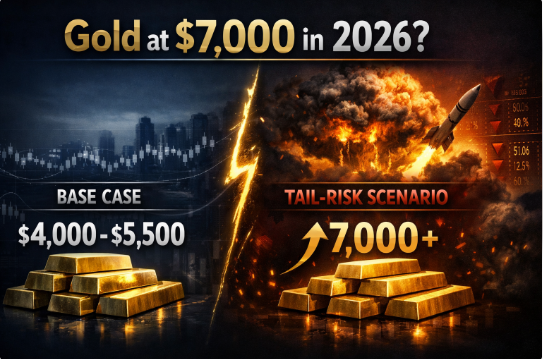
Will Gold Break the $7,000 Barrier During 2026?
If there’s one debate lighting up trading desks and dinner tables alike, it’s this: can gold reach $7,000 per ounce in 2026? That number sounds audacious at first glance, yet the last few years have taught markets to expect the unexpected. From rapid shifts in monetary policy to supply-chain reshuffles and nonstop geopolitical friction, gold has reasserted itself as the safe-haven asset non grata in no one’s portfolio. In this human-centered deep dive, we’ll map the forces that could propel bullion toward that headline-grabbing level, the obstacles that might stop it cold, and the practical ways long-term investors can think about risk, reward, and timing. Consider this your clear-eyed, jargon-light guide to the gold price outlook for 2026—rich with nuance but laser-focused on what moves the metal.
Why $7,000 Isn’t Just Clickbait
Every big round number invites skepticism. But $7,000 is a scenario, not a slogan. It implies a combination of factors that stretch but do not break historical precedent: persistent real-rate suppression, a weaker US dollar, episodic financial instability, sustained central bank gold buying, constrained mine supply, and a sentiment shift that pulls retail and institutional capital into the same trade. In other words, a “stacked catalysts” environment. Gold has already proven it responds asymmetrically to macro stress—small shocks don’t always lift it much, but regime changes do. If we get a regime shift in 2025–2026, the metal can move farther and faster than models built on quiet decades predict.
The Macro Engine: Real Rates, Inflation, and Growth
Gold’s primary macro driver is the real interest rate (nominal yields minus inflation). When real rates fall—because inflation is sticky or because central banks cut faster than prices cool—gold tends to climb. The 2026 path hinges on three macro setups:
Soft-Landing-ish: Growth slows but avoids recession; inflation grinds lower without collapsing. Central banks ease cautiously; real rates drift down. In this case, gold can climb steadily, aided by central bank demand and hedge flows—maybe not a moonshot, but a stair-step rally.
Hard Landing: A sharper recession forces aggressive rate cuts and balance-sheet support. Real rates plunge, the dollar softens, and safe-haven demand surges. Gold becomes a relief valve for portfolios, and the move can be violent—this is the scenario where $7,000 becomes plausible quickly.
Stagflation: Growth sputters while inflation refuses to vanish. Central banks face an ugly trade-off and may tolerate higher inflation to protect employment and credit conditions. Historically, stagflation is gold’s happy hunting ground, as negative real yields stick around. If this regime persists, the gold price forecast for 2026 tilts much higher.
The Currency Lens: Dollar Cycles and Diversification
Gold competes with the US dollar for “global reserve anxiety relief.” In dollar upcycles, the metal often treads water; in dollar downcycles, it breathes easier. Key risks that could pressure the greenback through 2026 include widening fiscal deficits, deteriorating interest-rate differentials if other central banks lag less on easing, and renewed reserve diversification. If global reserve managers (and large sovereign funds) decide the dollar’s share is too heavy, incremental flows into bullion—quiet, steady, relentless—can push prices higher without the fireworks seen in retail-driven asset manias.
The Invisible Bid: Central Bank Gold Buying
One reason gold has shown resilience is the structural demand from central banks. This is not speculative leverage; it’s strategic allocation—often unpublicized until after the fact. Why does it matter? Because an official-sector bid absorbs dips, reduces downside volatility, and creates a supply-demand imbalance that speculative capital can later accelerate. If this bid persists into 2026—especially from emerging markets seeking currency diversification—it underwrites the bull case and narrows the path for deep pullbacks.
Supply Constraints: Mines, Grades, and Capex Discipline
Unlike fiat money, you can’t “print” gold. Bringing a major deposit online takes years of exploration, permitting, financing, and construction. Many producers remain disciplined on capital spending after a bruising prior cycle; ore grades trend lower in mature districts; permitting is slow; energy and labor costs are sticky. None of this screams “surge in supply.” If prices rise, some high-cost ounces return, but the slope of supply response is shallow. That’s how you get squeeze-like conditions without a speculative blow-off: steady demand + rigid supply = tightness that translates directly into price.
Investor Behavior: From Shrug to Stampede
For the metal to flirt with $7,000 gold, investors need to move from casual interest to intentional allocation. That journey usually follows a familiar arc:
Hedge Curiosity: A handful of CIOs and family offices nudge allocations from near-zero to non-zero, citing portfolio diversification and tail-risk hedging.
Confirmation Through Volatility: A few market tremors vindicate early adopters; more follow.
Narrative Flywheel: Headlines about central bank buying, negative real yields, and dollar softness reinforce the thesis.
Allocation Creep: Gold shifts from a tactical trade to a strategic sleeve; miners catch a bid; gold ETF inflows turn positive and persistent.
Reflexivity: Price strength begets demand. That’s the phase where round numbers break, often faster than logic predicts.
Obstacles: What Could Invalidate the $7,000 Case?
Credible investing means embracing the bear case with the same rigor. Here are the speed bumps:
Rising Real Yields: If inflation fades faster than policy rates and growth holds up, real yields rise—historically a headwind.
Resurgent Dollar: A dollar spike on geopolitical flight-to-quality (oddly bearish for gold sometimes) or on growth outperformance can cap rallies.
Policy Credibility: If markets gain confidence that central banks can tame inflation without collateral damage, the urgency to hold hedges falls.
Supply Surprise: A handful of large projects beat timelines and budgets, or recycling floods the market during price spikes.
Positioning Washouts: If speculative length piles in too quickly, sharp corrections follow, scaring away latecomers just when patience is required.
The Pathways to $7,000: Three Working Scenarios
Think of $7,000 per ounce as a destination reachable by different roads:
Crisis-Catalyst Path (Fast, Jagged)
A financial accident—credit market stress, a major default, or liquidity breakdown—forces emergency easing and balance-sheet expansion. Gold price momentum surges as investors buy first and analyze later. The run is volatile, with scary pullbacks, but the slope is steep.Stagflation Path (Steady, Relentless)
Growth remains sluggish while inflation stays uncomfortably high. Central banks ease gradually to cushion labor markets, keeping real rates depressed. Central bank gold buying continues, the dollar drifts lower, and portfolios reweight defensively. Price climbs in steps, then sprints.Dollar Diversification Path (Quiet, Cumulative)
No single “big bang.” Instead, multi-year reserve diversification and steady ETF inflows tighten the market. Supply can’t catch up; miners stay disciplined. Technical levels break one by one—first disbelief, then acceptance, then enthusiasm.
Technical Context: Breakouts, Pullbacks, and Psychology
Even long-horizon investors benefit from technical context. Gold tends to trade in long consolidations, then break decisively. When it clears a major resistance band, the next advance often retraces a large prior range. Pullbacks to the breakout zone are common and healthy—support-as-new-resistance flipping to resistance-as-new-support is the classic pattern. If 2025 delivers a durable breakout on rising volume—especially if confirmed by miners’ relative strength versus the metal—that’s a traditional tell that the path into 2026 could be powerful.
Practical Allocation: How Long-Term Investors Can Think About It
Whether you’re a private investor or guiding a broad mandate, consider the role gold plays rather than just its headline price:
Hedge Sleeve: A small, persistent allocation can reduce portfolio drawdowns when equities and bonds wobble together.
Barbell Strategy: Pair growth risk with defensive real assets—gold, selectively miners, and possibly royalty/streaming companies for different risk profiles.
Rebalance Discipline: Pre-commit to trimming strength and adding on weakness. This keeps emotions in check when headlines get loud.
Diversified Access: Physical bullion for purity, ETFs for convenience, miners for torque, and options for defined risk. Each vehicle has its trade-offs—liquidity, tracking, custody, or operational leverage.
The Human Side: Why the Gold Story Resonates
Gold isn’t just an asset; it’s a trust meter. When people feel the rules of money are shifting—too much debt, too many rescues, too little clarity—they reach for something outside the system. That’s why the gold narrative reliably reappears when volatility spikes, even among investors who normally prefer spreadsheets to safe havens. A move toward $7,000 would reflect not just macro math but collective psychology—a desire for ballast in choppy seas. The more uncertain the policy path, the stronger that pull.
What to Watch Through 2025
If you want a simple dashboard for whether the 2026 gold price forecast is skewing high or low, track:
Real-Rate Trend: Especially 5- to 10-year inflation-breakeven spreads versus nominal yields. Downward drift favors gold.
Dollar Direction: A gentle downtrend is gasoline for bullion; a sharp dollar rally can stall things.
Central Bank Disclosures: Quarterly or annual tallies—not perfect, but enough to infer the structural bid.
ETF Flows: Persistent inflows confirm institutional adoption; outflows warn of complacency.
Credit Spreads: Widening spreads hint at stress that sends hedging demand higher.
Producer Guidance: Capex discipline plus cost inflation equals tight supply—bullish if demand holds.
Bottom Line: Can Gold Hit $7,000 in 2026?
Yes, in the right macro regime. It won’t happen because of a single headline; it will happen if multiple forces align: negative real yields, a softer dollar, ongoing central bank accumulation, supply rigidity, and a behavioral inflection where investors upgrade gold from “nice-to-have” to “need-to-own.” That confluence doesn’t appear every cycle, but when it does, the move is typically larger—and lasts longer—than consensus expects. The prudent stance is neither euphoria nor cynicism. It’s preparedness: size positions thoughtfully, diversify your access, and let the thesis prove itself through 2025’s data tape. If the signals persist, the $7,000 gold conversation won’t sound bold—it’ll sound late.
Quick FAQ for Readers Skimming on a Phone
Is $7,000 gold guaranteed?
No. It’s a scenario that requires several macro levers to pull the same direction: lower real rates, weaker dollar, robust official-sector demand, and constrained supply.
What’s the single most important metric?
Real interest rates. If they trend negative, gold’s risk-reward improves dramatically.
Do I need to go “all in”?
Definitely not. Gold works best as a portfolio hedge—a disciplined slice that smooths the ride, not a bet that defines it.
What if the dollar rips higher?
That would likely cap the advance and increase volatility. It’s a key downside risk to monitor.
Are miners the same as gold?
Miners offer operational leverage to the gold price—more upside and more downside. They’re different tools for different jobs.
Final Takeaway
Gold reaching $7,000 in 2026 is not a forecast carved in stone; it’s a conditional path that becomes more or less plausible as the macro puzzle assembles. The task for investors is to trade uncertainty for preparedness: watch real rates, dollar trends, central bank buying, ETF flows, and credit stress. If those dials tilt the right way through 2025, then 2026 stops being about if and starts being about how far. Keep curiosity high, conviction measured, and rebalancing rules prewritten. That’s how you navigate a market where the safe-haven asset might become the star of the show.
SEO Keywords (one paragraph): gold price forecast 2026, will gold reach $7,000, gold price prediction, bullion outlook, central bank gold buying, real interest rates and gold, US dollar and gold, stagflation hedge, safe haven asset, gold ETF inflows, gold miners vs bullion, dedollarization and gold, portfolio diversification, inflation hedge, recession risk 2026, macro outlook for gold, technical breakout levels, gold supply constraints, investment strategies for gold, precious metals market analysis, gold price outlook 2025-2026, commodity market trends, long-term gold investment, risk management with gold, gold market drivers, geopolitical risk and gold.