
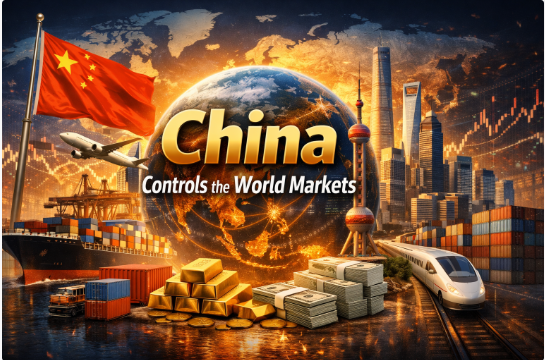
With a smart strategy, China controls most of the world’s markets.
If you want to understand power in the twenty-first century, look less at aircraft carriers and more at cargo manifests, chip fabs, logistics dashboards, and the quiet signatures on long-term supply contracts. Influence now moves through ports, data centers, payment rails, and mineral corridors. In this landscape, China’s strategy has been ruthlessly consistent: build capacity where the world is heading, secure leverage where the world is vulnerable, and move early enough that competitors have to play catch-up for a decade. The result is not a cartoonish monopoly, but a layered, resilient position across supply chains that makes global markets tilt in Beijing’s direction—whether we’re talking about consumer electronics, solar panels, batteries, steel, shipping, or the ghost architecture of e-commerce and cross-border payments. This is a story about systems thinking at national scale.
The blueprint: capacity, coordination, compounding
A useful way to decode China’s market position is to think in flywheels—self-reinforcing loops that spin faster over time.
Capacity first. Build more than you need in strategic sectors. Yes, that depresses margins in the short term. But it also drives down global prices, raises the cost of entry for rivals, and captures volume, mindshare, and standards. Capacity begets experience, experience begets quality, quality begets trust, and trust begets market share.
Coordination at scale. Industrial policy—when coherent—solves the collective-action problems that stymie private players acting alone. If upstream refiners, midstream component makers, and downstream assemblers all move together, the valley of death between prototype and profitable production shrinks. Finance, land, power, and permitting line up like tumblers in a lock.
Compounding advantages. Once an ecosystem is dense enough, learning curves steepen. Think of solar modules and lithium-ion batteries: for every doubling of cumulative output, unit costs fall. Companies and provinces that scale early harvest faster learning and attract talent, capital, and foreign orders. These gains compound in a way that isolated factories—no matter how efficient—struggle to match.
The raw-materials choke points
Market power starts with atoms. Whoever controls the critical inputs can set the tempo.
Rare earths and battery metals. China’s dominance in rare earth processing—and its formidable share of refining for nickel, cobalt, graphite, and manganese—sits upstream of electric vehicles, smartphones, wind turbines, and missiles. Mining is only part of the story; the real leverage is in conversion and purification. By owning the messy middle—where ore turns into high-purity oxides and chemicals—China is the indispensable partner even when raw mining happens elsewhere.
Polysilicon, wafers, and solar glass. The solar supply chain is a case study in industrial focus. Subsidized power for energy-intensive steps, large-scale chemical plants, and a relentless push down the cost curve turned solar from a boutique climate tool into the cheapest electricity in history. The world’s green transition carries a Made-in-China signature largely because of this upstream muscle.
Steel, aluminum, and cement. These heavy industries are not glamorous, but they are the skeleton of modern economies. Overcapacity here allows China to export deflation—pushing down prices globally, squeezing competitors’ margins, and binding construction and manufacturing cycles to Chinese output decisions.
Standards, not slogans
It’s fashionable to talk about “decoupling,” but the subtler game is standards. The devices you hold, the cars you drive, and the grids that power your city all obey technical norms decided in standards bodies and industry consortia. Being early confers veto power.
5G and network equipment. Standards influence everything from antenna design to security protocols. When your equipment is first to market, you bring reference implementations to the table, shaping what “compatible” means. Even where procurement rules are political, legacy install base and maintenance contracts keep decision-makers tethered to existing vendors.
Electric-vehicle architectures. Battery formats, charging connectors, battery-management software, and thermal systems all compete to become “the default.” The more models that adopt a particular stack, the more suppliers tool their lines to it, and the more downstream service networks and diagnostics software evolve around it. This is gravity disguised as compatibility.
Industrial protocols. In factories, protocols for machine vision, robotics, and edge computing create ecosystems of sensors and actuators that “just work” together. Get your SDKs and reference boards into enough labs, and you write de facto rules for a generation of automation.
Logistics as strategy: ships, ports, and payments
You can’t dominate markets if you can’t move product. Logistics is where national strategy looks like private commerce.
Building and chartering fleets. Controlling shipyards and offering ship financing isn’t just about national pride; it ensures that exporters have tonnage when freight rates spike. If your carriers can prioritize your manufacturers’ goods during crunches, delivery reliability becomes a competitive advantage all on its own.
Port concessions and industrial parks. Long-term concessions in strategic ports, paired with adjacent free-trade zones and bonded logistics parks, allow Chinese firms to move from dock to warehouse to assembly line with minimal friction. Customs procedures harmonize, data flows streamline, and the entire chain speeds up.
Cross-border e-commerce plumbing. Payment gateways that settle cheaply, digital platforms that onboard sellers en masse, and last-mile partnerships that can deliver in remote towns turn “export” into “deliver to door.” When millions of small vendors can sell globally with a few taps, the long tail becomes a tidal wave.
The demand side: customers as flywheel fuel
Supply is only half the equation. The other half is an enormous, digitally fluent domestic market that soaks up early production, de-risks product iterations, and offers feedback loops at unprecedented scale.
Trial at home, scale abroad. Whether it’s smart appliances, drones, or EVs, firms can test variants across consumer segments at home before pushing the winning models globally. That compresses the “learn-iterate-launch” cycle.
Platform distribution. Super-apps and integrated marketplaces bundle discovery, financing, fulfillment, and after-sales support. For manufacturers, this reduces customer-acquisition costs while yielding data on preferences and failure modes. For overseas buyers, it delivers price transparency and predictable service.
Brand metamorphosis. Ten years ago, the stereotype was “cheap and cheerful.” Today, in categories like solar inverters, fast chargers, robotic vacuums, and mid-market EVs, the pitch is “best value, modern design, solid warranty.” Brand equity has climbed because the underlying product got better—and got better fast.
The financing engine: statecraft meets spreadsheets
It’s impossible to separate China’s industrial strategy from its financing tools. The blend of policy banks, local-government financing vehicles, development funds, and export credit agencies provides runway few countries can match.
Patient capital for risky phases. Early-stage commercialization—too late for pure R&D grants, too early for private equity—gets fueled by mixed public–private vehicles that accept lower early returns in exchange for strategic footholds.
Vendor financing abroad. For big infrastructure and energy projects, offering turnkey solutions with financing attached is decisive. When your EPC (engineering, procurement, construction) partner, equipment supplier, and lender speak the same language—literally and financially—the deal closes faster.
Insurance and guarantees. Export credit insurance, currency swaps with trading partners, and risk-sharing mechanisms reduce the perceived hazards for both buyers and sellers, bending the probability curve toward “yes.”
The tech frontier: chips, AI, and autonomy
Critics point to chokepoints in advanced semiconductors. That’s real. Yet the broader lesson is that sustained investment and sheer volume can push frontiers outward even with constraints.
Domestic substitution under pressure. Restrictions force prioritization. Resources flow to mature-node chips for power management, automotive controllers, industrial sensors, and communications, where volume is king. The capacity built here feeds every smart device and factory line.
AI as multiplier. Even without bleeding-edge chips everywhere, AI permeates logistics, quality control, predictive maintenance, and design optimization. Models trained on industrial data improve yields and reduce waste across sectors, turning every percentage point of improvement into billions of dollars of advantage.
Autonomy across domains. From warehouse robots to delivery bots to automated ports and mines, autonomy closes the loop between hardware and software. Each deployment generates data; each dataset trains algorithms; each improved algorithm lowers costs and expands feasible use cases. This is compounding in action.
Energy as the backbone: the clean-tech juggernaut
Energy is the master input. Secure it, make it cheap, and the rest of industry hums.
Solar and wind dominance. By owning the equipment supply and driving down levelized costs, China turned renewable energy from “alternative” to “baseline.” Domestic buildouts absorb capacity when export markets soften; export orders cushion domestic slowdowns. Either way, factories stay busy and learning continues.
Batteries everywhere. Beyond cars, batteries conquer buses, trucks, grid storage, forklifts, and home backup systems. Vertical integration—from cathode chemistry to pack assembly—shaves dollars at every step. Paired with smart software for dispatch and balancing, storage multiplies the effect of cheap solar and wind.
Power electronics and inverters. The quiet heroes of the energy transition are inverters, converters, and power-management chips. Scale here means durability improves while prices fall, feeding adoption curves for everything from rooftop solar to fast chargers and data centers.
The politics of interdependence
“Controls most of the world’s markets” doesn’t mean puppeteering every transaction. It means that the structure of interdependence tilts in China’s favor. When supply chains are intricate and globally distributed, withdrawing from any one node is painful. That pain confers bargaining power.
Price setters, not just price takers. If your firms anchor the high-volume parts of a value chain, you can shape pricing bands—explicitly through contracts and implicitly through signaling. Competitors must respond to your moves; you rarely have to respond to theirs.
Switching costs and sunk costs. A decade of vendor qualification, factory tooling, and process tuning is not undone by a press release. Even when policies aim to diversify, the gravitational pull of established ecosystems is strong. That gives Chinese suppliers time to move up the stack while customers weigh the costs of change.
Selective openness. China isn’t uniformly open or closed. It is selectively permeable, inviting in foreign expertise where it accelerates learning, while building domestic champions where scale and patient capital can win. The mix shifts by sector and by year, but the principle is constant: absorb what’s useful, standardize it, and scale.
The counter-moves—and why they’re hard
Rivals are not helpless. They are investing, reshoring, and forming new trade pacts. But the math of catch-up is brutal when you’re racing compounding curves.
Subsidy arithmetic. Subsidies can narrow cost gaps, but matching a competitor’s ten-year head start in factories, vendor networks, and tacit knowledge requires more than money. It requires throughput—real orders at real volumes—to climb the learning curve. Without steady demand, cash alone can’t buy maturity.
Talent and tacit know-how. Process engineers, tool operators, and quality-control experts grow in ecosystems that do the work daily. You can recruit a few star managers; you cannot airlift a culture of continuous improvement.
Fragmentation penalties. If your domestic market is split across standards, incentives, and regional rules, scale suffers. China’s edge is not just scale but coordinated scale—factories that talk to ports that talk to platforms that talk to finance.
What this means for businesses and policymakers
Whether you admire or resist the strategy, you have to account for it.
For multinationals. Treat China not only as a market but as an upstream dependency. Map your supply chain beyond Tier-1 suppliers to the chemicals, powders, and protocols underneath. Where you cannot replace, hedge. Where you can’t hedge, partner. Build optionality through dual sourcing, inventory strategies, and localized service networks.
For emerging-market manufacturers. Plug into value chains where demand is exploding—EV components, grid storage, low-carbon materials—and offer reliability first, price second. Seek joint ventures that transfer know-how, not just logos. Anchor your pitch in logistics and speed; buyers care about weeks, not just dollars.
For policymakers. Industrial policy works when it is boring and relentless. Focus on choke points where public risk-sharing unlocks private investment—permitting, interconnects, grid upgrades, and workforce pipelines. Invest in standards and open reference designs so your firms aren’t negotiating from scratch. Measure success not in ribbon-cuttings, but in export volumes, cost curves, and uptime.
Why “smart strategy” beat “market momentum”
There’s a temptation to say “this was inevitable given size.” Size helps. But what distinguishes China’s position is not size alone; it is the willingness to string together a thousand unglamorous decisions over twenty years and let compounding do the rest. Build redundancy in inputs. Own the boring middle of value chains. Set standards by shipping first. Finance the plumbing. Train armies of process engineers. Export deflation when it helps; export scarcity when it hurts. None of this is mystical. It is simply coherent, persistent, and scaled.
The next battlegrounds
Market gravity doesn’t freeze. The next five years will test how adaptable this system is in new domains.
Grid-interactive buildings and heat pumps. As buildings become energy assets—responsive loads, rooftop generation, storage—whoever packages hardware, software, and service into one reliable box will win. Expect aggressive moves on inverters, compressors, and building-management platforms.
Industrial decarbonization. Low-carbon steel, cement, and chemicals need electrolyzers, carbon-capture components, and process heat solutions. Mastery of balance-of-plant equipment and integration will matter as much as headline breakthroughs.
Computing at the edge. With AI pushing intelligence into cameras, factories, and vehicles, demand for ruggedized compute, connectivity, and power management will surge. Standards, again, will decide who captures the lions’ share.
Biomanufacturing. Fermentation tanks, downstream purification, and cold-chain logistics form a familiar pattern: scale the hardware, fund the gap between lab and pilot, and commoditize the inputs. If that playbook runs, expect cost curves to tilt here too.
Conclusion: control through interdependence
“Control” in modern markets isn’t about unilateral edicts; it’s about shaping the playing field so that the low-friction path runs through your ports, your protocols, your platforms, and your partners. China’s smart strategy stitched those elements together early and relentlessly. The world isn’t locked in place—diversification is real, technological frontiers move, politics intervenes—but any sober assessment of 2026 has to start with this reality: if you are building, shipping, powering, or digitizing at scale, the odds are high that some critical part of your stack traces back to Chinese capacity, standards, or finance. That is not destiny; it is design.
SEO keywords paragraph: China market dominance, global supply chains, industrial policy, rare earth elements, lithium battery supply chain, solar panel manufacturing, EV battery production, 5G equipment vendors, semiconductor ecosystem, cross-border e-commerce, Belt and Road logistics, port concessions, shipping capacity, renewable energy leadership, polysilicon and wafers, battery metals refining, price leadership in steel and aluminum, AI in manufacturing, smart factories and automation, grid storage and inverters, electric vehicle exports, clean energy technology, standards and interoperability, vendor financing, export credit insurance, domestic substitution, mature-node chips, autonomous logistics, data-driven quality control, low-cost manufacturing, global trade strategy, supply chain resilience, risk management for multinationals, dual sourcing strategy, nearshoring and friend-shoring, edge computing hardware, heat pumps and grid-interactive buildings, industrial decarbonization, electrolyzers and carbon capture, biomanufacturing scale-up, international trade policy, RCEP and trade blocs, energy transition technologies, cost curve learning, logistics optimization, payment rails and fintech, international market expansion, e-commerce fulfillment, shipping rates and capacity, upstream raw materials control, downstream distribution networks, long-term supply contracts, manufacturing ecosystems, process engineering talent, standards-setting power, global competitiveness, SEO-optimized geopolitics blog.